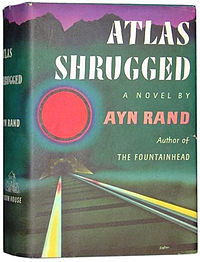
Atlas Shrugged, Chapter 6

AtlasShruggedI recently read an article on how my particular job title tends to get blank stares and awkward silences at cocktail parties. Before reading this chapter of Atlas Shrugged, I might have nodded along with the article and felt smug about my clear superiority. Having now seen this perspective in excruciating detail in Hank Reardon, I have learned my lesson. I now roll my eyes and want to tell the article writer to suck it up. No matter how dull the party-goers are, you can find a conversational topic. And if none of the topics you are interested in, interest them, then maybe it’s time to ask questions and learn about a new topic that they find interesting. If all the other people at a party are super boring, maybe you need to consider the fact that you might be the boring one.

With that lead up: In Chapter 6 of Atlas Shrugged, we have one of the most uncomfortable parties ever.

Continue reading

Atlas Shrugged by Ayn Rand, first impression

So this is my first live blogging experience and I’m going to be making multiple posts before handing this back to Anna next week. If nothing else, this book brings up a lot of issues. First, a quick review of my general impressions of the first five chapters of:
AtlasShruggedAtlas Shrugged
By Ayn Rand
1957

Atlas Shrugged has come up in various political discussions since I’ve been in college but it really got highlighted by Paul Ryan’s run for Vice Presidency. When Anna was contemplating reading it, I offered to read it if she did.

I went into it with really extremely low expectations. It has surprised me in the ways in which the book has been both better and worse than those expectations.

For the better:

It’s not bad writing. While there are some writing issues that I don’t care for (she has a very active narrator voice, with clear opinions, describing landscapes as “seeming” one way or another, even when there is no character to whom it seems anything), the writing is well done. Rand’s real strength is the way in which she delves into the thought processes of her characters. She also does a reasonably good job of building suspense.

Plus, my first reaction to the first chapter was that this was the beginning of one of the creepier (and more awesome) Doctor Who episodes and John Galt is probably either a Moriarty-type character or possibly even The Master. After reading the first five chapters, I’m still not sure this isn’t true.

For the worse:

It’s even more of a punch in the face of all liberals than I had expected. It’s less that there are some awful characters who mouth liberal concepts merely as hypocritical excuses (because, honestly, people like that do exist, much to my dismay), it’s that there’s no acknowledgement that these people aren’t actually liberals. The whole thing reminds me a bit of a quote that I half-remember from years ago: a bad Satanist is not the same thing as a good Christian. In this instance, the application is that an incompetent Capitalist is not at all the same thing as a successful Socialist. Rand, however, does not appear to see any distinction between these. (She also doesn’t see any distinction between monopolies and unions. I have severe doubts regarding her knowledge of business principals.)

For the depressed:

It feels like the writing of someone working through depression. I don’t actually know anything much about Rand’s life and haven’t even read her Wikipedia page, but I assume she was fighting depression and writing Atlas Shrugged was one attempt to deal with it.

One of the aspects of depression, as I know it, is the combination of thoughts that say (1) the world is an awful place, (2) I have a perfect understanding of how awful it is, and (3) I know with absolute certainty that there is nothing to be done about it.

Rand’s characters desperately want to make a connection with other people and yet are completely unwilling to put any effort into it at all and will self-sabotage any situation that might help. Since they know that no one can understand them, they refuse to see that there are other people out there, understanding them. They also know that certain people aren’t worth knowing. Anyone involved in business and politics are viewed as unworthy of any consideration to the extent that both Dagny and Rearden skip board meetings, ignore journalists, refuse to either ask or answer questions, and expect that nothing that those people can do would in anyway impact their own lives. They already know that those people aren’t worth their time without actually knowing anything about them.

This is a mindset that I find particularly frustrating, all the more so as I very much recognize it from dealing with one of my friends who struggles with both depression and with drug/alcohol addiction. Since he already knows that nothing can help him, there’s no point in trying to get help. Since he already knows that everyone hates him, there’s no point in trying to get anyone to like him.

This is a view of the world that I strongly disagree with. You can’t just know what someone else is thinking or doing without knowing them. There are always surprises and change is always possible if not inevitable.

That’s my perspective on the world we actually live in.

The world of Atlas Shrugged, however, is a dystopian world where values and morals are absolute, people are worthy or not worthy, and everyone knows it. This binary concept of values  is incredibly frustrating although it actually cracked me up a bit when it was applied to music in chapter four. The critics who dislike a piece of music write that, “The music of Richard Halley has a quality of the heroic. Our age has outgrown that stuff.” and “The music of Richard Halley is out of key with our times. It has a tone of ecstasy. Who cares for ecstasy nowadays?” Everybody knows the music is good, just the populace in Rand’s world apparently hate good music.

In one of my graduate classes focusing on intellectual property laws, the professor liked to remind us students that “reasonable people can disagree.”

In the world of Atlas Shrugged, reasonable people have a shared understanding of what is right and good and proper. If you disagree, then you are clearly incapable, incompetent, and morally bankrupt.

In conclusion:

This book is well-written and while it doesn’t suit my particular tastes, I can see how it would have a lot of appeal to some people. It brings up some interesting ideas and would likely help people define their thoughts and opinions.

My real problem is not with the book itself, but with the people who are reading it for guidance and direction rather than for thoughtful conversation. There are real politicians who are using this as a serious political treatise. It feels a bit like if, after reading The Hobbit and Lord of the Rings by J.R.R. Tolkein, a politician were to decide that every covert military action should include at least one untrained civilian to carry out some vital task. Or, after reading Ender’s Game by Orson Scott Card, one were to start recruiting child soldiers. These books are all good and thought-provoking and can certainly be used to develop one’s political stance, but they should not be taken as holy writ.
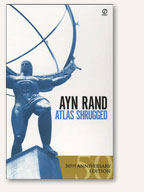
Atlas Shrugged (Chapters 1-5)

By Ayn Rand

Cover: Atlas ShruggedMy only previous references for Atlas Shrugged are Paul Ryan, of course, and a very funny recap of the movie version of the first half on Grantland. This, however, has not stopped me from judging anyone who spoke positively of the book. So, when a friend of mine listed Atlas Shrugged as one of her favorite books, I mocked her without restraint. She, of course, replied that maybe I should try actually reading it, which seemed like a fair point, so here I go with another round of semi-live-blogging.

A quick warning, though: I lean so far left, politically, that President Obama and the Democratic party are significantly right of me. In the 2008 Democratic primaries, I caucused for Kucinich (devastatingly unsuccessfully), and if there were a viable socialist party in the United States, I would probably be a member. I am very obviously not the audience for this book, and I am, under no circumstances, diving into it with anything close to an open mind. I intend to hate it, with my reward being that I can then mock its fans with complete impunity.

Rebecca, who has also never read any Ayn Rand, has agreed to join me in reading Atlas Shrugged and ‘live-blogging’ it for the next several weeks. Kinsey has already read The Fountainhead, so she got a pass. So, with no more delay, let’s get started with the spoilers! Continue reading

Teeth

Edited by Ellen Datlow & Terri Windling

Book Cover: TeethI picked up this book as an impulse loan at the library when the title typeface caught my eye. (Design nerd moment: I really like how they were able to make the title actually look like teeth without being totally cheesy about it – very elegant, especially coupled with the lack of teeth in the image) I also had already heard of the book because one of my favorite blog writers, Genevieve Valentine, wrote one of the stories in the collection, and posted that story online. It was awesome, so I figured I wouldn’t mind reading it again and see if the other stories were of the same caliber.

Of course, some were and some weren’t. Well, Valentine’s was still the best, but there were others I really liked, too. In fact, Valentine’s story was first in the collection, and then the second story, All Smiles by Steve Berman, dealt with a vampire myth from a more unusual, non-European culture, as well, so I was pretty pleased. (Actually, both these first two stories are available in a preview of the book here.)

The problem with this type of anthology is that lots of people, me included, like to read about vampires, so it makes sense to collect stories about them. Good vampire stories, though, often use vampirism as a surprise twist in the story, so you see the problem. Just being included in this type of anthology spoils a lot of the stories, so there were certainly several that I think I would have liked a lot more if I hadn’t just been reading them waiting for the vampires to show up.

A not-so-brief gripe to close out this review: the book cover promises contributions from Cassandra Clare & Holly Black, Neil Gaiman, Melissa Marr, and more. Now, I’m a recent fan of Holly Black, and I really enjoyed her story here, co-written with Cassandra Clare; and I’m starting to think Melissa Marr’s Wicked Lovely was a fluke because I haven’t enjoyed any of her other writing nearly as much; but my real gripe is with Neil Gaiman. I love his Sandman graphic novels and every full-length novel he has ever written. I consider myself a huge fan of his. However, his short stories are crap. So, I knew not to actually consider his name on the cover to be any sort of selling point, but he must have disappointed legions of not-already-disappointed fans with his short and hasty-seeming poem that reads more like a pop song. Weak sauce, Gaiman, weak sauce.

—Anna

The Diviners

Despite my best efforts at remaining separate from the sick people surrounding me, I started 2013 off with a wicked cold that left me too dazed to read or to even watch a movie. Instead I spent most of the first week of the new year slumped on my couch, grimly watching How I Met Your Mother reruns. But I finally appear to be pulling out of it, demonstrated by the fact that I managed to actually finish a book! A big one, in fact: The Diviners by Libba Bray.

Bray is a popular YA writer and The Diviners is the first in her new series about teenagers with special power living in Jazz-age New York. And even after reading all 500+ pages, I’m not quite sure how I feel about it. As I was reading, I kept just coming up with a continual list of pluses and minuses that seemed to balance each other out.

Plus: It was a fun look into 1920s New York! Remember way back in the summer when I mentioned The Rules of Civility, and how I was still looking for a better book about the glittering 30s? Okay, the 20s are not the same as the 30s, but this met my needs. Bray did a great job creating a past-New York that felt real and alive.

Minus: The main character was weirdly flat. The reader was clearly supposed to identify with this young girl who comes to New York from small-town Ohio, ready to have fun and make her mark, but she came across as a brat with no depth or internal monologue. I got tired of her very quickly, and she felt like a character in a middle-reader or kids book.

Plus: While the main character left me cold, the supporting characters were really interesting and much more complex. Specifically, a showgirl with a history and a numbers runner in Harlem.

Minus: It was dark. Like, really, really, creepy Criminal Minds kind of dark. I generally don’t get too up in arms about kids reading adult material and I’m not easily spooked myself, but I am not sure I was old enough to read this. That, combined with the weird flatness of the main character, made me wonder who the audience for this was supposed to be.

Plus: This initial story in the series was wrapped up quite neatly and there was a good sense of closure.

Minus: Despite being a long, looong book, character reveals were made super-slowly and a few really major pieces of information were tossed out at the end and not really followed up on. I’m assuming these threads will get picked up in future installments, but it still felt like I had made a pretty sizable investment of my time to end up with so many unanswered questions.

Final verdict? I’m still in. I wouldn’t recommend it to younger readers (super creepy!), but I was intrigued enough by the setting and some of the side characters that I’ll read at least one more to see where this is going. I’m just going to hope that the next book focuses on the showgirl, because she was aces.

The Word Made Flesh

I ran across this site somewhere on the internet, probably via my current addiction, pinterest: The Word Made Flesh, www.tattoolit.com, is just photos of tattoos that people have gotten that either are text or reference a piece of text. Some of them include short descriptions from the people on why they chose the tattoos. (Also, the site is mostly, but not entirely, safe for work; some of the tattoos get a tad intimate.)

The tattoos themselves are of varying quality, but I find the whole site really interesting for a number of reasons:

  • I love reading about what pieces of writing have really impacted a person’s life. (Some of them even make me a little misty-eyed, especially when it is clear that the person is using the tattoo as a visible reminder of recovery.)
  • It is super interesting to see which texts pop up over and over again (Catcher in the Rye, of course, lots of Kurt Vonnegut and e. e. cummings, and just tons of The Little Prince)
  • It is additionally interesting to read about someone being so inspired by a piece of text that I have also read but completely shrugged off. What is it about those books that just connected to these people and not to me? (My eventual mild enjoyment of the one Kurt Vonnegut book I have read is nowhere close to the adulation people feel for that same book, and I simply don’t get it.)
  • Some people have tattoos that I consider a little ridiculous (perhaps when you are a young adult, you shouldn’t get a Harry Potter tattoo until you’ve seen if it will continue to be such an impact in your adult life,* and that goes double for A Series of Unfortunate Events), while some people are just way, way cooler than me (the full-color pelvic tattoo of Aubrey Beardsley’s illustration of Oscar Wilde’s Salome, which is also the tattoo that kicked off this website and the photograph of which is totally NSFW)
  • Placement of tattoos is also important (an Ayn Rand quote on the upper thigh seems like it might be a bit of a turn off)

After wasting entirely too much time on the site, I have to say, though, that whatever my thoughts on the tattoos themselves, it just makes me happy to see all these people so inspired by such a range of books.

—Anna

*On the other hand, I didn’t grow up with Harry Potter, having started the series well out of college, and I’m told by my much younger cousins that it is a whole different experience reading each book as roughly the same age as Harry, which I guess I can see.

The Prophet by Kahlil Gibran

the_prophetThe Prophet
By Kahlil Gibran
1926

This is a really gorgeous piece of writing. The version I read was also a beautifully illustrated version, with Gibran’s own illustrations. The text also happens to be available online for free.

It is essentially a collection of poetry essays addressing a variety of issues regarding life and faith and living life in a spiritual manner.

While it’s relatively short (less than 90 pages in the version I read), it is not a quick read. It is made up of 28 chapters and it’s the kind of text that you can read a bit at a time and spend a lot of time thinking about. The wording is beautiful, the imagery is beautiful, and the philosophy is beautiful.

In many ways, it reads a bit like the very best of Bible passages, but while it’s clearly deist, it’s not any one religion. I highly recommend it to pretty much everyone ever.

While it’s gorgeous in it’s own right – to the extent that I have a hard time describing it without making it sound significantly more schmaltzy than it is – I would also recommend it to anyone who has to give some emotional speech. If I ever need to give a speech or a toast or something at a wedding, a graduation, a funeral, or whatever, this will be my first go-to book for inspiration and quotes, before either Shakespeare or the Bible.  (I am clearly not the only person to have this thought, though, since I recognized several quotes from it.)

But anyway, I highly recommend it. Go forth. Read it. Or listen to it. Whichever.

The Talisman Ring

By Georgette Heyer

Book Cover: The Talisman RingComing back from vacation, I picked up an old favorite of mine, and a bit of a guilty pleasure. Georgette Heyer is known for her Regency romance novels (and, strangely, also for meticulously researched historical battles). My mother has all of her novels, so they were some of the first adult novels I started reading. Luckily for my tween sensibilities, the romance is actually quite light in these books, comparable in raciness to Jane Austen, I would say.

The Talisman Ring is one of my favorites, since it includes a murder mystery as well as romance. Heyer also does a bit of a switcheroo, where the first 50 pages features a young and somewhat insipid heroine before a more mature and much more interesting heroine is introduced, I believe in a conscious play on traditional romance tropes. Almost every review of Georgette Heyer mentions her humor, lively characters, and witty dialogue, and this one is no exception. Her characters and the farcical plot lines are what make her books such a pleasure to read.

What is not so much a pleasure to read is the racism. Heyer lived from 1902-1974, which of course was significantly more racist than today, and while most of her books don’t feature people of color at all, thereby avoiding racism by pure omission, a few are totally and irredeemably cringe-worthy. In fact, all of the reviews of Heyer’s novel The Grand Sophy are quite entertaining in how they start with how delightful all the characters and dialogue are, and you can just see each reviewer slowly winding down the praises in order to end up addressing the extreme bigotry. I just imagine all these slumped shoulders and heavy sighs, and the ominous tone in which they refer to the Goldhanger Chapter.

It can be quite appalling, and after rereading some of these scenes as a more culturally-aware adult (and an adult who couldn’t quite understand how I’d overlooked them as a tween), my pleasure in Heyer’s novels both diminished and became ethically confusing for me.

I was pleased to run across the essay “How to be a fan of problematic things” online just recently, and was somewhat comforted that I perhaps didn’t have to swear off all things Heyer as long as I stayed entirely open-eyed about the problematic things. Which, I mean, they are blatant enough that it would be really hard to try to explain them away.

The Talisman Ring doesn’t feature any people of color, but has some class issues instead. People of status and wealth are invariably smarter, kinder, and just better all-around human beings than middle- and lower-class people. My increasingly socialist heart couldn’t take quite the joy in seeing the aristocratic young smuggler best the poor working detectives that my teenage heart could.

So, this ended up being quite a negative review about a book that is very close to my heart, but I guess in the end, after all the very problematic issues, I can’t quite quit this author, and that says a lot, doesn’t it?

—Anna

Twelve Fables of Aesop

AesopTwelve Fables of Aesop
narrated by Glenway Wescott
illustrated by Antonio Frasconi
1954

This is a gorgeous book with a series of really excellent woodcuts. I got it as a Christmas present and I love it. Gorgeous.

On the other hand, the text is kind of… um… odd? I remember Aesop’s fables in a sort of vague way from when I was much younger. They were short, yeah, but they tended to make sense. There were characters who did things and learned lessons, right? These versions, on the other hand, seem really pretty random. They’re actually oddly post-modern in their randomness.

This makes them hard to review. So in preparation for trying to review the book, I listened to The Dead Author’s Podcast (reviewed earlier by Anna) with guest Aesop.

It’s hard to tell how accurate/historical the podcast really is, but it’s certainly clear that I am not alone in thinking that some of these fables are really incomprehensible. And short.

So I loved this book for the art but I kind of suggest that you check it out for the stories for the bemusement factor as well.  It’s also really short. Twelve stories, none of them longer than two pages.

So to sum up: Beautiful but peculiar.

The Rest of 2012

When I read a really good book I almost always write it up on the blog, generally because I’m so excited I want to make everyone I know read it. However, when I looked back over the list of books I read in 2012 (yes, I keep a list, otherwise I can never remember) I realized that I read some awfully good things that never made it here. So, to wrap up 2012, here are the five best books I read this year that I never got around to mentioning.

1) How To Be A Woman by Caitlin Moran. This is such a fabulous memoir. Moran uses her own life story to make a lot of points about feminism, beauty, generally living life as a woman in this society. But she’s funny, while also being radical! She’s also hilarious on Twitter.

2) The Family Fang by Kevin Wilson. I feel like this book sells itself as story about family, yet at the end of the book I felt sort of repulsed by the whole idea of families. But it’s a fascinating book.

3) Bring Up the Bodies by Hilary Mantel. This is on everyone’s best of the year lists, for good reason. This one moved a lot faster than Wolf Hall, Mantel’s first book about Thomas Cromwell, but you need to read them both to make sense of it. I admit that Tudor history is an interest of mine, but the beauty of these books is that the characters are so well-drawn that the historical details are just a backdrop for Thomas’s story.

4) Angelfall by Susan Ee. The first in another series of YA post-apocalyptic novels. There is no shortage of these books out there, but I liked this one a lot. Dark, but an interesting premise in which angels are the cause of the destruction. It also takes an unexpected position on religion, and I’m intrigued with how future books will play that out.

5) Broken Harbor by Tana French. The fourth in French’s of mystery novels set in modern-day Dublin is actually less a mystery and more the portrait of a family falling apart. My favorite of her books is still The Likeness, the second book, but they are all completely compelling and very, very well-written. There are connections between the books, but they are not a series, really, and they can all stand alone. Feel free to start with whichever one sounds most interesting.