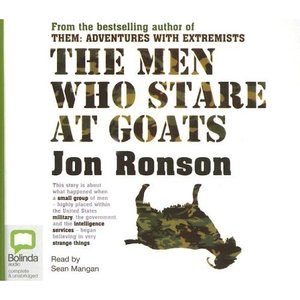
The Men Who Stare at Goats

men-who-stare-at-goatsThe Men Who Stare at Goats
by Jon Ronson
2004
read by Sean Mangan

This book is awesomely hilarious. Hilarious, if, you know, you can get past the very real horror that is mixed in with the craziness. Apparently, I can. In many ways, the book as a whole reminded me of Keller’s Catch-22, an awesomely hilarious comedy all about the inhumanity of war.

And unfortunately, I once more have to warn for animal harm. Given the intent (by the men who stare at goats) of doing harm, I shouldn’t be surprised, but given the proposed method (i.e., staring), I found I was surprised after all. (It hadn’t occurred to me to ask: where are these goats coming from?) Plus, once we’re past the animal harm, we then move on to torture of prisoners.

Somehow it still manages to be super funny.

Jon Stewart on the Daily Show called Jon Ronson’s writing “investigative satire” and that’s pretty much what it is. This book is also an illustration of the phrase: “Truth is stranger than fiction, (because fiction has to make sense.)” In the final chapter of this book, Ronson sums it up by explaining that this is the story of how, in the aftermath of the Vietnam War, the discouraged and demoralized U.S. army attempted to incorporate some of the “New Age” culture that was developing, but in true military style, rather than seeking new ways to find peace, they looked for new ways to make war.

Ronson himself is also quite the character: a soft-spoken, somewhat nebbish guy. He’s gone on The Daily Show with Jon Stewart, twice, so you can see him for yourself. It’s worth seeing him for yourself, especially if you’re planning on listening to the audiobook version of this book, because, in stark contrast to Ronson, Sean Mangan reads the text with a deep intent and melodrama that just adds an extra layer of hilarity to it all.

There are a lot of conversations in which the various interviewees are saying something either crazy or horrifying or both, and Ronson is recounting the conversation:

So-and-so said: some crazy and/or horrifying thing

I said, “hmm.”

Now imagine that spoken in a deeply melodramatic fashion.

“I said,” Mangan intones, “hmm.”

I, the listener, can’t help but giggle.

To use Kinsey’s practice of a Three Word Review: funny, informative, disturbing

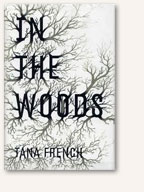
In The Woods

By Tana French

Book cover: In The WoodsI really liked this book: it has a plot that I couldn’t anticipate and building suspense that I couldn’t put down, and the characters are where it really shines. The narrating detective’s female partner, especially, is tough, smart, and likable, and that’s a lot less common than it should be. My favorite passages of the book just follow the various officers working through the minutiae of the investigation. However, there were a couple of issues that kept me from loving it:

First, a pet peeve: I just hate foreshadowing. I know that is an important writing device for building suspense, but I hate it when the narrator says stuff like, “if only I knew then where this would all lead” or “at the time I was so sure I was right.” I just hate it, and this book was chock full of it. I will say that French put it to better service in this novel than I’ve seen in used before, but it still didn’t make me like it. I prefer to advance through the story at the same time as the narrator, and see missteps retroactively as well.

Second, from the very beginning, even on the back cover blurb (so this isn’t a spoiler; the full plot spoiler follows below the cut), it is known that the narrating detective’s past is related to this new crime. Though the book primarily focuses on the present-day murder, the cold case, with the same setting and similar victims, runs as a parallel undercurrent. Our narrator knows he shouldn’t be working this case, but he is obsessed and becomes increasingly unbalanced throughout the book. French does a very good job of subtly depicting his unraveling mentality, and I gradually began losing patience with his growing belligerence and incompetence and all-encompassing self-involvement.

So, I found the actual reading of the book a bit more a chore than I like in my for-fun books, but the twist ending (which I couldn’t even guess at) made it all worth-while, and I want to bring it up because I want to gasp over it with other readers, specifically Kinsey, who recommended it to me and mentions the second and fourth in the series here.

WARNING: I’m seriously spoiling the entire mystery in the following paragraph. Pet peeves aside, I really do recommend this book if you like the grittier-type murder mysteries and suspense, and if you haven’t already read it, you should check it out without my spoiler. Continue reading

Femme Fatales: Femme and A Dame To Kill For

Femme

By Bill Pronzini

Book Cover: FemmeAh, Bill Pronzini. You were one of my early introductions to pulp mysteries, and I have a lot of left-over affection for you, but I’m afraid I may have outgrown your nameless detective.

I hadn’t read a Bill Pronzini novel in at least 15 years, but I ran across this very short novella in the new releases shelf at the library and picked it up, as I do love a femme fatale! I also had very fond memories of Pronzini’s nameless detective series from high school; they are somewhat run-of-the-mill novels, but are told in first person by a detective who is never named (I was also at the time watching Clint Eastwood’s “The Man with No Name” series, so it was a bit of a theme).

I read Femme in the space of one delayed flight, so probably over 3 hours total, and it was the fluffiest of fluff. I have a bit of a problem with novellas, actually. Whereas authors seem to put extra effort into short stories to be concise and compact as independent entities, novellas have a tendency to just come off as reading like general outlines for a future novel, and this one was no exception.

The plot, characters, and setting were quite generic, which is especially problematic when it comes to a femme fatale. A woman who uses her very femininity to lure men to death and destruction really needs to stand out. This particular femme seemed no different than the average murderess on any given Law & Order episode. I get that it is more difficult to make violence stand out in this modern age, but that’s what makes writing a femme fatale such a challenge.

Now, if you want someone who is up to that challenge:

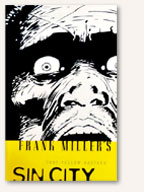
A Dame To Kill For

By Frank Miller

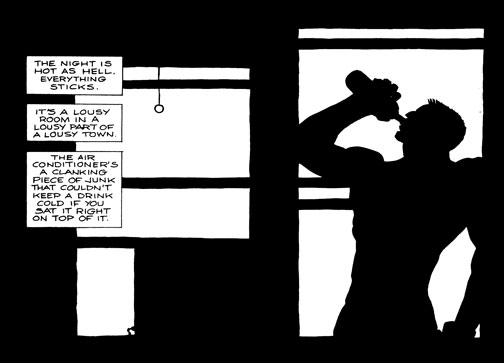
Book Cover: A Dame to Kill ForFrank Miller’s A Dame To Kill For is the basis for the new Sin City movie coming out next year, and coincidentally the only Frank Miller graphic novel that Rebecca owns. I really enjoyed the first Sin City movie and was torn over whether to read the graphic novel for the second one, and thereby “spoil” it for myself, but finally decided that part of the fun of the movie is seeing what a brilliant job it does of bringing to life each individual illustrated panel. (I saw in a “making of Sin City” that they actually used the graphic novel as the original story boards for the movie, which makes a lot of sense, given Frank Miller’s very cinematic style.)

While it is no spoiler that Frank Miller loves a femme fatale (or ten), I’m going to go ahead and spoil this particular book (and upcoming movie), so proceed with caution. Continue reading

She Left Me the Gun

I love memoirs–I’ve said this before–and can read one after another, but even I get a little tired of the endless string of “Here’s The Unique Way that My Parents Messed Me Up” stories. I certainly understand how a traumatic childhood can allow for the kind of narrative arc that works well in memoirs, but they are such a drag to read. Which is one reason that She Left Me the Gun: My Mother’s Life Before Me by Emma Brockes was a such a refreshing change from the usual memoir.

Though told from Emma’s point of view, the book is really about her mother Paula, who was born and raised in South Africa but emigrated to England as an adult. After arriving in London, she got married, had her daughter, moved to the country, and lived out a normal, sedate village life. It was only after her mother died that Emma started looking into some of the vague things that her mother had said about her past. It takes Emma a fair amount of research, including multiple trips to South Africa and visits with extended family, to piece together exactly what happened to her mother before she got to England, and I’ll just say that very little of it was good.

The book goes into some detail about what happened to Paula, and offers an intriguing glimpse into everyday life in modern South Africa, as Emma ends up spending a great deal of time there meeting family and doing research. But the real heart of the book seems to be Emma trying to get her head around both who her mother was, and how much of the past she has the right and/or responsibility to know. Her mother kept this information from Emma for her whole life, and clearly wanted her to be as protected as possible; by discovering the truth, does Emma undo her mother’s work? Did Emma really know her mother, if she knows nothing of the first 30 years of her life and the momentous events that shaped her? (Emma does a great job of explaining that kid feeling of, “My mom was born, and then she had me. The end.”) And after her mother has died, does Emma have an obligation to learn what happened, so that SOMEONE knows exactly what her mother had to overcome?

The biggest question asked here, though, is just how does someone start over again? No matter the specifics of what happened to Paula, the upshot is that at 30 years old she walked away from a troubled life in South Africa and started all over again in London. She got married, had a child, and remained, as her daughter describes her, a vibrant, funny, functional person. How does someone do that? How could Paula do it when so many others couldn’t? The book doesn’t really answer that, of course. It’s a bigger mystery than one book can solve and Paula herself isn’t around to offer her thoughts. I wish she were, because she sounds like she would have been a riot, even if she couldn’t tell you how she did this magic act of creating a new life.

Kinsey’s Three Word Review: Inconclusive, but satisfying.

You might also like: The Glass Castle by Jeannette Walls, another memoir by a daughter that is (largely) about her mother. In this case, the unknowable part seems to be how Walls ended up so functional when her mother was so dysfunctional, but it addresses some of the same key questions about how you construct a life.

Simplexity

SimplexitySimplexity:
Why Simple Things Become Complex (and How Complex Things Can Be Made Simple)
By Jeffrey Klugger
2009
Read by Holter Graham

This was a fascinating book, although it wasn’t quite what I had expected. The subtitle is a bit of a misnomer as the book doesn’t really address why things become complex or how they can be made simple. Instead, it shows that many simple things actually are quite complex and many apparently complex things actually are quite simple. So I suppose it does tell you how, if only by showing you how to shift your perspective.

The book is essentially composed of a series of case studies. The studies range from the evacuation of the Twin Towers on 9/11 to regular New York traffic patterns, from stock market fluctuations to cholera outbreaks to Jackson Pollok paintings. All of these are used as examples of the simplicity-complexity continuum, in which both extreme regimentation and extreme chaos are conceptually simple, while in between these two extremes is the place where some extremely complex patterns form.

As is, perhaps, appropriate for a book on this topic, I’m not quite sure what else to say about it. It would be easy to recount some of the interesting details, of which there were many, but the premise itself was quite simple: some things are simple, other things are complex, but it is not always obvious which is which.

Kluger presents a different way to examining the world, and I enjoyed it a great deal.

Yes, Chef by Marcus Samuellson

Yes-Chef-Marcus-Samuelsson-Random-House-Audio-booksYes, Chef
By Marcus Samuellson
2012
read by Marcus Samuellson

Now, Marcus Samuellson is a successful celebrity chef. Way back when, he was a toddler in Ethiopia dying of tuberculosis, and then a kid in Sweden determined to become a professional soccer player, and then a young man in Europe and America trying to get a job and work his way up the career path. This is the story of how he got from there to here, and it’s an excellent story.

One thing that really impresses me with this book is how he manages to not only tell about his actions and experiences in the past, but also to portray his perspective and thought process in the past. When he was writing about his childhood, he wrote as an adult recounting his childhood, but as he was writing about his experiences as a young adult growing into a mature adult, his writing also changed to reflect the change from being driven young man with an overriding ambition to being a much more socially aware adult who didn’t take family for granted.

I was really glad that I experienced this as an audiobook, not because it would have been at all bad as a standard book, but because the audio version is read by Samuellson himself. He doesn’t have the perfect elocution of a professional audiobook reader, but he does have real emotional connection to the story he’s telling. As an autobiography, it gains even more power by being told, literally, in his own voice.

Also, his descriptions of food make me wish that I was more of a foodie. I like food, but I also like simple flavors. Samuellson’s descriptions of the rich and complex flavors that he loves are tantalizing.

The one problem I had with the book is that some of the transitions are pretty abrupt, and a couple of times abrupt enough to be confusing, where I wasn’t quite sure what happened. Also, I got the distinct impression that he was living by the same parental advice I got, that “if you can’t say something nice, don’t say anything at all.” Not that all of his experiences were good by any means, or even that all the people were nice (not at all!) but no one and nothing is presented as unmitigated badness, and that is something I appreciate. Sometimes that might mean skipping over a period of his life, maybe, but for the most part Samuellson seems to genuinely like and respect people. Even the most difficult people (and there are apparently a lot of difficult people in the cooking community, good grief – I’m extremely glad that I don’t have to put up with that) have something good about them and Samuellson sees that.

Anyway, I enjoyed this book a great deal and I definitely recommend it so that you can enjoy it, too.

Rest In Peace, Elmore Leonard

Elmore LeonardMan, 2013 has not been a good year for authors! Today, Elmore Leonard passed away, and even if you don’t think you are familiar with him, you are sure to be familiar with some of the movies and television shows he wrote or inspired: Out of Sight, Get Shorty, 3:10 to Yuma, and Justified, to name just a few. I was first introduced to Leonard through the very short-lived tv show Maximum Bob which ran for just seven hysterical episodes in 1998, but inspired me to read the novel with the same name and become a lifelong fan of the author.

I consider him one of the founding fathers of the craziness-in-Florida niche genre continued by Dave Barry and Carl Hiaasen, and if you haven’t read any of his work, you should definitely check it out if you want to laugh at some head-shaking craziness that doesn’t seem that farfetched anymore. Honestly, with Florida, you laugh so you don’t cry, and Leonard is very good at making the reader laugh. In eulogy, Vulture posted Leonard’s Ten Rules of Good Writing, and it is easy to see why I am such a fan.

—Anna

Magic Rises

By Ilona Andrews

Book Cover: Magic RisesThis is the sixth book in Ilona Andrew’s Kate Daniels series, and Rebecca has previously introduced the series here.* It is my favorite in the over-abundance of series about spunky women in a werewolf- and vampire-populated world, but to my mind the series peaked at book 3 and went downhill from there. (As an aside, Rebecca and I had a lengthy discussion about whether this is a common phenomena; are trilogies so standard because authors tend to lose steam after the third book? There are a lot of series that support that thesis, and only a few that belie it.)

Maggie Q as Nikita

As an aside on first impressions, when I first got the book, I was somewhat taken aback by the cover. The featured woman looks somewhat different than previous illustrations of Kate Daniels, which is fine, artists change visions, etc., etc. But, doesn’t she look strikingly similar to someone else instead? I feel like, as an artist, you should take your inspiration from wherever you like, but maybe don’t make it so blatant.

A very mild spoiler for the series: book 3 settled a romantic tension that had run through all three initial books, and all the subsequent books have had relationship drama that I don’t care for, and increased violence, possibly to counter-balance the relationship drama, now that I think about it. A lot of the violence, too, was starting to be directed toward various magical (and deadly) creatures that populate the world, and I have a big problem with violence against animals, even fictional ones. A true hypocrite, I don’t have nearly the same problem with violence against people, which is why I was fine with the earlier books. I was still committed to the series, but was not anticipating this book with the eagerness I had earlier in the series.

In fact, this book way exceeded my expectations, and I believe rejuvenated the series a bit in a very clever way. Andrews changes the setting from Atlanta, Georgia, where all previous books are set, all the way to Europe, so there is a freshness just in the change of scene. With the new setting, she also constrains the number of characters, which had been expanding exponentially with each book, until the action started to get muddled with so many players. Magic Rises is pared down to just a cleanly written and plotted, extraordinarily fun supernatural adventure, and I am just so, so happy to have my favorite fluff series back.

One caveat to all of my praises: I went back to the earlier books to double-check a minor character’s name, and it reminded me of the casual humor and one-liners that made the early books such a pleasure. As the books have ratcheted up the drama and tension, that humor has mostly disappeared and I miss it. I almost feel like that as the authors have become more accomplished, they perhaps have edited out those parts as being less polished, and that makes me sad.

* There has been some update in information from this original review. The series has been expanded to ten books instead of the previously planned seven, when the authors realized that they would not be able to wrap it up conclusively in just two more books.

Books and Food: Two of My Favorite Things

Although I’m currently in the middle of about five different books, my reading for the last month hasn’t been particularly blog friendly, as it’s been heavy on sequels, things Anna or Rebecca have already reviewed, and books that I didn’t like enough to spend any time writing about. But was thinking about cookbooks recently when I gave a couple of new ones as birthday presents (It’s All Good by Gwyneth Paltrow and the Joy the Baker Cookbook by Joy Wilson–I’m hoping Anna or Cara might pop into the comments to report on how they like those). Considering that I don’t actually cook all that much, it’s possible that I have a small cookbook problem, since I have two shelves full of them and another box in storage. I love getting them as gifts, I love browsing through them, and on occasion I even cook things. Despite my small cookbook library, there are few key ones I come back to again and again.*

More-With-Less Cookbook by Doris Janzen Longacre
My family calls this “the Mennonite cookbook” since it’s really a collection of recipes from Mennonites around the world. These are very basic, hearty, healthy recipes that focus on economy, using what you have, and feeding the world. (The Mennonite were into sustainability and unprocessed foods before those things were cool.) And because Mennonites so often work as missionaries, there are a surprising number of recipes with Indian, Asian, or South American origins. This was the first real cookbook I ever used as an adult, and the easy curry, golden eggplant casserole, and eggplant Parmesan recipes were standbys in my early 20s.

Chocolate from the Cake Mix Doctor by Anne Byrn
At the opposite end of the spectrum from the Mennonites. Byrn has a whole series of books on how to use modern convenience foods as shortcuts in recipes. I know that sounds a lot like Sandra Lee (and not in a good way) but her cake mix books are quite smart. All the recipes start with a cake mix, but then add things like sour cream, yogurt, fruit, flavorings, puddings, etc. The processed cake mix makes the recipes practically foolproof, but all the additions make them taste fabulous. I’m quite a good baker and I don’t have problems making cakes from scratch, but I will admit here and now that this book contains the recipe for the single greatest cake I have ever baked or eaten–a white chocolate lemon cake with lemon curd filling.

The Homesick Texan Cookbook by Lisa Fain
I’m from Texas, so I can tell you with authority that the things you cook from this book taste right. I am a particular fan of the cheese enchiladas with chili con carne, the Ranch oyster crackers, and the Texas sheet cake.

How to Eat by Nigella Lawson
The pictures in How to Be a Domestic Goddess or Forever Summer might be better, but Lawson’s first book is packed with not just recipes, but ideas for how to put food together. This is the book that helped me figure out how to roast vegetables, and her sticky toffee pudding is so, so good. I am big Nigella fan and have lots of her books, but this is my favorite.If you have a cookbook that you love, tell me about it in the comments!

*My actual favorite cookbooks are those Kinkos-produced, spiral-bound ones that churches sell, where each recipe lists the name of the nice church lady who contributed it. I have a collection of those dating back to the 50s, and I use them more than you might think.

RIP Elizabeth Peters

Elizabeth_Peters
RIP Elizabeth Peters
(Sept. 29, 1927 – Aug. 8, 2013)

I just learned that Elizabeth Peters recently died. Her actual name was Barbara Mertz, but I knew her as Elizabeth Peters when I grew up reading her books.

She was a prolific mystery writer, her characters are a delight, and her writing easily mixed suspense and humor. I particularly loved her sense of character though. Her heroines were all very real, with very definite personalities and perspectives. They were all people that I would have loved meeting, but also that I could have imagined meeting. They were real people and they continue to delight me. The love interests were also all strong personalities that could hold their own against the main characters, and the large casts of secondary characters were always zany and delightful.

I think growing up reading these books provided a wonderful salve to also growing up reading classic science fiction, which tended to skimp on the character side of things, especially when it came to females. Peters’ characters more than made up for the lack in any other books, though. Her were a delight and a wonder.

crocodile-on-the-sandbank   The first book of hers that I read was Crocodile on the Sandbank, which introduced me to Amelia Peabody, Peters’ most well-known character. Peabody is a British female Egyptologist in 1884. As you might guess from that, she is quite opinionated and strong-willed. Watching her butt heads with pretty much everyone is a delight. Amelia along with her eventual husband and eventual son are the focus of 19 books.

borrower-of-the-night-a-vicky-bliss-murder-mystery-by-elizabeth-peters     streetoffivemoons    silhouette

My favorite series of hers though is the one that follows Dr. Victoria Bliss, a medieval arts scholar who works at the National Museum in Munich. Vicky is Barbie-doll-esque enough in appearance that most people don’t take her seriously as a scholar. Her boss Herr Professor Anton Schmidt is Santa-Claus-esque enough in appearance that no one takes him seriously as an adventurer. John Tregarth is a master criminal who tries valiantly to not be taken too seriously. Together they find and/or get drawn into all sorts of historical and criminal adventures.

summer_of_the_dragon     devilmaycare     lovetalker

Some of my favorite books of Peters, though, are her stand alone novels, introducing whole new casts of characters and a single mystery to be resolved. Of her many such books, Summer of the Dragon is probably my favorite, closely followed by Devil-May-Care and The Love Talker.

This is an author well worth reading and who has had a major impact on my youth, reading, and writing. She set a high bar for others to follow.

Rest in peace, Elizabeth Peters.