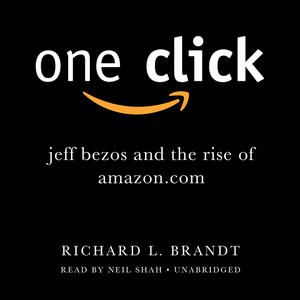
One Click

One_ClickOne Click: Jeff Bezos and the Rise of Amazon.com
By Richard L. Brandt
2012
read by Neil Shah

Curiously, this kind of reminded me of Mr. Penumbra’s 24-Hour Bookstore. It’s about a rather eccentric bookseller who isn’t actually interested in selling books so much as making a major impact on society. The fact that Amazon.com started by selling books is mostly a side effect of the fact that Bezos wanted to start a transformative online retail business.

Bezos seems like an interesting character. He’s presented as very analytical in his thoughts and emotions, as well as a visionary. I can’t help but compare him to Mark Zuckerberg of Facebook as presented in The Social Network (i.e., I haven’t actually read any nonfiction about Zuckerberg, but I’m still going to make this comparison.) They’re both very smart with a vision of using the Internet to revolutionize the world and somewhat out of step with other people socially. But where Zuckerberg comes across as trying a bit too hard to both fit in and to make other people fit to him and generally being an ass, Bezos comes across as being very comfortable with himself and honest about who he is and what he wants. He seems like a decent guy. Oddly, the author of the book strikes me as falling in between the two, trying rather desperately to model himself after Bezos (good for him) but still uncomfortable and nervous and trying too hard to casually use “nerd” as a descriptor rather than an insult.

In fact, Brandt come across in awkward in several says. First, he slants all the descriptions to show Bezos as being ultimately in the right, and all of Bezos’ questionable activities (standard CEO stuff: too demanding, too micro-micromanaging, too distant, too whatever) are presented in a lump in one of the later chapters rather than interspersed through the story.

Another oddity in Brandt’s writing is some of the rather lurid prose that occasionally pop up in a rather jarring fashion. I enjoy a certain level of purple prose: the grammar alone can add a pleasing complexity and richness to a description even beyond the subject itself. That said, “the stock prices fell like spit off a bridge,” “the stock was as sickly as a CEO with swine flu” and similar phrases gave me pause. The writing is generally fairly straightforward and even a bit pedantic, but it’d dotted with these WTF metaphors and similes that make me blink and go “huh.”

I’m really glad that I was listening to the audiobook version of this rather than trying to read it. There are long sections that strike me more like elaborated lists than any real narrative, and I’m fairly sure I would have bogged down in them if I’d been trying to read them. But with it read and simply playing out during my commute, I go at a steady pace and the information is fairly interesting.

Despite the rather lukewarm review, I enjoyed the book. I also found it a particularly timely read.

On Monday, I learned that Bezos is buying The Washington Post. He’s not even buying it as an Amazon.com acquisition, but rather through his personal wealth.

A while back, I watched Page One: Inside the New York Times, and despite it’s apparent intent to convince me that newspapers were still important, it mostly succeeded in convincing me of the opposite. Bezos has demonstrated a deep understanding of how online capabilities change retail. I very much look forward to seeing if he will demonstrate a similar understanding and sense of innovation regarding online capabilities in the information business.

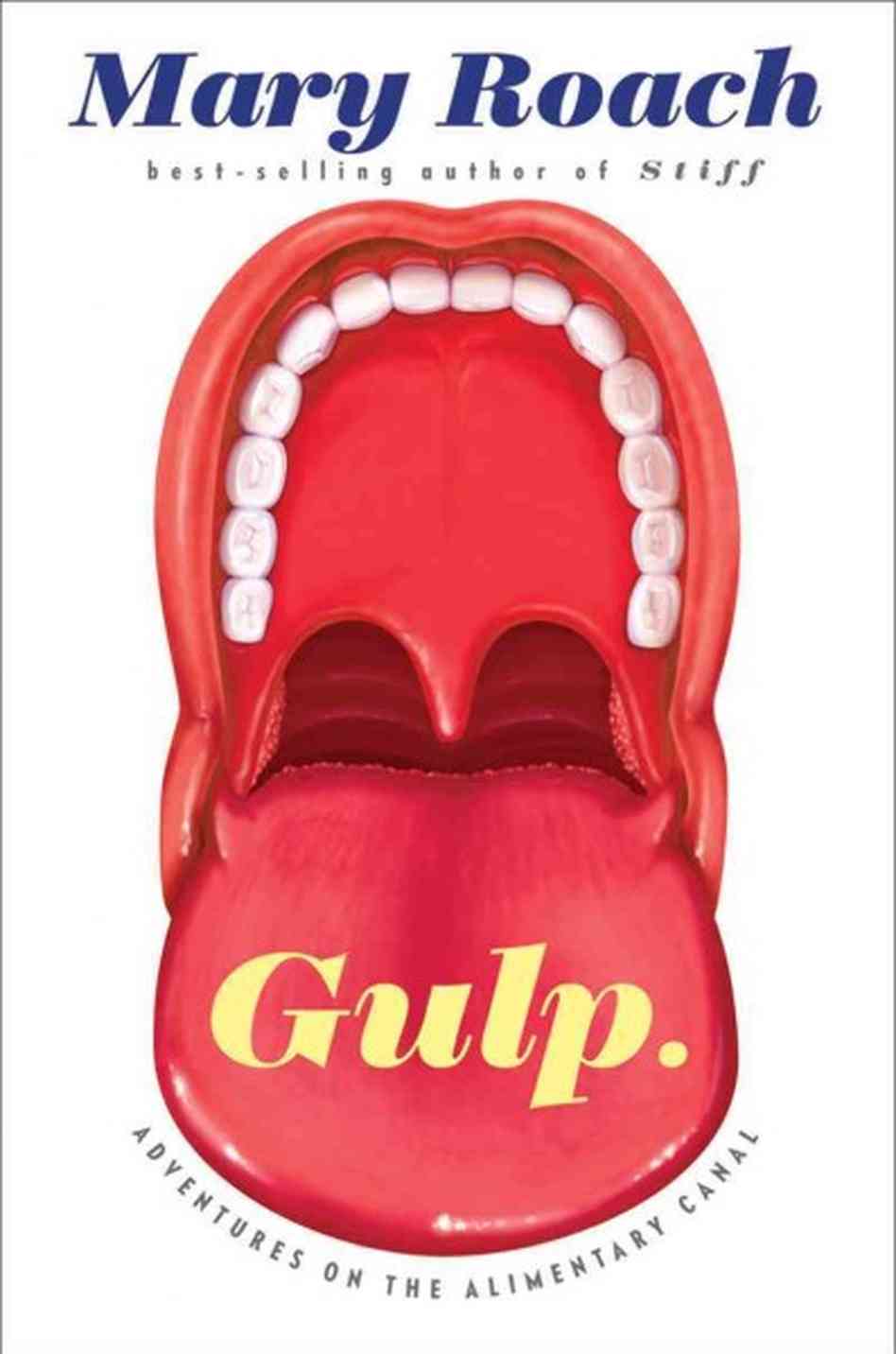
Gulp: Adventures on the Alimentary Canal

gulpGulp: Adventures on the Alimentary Canal
By Mary Roach
2013
Read by Emily Woo Zeller

This was excellent, but…

That’s pretty much my review of this book. It was excellent—funny and informative—and yet, there are so many warnings necessary before I could possibly recommend this to anyone else.

I read Mary Roach’s Stiff: The Curious Lives of Human Cadavers some years back and enjoyed it a lot. It was funny and educational and oddball and also kind of gross but mostly that just made me get all picky about what I want to have done with my body after I die. I had not expected adventures in the alimentary canal to be significantly grosser than a recounting of the things that can and do happen to bodies after death. Oh, how wrong I was! Gulp got incredibly gross, and I am now hyper conscious of my bowels. I can only hope that awareness disperses after I move on to another book.

Second: I have to warn about animal harm. So. Much. Animal. Harm! You know how people have learned about the digestive track over the centuries? Largely by doing really unpleasant things to animals. Do you know what vivisection is? If you don’t, then count your blessings and don’t ask.* If you do, well, if you read this book, you’ll know a lot more about it. The people at the dog food factory loved their dog taste-testers and treated them extremely well. I cling to the fact that there are people here who love their animals. Because all the other animals mentioned in this book came to gruesome ends.

Moving on, I was surprised about how Roach didn’t spend much time on the intestines. She started at scent and taste and swallowing, moved on to the stomach, and then dealt with digestive juices, but then moved on to the colon (and stayed there for a really long time) but I didn’t really think the small and large intestines got their fair share of time. On the other hand, this isn’t exactly intended as a textbook. Maybe she just couldn’t find the same number of stories—horrifying and hilarious—for that particular section of anatomy as she could for the rest.

Finally, while I listened to this in audiobook format, I think it probably works better read in a traditional book format. There were a fair number of footnotes that discussed tangential issues and it was occasionally difficult to track the divergence and subsequent return to the regular text.

So, if my various warnings haven’t put you off too much, then I do recommend this book. It is hilarious and I have learned things that I never would have expected.

* I first learned of vivisection from a book in which the bad guys did it and the good guy was Jack the Ripper. Let that give you some perspective.

Me Before You

I can’t remember why I picked up Me Before You by Jojo Moyes–I must have seen it recommended on a blog or on Twitter, since those are those places I learn about everything–but I didn’t know a thing about it when I started reading. I think I thought it was a romance. Which I guess it is, sort of, but calling it a romance seems way too simple.

Now, when I summarize the plot, you’re going to think it sounds like a bummer. It’s about a young British woman, Louisa, who takes a job serving as a companion to Will, a man who was recently paralyzed in an accident and isn’t very pleased about having her around. I know, I know, I wouldn’t have wanted to read it based on that either. And it’s not a happy book–there were definitely tears. But it’s also charming and the characters are real and funny. When the book starts, Lousia is working at a coffee shop with no plans to do anything else, and Moyes did a great job of making Louisa aimless without her seeming dumb or unsympathetic. The relationship Louisa has with Will is complicated and layered, but her relationship with her family is presented with equal care. Even when some of the plot turns got a bit melodramatic, the characters kept the story grounded.

Gretchen Rubin (the author of The Happiness Project, a book I’ve raved about before) offers monthly book suggestions on her site, but very specifically doesn’t describe the books at all. She says that she finds herself less interested in reading a book when someone tells her what it’s about. I like hearing details about books before I read them, but I struggle with the actual describing part here on the blog sometimes. Often I feel like I’ll steal some of the magic of a book by revealing things that are better discovered as you go along. If I were queen, I would just tell everyone that they should trust me and read what I tell them to. Me Before You is definitely a book where I don’t want to risk any of the magic, so just trust me and read it already.

If you need any more convincing, Anne Lamott raved about this book in the most recent People magazine, so I feel like it’s been blessed–if she likes it, how could anyone not?

Kinsey’s Three Word Review: Funny, sad, cathartic.

You might also like: Wild by Cheryl Strayed. It’s not really like Me Before You–it’s a non-fiction memoir for one thing–but it’s the last thing I read that inspired the same kind of emotional reaction (laughter, tears, inability to get it out of my mind days later).

The Art of the Steal by Frank Abagnale

The-Art-of-the-Steal-Abagnale-Frank-W-9780786121373The Art of the Steal
How to Protect Yourself and Your Business from Fraud, America’s #1 Crime
By Frank W. Abagnale
2001
Read by Barrett Whitener

This book is enthralling and funny and useful. I definitely recommend it.

I just started a new job (yay!) which comes with an hour-long commute (hmm), so I’m starting to look at audiobook options. I started listening to this one when my hour-long commute (which would be half an hour if it weren’t for rush-hour traffic) turned into a two-hour-long commute due to construction. I give this audiobook full credit for saving my sanity. It’s not only well-read, but the reader is well-matched to the author. I have no idea what Abagnale actually sounds like, but in my head, he sounds just like Whitener and not much at all like Leonardo DiCaprio.

The DiCaprio reference is not as random as it might at first appear. The character of Frank Abagnale was played by DiCaprio in the movie based on Abignale’s autobiographical book, Catch Me If You Can. He was a con-artist for five years, from age 16 to 21, and then managed to grow up and started to understand consequences. Since being released from prison, he has made a career out of helping businesses avoid being conned in one way or another. Interestingly, this book is apparently his first effort to reach an audience of small-businesses and private individuals. The Art of the Steal goes over a lot of the major methods of fraud, how they are perpetrated and how they can be avoided or at least dealt with.

I think the part that I found funniest was Abagnale’s suggestion on what to do to embezzler’s. Since embezzlement is really difficult to prosecute, and often has more major consequences for the victim than the perpetrator, most companies just cut their losses and let the perpetrator go with no reprisal. Abagnale suggests filing an IRS form letting the IRS know that the company “paid” the perpetrator the amount that was embezzled. The criminal and civil court systems might not do much to embezzlers, but the IRS is not at all nice to tax dodgers. The thought of using the IRS as your personal attack dog just cracks me up.

There were also a lot of descriptions of awesome and interesting science projects and social science experiments that I would love to try out if only they weren’t both illegal and malicious. (Is it really that easy to set up an entirely new identity? I kind of want to try it and see! But I won’t. Because I am moral, I am lazy, and I don’t want to deal with potential consequences.) But there are all sorts of interesting ways to forge different types of documents and it’s fascinating to hear what they are and what their various strengths and weaknesses are.

The book contains eleven chapters, nine of which were excellent. The chapter on online and digital fraud was necessarily severely dated: this book was published twelve years ago and the digital/online landscape has changed a lot in the interim. The chapter on counterfeit objects too clearly highlighted the fact that Abagnale’s normal clients are big business: he conflates the issues of (a) getting high-quality goods without the expensive middleman with (b) getting low-quality goods with counterfeit expensive branding. These are different issues and should be treated differently.

Anyway, with those caveats, this was a fascinating book and kept me well entertained on my daily commutes. I definitely recommend it as being well-done, interesting and useful.

Dark Triumph

By Robin LaFevers

Book Cover: Dark TriumphKinsey recommended the first in the His Fair Assassin series, Grave Mercy, just a couple of weeks ago as a fun historical romance about deadly nuns. I was at the library when I read her post, and figured, why not? I checked it out, despite the size of the book (large), the cover of the book (beautiful girl posing melodramatically), and the inside blurb description (“For how can she deliver Death’s vengeance upon a target who, against her will, has stolen her heart?”), and I gobbled it up within the next week. It is just nonstop fun with the historical intrigue, which I liked better than Kinsey, and lots of romantic hijinx. I had a great time reading it, but wasn’t sure I was going to continue to read the series until I read the little teaser for the sequel in the back, at which point I immediately went back to the library to get the sequel.

Dark Triumph follows a peripheral character introduced in Grave Mercy, another, more troubled novice of the nunnery for the God of Death. The book focuses more on the character and her past than the surrounding politics, and is thus able to make her more nuanced and interesting to follow. The two books remind me a bit of Ilona Andrew’s Edge series, where the first one is lots of fun action with somewhat generic heroine and hero, and the second one takes the more interesting side character and continues his story. While I liked Grave Mercy, I loved Dark Triumph, and literally struggled to put in down at times within the three to four days that I devoured it. So Grave Mercy is worth reading if only to then read Dark Triumph (which does not stand alone, so needs to be read sequentially).

I would be reading the third book in what I believe will be a trilogy if it was out already, but unfortunately I have to wait until Spring 2014. I’m not terribly intrigued by the heroine, already introduced in the background of both books, but I’m hooked on the series now. In the meantime, I will leave you with a phrase from a critic’s praise for Grave Mercy that I found amusing (from the back cover panel of Dark Triumph): “a plot that nods to history while defying accuracy.” (Yep, that seems about right.)

P.S. – While looking for the book cover image, I ran across the author’s website, where she has posted the first chapter of Dark Triumph, which gives an excellent preview to the book, and also does spoil Grave Mercy a bit, so use caution.

—Anna

Parecomic and That Lovely Horrible Stuff

parecomicParecomic: The story of Michael Albert and Participatory Economics
Written by Sean Michael Wilson
Drawn by Carl Thompson
2013

Not liking the current economy very much, a book about an alternate way for an economy to run seemed like an excellent opportunity for me. Especially since it’s a graphic novel and thus likely to be at least slightly livelier than other books about the economy.

However, while it wasn’t a terrible book, it wasn’t a particularly good one either and I was really not impressed with participatory economics as it was described.

The first two-thirds of the book were more a biography/personal history of the civil rights era. I found this portion extremely interesting, even if it wasn’t saying much about participatory economics. The people and the times were interesting enough that it was okay that I didn’t find the main character (or any of the other characters) very sympathetic.

The later third of the book did discuss participatory economics, but did so very poorly. This is the closest I’ve ever come to feeling like I might understand why Ayn Rand was so down on liberals and socialists. Given that this book was written in Albert’s words, defending his ideals, presumably to the best of his ability, I have to admit that maybe Rand wasn’t entirely making up her annoying “liberal” characters as I’d assumed.

Albert wants to save the working class and the poor, but he sure doesn’t respect them. He argues that white-collar workers aren’t any better than blue-collar workers but assumes that it’s obvious that white-collar work is better and more empowering than blue-collar work. He assumes that everyone will like the same things and dislike the same things and generally have the same opinions if only they really understood. Thus, in his view, business meetings can reach consensus quickly and easily, and if you don’t agree with him, then you just don’t understand the situation.

It started out interesting, but ended up mostly irritating. On the other hand, it was well-illustrated, the first part was interesting, and the book as a whole wasn’t that long. So, faint praise, but still praise.

FinalCOmpsThat Lovely Horrible Stuff
By Eddie Campbell
2012

This was in the nonfiction new-release section at my library and it seemed to be a graphic novel about currency, which I thought would be interesting. Instead it was mostly some biographical ramblings of the author about his money troubles. It did have a section about the stone money of the island Yap, which was really interesting. I wish the whole book had been like that. Instead I mostly got annoyed at Campbell for being whiny. Like Parecomic, it was interesting and well-illustrated (and really quite short), but the main character was even more off-putting.

List Challenges and Book Lists

Screen Shot 2013-07-09 at 10.27.17 PMI recently discovered List Challenges, the website. I do like list challenges, especially ones about books. And here are a whole bunch of them:

NPR’s Top 100 Science Fiction & Fantasy Books
(I’ve read 32 of these, and saw a bunch more that I’ve been intending to get around to reading. It really is an excellent list.)

Top 25 Fantasy Books, from IGN
(I’ve read 11 of these.)

101 Best Selling Books of All Time
(I’ve read 27 of these, but more to the point, these books made for a really odd collection. They aren’t themed or anything, just the books that have sold the most copies. Very odd.)

Modern Library 100 Best Novels (Modern Library ran the poll in 1998)
(Urg. Here are the Great Classics, the real, high literature. I’ve only read 6 of these books, and only enjoyed 3 of them. Just, urg. There’s only so much delving into the human condition that I can take and it’s not that much.)

BBC’s The Big Read – Best Loved Novels of All Time
(I’ve read 30 of these and loved most of those.)

The 50 Best Books for Kids (from the National Education Association)
(So I’m not exactly the audience for this list anymore, but I’ve still read 25 out of the 50, and not all of them while I was a kid. These are good ones, and also include books for a range of ages, from picture books for toddlers to young-adult readers.)

The 20 Best Books of the ’00s
(Now, this is just embarrassing, but I’ve only read 1 of these 20. At least I recognize several more?)

NPR’s 100 Best-Ever Teen Novels
(I’ve read 31 of these.)

This website of lists is a major time-sink so I had better tear myself away from it so I can go do something at least moderately productive. But you, dear reader, should definitely go and lose yourself in the various lists. How many of these books have you read?

Grave Mercy

Have you been thinking that there are not enough young adult novels out there about nuns who kill people in the name of the god of death? Well then, I have the book for you! But seriously, I really enjoyed Grave Mercy by Robin LaFevers, and it’s lots of fun to tell people that you’re reading about assassin nuns.

Set in Brittany (now part of France) in the 1400s, the story follows Ismae, a teenage girl who is saved from an abusive father and an arranged marriage by joining a convent dedicated to Mortain, the god of death. And this convent teaches it’s novices some very specific skills, training them to be sent out into the world to kill those people marked by Mortain for death.

This was clearly published in the wake of The Hunger Games and Divergent and all those other teenage dystopian future series (this is the first in what looks like a planned trilogy), and it feels very much like those books. But if you’re a little sick of dystopian futures, like I am, this offers a nice twist by being set in the past. And while there is a bit of the magic/supernatural happening with the god of death and all, it’s really mostly a historical novel about life in medieval Europe. It featured a little more political intrigue than I would have preferred (However will the Duchess keep her crown? I don’t really care all that much!) but it also had adventure, romance, and strong female characters with a lot of agency. And it sure wasn’t like anything else I’ve read lately.

Kinsey’s Three Word Review: Dramatic, historical, romantic.

You might also like:  Scott Westerfeld’s Pretties/Uglies series. Those are set in the future, but the books felt very similar. And I consider those really fun books, so.

Those Who Hunt the Night

Those_who_hunt_the_nightThose Who Hunt the Night
By Barbara Hambly
1988

This is an excellent vampire book. There are a lot of fun vampire books, but this one is actually good. I love the characters, I love the way they interact, and I especially love the way that the author presents the vampire characters.

The book is set in Edwardian England and our main character is Oxford professor James Asher. He’s living a calm quite life, but has a rather gritty past as a secret agent for the British government. At the start of this book, the vampire Don Simon Ysidro approaches Asher, informs him that (1) vampires exist, (2) someone has been hunting the vampires of London, and (3) Asher is going to be Ysidro’s agent in tracking down the hunter or Ysidro is going to kill Asher’s wife Lydia. The plot progresses from there.

The problem with vampires (as it were) is that they eat people. Humans are their prey. There just can’t be any sort of natural alliances between predator and prey. Most vampire stories hand wave this away: the vampire just feels terrible about it, or refrains from following his natural urges, or some such. This book, though, directly confronts the fact that these vampires kill people; both ‘good’ and ‘bad’ vampires kill people.  The alliance between Asher and Ysidro is necessarily deeply coercive and fraught.

Very much related to the previous point, I like a certain amount of ruthlessness in my characters. I don’t want them to be mean or cruel, but I like characters who are smart and determined and accept personal responsibility for their actions and the repercussions of those actions. Asher, Ysidro, and Lydia are all like this. They have goals and they do what they need to do in order to achieve those goals. They know what risks they take with their actions and they are very careful in how and what they do.

Another wonderful thing about this book and these characters is that Lydia, Asher’s wife, is an excellent character in her own right and the marriage between her and Asher is equitable. They not only love each other but they also respect and support each other. They are honest and forthright with each other. They trust each other, not just to be faithful, but to be capable.

Anyway, the investigation that makes up the actual plot itself was good, but what makes this book shine are the characters and their interactions with each other. I definitely recommend it.

Among Others

By Jo Walton

Book Cover: Among OthersKinsey introduced me to Jo Walton through her Small Change series, which is actually pretty brilliantly titled, now that I think about it. The three books, titled Farthing, Ha’penny, and Half a Crown, are solidly written English murder mysteries with the added brilliance of being set in an alternate history in the 1930s and 40s in which England supported the German Nazi Party (which is not all that improbable: if not for Wallis Simpson, Edward, a known nazi sympathizer, might have stayed on the throne). Anyway, the mysteries themselves are intriguing, but it is the setting and characters that really make those books shine.

When I ran across several (very favorable) reviews for her new book, Among Others, I added it to my to-read list immediately. It was described in the reviews as a coming-of-age story set in a world of magic and fairies, and I was so there! It…isn’t exactly that. I still really, really liked it, but the magic is very much in the background, an alternate setting like in the Small Change series. It follows a teenage girl from Wales recovering from personal tragedy while attending a very British preparatory school, and on occasion she confers with local fairies for advice. The magic of the world is utilized very effectively as a way to look at the world around you and make decisions for the direction of your life. I quickly got over any disappointment in the marginalized fantasy because once again, the characters and settings were completely engaging.

I’ve insisted that Rebecca read it next because I think she’ll appreciate the one aspect of the book that I found a bit alienating. Very minor spoiler: Mori, the heroine, finds comfort and friendship in a SF book club held at her local library. Much of Among Others is a love letter to the genre of science fiction and all the great authors that founded the genre. I’m not much of a SF reader, though; I had only read a few books by the authors mentioned, and I had liked even less. (The book is set in 1979, so I kept having to bite my tongue against criticism over the omission of more recent authors.) The heroine and the club are very sniffy about people who don’t like science fiction, and the book does such a good job of carrying that feeling through in the writing that I felt the alienation a bit as a reader.

—Anna