Hyperbole and a Half

By Allie Brosh

Book Cover: Hyperbole and a HalfI received the Hyperbole and a Half book for Christmas and it was awesome! I tried to portion it out so it would last longer, but was only able to stretch it out over four days. A lot of her fans say this, but author Allie Brosh seems to live, at least part of the time, inside my head.

If you’ve never heard of Allie Brosh or Hyperbole and a Half, the book is a selection of stories, both new and from her blog by the same name, which you have to go visit right now. You should read my two favorite stories, which are also in the book, “The Simple Dog” and “The Party.” And read Wolves, too, because that one is also really funny. Oh, and Sneaky Hate Spriral is great. Basically, just start at the top and read until you hit the end. And buy the book, especially to read “Motivation,” one of the new stories, because I’ve been quoting it all week: “I don’t want to do anything more than I don’t want to hate myself.”

It was actually a perfect gift for me because although I’m a big fan of hers, I’d mostly stopped reading her blog for the last year, for a reason that shames me a little. She stopped posting for several months, during which I checked back regularly, but when she came back, she discussed how she was recovering from a serious bout of depression, and I couldn’t bring myself to read about that, and I got too anxious to check back in afterwards. So, basically, I’m pretty much as unsupportive as can be, and was seriously ashamed of myself, but luckily her book actually addressed her own coming-to-terms with her selfishness and egotism, so once again, I felt very like she was talking from my own head.

—Anna

Fanfiction Selection

The last month (or two, or three) has been somewhat frenetic for me, and I haven’t really had the energy or focus to read full books. However, I couldn’t not be reading something, and what I’ve been reading is fanfiction. I’ve introduced the genre before, so I thought I’d take a moment to recommend a few more short fanfics.


Friends Across Borders
by MueraRashaye

To understand these stories, you need to be familiar with Mercedes Lackey’s Valdemar universe.

Summary: Two long-time enemy nations can’t become meaningful allies overnight. Stories from the lives of a border-guard Herald and Sunpriest, from their first meeting to the end, and insights into just how Karse and Valdemar were able to turn around their relationship so fast.

Warning: This is a series rather than a single story. The first three stories are complete, but the forth one is still a work in progress. Each of the first three stories can absolutely stand on their own, though, so if you won’t want to take a chance on a half-completed story, it’s okay to just not start the fourth story until it’s been completed.

Why I like it:  This takes a part of my childhood and makes it a tad bit more realistic, but without ever tarnishing the joy of the original. The main characters are both a delight and their mutual bewilderment regarding their developing friendship is a joy to behold. Also, one sign of a good series, in my opinion, is that the individual stories can stand on their own. So you don’t have to commit to reading the whole series to enjoy just the first story: Enemy, It’s Cold Outside.


Monster
by Laura JV (jacquez)

To understand this story, you need to be familiar with the character of Methos from Highlander and Sesame Street in general.

Summary: “Someone new moved in, Chris, next door to Gordon! Come meet him with Elmo.”

Why I like it: This is super short but it’s sort of like a John Donne poem in its own way. Without ever directly saying anything, it plays with the different meanings of the word “monster.” And, let me reiterate: it’s a Highlander/Sesame Street crossover. 😀


The Whole Truth (So Help Me God)
by Metisket

To understand this, you should be at least passingly familiar with the new Teen Wolf tv show. Although, actually, I read and enjoyed it without ever watching the show, just knowing the basic premise.

Summary: And this is a Stiles character study, so there you go. It’s multiple POV and set around “Night School.” Mostly because it will never stop being hilarious to me that Stiles punched Jackson viciously in the face and the only person who was remotely surprised was Allison. XD WHAT WERE YOU LIKE AS A CHILD, STILES?

Why I like it: First, I have to admit that I don’t watch Teen Wolf, I just really like the fandom. Fan authors can, and often are, much better than, say, MTV script writers. My pleasure in this fandom comes, in large part, from how the character of Stiles is treated, and this is just a concentrated look at how hilariously fascinating Stiles is and why the other characters wince when they have to deal with him. I wouldn’t necessarily want to be around him, but I sure like reading about him. It just makes me laugh.


A Perpendicular Expression
by leupagus

To understand what’s going on here, you should know the tv show Person of Interest.

Summary: Pissing Finch off never actually ends well; usually it ends like this, with John scaring the shit out of her at two in the morning.

Why I like it: There’s a certain joy in reading about super-competent people who just fail at being reasonable human beings. And Joss Carter is hilarious as she has to put up with them and explain basic social behaviors like not stalking your friends.


Kissable Fanatic, Unhinged Minim Artists
by Basingstoke

This fic is set in the X-Men universe, although the X-Men characters appear only briefly. If you are aware at all of the character Toad, in Magneto’s Brotherhood of Mutants, you know enough to read this.

Summary (provided by thefourthvine): Best FF featuring a powerful anti-drug message; namely that if we spend all our time stoned we might fail to notice critical things in our environment, like that one of our friends is actually green.

Warning: This is not family-friendly or work safe, i.e. any sort of filter at all should filter out this story. There’s drugs, profanity, and graphic homosexual sex.

Why I like it: I fought with myself over including this particular story because so far all my recommendations have been intended for a general audience (which is not necessarily common in fandom) and this one is absolutely not. This is, in fact, the first story I’ve recommended that includes a serious warning. (It’s standard policy with fanfiction to include warnings, a policy that is immensely helpful for maintaining some sanity when wandering dark corners of the internet.) However, this story is just too good to not recommend. Basingstoke takes Toad, a character that is treated as a barely 2-dimensional character in the comics, and makes him fully human (as it were). This story makes him real and that is one of the things I really love about fanfiction: that it will take minor characters the original author threw in to take up space and develop those characters into the main characters of their own lives. This story is just really, really good with that.

The Rest of 2013

As I said at this time a year ago, when I really love a book I generally write about it here, mostly so I can tell as many people as possible what to do. So you’ve already read here about the best books I read in 2013: Code Name Verity, Eleanor and Park, Me Before You, and Mr. Penumbra’s 24-Hour Bookstore. But there were plenty of other books that I enjoyed but never got around to reviewing on the blog for one reason or another. Rather than let those slip through the cracks, here are the five best books I read in 2013 that I didn’t already mention on the blog:

1) 11/22/63 by Stephen King.

I am not a Stephen King fan, and this didn’t make me want to read anything else by him. However, I love books about time travel, John Kennedy, the 1960s, and Texas, so it’s like this was written especially for me. It’s way too long, and there are some annoying factual errors–some of them might not be noticeable if you’re not from Texas, but at one point he mentions JFK’s daughter, “Carolyn.” Where was his editor? But it was engrossing and I really enjoyed it, even if if weighs a ton and took forever to finish.

2) Miss Buncle’s Book by D.E. Stevenson

Did you know that you can give someone a book via Kindle, and it will appear on their device as if by magic? I love my Kindle. Anyway, one day I got an email saying that my friend Jocelyn had given me this book I had never even heard of, and it is completely delightful. Written in the 1930s, the book is set in a tiny, picturesque English village where Barbara Buncle has written a book based on the people she knows in town. When the book is published, anonymously, and becomes a hit, the townspeople are not too happy to see themselves in print. The whole thing is just charming.

3) You Don’t Have to Say You Love Me and Unsticky by Sarra Manning

The night before I was leaving for vacation this summer I realized I didn’t have enough to read to carry me through my whole trip, so I frantically got on Twitter looking for cheap e-book recommendations. Someone (I can’t remember now who, but thank you, whoever you were!) said that these were $2.99 on Amazon and were entertaining, and I bought them without knowing anything else about them. And I loved them both! I guess you’d call them chicklit–they’re both romances that involve cool, young, urban (London-based) 20-somethings. But I found them unpredictable, and all the characters were much more complex than I was expecting. I think Unsticky was my favorite, but they were both fun.

4) Going Clear by Lawrence Wright

I am OBSESSED with Scientology. As in, I read blogs and message boards where people who’ve left the church hang out, and follow the gossip like it’s about people I know. It’s all just so INSANE. I’ve read a bunch of books about the church, and this one is definitely the best. It swings between detailing L. Ron Hubbard’s life  and the beginnings of the church, and current day leadership and scandals. It a long, detailed book, and I found every word of it FASCINATING.

5) The Good Nurse by Charles Graeber

Do you ever watch those true-crime TV shows, like Dateline ID or 48 Hours? I love those, and this is like a really, really good one in book form. It’s about a nurse who killed people–maybe dozens, maybe hundreds–during his career, and how he was ultimately caught. A quick, but riveting read, that may make you terrified of even the idea of being in the hospital.

And now I’ve started a new list of Books Read for 2014 and am looking forward to a year of more awesome reading.

Christmas Present from Ilona Andrews

For those of you crazy people out there who don’t obsessively check in on their favorite author’s websites, we at Bibliotherapy here for you!

Ilona Andrews is one of my favorite authors currently writing and she has quite an active website, in which she posts regular snippets of stories, and, more to the point, posts Christmas presents to her fans.

Her Kate Daniels series is all told from the point of view of Kate Daniels, but has Curran, the Lord of the Beasts and Kate’s love interest, as another main character. The Christmas present is a collection of short snippets retelling pivotal moments in the Kate Daniels books from Curran’s point of view. It’s quite fun and while I recognize several of the snippets from having been posted individually on prior occasions, other snippets I don’t recognize at all.

So, if you enjoy the Kate Daniels’ series: here’s a “Merry Christmas!” from Ilona Andrews.

The Reason I Jump

By Naoki Higashida

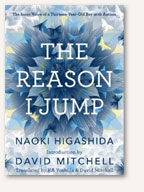
Book Cover: The Reason I JumpJon Stewart interviewed the translator for this book, and then continued to rave about this book in subsequent shows, so I figured I’d give it a shot. That the book itself exists is amazing: the thirteen-year-old author with autism answers questions that he frequently hears. It is a fascinating look into a viewpoint that is usually inaccessible, and I imagine it is an immeasurable benefit to those who interact with people with autism. For myself, I found it very interesting—it is a short book, but not a quick read, since I kept putting it down so I could think more about what Higashida was saying—but occasionally a bit repetitive, which makes me sound like the worst person ever, since that is clearly one of the traits of autism. I try to justify my criticism by saying that Higashida is so mature and perceptive that it is easy to forget that he is working with quite a severe handicap.

My only previous insight into autism was the sporadic postings by one of my favorite bloggers, Matthew Baldwin, aka Defective Yeti, on raising his autistic son. He hadn’t posted in several months, so I’d gotten out of the habit of checking, but this book reminded me to check back in, and it turned out he spent all of October posting each day about his son. His love and delight in his son are evident in each post and make the posts such a pleasure to read.

And, finally, while I’m bringing up blogs about interesting parenting situations, I ran across Gender Mom just about a month ago, and have been completely caught up in it ever since. Gender Mom’s five-year-old daughter was born male, but announced she was female at age three, and a year later they decided to raise her female. It is a truly fascinating look at a mother trying her best in fairly new territory.

—Anna

The Ocean at The End of the Lane

By Neil Gaiman

Book Cover: Ocean at the End of the LaneI have a bit of a love–hate relationship with Neil Gaiman. I loved the Sandman series, of course, and American Gods, and I hated his short story collection Smoke and Mirrors. All of his other stuff sort of falls between those two extremes, and The Ocean at The End of the Lane is pretty smack dab in the middle.

It is quite short, less than 200 pages; really more of a novella, despite “A Novel” being printed on the cover right under the title. And to go off on a side rant: I hate novellas! Somehow they are always both too long and too short. Like, authors write short stories to be compact and novels to be all-encompassing, but novellas pretty much always fail at both, and seem like initial outlines for a full novel. I almost always end up feeling like I’m reading an incomplete work and it has been a waste of my time. I then get sulky about the author being lazy, and bitter about the state of publishing, and it all cycles down from there, so novellas are not my thing.

So, I wasn’t too enthusiastic about this one, but I follow Neil Gaiman on twitter, and lots of people were raving about it. When I ran across it in the library, I figured I’d give it a shot, since I really did like American Gods and this seemed all fantastical, too.

It was okay. It starts off pretty slow, with the narrator reflecting back on the summer when he was seven, when a boarder in his house dies, kicking off a string of supernatural events. He meets his mysterious neighbors, a family of three-generational women including a girl just a few years older than him, and helps them try to contain the odd happenings. It all takes some time to get rolling, but by the middle, the story is quite engaging, though at times I felt it followed a very standard “yellow brick road” narrating style, as the two children walk a path into another reality, and must deal with one strange thing after another.

Gaiman does introduce some quite intriguing characters and imagery that simply don’t have the space to really grow to their full potential in such a short book. It ends up feeling a bit like Chis Van Allsburg’s The Mysteries of Harris Burdick, in which the readers must flesh out the story on their own, and it makes me bitter, having to put all this unexpected work into a story. I just told Tom that this review was circling the drain, and he commented that while I often talk about how much I like Gaiman, I don’t really like the majority of his work, so I guess maybe I’m not really a fan at all. Oh, well.

—Anna

The Coldest Girl in Coldtown

About this time last year, Anna reviewed a series of YA fantasy books by Holly Black that started out with White Cat. We both finished that trilogy this year, and really enjoyed them. So imagine how happy I was to see that Black released a new book this fall! It’s a YA book about a teenage girl who gets swept up into a whole adventure with vampires. Yes, another one of those. But this one is awesome, and rather than try to explain why by describing the plot, I’m going to list just a few of the ways this book is better than Twilight:

1) First and foremost, the main character, Tana, is the totally kickass opposite of Bella Swan. She takes care of herself and others and doesn’t particularly need saving. And it’s not that she’s a superhero–she’s terrified most of the time–but she sees things that need doing, so she just does them.

2) There is a bit of romance, which I like in my books, but it not the main point of the story. Also, it isn’t a love triangle. Why do books and movies so often involve love triangles, when my experience is that they are just not that common in real life?3) In this book, the public is aware of vampires, because although the old vampires had managed to keep themselves secret for years, they eventually lost control and it all came out and vampires ended up being celebrities. You know that if vampires were real they would be all over YouTube and People.

4) Being a vampire isn’t particularly romanticized here. There are characters that do glamorize it, but it’s actually presented a lot like fame: it might seem exciting, but the reality is not that much fun. The main character spends most of her time trying very hard to not become a vampire, which I found refreshing.

So, overall, a little gory, but very entertaining and way way way better than a lot of vampire stuff out there.

Kinsey’s (Approximately) Three Word Review: A fun, dark ride.

You might also like: Sunshine by Robin McKinley, which Anna already told you to read.

Wheel of the Infinite

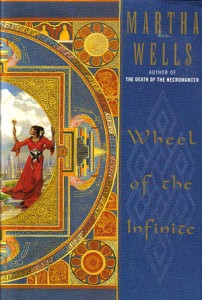
Wheel-of-the-InfiniteWheel of the Infinite
by Martha Wells
2000

Having thoroughly enjoyed The Books of the Raksura by Martha Wells, and going through a bit of withdrawal from reaching the end of the series, I checked out an older book of hers and am extremely glad I did so.

I love stories that involve gods and godlike powers and the difficulties faced by both the people who struggle against those powers with just human strength and the gods who struggle to avoid unintended consequences. (Some of my all-time favorite books deal with these issues:  Isle of the Dead by Roger Zelazny, Curse of Chalion by Lois McMaster Bujold, Nameless Magery by Delia Marshall Turner.)

The world-building here is amazing particularly as it comes to the rules of magic and religion, and we get it from two perspectives:

Maskelle is The Voice of the Adversary, a highly ranked priestess, but she was exiled (rightly so) for murder and treason some years back. She has been summoned back to the Imperial and religious center of the land by the request of the Celestial One to help regarding a problem with the Hundred Year Rite, in which the Wheel of the Infinite recreates the world. (A problem with the re-creation of the world is, rather obviously, quite a problem.) But she approaches the people and the magic with deep familiarity and deep discomfort given her past.

Rian is a bodyguard from a far distant land who ran away from an unpleasant situation, and manages to fall in with Maskelle on her return trip, and sees the political and religious situation with fresh eyes.

And that is the premise. From there, stuff happens: after all, there’s a problem with the ritual that recreates the world. Stuff. Happens. I love the exploration of the world that is inherent in our main characters’ investigation of what has happened.

In addition to the amazing world-building, I also just love the characters. Rian’s culture shock is somewhat hilarious (especially as it mirrors the reader’s own shock at this culture). And Maskelle’s deadpan practicality, even as she struggles with her own issues, is a delight.

Another thing I appreciated about this book was that Maskelle was middle-aged and black. The book is high fantasy, in an entirely different world, so clearly she’s not African or African-American, but she and her whole culture are dark-skinned and her hair is in braids.  Scifi and fantasy, for all their alien species, tends toward the homogenous white humans, in both writers and characters. (The one exception to this that I can think of off hand is Octavia Butler, but her books tend to be both excellent and extremely hard hitting. Wheel of the Infinite is readable purely for fun.)

The first chapter of Wheel of the Infinite is available online, so you can get a taste. I highly recommend this book.

The Girl You Left Behind

Back in the summer I raved about Me Before You by Jojo Moyes, and I have apparently become one of her groupies: she is delightful on Twitter and I’m here now to tell you to go read her new book. Like Me Before You, this latest one would be an excellent airplane book, and would be a great distraction for those of you about to embark on holiday travel.

The Girl You Left Behind is a little more intricate than Me Before You, with a narrative alternating between two story lines. The first story involves Sophie, a French woman in a small town occupied by the Germans during World War I. Her husband, a painter, has been sent to the front and all she has to remember him is a portrait he painted of her. But the portrait catches the eye of a German officer, and no good can possibly come of being too involved with the occupying soldiers. The second story line follows the painting to the current day, where it’s owned by Liv, a London woman with problems of her own. Her troubles get worse when the mystery of how the painting got from small-town 1917 France to modern-day London blows up in a very public way.

I have heard some critics of Me Before You say that is was predictable, and at times a little far-fetched. I think both those things are true and they’re true of this book, as well. I never know where any story is going, and I guessed pretty early into The Girl You Left Behind how the issue with the portrait would be resolved. But that doesn’t really matter in either book. The characters are so nicely drawn–complex and flawed, but sympathetic–and the stories move along at such a clip that both of these books are just very readable. And I mean that as a high compliment. I finished The Interestings by Meg Woltizer not long ago and while I was reading it I enjoyed it a lot and thought it was very well done. But the instant I closed the book each night I forgot all about it and lost all interest in picking it up again. I didn’t think about it when I wasn’t reading it, I didn’t long to get back to it, or feel the need to read “just one more chapter.” With The Girl You Left Behind, I stayed up until 1:00 in the morning on a Tuesday, desperate to find out what happened.

Also, both of Moyes’s books seem absolutely made to be turned into movies. I’m not sure what it is about them that make me think that–I’d be interested in hearing what other folks think makes a book seem ready for adaptation to the screen. But I think both of these stories would movies as compelling as the books are.

Kinsey’s Three Word Review: A sad, suspenseful page-turner.

You might also like: The Girl in Hyacinth Blue by Susan Vreeland, which also deals with a painting of mysterious provenance, or any of Tracy Chevalier’s novels about historical figures, including The Girl With the Pearl Earring.

Julian Kestrel Mystery Series

By Kate Ross

Book Cover: Cut to the QuickSo, I’ve been having a bit of a rough time over the last couple of weeks with some family medical issues, and as usual, I’ve turned to my main comfort, rereading old favorites. There is nothing quite so comforting as reading a book where you already know everything that happens, so you can give it as much or as little attention as you have to spare at any given time (highly recommended for waiting room waits). You already know the outcome, so there is no anxiety (you probably have enough of that in your actual life already).

All of this to say that I’ve just reread Cut to the Quick and A Broken Vessel, the first two in Kate Ross’ Julian Kestrel mystery series, and they were exactly right for my current mood. The protagonist, Julian Kestrel, is the epitome of a dandy in Regency-era London, focused entirely on his appearance and amusements until he is framed for the murder of a strange woman who appears at the country house in which he is attending the engagement party of a slight acquaintance. In order to clear himself and his valet, an extremely endearing former pickpocket named Dipper, he must uncover the true murderer among his host’s upper-crust family. The plot and characters of Cut to the Quick aren’t anything new in the extremely well-covered genre of Regency-era mysteries, but they are all just so well written that the book and the series really stands out.

Book Cover: A Broken VesselNow, A Broken Vessel is another matter entirely, introducing Dipper’s sister Sally, who shares narration of the book with Julian. Sally is clever, courageous, and a completely unrepentant prostitute, who has stolen a letter pleading for help from one of three men. Sally is wonderful, the mystery is even more intriguing than in Cut to the Quick, but the most interesting thing for me in A Broken Vessel is how it describes the various levels of society in Regency London, with the aristocracy at top, to their servants, to the shop and pub keepers, and finally to the dregs of the crime world, and how people either fall down those layers or claw their way up.

The series contains two additional books, which I read years ago, and haven’t reread yet, though I remember them both as being quite good as well. Our mother first introduced Rebecca and me to the series, and she had a theory on where Ross was taking Kestrel’s character, and we were eagerly awaiting to see if this proved true when unfortunately Ross died, and so no more books in the series will be forthcoming. This shouldn’t dissuade anyone from reading these, though: each book stands alone, plot-wise, though they occasionally refer back to previously introduced characters, and no book ends on a cliff-hanger. You’ll just be sad that there aren’t additional books to enjoy, but you can always just reread these four in times of need.

—Anna