Happy Halloween!

Happy Halloween, dear readers!

As a bit of terrifying Halloween fun, here’s a short online comic strip for you:

Bongcheon-Dong Ghost
written and illustrated by Horang

I ran across this several years ago (the link was messaged around my classroom at the time and you could tell who had clicked on it by the flinches and stifled shrieks) but all the text was in Korean. When I went looking for it again, I found it translated into English. It remains really well done.

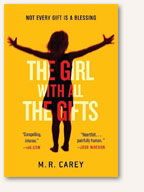
The Girl With All The Gifts

By M. R. Carey

Book CoverI’ve only paused in working my way through the Flavia de Luce series, which I’m continuing to love, because a reserve that I’d placed a while ago at the library finally came in. I hadn’t intended to find an appropriately spooky book for Halloween, either, but I guess things just aligned that way.

io9 gave The Girl With All The Gifts a raving but very coy review. Having read Carey’s other novels, I was willing to take the plunge on this one without more detail about the book itself. This novel has a similar setting as his others, of a dystopian London, but ratchets up the suspense significantly. This is due in large part to the truly excellent characters. I found some of Carey’s previous characters a little cartoony, but his characters here are very real. The novel shifts viewpoints between the various characters, so the reader gets wildly different perspectives on the same situation. Because there is no objective voice, I found my judgments of characters and situations constantly evolving.

The Girl With All The Gifts opens with a strange 10-year-old girl, locked in a small cell in an underground bunker, along with dozens of other children, who are delivered to and from a classroom each day under armed guard. This is all she (and the reader) knows, and while she doesn’t care for the guards, she loves her teacher and is not unhappy.

The book slowly expands from there, with the multiple perspectives helping the reader put the pieces together, which is half the fun, so I certainly don’t want to spoil it here.

In lieu of a longer book description, here’s another Halloween recommendation. I decided that I couldn’t stomach another season of American Horror Story, so to fill the void, I decided to watch HBO’s Carnivale, which I’ve been meaning to watch for years. And it is exactly what I wanted: suspenseful and creepy without being gross. Also, I was congratulating myself on being so smart to recognize all the religious symbolism in the first episode, before I saw how heavy they were hitting in the second episode, so there’s that.

—Anna

Spooky Graphic Novels

In honor of the approaching Halloween, I’ve been reading some extremely good graphic novels, that seemed seasonally appropriate. Although possibly more thematic to a more traditional concept of All Hallow’s Eve than to the modern concept of Halloween, per se. This is a time when the barriers between the living and the dead are the weakest and who knows what could be roaming the streets… you’d better prepare to be scary, too, to fit in.

Anyway, the artwork for all three of these are just gorgeous, which can possibly go without mention, since I don’t read graphic novels if I don’t like the art. But still, the art is really gorgeous.

East of West
written by Jonathan Hickman
drawn by Nick Dragotta

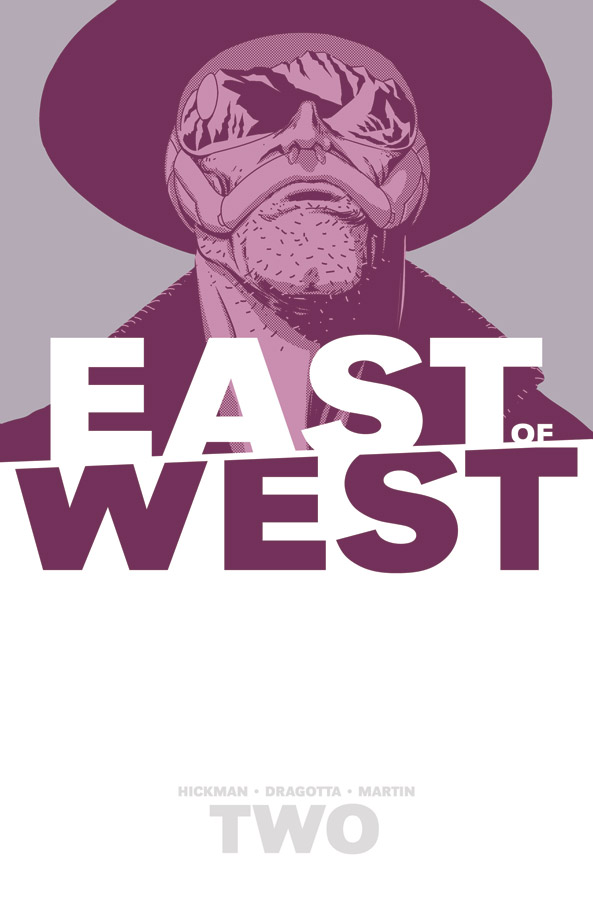
200px-East_of_West  east-of-west-vol02  East of West 3

This is a futuristic western based on an alternate past with a whole lot of mystical beings thrown in for good measure. I love it.

One of the main characters is Death. The three other horsemen of the apocalypse are also wandering around, and there’s some sort of evil prophesy that a scary number of the world leaders are fanatical believers of. No one is really good or nice in this, by they’re all really dedicated to their various (and generally conflicting) causes. And there’s something very appealing about competency, good or evil, and something fascinating about manipulative people attempting to manipulate each other.

The back sums it up well:

“We would tell you to pray. But it wouldn’t do any good. You have earned what is coming to you.”

Anna gave the first one of these to me for Christmas last year and then I bought the second one for myself last month, and the third one has just been released a couple of days ago but I haven’t gotten it yet. I’m still going to review this whole series as awesome.


Pretty Deadly
written by Kelly Sue Deconnick
drawn by Emma Rios

PrettyDeadly_Vol1-1

This is another mystical western, although minus the science fiction aspect of East of West. Instead, the whole story has a surreal quality as it is structured as a fairytale told by a bunny (or rather the skeleton of one) to a butterfly (who might be part of death’s daughter) and there are stories within stories. I still need to read it again (probably a few more times) to really track down who all is who and what their intents are, but it’s fascinating. It’s also a complete story, which is nice. There are plenty of other characters who can be developed in the next volume, whenever it comes out (and that I’m looking forward to getting when it does), but the main plot arc following the girl in the vulture cloak is resolved at the end of this volume, and thus ends the story told by bunny to butterfly.


Peculia and the Groon Grove Vampires
by Richard Sala

Peculia

This is a stand-alone single story, and a much quicker read than the others. The story-line is extremely straight-forward without any real surprises. The plot-line sort of reminds me of a Nancy Drew story, although with even fewer surprises. In that way, it seems like something for a fairly young reader.

On the other hand, a lot of characters die, some in relatively gruesome ways. The focus on the gruesome deaths is actually the opposite of gratuitous, though. They’re shown quickly and casually and it all comes across as fairly light. It reminds me of the some of the older Grimm’s fairytales where, say, children push witches into ovens and then go home to celebrate with their families. So, you know, maybe it is intended for youngish children, but cheerfully bloody-minded young children.

And me, too, because I liked it a lot.

The art is also interesting in the way it’s all in black and white, with the appearance of woodprints.
Halloween ComicFest

ComicFest 2014I did not know this was a thing until yesterday evening, but now I’m all pumped to go tomorrow: apparently, in addition to Free Comic Book Day in May, comic stores have Halloween ComicFest, where they offer free Halloween-themed comics! I don’t actually have anything to add to that: Halloween! Free comic books! (Okay, I’ll add two things: one of the free comics is done by Terry Moore, who did (does?) Strangers in Paradise, and one is done by Loeb and Sale, the team that created Batman: The Long Halloween, both series I’ve very much enjoyed.)

2-sentence horror stories

In honor of approaching Halloween, I present you with some short horror stories.

The background is: about a year ago, a Reddit user asked “What is the best horror story you can come up with in two sentences?” The response was tremendous and there are currently 3397 comments in that chain (admittedly, a lot of them are responses to the responses, so there are fewer than 3K stories, but still.)

To see nine of them, nicely formatted, go here.

To see all of them, with the original formatting, go here.

Warning: these really are terrifying. Oof. Who needs sleep anyway?

Bellweather Rhapsody

I’ve talked before about how I like reading seasonal books–scary things at Halloween, spring-time-ish books as winter is ending–and I think Bellweather Rhapsody by Kate Racculia would be an excellent addition to an autumn/winter reading list. It’s creepy, sort of dark, and definitely wintery–the kind of book that makes you want to wrap up in a blanket with a cup of hot chocolate.

The story takes place over a few days in the Bellweather, an once glorious but now shabby upstate New York that is hosting a high school all-state band event. Over-achieving teenagers, their tired chaperones, ambitious conductors, and harried hotel staff are already bracing for the event when things get derailed by a blizzard and the mysterious disappearance of a student. Hanging over this is all is the hotel’s past–it was once the site of a tragic murder-suicide where a bride killed her new husband and herself on her wedding day.  Rather than seeing all this from one point of view, the action is narrated by a whole list of characters including, but not limited to, twin high school student named Alice and Rabbit Hatmaker who each have their own talents and secrets, their music teacher who has a complicated past of her own, the hotel caretaker who cannot quite believe what is happening to his beloved Bellweather, and a guest who has come to the hotel to face her demons.

Racculia manages a neat balance in that the book feels big and sprawling with all the character threads weaving in and out, but at the same time has a sense of claustrophobia as everyone is trapped in this one old hotel that does not feel particularly welcoming. But this isn’t a horror novel, as much as the trapped-in-a-hotel piece makes it sound like The Shining, and it’s not a traditional mystery, even if the central question of the book is what happened to the disappeared student. Instead, it felt more like reading a modern Dickens novel. Characters and back stories and coincidences and problems kept piling up and up and I kept getting more nervous, trying to figure out how it was all going to resolve. But I did find the ultimate ending gratifying, maybe because I was surprised by the outcomes of many of the characters–narrators I thought were reliable turned out not be, people I initially hated started to endear themselves to me, someone I was desperately worried about pulled herself through and out the other side, that sort of thing.

It’s not exactly heartwarming, and it’s not exactly funny, and it’s not exactly scary, but it sure made me want to keep reading to figure out how it was all going to end.

Kinsey’s Three Word Review: Quirky, creepy, and satisfying.

You might also like:
This reminded me of Skippy Dies and The Lonely Polygamist, although Bellweather Rhapsody is kinder than either of those. But more than anything else, this made me think of Fargo–both the original movie and the recent TV series adaptation. They all share something in the matter-of-fact way that bizarre people and things are presented.

The Flavia de Luce Series

By Alan Bradley

I read a recommendation for Alan Bradley’s Flavia de Luce mystery series online and was intrigued by the idea of an 11-year-old girl detective in a small British town in the 1950s (seriously, who wouldn’t be?). Reading some background on the series before diving in, I also learned that the author wrote his first book, the first in this series, at the age of 70, which is just very encouraging to people who haven’t quite found the time to pursue their passion yet. Of course, he’s had to spend years now answering why a 70-year-old man chose an 11-year-old girl as his protagonist, which has got to get a little tiresome, but I thought his answer was a good one: he wanted his protagonist to be someone who is almost invisible in society, so is able to go unnoticed in pretty much every situation.

Book Cover: The Sweetness at the Bottom of the PieAnyway, I started with the first book, The Sweetness at the Bottom of the Pie (I love his titles), and it was an utter delight! The mystery is a little obvious, but I was much more willing to forgive Flavia for not putting the pieces together much sooner, especially since a great deal of her time is spent trying to disrupt her family whenever possible. Her family consists of her emotionally distant widowed father and two older sisters banging around in their centuries-old ancestral home, and it is just classic British flakiness.

The author is maybe a little heavy with the similes at times, but though it sometimes distracted me, it was inoffensive overall. A sign of my advancing age may be that I often sympathized with the poor inspector who was just trying to solve a somewhat unpleasant murder and everywhere he turns, there’s a small girl underfoot, certainly quite bright, but still a very young child nonetheless. I struggle a bit to describe how well I think the author describes Flavia’s brilliance while also keeping her clearly quite young.

The second book, The Weed That Strings the Hangman’s Bag (seriously, such fun titles!), however, has a passage in it that I think really showcases the balance and which I particularly loved. I’m including it after a page cut, not because it has spoilers (though it does spoil Madame Bovary, so take that caution I guess), but so that it doesn’t fill up the entire home page: Continue reading

Suddenly Last Summer

By Tennessee Williams

So, I watched “Suddenly Last Summer” the other night – I’d been meaning to watch it for a while because what a cast! Katherine Hepburn! Liz Taylor! Montgomery Clift! Also, what a plot – psychosis, lobotomies, and cannibals! I had no idea how all of this could fit into one two-hour movie, and I’m still not entirely sure, actually.

My first impression (spoiling the big reveal, but you’ve had over half a century to check this one out) was that this was one of the most homophobic movies I’ve ever seen, but then I was confused because the original play was written by Tennessee Williams, who was openly gay himself, and though he clearly had a wide variety of issues, I never thought his sexuality to be one of them. (It turns out I may have been wrong about this, actually.)

There was another, subtler theme of gods and sacrifices running through the play, though, and I wondered if that was more prominent in the original version, and a homophobic Hollywood played up the homosexual angle instead. All of this to say that I checked out the one-act play to see for myself.

So, I remain a bit confused. It is not wildly different from the movie. The first part is pretty much a monologue by the mother (Katherine Hepburn’s character), and it showcases Williams’ trademark Southern mother – overbearing, out of touch, and clinging to old-fashioned social mannerisms. There are some hints that Williams is also criticizing some artifice in the gay lifestyles of the time, though I haven’t gotten to the worst part yet (the end). The lobotomy aspect was rolled out a bit more subtly than in the movie (which wouldn’t have been difficult, since the movie opens on a lobotomy procedure), and is more conflicted about the process than the movie projected (the adulation of the lobotomizing doctor in the movie made me a little uncomfortable, as well).

The second part is mostly a long monologue by the cousin (played by Elizabeth Taylor), and this is where the most problematic parts of the movie come in, with her exposing her cousin’s homosexual and promiscuous lifestyle and how it ultimately lead to his downfall. In the end, I guess I would say that the movie switches the priority of themes from the book; the theme of a sacrifice-demanding god is somewhat more prominent than homosexuality in the written play. Though because the play is really just two monologues strung together by a bare minimum of structure, I would say that this is more of philosophical and/or psychological study than anything else, really. I’m still somewhat baffled by it all, but after doing some brief online research, it looks like I’m in good company; this play is still quite the cinematic controversy. (Also, the contemporary review of the file is a hilarious panning!)


Mike Mignola Graphic Novels

Mike Mignola is most well known as the creator of the Hellboy series, which I find a little too silly for me. However, I really admire the artist that partners with him on the inside pages (Mignola himself illustrates most of the covers and I like his style, too). So, I was interested in checking out some of his non-Hellboy work. I previously read, hugely enjoyed, and reviewed Baltimore Volume 1: The Plague Ships here, and just recently remembered to track down the now-released sequels.

Book CoverBaltimore Volume 2: The Curse Bells

This volume goes a bit darker than the previous one, exploring how men can become monsters themselves through their obsessions. I found it gripping, but not exactly pleasant to read. What I did enjoy, though, was that the story expands more on the alternate history of this world, confirming that it is set just barely post-WWI, with foreshadowing of WWII. It also has vampire nuns.

Book CoverBaltimore Volume 3: A Passing Stranger and Other Stories

I was a little hesitant over this one because short stories can go either way, but I really liked it. Mignola uses the shorts to really focus on the characters themselves. We get backstory on two main villains from both previous volumes, and quite a nice look at Baltimore’s struggle to stay moral in his own obsessive quest. It made some of the ickiness from volume 2 more palatable.

Book CoverThe Amazing Screw-on Head and Other Curious Objects

This book is very odd. I believe it is really just Mignola playing around with stories and drawings that he knows won’t hold up to a full graphic novel treatment, but he is so successful that the publisher figured fans would probably be entertained. I would agree, too, that this is probably just for the true fans that want a comprehensive collection of Mignola’s works. The titular Amazing Screw-On Head is literally a sentient head that can be screwed onto a variety of mechanical bodies and does sort of vague battle in service of President Lincoln. Even the backpage blurb didn’t seem quite what to make of it: “If you read only one comic about severed robot heads fighting…I dunno, some damn thing or the other at Abraham Lincoln’s behest, that comic should be The Amazing Screw-On Head.” —Comic Book Resources.

I will say that my favorite vignette in the collection was The Magician and the Snake, written by Mignola’s seven-year-old daughter. It was no less cohesive a story than the rest, and had a very charming description of love and friendship that continues even after death. So, I guess what I am saying is I can take or leave Mike Mignola on this book, but I quite recommend Katie Mignola.

Book CoverWitchFinder: In the Service of Angels

Mignola is back to what I like best: supernatural period pieces. WitchFinder features Sir Edward Grey, recently knighted by Queen Victoria for hush-hush deeds done in service of the crown. In this volume, though, he is tracking a demon brought out of the excavation of an ancient Egyptian tomb and made corporeal in London.

It has a similar feel to Baltimore, though a different historical period and Grey is different enough in character (not quite as hardened and still able to be smitten by a comely medium) that it is not simply a retread. The illustrations are lovely, as usual, and the story interesting, but the pacing was a bit slow. It ends a bit abruptly with only partial resolution, and though there is a second volume out, I’m not sure I’m going to follow up with it. (Except, that upon further research, i.e. amazon description, the second volume takes place in the American West and I love a wild west story.)

—Anna

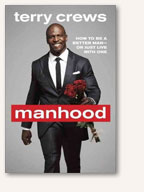
Manhood: How to Be a Better Man – Or Just Live with One

By Terry Crews

Book CoverI’ve been a fan of Terry Crews since I first saw him as the dad on “Everybody Hates Chris.” In fact, he did such a good job of inhabiting the overworked and often exhausted character that I was surprised to learn later that he is a body builder and ex football player. When I heard him interviewed on NPR in promotion of his autobiography/guidance book, he was just so charming that I was immediately interested in the book.

His writing is as humorous as his acting, but what really surprised me was his complete openness and honesty. He is upfront and unflinching when examining truly vulnerable things in his life, like what caused him to wet the bed until he was fourteen, and what led to a decades-long addiction to pornography that he only recently got help for. The real eye-opener for me, as a woman, was his discussion of the stresses that our culture puts on men. Because being scared or sad is considered weak in a man, he felt like his only outlets for these emotions were anger and aggression.

Crews writes with a sincerity that occasionally came across as oddly childish to me, and then he’d catch me off guard with something really funny in exactly the same tone, and I’d wonder, “does he even realize that he’s being funny?” But, of course he does; he’s a master comedian.

Some additional take-aways:

  • The NFL is crazy dysfunctional. Like, take every horrible work story you’ve ever heard and bundle them all up into one entity, and it would be the NFL.
  • Terry Crews has had to pull himself up by his bootstraps a shocking number of times. Every time I thought “oh, this is where his success began,” it would all crumble and he would have to start over again from scratch.
  • The person who most deserves to reap the rewards of Crews’ current success is his unbelievably patient and supportive wife of over 20 years.

To end this review on a more superficial note, I think the cover designer did Crews a real disservice. I was a bit embarrassed carrying it around in public, so I can’t imagine that the young men who could really benefit from his advice would love to be seen with it.

—Anna