Books You Already Knew I Was Going To Tell You To Read

I was on the road quite a bit in December and read a whole pile of books I enjoyed. But none of them quite seemed to warrant their own review, since none of them are going to come as a surprise to anyone who’s spent any time here. So a list seems appropriate, so I get to mention a few things that I heartily, if predictably, recommend:

1) Landline by Rainbow Rowell. I saw Rainbow Rowell speak in person earlier this fall, and that woman is made up entirely of curly hair and charisma, and the stories she told about writing this book had the audience literally screaming with laughter. This is no Eleanor and Park, but I’m not sure my heart could handle another one of those, so this story about a marriage and a magic telephone will do just fine.

2) Dreams of God and Monsters by Laini Taylor. Quite a while back on the blog I mentioned the first book in this trilogy, Daughter of Smoke and Bone. That book was your fairly standard YA, magical realism, independent female narrator, star-crossed lover sort of story. And then book two, man, book two took a turn. It got dark and weird and tragic and bloody, and I actually put off starting the third one for months because I was scared of where things might go. But I ended up really liking how the story resolved, and I promise you, you have not read anything like this.

3) One Plus One by Jojo Moyes. I’ve already raved about Me Before You and The Girl You Left Behind, so it shouldn’t be any surprise that Moyes’s latest was equally heart lifting/breaking. (Note, because I know my readers: don’t worry too much about the dog. It will work out.)

4) The Secret Place by Tana French. This wasn’t my favorite of the Dublin Murder Squad novels–that would be The Likeness–but it was a compelling read. While the plot and mystery of this one didn’t grab me the way some of them have, it still delivered on the two things I think Tana French does best–unsympathetic but fascinating characters, and a romance-free vision of modern-day Ireland.

All Seated on the Ground

By Connie Willis

Years ago, author Connie Willis released a collection of delightful Christmas-themed scifi stories called Miracle. The two best stores are considered annual reading in my family: one is about a woman who gets “haunted” by a Christmas spirit that insists on granting her heart’s desire; the other is about an invasion of puppet-master type aliens during Christmastime. My extremely brief summaries here do not at all capture how funny these two stories are, which is what makes them so wonderful (not all the stories in the book are funny, and be warned, when Connie Willis goes serious, she goes very serious indeed.).

Then, in 2011, Willis released the novella “All Seated on Ground,” which I put off reading due to my dislike of novellas (they always seem both too short and too long), even though it sounded like it recaptures the tone from her earlier Christmas stories. Unfortunately, I felt that it recaptured her earlier writing a little too much, becoming a bit of a retread. Once again, aliens have come to earth, but in this scenario, they have landed and then proceeded to stand around, saying nothing but glaring disapprovingly, while an array of academics and politicians attempt to communicate with them. This has been going o for nine months until just before Christmas, when they react to something for the first time by promptly sitting down upon hearing the line “all seated on the ground” in a Christmas carol.

The novella then follows the rush to determine what they are reacting to and what their reaction is trying to communicate. I love the idea of having to deal with disapproving aliens on top of all the other holiday stresses, but the implementation was just so similar to some of Willis’ other stories that while it was still quite funny, it was just not as surprisingly funny as some of her earlier work.

—Anna

P.S. – In case you are looking for a quick holiday-themed distraction at work, may I recommend Cracked’s “6 Things People Get Wrong About the Bible’s Christmas Story”? This line made me snort on the metro: “It wasn’t until the Middle Ages that the magi began to be described as kings, largely to make the New Testament story better match the Old Testament messiah prophecies, and probably because ‘kings’ sounded better than ‘magical spice perverts’.”

Lean In: Women, Work, and the Will to Lead

By Sheryl Sandberg

Book Cover: Lean InSo, clearly, there has been a ton of buzz about this book, which tends to turn me off a bit, but when it came up at Rebecca’s work, we decided to bite the bullet and read it (I just beat her to it here on the blog). I entered with super low expectations—I had imagined some sort of 80’s powersuit, dog-eat-dog type of guide—but I have to admit that I very quickly changed my mind.

After reading the introduction, where Sandberg directly addresses how complicated and potentially problematic it can be to try to give blanket professional advice to women across all lifestyle choices and financial situations, I thought, okay, this might not be so bad. After the first couple chapters, I started to find points relevant to my own work behavior, and by a third of the way through, I was completely sold on Sandberg.

Now, I did have to tailor the advice to my own situation, of course. I am not a particularly aggressive or ambitious person, pretty much directly opposite to Sandberg herself, but one of the most important take-aways for me was guidance on how to work with aggressive and ambitious people (especially being vigilant about not letting cultural indoctrination lead me to react poorly to women in particular being this way).

So, I guess I’m just jumping on the very crowded bandwagon to say that this book is both a worthwhile read and actually a pretty entertaining one, as well. (In the acknowledgments page, she thanks her editor “who never heard an anecdote that couldn’t be expanded on” and I’d like to extend my thanks to her, too, since I love a good anecdote!) So even if you don’t think it is your type of book, you may very well enjoy it.

—Anna

Marat/Sade

The Persecution and Assassination of Jean-Paul Marat as Performed by the Inmates of the Asylum of Charenton Under the Direction of the Marquis de Sade

A Play by Peter Weiss

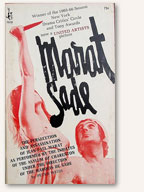
Book Cover: Marat/SadeI’d heard of this play years ago, and not to put too fine a point on it, it sounds like a complete clusterfuck, and I have been curious about it ever since.

The premise is based on the historical facts that Marat was assassinated during the French Revolution in 1793, that Sade participated in the revolution and even made the memorial address at Marat’s funeral, and that Sade later put on plays with the other inmates during his internment in Charenton Asylum from 1801-1814.

In this fictionalization, Sade is producing a play about the assassination of Marat, casting the various other asylum inmates. It is quite short, just two acts that together are just 102 pages, and it starts off surprisingly funny, with sort of slapstick humor around the extremely amateur production. I was pleasantly surprised, and thus lured quite capably into the subsequent ugliness surrounding the French Revolution and Sade’s personal philosophies.

Both the revolution and Sade committed horrific atrocities, though they came from opposite justifications: the French Revolution declaring that some violence must be committed for the improvement of society (so, basically, a regrettable side effect in the search for good), and Sade declaring that the only way to understand the human condition is to explore the very worst of it (the search for evil as humanity’s defining feature). This basic disagreement is explored through debates between Marat and Sade that appear to happen outside the play-within-the-play, and possibly only occur in Sade’s head.

The back blurb advertises that “It is total theatre: philosophically problematic, visually terrifying…. The play is basically concerned with the problem of revolution. Are the same things true for the masses and for their leaders? And where, in modern times, lie the borderlines of sanity?” My main take-away, however, was to wonder how much of the political and philosophical grandstanding by Marat and Sade was purely self-serving to justify their own personal indulgences. Sade likes to rape and torture, but he wants to see himself as something greater than just a violent sociopath, so he claims that all of humanity has these same urges, but only he has the courage to explore them honestly. And, though I am more sympathetic to Marat’s ambitions, he clings to his ideal of how the revolution will be played out, with himself as the people’s savior, and any deviation from that is treason and must be eradicated violently and completely.

I would pay quite a bit to see this live, actually – the descriptions of the sets, with a rudimentary stage and props within an asylum, the inclusion of a four-person chorus to punctuate points throughout the play, and the wide variety of players, often wandering on their own would make it quite the spectacle. (I would also like to see the movie from 1967, but the library doesn’t have it, and I don’t want to swing $38 for it, which is amazon’s very cheapest offer.)

—Anna

I, Lucifer

By Glen Duncan

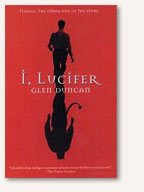
Book CoverI actually first ran across the album of the same name by The Real Tuesday Weld several years ago, which quickly became one of my favorites, but even after I found out the album was inspired by this novel, I hesitated to read it because what if I hated it and then couldn’t enjoy the album as much?

However, it was then recommended by a commenter on io9, where I’ve gotten quite a few good book recommendations recently, so I decided to take the plunge. I figured it might be similar to Good Omens.

It isn’t really. It is darker and nastier, which, I mean, makes sense, given we are talking about Lucifer here, but most modern personifications of the Devil as protagonist aim for something a little more sympathetic.

The very basic premise is that God is willing to welcome Lucifer back into Heaven on condition that he lives out a human lifespan in a human body, without committing any mortal sins. Lucifer narrates this ordeal, and is deeply unlikable—his narration is a manic flow interrupted often by praises of sex, violence, abuse and torture. I mean, it is a good job of personifying the Devil, but it was a pain to read at times.

What really surprised me, though, was the more nuanced discussion of the somewhat problematic aspects of religion, like the balance between freewill and predetermination, an omniscient being having an adversary, and Good begetting Evil. It was disconcerting to end a paragraph about bestiality and rape jokes, and start the next one on the deeper meaning of life.

So, this is a little embarrassing to admit, but in the end, I, Lucifer, a memoir of sorts by Satan himself, talked about religion, faith, and devotion in a way that really resonated with me. I realize that this does not speak highly of me.

There is a particular line in which Lucifer scoffs at his previous life as an angel in Heaven: “He turned a side of Himself to us and from it poured an ocean of love in which we sported and splashed like orgasmic kippers, singing our response in flawless a cappella.” And I thought, if Heaven is like being a fish in an ocean of love, surrounded on all sides with love, even breathing love into your body and circulating it throughout so that there is nothing but love and warmth and light in your entire existence, well, that would be pretty nice, I think.

And if you were created in this environment and had experienced only that, ripping yourself free would leave you so wholly cold and empty and hungry, that it would be little surprise that your existence outside of God would be pure torture and the crazed search for something, anything, to fill that void.

So, in the end, I’ve been happily listening to The Real Tuesday Weld’s album all week, so no harm done, and I will say that the odd, vaudeville-style song in the beginning called “Bathtime in Clerkenwell” makes a lot more sense now.

—Anna

P.S. This book actually complements Rebecca’s Biblical reviews quite well. Lucifer has a lot of the same complaints that Rebecca has brought up, particularly about God “not playing fair” when He hardens various people’s hearts so that He can smote them all the harder later.

Bible: illustrations

So it’s probably pretty obvious that I’m falling behind in my year schedule for reading the Bible. I will excuse it because a) this has proven to be a remarkably difficult year, and b) the Bible is really amazingly dense.

However, I just ran across some pretty awesome biblical artwork that I want to share:

Photographer James C. Lewis noticed that while the bible is set in the Middle East and Africa, most of the illustrations of the people involved look really northern European. So he decided to fix that:

What Would Characters From The Bible Really Look Like? Here’s One Photographer’s Idea (The Huffington Post article shows 10 of the photographs)

An antidote to lily-white Bible characters (The Church Times article shows 14 of the photographs)

A Tumblr post (shows 51 of the photographs)

I’ll also take this opportunity (despite not having gotten anywhere near the New Testament yet) to reflect back on a really gorgeous painting by Janet McKenzie, “Jesus of the People”, which won the 1999 National Catholic Reporter’s competition for a new image of Jesus, judged Sister Wendy Beckett.

How To Cook a Wolf

I can’t remember why I requested How to Cook a Wolf from the library. It must have been recommended online somewhere and I’m sure that the kick-ass title caught my eye, but by the time it came around on my library holds list all I could remember is that it was about cooking during World War II. And I guess you could describe it that way, but that summary really does a disservice to an entertaining, funny, and thoughtful book. No interest in cooking or history is required here–the writing is enough.

MFK Fisher was one of America’s premier food writers (and was also, based on the portrait on the front of the edition I read, a stone fox) was published in 1942, right as food rationing was kicking in, in order to offer readers advice about how to make the best of their meals during the war years. However, she never mentions the war directly, talking instead about how cooks can work to keep away the wolf of poverty, always sniffing at the door. As a result, the book has a timeless feel–she could be talking about about any hard times that stretch to the kitchen, and a lot of her suggestions fit remarkably well into out post-recession world. Especially since the book is not so much about the specific how-to-cook-things instructions, but is more about a philosophy or a way of approaching food that is frugal and reasonable, but also hopeful. So her chapters are called things like How to Rise Up Like New Bread, How to Be Cheerful Though Starving, and How to Comfort Sorrow.

There are recipes involved here and you could definitely cook from this book, although I suspect that the dishes Fisher describes are made for the palates of a previous generation (she wants you to add tomato juice to A LOT of things that I don’t think should have tomato juice anywhere near them). But even when she is talking about specific dishes, her writing reminds you that food is not just about the ingredients, but that it speaks to how we feel about ourselves and about life. For example, before offering her minestrone recipe, she says, “Probably the most satisfying soup in the world for people who are hungry, as well as for those who are tired or worried or cross or in debt or in a moderate amount of pain or in love or in robust health or in any kind of business huggermuggery, is minestrone.” And some of the recipes sounded pretty good–I was tempted by something she recalled from her childhood as War Cake, and at least one blogger out there made this with great success.

The other awesome thing about the edition of the book I read is that it was a re-release from the 1950s, and Fisher had gone back through and added notes throughout the book either agreeing with her original statements or offering an updated perspective. Here’s an example from the How Not To Boil an Egg chapter:

“Probably one of the most private things in the world is an egg until it is broken.

Until then you would think its secrets are its own, hidden behind the impassive beautiful curvings of its shell, white or brown or speckled. It emerges full-formed, almost painlessly {The egg may not be bothered, but nine years and two daughters after writing this I wonder somewhat more about the hen. I wrote, perhaps, too glibly.} from the hen.”

I think I would have liked having cocktails with her. Anyway, it’s a quick read and it’s quite funny, while also reminding the reader how different things were not all that long ago, and that there are likely still tough times to weather ahead. Also, if you would like the read a sexist but otherwise entertaining original 1942 review of How to Cook a Wolf from the New York Times, you can find that here.


Kinsey’s Three Word Review:
Wonderful historical snapshot.

You might also like:
For more great food writing, you can check out Julia Child (obviously and forever) or Ruth Reichl. But if you’d like to read some fiction of the era with a similar voice, try the Mitfords or Barbara Pym.

Habibi

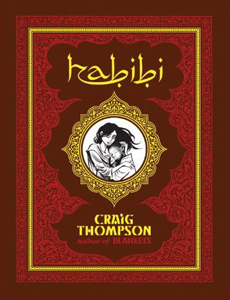
HabibiCoverHabibi
by Craig Thompson
2011

Wow. This is a graphic novel that really earns both of those words: it’s definitely a novel, and it’s definitely graphic (in every sense of the word.) It is most definitely not a comic book.

I’d noticed this book in passing for a while now, because it’s beautifully bound and the illustrations are gorgeous. Just, it’s a really beautiful book. It also has an obvious theme of exploring religion, which is something I often enjoy. On the other hand, it was struck me as trying really hard to be high literature by means of showing a life fraught with hardship, pain and suffering, and yet perseverance through it all.

Then I found myself waiting for a couple of hours in a library for which I didn’t have a library card. So I settled down to read this. And sure enough, I was absolutely right.

It shows a grim world filled with caricatures of characters who still have a bit of individuality to bring them to life and make them interesting. It’s really obviously trying very hard, and yet it largely succeeds in being that story about strength of will and perseverance and the times when there are no good options and so you just carry on. The characters are heartbreaking.

It makes me think of the story of Scheherazade, the narrator of the 1,001 Arabian Nights, and think of what her life must have really been like. After all, she was literally telling stories to preserve her life. (The main character also retells some of Scheherazade’s stories.)

It also reminds me of Caravan by Dorothy Gilman, a book I enjoyed a great deal but was possibly the first book I read in which it was clear that neither the main character nor the love interest were going to be protected by their status as the main characters of the book.

Bad things happen. A lot. And are, with one notable exception, shown rather explicitly.

It is not my particular kind of book, for all that it is just really, really beautifully drawn and bound. After reading half of it while waiting at the library, I got up and walked away when my class started. But when I saw it again at my local library, I thought, you know, let’s carry on. So I checked it out and read the rest.

It joins the ranks of books that I’m impressed with, proud that I’ve read, but feel no particular urge to re-read or own.

The Bible: Samuel 1

With all the horrible things that happen in the bible, it’s been easy to forget how funny it is sometimes. I find myself chortling a bit.

In chapter 3, young Samuel is dedicated to the temple and is very devoted in his duties to the elderly priest Eli. Samuel is still quite young when God first reaches out to make him a prophet.

One night, God calls to him: “Samuel.”

And Samuel leaps out of bed and to Eli’s bedside: “I am here! You have summoned me!”

And Elis says, “No, I didn’t. Go back to bed and get some sleep.”

So Samuel goes back to bed, but then God calls out to him again, “Samuel.”

And Samuel leaps up and to Eli’s side, and once more Eli sends him back to bed.

The third time, though, God calls, Samuel goes to Eli, Eli (who is in his nineties at this point and dealing with an eager young devotee “realizes” what must be happening and tells Samuel: “It must be God calling you. So next time you hear someone call your name, stay in bed, and say, “I hear you, Lord! I am listening.” And then you can tell me all about it in the morning.”

😀

This works admirably.

And so God talks to Samuel and tells him that something big is going to happen soon.

The Lord said to Samuel, “See, I am about to do something in Israel that will make both ears of anyone who hears of it tingle.” — Samuel 3:11

“… make both ears of anyone who hears of it tingle.” That just… hee! There are bound to be some parts of the bible that get a bit mixed up in translation, but there’s only so far off it can be.

😀

In chapter 8, the people of Israel offend God by asking for a king. Samuel is an elderly priest by this point, and tries to convince them against this (his arguments come down to the idea that God is their king and is offended that they would want anyone else; their arguments come from wanting an actual physical person who can do people things like interact with people who are not the head priest.) God is offended, but does the passive aggressive thing where he’s, like, oh, I’ll show you, I’ll give you what you’ve asked for and then you’ll see how wrong it all goes!

So this does not speak well of the future king, and you’ll notice that while the people are demanding a king, none of them are exactly volunteering for the position. And thus along comes Saul, in chapter 9, who’s searching for a pair of goats who wandered away from the herd. In chapter 10, Samuel waylays poor Saul, strong arms him into having dinner with him, and then anoints him the new king of Israel.

Afterwards Saul sneaks off, gets his goats, and returns home hoping to never speak of these events again.

😀

It doesn’t really work, though, and in chapter 11, Saul is forced to take up the kingship in a more practical sense, ie, raising an army and defeating the enemies of Israel.

Chapter 14 is pretty hilarious too, not so much intrinsically as because I recognize the storyline from Tamora Pierce’s Alanna: The First Adventure, right down to it being Prince Jonathan who disobeys his father the king to cross a battle line. I’m not sure if it would be funnier if it was pure coincidence or if Pierce was inspired by this.

😀

Anyway, there are more battles after that and much hewing of various people, and David the shepherd is introduced and has his infamous battle with Goliath in chapter 17.

Then seriously, the rest of the book starts reading like a somewhat more developed version of Wiley Coyote and the Road Runner. David gains much renown and Saul becomes jealous and tries to kill him. But David is too clever to be caught and is always running away just out of reach, and occasionally counting coup back on Saul but never makes a serious attack.

Samuel dies at the beginning of chapter 25 (out of 31) of Samuel 1, which is particularly odd because there’s whole second book of Samuel. But the death of Samuel does not stop the somewhat ludicrous chases and ambushes attempted by Saul on David.

There’s still battles against external enemies though (ie, the original inhabitants of the land) and thus both Saul and his armies and David and his roving band of dissidents are having battles with other people. Ultimately, though, David is favored by God and is victorious; Saul is the poor schmuck who was coerced into fulfilling the role of king and thus offending God even in his obedience to God, and thus dies along with all of his sons. (Poor Prince Jonathan!)

And with the death of Samuel ages ago, and Saul more recently, apparently Samuel 2 will be all about David?

Summary: This is kind of a somewhat black slapstick comedy of war and religion and conflict. Samuel is an adorable kid, Saul just wanted to get his goats, and David is the Road Runner.

Moral: Stay away from priests: they can con you into getting a bit too close to God.

Next up: Samuel 2

Mermaid in Chelsea Creek

By Michelle Tea

Book CoverWhew, this is a good book. This is how good it is – I actually started reading slower at the end to stretch it out longer.

Mermaid in Chelsea Creek is basically my favorite kind of book: metaphorical fairytale. And it is a fairy tale, but kind of a grimy one, if that makes sense. Thirteen-year-old Sophie starts getting visions of a mermaid who tells her that she is destined to save the world. Sophie, however, is your average young teenager, cranky, stubborn, and self-centered, trying to figure out her place in the world and her relationship with the people around her. She lives with her overwhelmed single mother in the economically struggling city of Chelsea, MA, where everyone seems to be hanging on by a thread.

It truly is this real-ness where the book really shines. The titular mermaid just puts a mystical filter over the growth every teenager must go through, and how difficult it can be even if you don’t have a grand prophesy to fulfill. Even the various magical creatures are trying to find their places in a decreasingly magical world. The themes of how full of pain and anger and sadness the world is, and how easy it can be to give up in the face of it all, but also how important it is to fight it with kindness and understanding, in whatever small ways are available to you — well, those struck a cord with me right now.

The mermaid is the most fantastical character, for sure, but the pigeons are the best, which is why they are on the cover. I hate to even mention anything that might make someone hesitate to read this, but I do feel that I have to extend a couple of warnings: there is some animal harm, which is pretty devastating, of course, and the book ends on an utter and complete cliff hanger.

The one problem with metaphorical fairy tales, if it can even be considered a problem, is that with things like cliff hangers, you never know whether it means there will be a sequel or if it just serves to show that there are no true endings where everything gets wrapped up. I’m okay with that, actually, but I’m rooting for a sequel because I would love to read it. (Edited to add: there is a sequel – Girl at the Bottom of the Sea comes out next year!)

Incidentally, the hardcover edition is published by McSweeney’s, and is a gorgeous volume, with an embossed cover, thick paper, and lovely line illustrations.

— Anna