How To Be Black

By Baratunde Thurston

Clearly I’m not so much the intended audience for this book, though author Baratunde Thurston was very kind of include a welcome to non-black readers in his introduction:

Book Cover: How To Be BlackIf you are not black, there is probably even more to be gained from the words that follow. They may help answer the questions that you’d rather not ask aloud or they may introduce a concept you never considered. You will get an insider perspective, not only on “how to be black” but also on “how to be American,” and, most important, how to be yourself. This book is yours as well.

He does provide a caveat though:

If you purchased the book with the intention of changing your race, I thank you for your money, but there will be no refunds. None.

This made me laugh and also feel better about reading about it, though not enough to read it in public. (In fact, Rebecca told me that it made a list of poorly-chosen books to read in public.) Then, I felt worse when I realized when I was reading it. Another excerpt:

Now, more to the heart of the matter, the odds are high that you acquired this book during the nationally sanctioned season for purchasing black cultural objects, also known as Black History Month. That’s part of the reason I chose February as the publication date. If you’re like most people, you buy one piece of black culture per year during this month, and I’m banking on this book jumping out at you from the bookshelf or screen. Even if you’re reading this book years after its original publication, it’s probably February-ish on your calendar.

And so I am. Sigh. I actually heard about the book through Samantha Irby on her blog bitches gotta eat, (which I’m slowly reading all entries backwards in order to catch up) in which she talks about getting to open for Thurston at his Chicago show.

Anyway, the book is a combination of his personal memoirs, thoughts on the black culture in the United States, and interviews with a group of other writers and artists. It is just really funny (as it should be—Thurston works for The Onion), and really informative.

This is making me very uncomfortable to write, but I think it is important. It is very easy to fall into the liberal trap of ‘black people aren’t scary, just culturally different’ while still keeping them very much grouped as one solid entity and separate from yourself. I was continually surprised at how many similarities there were between my childhood and Thurston’s.

First off, my mom and his mom would have gotten along like gangbusters, both outspoken and often radical feminist professionals in large urban areas (Boston and DC, respectively) with long-standing hippy tendencies. We were both the first ones in our peer group to know what tofu was and to have eaten, if not enjoyed, it regularly for dinner. Both of our parents struggled with the idea of sending us to underfunded public schools, before deciding to send us to the local private Quaker schools (of course, his turned out to be Sidwell, so he won this round).

The funny thing is that some real disconnect for me happened around college, when Thurston describes going to Harvard, and while he mentions certainly having to deal with entrenched racism, the experience was overwhelmingly positive and his main take-away was that anything was possible for him and his fellow Harvard grads. At which point, the grubby little communist in me rose up to bitch about how these rich college boys think they can just have whatever they want whenever they want, which was certainly not a response I thought I would have to this book.

Honestly, though, the biggest take-away for me, the thing that was the most important lesson and revealed some hidden racism on my part, was just how funny I found the book to be. Because a lot of humor is shared experiences and personality, and I guess I’d figured that Irby and I are both women, so I relate to her humor in that way, but I just hadn’t expected to relate to Thurston so much. I’m glad I did, of course, and more than a little ashamed that I assumed I wouldn’t.

—Anna
Station Eleven

It’s still early in 2015, but I feel pretty confident saying that Station Eleven by Emily St. John Mandel will be on my list of the year’s best. I just loved this book. And I think that almost everyone could love this book, because it is so cleverly structured and covers so many kinds of stories without being too dense or 1000 pages long.

The short plot summary is that at some point much like today a pandemic swept the planet and killed 99.9% of the population. Twenty years later, a traveling symphony/theater company tours around the Great Lakes, playing music and performing Shakespeare for small settlements of survivors. This makes it sound very grim and futuristic, but it isn’t. The story jumps around in time and from character to character, so there are bits of stories happening long before the pandemic hits, and then during it, and at different points in the years afterwards. Which means that part of the book is “what you do when the world is falling apart” and part is “how we live in the new normal,” but another big piece of the story is about actors and artists trying to balance fame and creation and marriage in current-day Hollywood. The brilliant Swistle called the shifts in time and characters a relief, and that’s the perfect word–just when I would start to think I couldn’t handle what was happening in a particular story, the narrative would move forward or back and let me take a deep breath and keep reading.

In general, I appreciated that the story wasn’t unbearably dark. While the pandemic certainly doesn’t sound like any fun, Mandel focuses mainly on the very beginning as people are realizing what is happening, and then on life years later as people have adapted to to world post-pandemic. Maybe some people want the realism of The Road, but I am a delicate flower who can’t handle reading that sort of thing. And I was much more interested in hearing about how even with all the losses, there is still beauty in the world (painted on the side of the traveling symphony’s caravans is the motto “Because survival is insufficient”). I also loved the question that came up over and over of whether it was better/easier to remember what once was, or to have been raised only knowing what is possible now.

I always joke that my plan for the zombie apocalypse is to die in the first wave and not have to try to survive, and I stand by that. But this is one of the first books I’ve read that managed to make me incredibly grateful for air travel and refrigerator lights and antibiotics, while also making me feel like the World After might have some hope after all.

Kinsey’s Three Word Review: Graceful, sad, and hopeful.

You might also like:
This book has the DNA of about 12 different books–it reminds me of everything. If you like the world-falling-apart bits, I’d recommend reading the Susan Beth Pfeffer Life As We Knew It trilogy, the The Age of Miracles by Karen Thompson Walker, or How I Live Now by Meg Rosoff (one of my favorite books of all time, although it’s so sad I’ve never been able to reread it). For more of the how-society-rebuilds pieces, try The Passage by Justin Cronin (actually mentioned by Mandel in Station Eleven). But if you like the traveling band of actors/Shakespeare parts the most, you might try The Great Night by Chris Adrian or the Canadian TV show Slings and Arrows. And while Could Atlas is a hard book to recommend–long and dense and people tend to love it or hate it–it has a similar “a bit of everything” feeling to it.

Rebecca

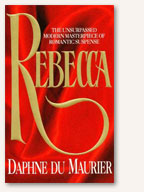
By Daphne du Maurier

Book Cover: RebeccaI’d tried reading Rebecca years ago, but it starts off with a lengthy dream sequence that is just a description of a decaying estate, and that is a lot to get through right off the bat. I was inspired to try again by the “Rebecca” chapter in Mallory Ortberg’s Texts from Jane Eyre. (I received two copies of this for Christmas, which was good, because it meant that my cousin’s wife didn’t have to steal my copy. This is also the second classic it has inspired me to read.)

The thing is, Rebecca makes me feel old. Perhaps if I’d read it when I was 22, the age of the unnamed second wife and narrator, I’d have been full of righteous indignation about what an awkward situation she’s in and how much more difficult everyone around her is making it. But, instead, I find myself sympathizing with the disdainful and bullying housekeeper, who loved and respected Rebecca, the first wife, and now has to deal with this shrinking child who can’t seem to do anything but apologize for her existence.

As soon as her much older husband starts showing exasperation, though, I’m all in her corner, and she gets somewhat less cringing as the book goes on and she even starts to show some personal agency. Also, du Maurier has a real skill at building a suspenseful atmosphere, so I was still invested in the scenes when not totally invested in the characters.

It took me a few chapters to realize something, but once I did, I was able to enjoy the book even more: I’d had a vague sense that this was a ghost story, either literal or metaphorical, but it is in fact a mystery, and unnamed second wife is not unlike Nancy Drew (in that she behaves like an exceptionally naïve teenager). Rebecca died under mysterious circumstances, and there are hints that she was not exactly as people thought she was. Reading the unfolding of that is actually quite satisfying, and I was even surprised by the series of big reveals at the end, which is always nice.

I wish I’d thought to live blog this one because just every scene is so full of craziness: the costume ball that goes predictably but still agonizingly wrong! The demonic housekeeper trying to hypnotize our narrator into suicide! The shipwreck unearthing secrets of the deep! (Another horrifying reveal that is too spoilery for me to discuss here, but that all the characters took in much better stride than I did!) It is not unlike The Shining, really, with an unbelievably passive woman feeling oppressed by a building and her emotionally distant husband, and would have been fun to go through chapter by chapter, but I was also able to read the book in under a week, which makes a bit of a rush job out of live blogging.

—Anna

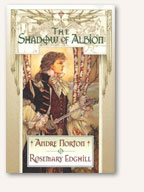
The Shadow of Albion

By Andre Norton and Rosemary Edghill

Book Cover: Shadow of AlbionWhen I first read this book, I recommended it to Kinsey as “the best time-traveling, regency romance, espionage fantasy book you’ll ever read” and I stand by that, even if it isn’t time-traveling so much as alternative realities, but that’s splitting hairs a bit, I think.

The only drawback is that the authors pack the plot so full of intrigue and plot threads that they weren’t able to tie them all up in this book, or even the sequel, and then most unfortunately, Andre Norton passed away in 2005, and I’m just a little resentful that Rosemary Edghill didn’t finish off the third one on her own. (The second one has a blurb at the end saying that they are working on the third! Also, the sequel was published in 2002, and Norton didn’t die until 2005, so what were they doing those three years?!)

Anyway, the premise is a little difficult to explain, especially with my very murky knowledge of history. The year is 1805, and our heroine, Sarah Cunningham, is introduced both dying in her ancestral mansion in England and orphaned in colonial Maryland. In order to fulfill mystical oaths to the land, the living Sarah is brought from her world (our world) to take the place of her dying double in a world in which magic exists. Magic!

So, in this other world, each artistocratic land owner is magically tied to their land, and each king is tied to his country through even greater magic, which means two things: one, overthrowing kings is much trickier to do, so the Stuart family still rules England; and two, Napoleon is playing even more havoc with Europe than he did in the mundane world. Politics!

Also, in this other world, Sarah turns out to be betrothed to the dashing and dangerous Duke of Wessex, who of course she has never met. Wessex is also an undercover agent for not one, but two government agencies, where he foils assassinations and facilitates treaties. Espionage!

Honestly, I don’t know why I’m trying to summarize the plot for you – dukes and duchesses, kings and queens, spies, assassins, fairies – honestly, that should be good enough, just read it!

I’m not even going tell you anything about the sequel, except that it has all of the above, but shifts the setting to the new world, where there are pirates, native mysticism, and the Marquis de Sade, communing with very real demons. Read it!

The Poison Eaters and Other Stories

poisoneatersThe Poison Eaters and Other Stories
by Holly Black
2010

I checked this book out of the library less because I actually wanted to read it and more because I was testing out the ability to check out kindle books. (It works! I love it! I can get books when the library is closed, when it is snowing out, and without getting dressed for the day.)

It also wound up being an interesting book of short stories. This is clearly the author experimenting with different characters and plot points. Some of them work better than others, but they’re all quite interesting. It makes me think that I need to read more of her Black’s books, because I really do think these stories were testing grounds for her books, and I want to see what she made of the more successful stories.

I thought it was pretty funny that one short story, The Coldest Girl in Coldtown, is set in the same universe as the author’s book, The Coldest Girl in Coldtown, but has an entirely different set of characters and plot arc. There’s a single throw-away line in the book that references the events of the short story. I really liked both the book and the short story, but I am left wondering: who does the author think is the coldest girl in Coldtown?

I’m virtually sure that The Land of Heart’s Desire is set in the same universe as Black’s Modern Faerie Tales series, using characters that I would recognize if I had read those books. And it probably would have made more sense if I had recognized them and thus knew their various backstories. I might need to go ahead and read at least one of those books to see.

I liked the short stories, The Night Market and The Coat of Stars, both of which are complete in and of themselves in a way that most of the other stories in this compilation are not. The rest tend to be character studies (Going Ironside) or plot summaries (The Dog King and The Poison Eaters) or single interludes from larger universes (Virgin). So while they’re interesting, they don’t really stand on their own. I enjoyed them, but I don’t necessarily recommend them.

Not Actually Fanfiction

As should be obvious, I really enjoy fanfiction. They are (often) fun stories by (presumably) amateur authors who can sometimes do amazing things unconstrained by thoughts of salability. They write because they have ideas they want to get out. And sometimes, it’s not actually fanfiction. Sometimes an amateur author, in the same spirit of fanfiction, will write an original story and post it online for anyone and everyone to enjoy.

There are even a few archives specifically for these types of short stories, presented like fanfiction except for being entirely original. The parallel for Fanfiction.net is FictonPress.com. ArchiveOfOurOwn simply added a category for Original Fiction.

Here are a few recommendations for original short stories presented online:

Suite for the Living and Dead
By Inland Territory
Summary: When he was twenty three years old, Mike Lafayette took it on himself to write an oratorio for a people without a god.
Why I like it: This is just beautiful. A beautiful concept and beautifully written, but also speaks directly of the particular pain of seeing a deadly and important conflict happening in front of you and, for one reason or another, not joining the fight.
Extra comment: This feels a bit like a fanfiction story in that it references a much more epic story with main characters who are minor characters here. It makes me wonder if there is a book out there this is connected to but I haven’t been able to find. My current assumption is that it is that the author of this short story has an idea for a book and maybe she’s even half-written it, but it’s not available anywhere.

Toad Words
By Ursula Vernon
Summary: Terri Windling posted recently about the old fairy tale of frogs falling from a girl’s lips, and I started thinking about what I’d do if that happened to me, and…well…
Why I like it: One of the problems with traditional fairytales that I (and many other women) are increasingly aware of is how they often reward young girls for being quiet, polite, beautiful, and awaiting rescue, while punishing young girls for being outspoken, ugly, and actively attempting their own rescue. This takes one such fairytale and shows the repercussions, and how a curse can ultimately be made a reward and a blessing can ultimately be a punishment.

Never the Same
By Polenth Blake
Genre: science fiction
No summary, but the first paragraph: Everyone thinks my brother is nice. He set up a rescue centre for birds, after the terraforming accident poisoned the lake. That’s always the image of him, holding a bird covered in sludge. The birds are never the same after they’re cleaned, but the gossips never talk about that.
Why I like it: This is a lovely little mystery, with a main character with mental health issues. With a somewhat unreliable narrator investigating a situation in a highly biased community, the story looks into the difference between right and wrong actions and right and wrong motivations.

The Emperor’s Last Concubine
By Yamanashi Moe
Warning: this has explicit sex in it
No summary, but I bookmarked it as: a story of love and politics
Why I like it: This story has the standard Cinderella structure but focuses on what happens after the handsome prince whisks his beloved away and the difficulties faced by both prince and beloved as they both become aware of the golden cage the palace makes.

Maya Angelou

I read I Know Why the Caged Bird Sing in high school after my particularly awesome English teacher won her stare-down with the school board. Unfortunately, I don’t actually remember it all that well and didn’t remember much about the author either, for all her name recognition. Clearly that needed to change.

So for my Christmas road trip, I picked up (thank you public libraries!) three of Maya Angelou’s audio books, each of which she read herself. I like audio books that have been read by their authors. All readers add their own nuances to texts and when the authors read them you know it’s the intended nuance. Maya Angelou has the added benefit of actually being a professional performer and reciter.

Curiously, her speech pattern reminded me of William Shatner’s, and I wonder if he modeled his after hers. Very well enunciated, and with frequent, intentional pauses. She carries the style off better, though.


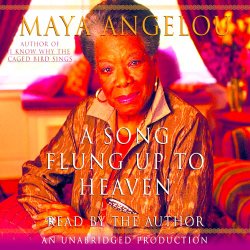
asongflunguptoheavenA Song Flung Up To Heaven
2002

Maya Angelou had a pretty amazing life with many ups and downs. Where before my impression of her was as this iconic individual almost out of sight on a pedestal, this autobiography shows her as fully human with all the attending strengths and weaknesses. One of her many strength is surely her willingness to show the world her weaknesses.

Rather than a single long book, this felt like a themed collection of short stories. Rather than telling the story of her life, she’s telling stories from her life, giving the reader a look at different times and events. Each chapter could potentially stand alone and be well worth reading.


momandmeandmom2Mom & Me & Mom
2013

Wow. Maya Angelou’s mother, Vivian Baxter, sounds like a truly amazing woman who lived her life to the fullest. As tumultuous as Maya Angelou’s life has been, her mother’s seems to have been that much more so. This book focuses on Maya’s relationship with her mother, which was excellent, but I also wish there was a full biography of Vivian Baxter, because just the glimpses we see into her life as it intersected with her daughter are pretty amazing. She was strong and determined and opinionated and just an amazing woman but she was not necessarily a comfortable woman to be around. She seems to have been utterly and completely herself and lived out loud.


lettertomydaughterLetter To My Daughter
2009

This struck me as pretty much a perfect graduation gift (highschool? college? some other major life transition where you’re not sure what you’re going to be doing next?). Many of the chapters are slightly edited versions of chapters from her other books, but they’re collected here for a reason. The overall message of this book is that life is going to throw a lot of different things your way, some wonderful opportunities and some awful experiences, so stay strong and try your best to take advantage of the first and get through the second.


I recommend all of these.

Gabriel: A Poem

By Edward Hirsch

Perhaps I should add a tag for “mourning” here? I feel like I readreadread as much escapist nonsense as I can take in, but then suddenly get jerked to a stop by some book that looks like it might address my reality in an important or useful way. I saw this headline from NPR on my facebook feed: “A Poet On Losing His Son: ‘Before You Heal, You Have To Mourn’”, and I thought, that sounds promising; I don’t feel like I’m healing much at all yet – maybe I just need to mourn some more.

I’m actually not that big on poetry, either; I have great respect but little understanding for it. The following excerpts caught ahold of me, though:

Some nights I could not tell
If he was the wrecking ball
Or the building it crashed into

*****

Like a spear hurtling through darkness
He was always in such a hurry
To find a target to stop him

Turns out this…was not an easy read. It has taken me two months to get through 78 pages of short lines of poems (and an additional month to post about it). I’ve been reading other books, too, of course, because I couldn’t bear to take this one on my commute with me. So, I read a few pages at home until I needed to stop and then I waited until the next day.

I truly don’t really get poetry. Even reading this, I don’t understand how Hirsch has managed to capture so much of what I’ve been going through more accurately in like 15 words than the various prose books have in pages and pages of text.

Hirsch dedicates the majority of the poem to describing Gabriel and their history together. And there were so many similarities: Gabriel was adopted like Thomas, was raised in an upper middle-class and highly academic family, and had serious teenage rebellion that included drug use and short stints of homelessness.

Toward the end of the poem, Hirsch describes his own mourning, and there were even more similarities: the desperate practicalities that have to be done even though you are barely holding yourself together, the agonizing over what you were doing the exact moment your loved one died, what you were doing just before that when you could maybe have done something to prevent it instead.

Yeah, this was a tough read, but a lot of the lines continue to echo in my head, and I know that I will read it again in a year or two, as well, when hopefully things are a little better.

—Anna

The Best of the Rest of 2014

I’ve said here before that when I read a really great book, I am so excited to share it with people that I immediately write a blog review. Hence, my short list of the best things I read this year would be The Goldfinch, The Signature of All Things, Love, Nina, and Americanah. (I was looking at the list of the books I read this year and wondering why it was so much shorter than last year–I read about 45 books this year, rather than my typical 80-100. Maybe it’s because I spent half the year reading giant doorstop literary novels that took forever? At least most of them were good; let’s just not talk about The Luminaries.)
But  I did read a few other things in 2014 that I loved but that never made an appearance here. So before this year runs away from us entirely, let me put in my vote for a few more things:

1) Bridget Jones: Mad About the Boy

I have a love for the first Bridget Jones book that I cannot explain. I just think it’s brilliant and is working on about four different levels and I still reread it once a year. Even Helen Fielding would probably admit that the second one went off the rails a bit, but I really, really enjoyed this third Bridget installment. Rather than picking up where things left off, the book ages Bridget and puts her in an entirely different situation. Bridget is still recognizable, but she’s gown up a little, and as predictable as the book was, I found it charming and surprisingly touching.

2) Mastering the Art of Soviet Cooking

I am kind of obsessed with the Soviet Union, but I find it really difficult to find things to read about it. Nonfiction books tend to be incredibly dense, academic tomes along the lines of “and then that other diplomat issued a statement that countered the previous statement  . . . ” And fiction tends to be unbearably dark, which is understandable but difficult to read (Child 44, you still give me nightmares). This memoir uses food–from pre-revolutionary excess to the siege of Leningrad to Soviet institutional cafeterias–to show how the Soviet state affected the everyday life of it’s citizens. And it shows how one family rebelled against that state, at least partly through food. Really charming, although I’m not likely to cook any of the recipes provided.

If you are not already reading the website Bitches Gotta Eat, you should go do so immediately, because it is one of the funniest things on the Internet (assuming you’re over 18–if you’re not, please go look in our YA tag for something more appropriate, because this sure isn’t). Meaty is a collection of essays by Samantha Irby, who writes the site, and it is equally funny. However, I should warn you that she uses the essay format to also tell some less funny stories about her life, including one about her mother that was so sad it made me put the book away in a drawer for several months so I could recover. But the funny stories are really funny, the sad stories are stunning, and Irby definitely deserves a bigger outlet than she’s gotten so far.

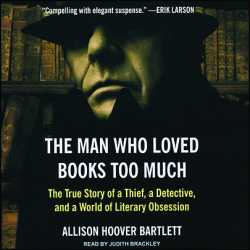
The Man Who Loved Books Too Much

The-Man-Who-Loved-Books-Too-Much-937489The Man Who Loved Books Too Much
By Allison Hoover Bartlett
2010
Read by Judith Brackley

This was an interesting look into the both the rare book collecting community and the criminal mentality as a journalist recounts her research into an unrepentant book thief and the book seller who tracked him down to bring to justice.

It reminded me of a combination of Mr. Penumbra’s 24-Hour Bookstore, with its quirky book lovers, and The Art of the Steal, with its discussions of how con jobs and thefts are both implemented and guarded against. With a side of Marching Powder, with it’s unpleasant main character who just gets less sympathetic the more he tries to explain his perspective.

And actually, regarding that last bit, Gilkey’s (the thief) attempts at gaining sympathy and explaining his rational is so crazy that even the Bartlett (the journalist) is completely taken aback by it. But she’s still more accepting of it than I am, to the extent that her writing almost reads like an unreliable narrator as she first recounts a conversation verbatim and then describes how he still seems like such a nice, polite guy… and I’m going: nope!

But it’s still quite fascinating and does make me want to visit a rare book convention and see the stalls where different book sellers set up with their books with prices that range from less than a $100 to more than $100K.