Stones into Schools by Greg Mortenson

StonesIntoSchools coverStones into Schools
by Greg Mortenson
read by Atossa Leoni
2009

What is particularly wonderful about this book is the pervasive optimism. At a time when I often feel hopeless in the face of atrocities I can’t fight, this is a story about a guy who figured out how to fight. And by fight, I mean arrange the building of schools for girls in rural Pakistan and Afghanistan.

I may be the last person to know about this book since it’s a sequel to “Three Cups of Tea”, which I vaguely recall from that having been on the New York Times Best Seller list for a gazillion weeks some years back, but I never read. I now probably need to do so. But I picked up “Stones into Schools” kind of randomly as one of the few audiobooks at my local library that looked like an interesting read for my work commute. And it really was.

Apparently, in the first book, Mortenson talks about having been a mountain climber who got lost in Pakistan, winding up in a small rural village where a very goal-oriented young child wrangles a promise out of him that he will return and build her a school in her village. There’s some extreme mission creep, as happens, and he winds up with a nonprofit that builds a number of schools in a number of rural villages.

The second book, this one that I’ve just read (ie, listened to), starts with Mortenson checking in on one of these schools along the Pakistan-Afghan border, when horseriders come down from the Afghan mountains to meet him. They explain that they had heard he was in the area, and by area, they meant a mere six-day horseride away, and had come to ask him to build a school for their community of nomadic yak herders in the heights of the mountainous Wakhan Corridor. This was in 1998.

The book covers the next ten years of Mortenson’s attempt to get that school built, through the rise of Taliban and the complex series of relationships, favors given and owed, with all the people and communities along the way.

The book does an amazing job of introducing the people he meets and works with, in all their complexities of personal histories and motives, and how, in the end, they align in trying to bring literacy to rural girls. It also really introduced me for the first time to exactly how horrific the Taliban was to the people it claimed as its own, and how few they truly numbered for all their viciousness. The Taliban created an unsustainable society that hates its own women, but the women and the men who cared for them continued to strive for better.

This book makes me feel hopeful. And that is something I desperately need right now.

When I checked my library catalog to make sure they had “Three Cups of Tea” for my future reading/listening (they do), I discovered another book “Three Cups of Deceit” all about how Mortenson is a liar and a fraud and just the title felt like a slap in the face after such optimism. I looked up both that book and Mortenson on Wikipedia to figure out what the actual truth was and, as far as I can tell, the “Three Cups of Deceit” guy was angry that Mortenson isn’t perfect, nonprofits are always weird, rural schools for girls haven’t immediately created peace in the middle east, and decided to ride the coattails of fame with a clickbait title, while doing his best to turn optimism into cynicism and hope into despair. Mortenson promotes his successes and talks less about his failures and there’s no more financial shenanigans in his nonprofit than in many others. I think the ultimate lesson here is: you don’t have to be flawless to still be good. Find a quest, like-minded people will join you on the quest, and do as much good in the world as you possibly can.


The ABC Murders

By Agatha Christie

ABC_MurdersI was telling my mom, a big Agatha Christie reader, how disappointing the miniseries was, and she casually gave me a spoiler to the novel which made me want to read it immediately. I won’t pass along the spoiler, but I will say Christie sets up so many zigs and zags that I was surprised at almost every turn, even knowing a key part of the ending.

In the past, I’ve found Hercule Poirot just a bit too self-satisfied to be entertaining, but compared to the completely dour Malkovich portrayal, he’s an absolute delight. Like the miniseries, Poirot is older and has retired, but unlike the series, he is happy as a clam, traveling around, selecting only the very most interesting crimes to solve.

One particular scene stood out to me early on in contrast: John Malkovich shuffles around his threadbare apartment, dying his hair over a chipped and stained sink in a scene of utter pathos. Book Poirot, on the other hand, delightedly shows off his new blackening hair tonic to his friend, after being complimented on his youthful appearance. He is unapologetic and incorrigible, and I loved it!

Ordeal by Innocence

By Agatha Christie

Ordeal_By_InnocenceWe finally bit the bullet and got Amazon Prime in order to watch “Good Omens,” and since then I’ve also been diving into all the Agatha Christie I’d been pining after. I’d previously reviewed the novel Crooked House, and the movie lacks a fair amount of the charm of the novel, replacing the more familial relationships with additional drama. However, the casting is truly amazing: Glenn Close, Gillian Anderson, and Christina Hendricks, all playing extreme personalities rubbing against each other in the titular crooked house. So, while I preferred the novel overall, the movie is well worth a watch.
After Crooked House, Amazon recommended “Ordeal by Innocence,” a three-part miniseries based on another stand-alone Agatha Christie novel I wasn’t familiar with. Well, I absolutely loved it! An authoritative matriarch has adopted five children from a variety of troubled backgrounds and raised them with dictatorial love. At the time of the book and miniseries’ start, she has been murdered 18 months ago, and the youngest son, with a history of delinquency, found guilty from overwhelming evidence. The son had insisted on his innocence until he died in prison, providing an alibi that couldn’t be confirmed.

The first character we meet is the man who could have proven the alibi, but has been incapacitated for the past 18 months, and is only coming forward now. This of course opens a whole can of worms, as the family had finally settled into some semblance of acceptance of the mother’s death and the son’s culpability, and now suspicion is everywhere again.

The miniseries takes some of the subtext from the book and makes it straight up text, leading to some deliciously shocking reveals along the way. Controversially, the series actually changes the ending, going with a different perpetrator and motive than the book. The revised ending maintains the spirit of the book, and gives a clear nod to a pivotal relationship in the original.

The book is much quieter, taking a more philosophical approach toward what it means to be innocent of a crime if no one can prove it (thus the title). Wikipedia cited that it was not one of Christie’s more popular novels, with reviewers wary of the psychological delving into motives and character. I wouldn’t normally have minded this, but 1950s psychology is rough. The women are portrayed especially uncharitably, which I would guess inspired the changed ending.

As Rebecca pointed out, the two books complement each other fairly well: both large, wealthy families consisting of conflicting strong personalities; in one, the troubled backgrounds of the family members lead naturally to conflict; in the other, the family seems to turn to conflict themselves just for the entertainment. For each, I preferred the version that included the most warmth in characters, and for one that was the novel and for the other the updated series.

As an aside, we also tried to watch “The ABC Murders” with John Malkovich as an aging and depressed Hercule Poirot, and it was such a depressing grind that we couldn’t get past the first episode.

eNewsletters

I promise that I’m going to review an actual book eventually, but in the meantime, here’s some more links!

We’ve all mourned the closing of The Toast on this blog (though thank god for the archive!), and before it closed, the editors tried multiple ways to make it financially sustainable but not exclusive without success. E-newsletters may be the answer! Both Nicole Cliffe and Daniel Mallory Ortberg, founding editors of The Toast, have ones that mirror their respective writing styles. Both newsletters are primarily for a paid subscription, though include periodic public posts for people who either cannot afford the subscription or want to read some samples first.

Nicole Cliffe’s daily newsletter, Nicole Knows, lists interesting reads from around the web, including long-form articles, YouTube videos, tweets, advice column letters, and my favorite, particularly juicy reddit posts. She also recently published an interview with Alanis Morissette in Self Magazine, and I’ve never been a huge fan of Morissette’s music, but reading these two smart and compassionate women talk about feminism and motherhood and individuality was a real inspiration.

Daniel Mallory Ortberg’s newsletter, The Shatner Chatner, is not as regular as daily, but several times a week, and my best idea is that it spans whatever he happens to be thinking of that day. It is often very funny, often very insightful, and sometimes so educational on trans issues that I’m scrambling to keep up.

And finally, this isn’t really a newsletter in the same way as the above, but R. Eric Thomas, an incredibly funny writer for Elle.com, writes a weekly tinyletter, in which he collects his 3-4 articles for Elle.com with some additional commentary or personal anecdote. They are free to subscribe to, and I look forward to them every Sunday as the only thing making current politics even remotely bearable.

—Anna

Running from COPS

So, I’ve moved to Michigan! My life got increasingly frantic leading up to the move, and now I’m surrounded by boxes, but things are calmer. I’m currently reading Rewind, the fourth in the Pinx Video mystery series, which continues to be a delightful mix of noir-ish detachment and absurdist humor. It is a perfect counterbalance to the stress of packing all of one’s belongings up in boxes and then having to unpack them again.

Running_from_COPSHOWEVER, have I got a podcast recommendation for you! It is fascinating, intense, and disturbing, and I have to take it a little at a time. “Running from COPS” is a widespread look at the show COPS, which I was shocked to realize has been on for 30 years and has aired more than a thousand episodes.

I was never a huge fan of the show, but also didn’t think very hard about it, assuming it was just a normal look at law enforcement, and how you viewed the show depended on how you viewed law enforcement in general. Which, according to the podcast, is an entirely intentional impression created by the show and has had truly insidious effects on the evolution of law enforcement.

The podcast interviews the creators of the show, network producers, retired police, lawyers, and most importantly the “criminals,” who are often found not-guilty after the cameras have turned away but will forever be “the person on COPS”. The creators ask a lot of very good questions and then follow up with the people that can answer them, which is the very best of critical-thinking media these days.

I think, like a lot of complacent, middle-class, white people, I had generally bought the argument that while flawed, law enforcement was generally trying its best, and the last decade or so has been a continual waking up to a very different reality. This podcast, for me, has been yet another wake-up call on how methodically the institution of law enforcement has been normalizing and even celebrating human rights abuses. It is not always an easy listen (honestly, in this day and age, just listening to the audio from episodes is upsetting), but I highly recommend it, not only because it is an important eye-opener but it is just great podcasting!

More Fleabag

A few weeks ago I recommended some TV that I thought the Biblio-therapy readers would enjoy, since books have been a bit disappointing of late. (I did recently enjoy Normal People by Sally Rooney, but basically everyone else in the world has written a glowing review of it.) One of the shows I talked about was Fleabag, and I mentioned that the second season would be coming to Amazon soon. I have to admit that I was a little wary of this new season–the first season was such a beautifully complete story that I couldn’t imagine how a second season could measure up. But, you guys, Season 2 is BETTER. I don’t want to give away too much, but there are wonderful things happening with characters and with the narrative structure, and it was just a sort of a perfect season of TV. Everyone should watch it. Seriously, please go watch it, because I really need someone to talk about it with.

Great Literary Takedowns

HunterSThompsonI can’t remember what social media recommended this, but a while ago, someone linked to this truly incredible ‘eulogy’ that Hunter S. Thompson wrote for Nixon on his death:

Some people will say that words like scum and rotten are wrong for Objective Journalism — which is true, but they miss the point. It was the built-in blind spots of the Objective rules and dogma that allowed Nixon to slither into the White House in the first place. He looked so good on paper that you could almost vote for him sight unseen. He seemed so all-American, so much like Horatio Alger, that he was able to slip through the cracks of Objective Journalism. You had to get Subjective to see Nixon clearly, and the shock of recognition was often painful.

It is also shockingly reflective of the current president, as well. In these terrible times, I’ve been really missing the political writers like Molly Ivins, who could make me laugh while exposing the most outrageous politics, and we need more of them. I hope to God someone writes something similar about Trump on his demise (or sooner).

* * * * * * * * *

MarkTwainWhen I was relating this to my mom as perhaps the best literary take-down I’d ever read, she reminded me of Mark Twain’s savaging of Fenimore Cooper, which if you haven’t read, you need to go do right now:
We must be a little wary when Brander Matthews tells us that Cooper’s books “reveal an extraordinary fullness of invention.” As a rule, I am quite willing to accept Brander Matthews’s literary judgments and applaud his lucid and graceful phrasing of them; but that particular statement needs to be taken with a few tons of salt. Bless you heart, Cooper hadn’t any more invention than a horse; and don’t mean a high-class horse, either; I mean a clothes- horse. It would be very difficult to find a really clever “situation” in Cooper’s books, and still more difficult to find one of any kind which has failed to render absurd by his handling of it.

Honestly, is there anything better than a truly skilled author using their gifts for maximum snark?

* * * * * * * * *

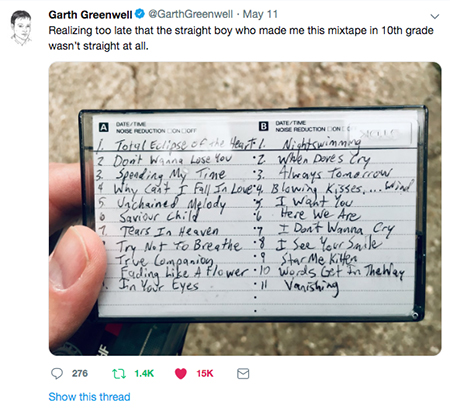
Unrelated, but since I’m linking to things, I’ve been obsessed with this tweet all week:

GarthGreenwell

Some good samaritan put together a spotify list that I’ve been listening to all week, and just mulling over how hard it is to feel vulnerable in your teens, trying to make meaningful connections with other people. And, of course, it is just a total shot of pure 90s teenage longing!

— Anna

Love for the Cold-Blooded by Alex Gabriel

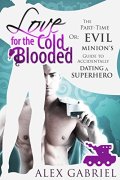
coldbloodedLove for the Cold-Blooded: Or: The Part-Time Evil Minion’s Guide to Accidentally Dating a Superhero
by Alex Gabriel
2014

This is such an amazingly delightful and hilarious book! I highly recommend it! It had me chortling to myself. It also had so many scenes that I would have expected to hit my second-hand-embarrassment squick but instead sailed right past it with a derogatory look of: don’t expect these characters to be embarrassed by anything they do or allow anyone else to be embarrassed on their behalf. They are just fine with rolling with the situations.

And as a warning to Anna: it does have graphic sex scenes, that are not only graphic but also involve significant character development and plot progression so they can’t just be skipped.

This is the world of superheroes at it’s best: the superhero world of Saturday morning cartoons where the good guys win but the bad guys get away and no one is ever permanently harmed. The drama is high, the philosophy is pointed, and the aesthetics are amazing.

It also reminds me a bit of The Rest of Us Just Live Here since Pat, our main character who does the occasional part-time duty as a minion to whatever supervillain is currently making a bid for world domination, is mostly a college student who loves his major and has a pretty decent part-time job. He’s just so irrepressible and he loves his mom and dad and his sisters and his studies to be an urban developer and even being a minion is often annoying but sometimes fun and just part of life.

And Nicholas Andersen is the Tony Stark / Bruce Wayne of this world: the billionaire philanthropist tech-genius with awkward social skills who starts out thinking that Pat is the prostitute he requested sent up. (And Pat isn’t about to say “no” to sex with a hot guy who apparently wants to have sex with him.) And then life happens and it is all so ludicrously delightful and I love it!

stillwatersStill Waters
by Alex Gabriel
2015

As soon as I finished “Love for the Cold Blooded” I went to check out the author’s page for more. Sadly, there’s not much else and nothing in the last three years, but this novella is still really good.

It packs a fascinating amount of world-building around a very character-driven fantasy plot. Anyone who has read a lot of urban fantasy knows that it comes in a wide range of styles: from dark/gritty/game-of-thrones-esque to light/fluffy/romcom-esque. Are werewolves vicious slavering creatures going on murderous rampages or are they people who turn into puppies? In this story, they are both! Because the background premise is that there are rips that will occasionally allow people from one world to pass into a different world.

Drakjan, going by Julian, is one such individual. The world he’s from is a dark and dangerous fantasy world in which vicious creatures fight and kill and the world he’s now in is a softer fantasy world in which those same fantasy creatures share borders and have council meetings and are shocked when one of their own is murdered!

One of the great things about this book is Drakjan’s perspective because the whole world is so foreign to him even after  he’s settled in to the periphery of life in the new world, giving up the joy of killing for the pleasure of peace. But he’s still very much an outsider looking in, not quite understanding how (or even why) to fit in with the rest of the society.

The plot happens when someone else comes through another rip. (Two someones actually: a love-interest and a plot-point.) The plot is extremely straight forward but the characters and the world building are amazing and it’s just as well that the plot doesn’t get in the way of that. I would love to read more but it’s also self-contained as is.

Awesome New(ish) TV By and About Women

Do other people fall into reading ruts where you’re reading all the time and finishing lots of books, but nothing really excites you or even sticks in your memory? Over the past couple of months I’ve read all sorts of things, including some with quite a bit of buzz (The Woman in the Window, The Immortalists), but have been pretty uninspired by all of them.  But I have been watching lots of great TV, across the full range of steaming services I apparently now have to pay for. I have particularly enjoyed several short series that show some realities of being a woman that I haven’t often seen on TV before. So here are Kinsey’s official recommendations for your spring TV viewing. They’re all short enough to knock out in a single evening, although they are all also at least a little raunchy and maybe things you don’t want to watch with your mom or your kids. Although, I don’t know your life or your mom or your kids, you do you.

Derry Girls (Netflix) is a comedy about a group of friends who go to a Catholic girls school in Northern Ireland in the 1990s.  It captures the intricate social strata of high school girls perfectly, and the family interactions have a completely non-saccharine ring of truth to them, while also being very funny. There’s a scene where someone drops a glass on the kitchen floor and a character’s mom acts like a nuclear spill has occurred and makes everyone stand on chairs–I loved it so much I had to rewind and watch that bit again. But as funny as the show is, the Troubles in Northern Ireland are always hovering on the edges, never letting anyone completely forget that they are living their lives in a battle zone. Also, there is amazing 90s music for my fellow Gen Xers, and Northern Irish accents that required me to have subtitles on to understand everything going on.

Shrill (Hulu) Lindy West’s memoir didn’t originally strike me as good source material for a fictional show, but the first season absolutely charmed me. Aidy Bryant (who I didn’t know before because I hate Saturday Night Live and never watch it) is amazing as a woman trying to navigate life as an entry-level journalist with a meddling mom and a terrible non-boyfriend. I guess you would say that her weight is the hook of the show, but it’s not like every episode is about how hard it is to be fat. Very early on she decides she is going to stop obsessing and just live her damn life, and most of the episodes are about her doing just that. Within the first five minutes of episode one I started googling to try to figure out where to buy her cute clothes and the infuriating answer is that they had to custom make basically everything because plus-size clothes are so awful. So enjoy the show, but know going in that you will not be able to buy those dresses.

Fleabag (Amazon) When I started writing this I initially thought, “Oh, I have three women-centered comedies to recommend!” But Fleabag might stretch the definition of comedy, so be warned. It follows a young London woman though encounters with men, her father and stepmother (played by the marvelous Olivia Coleman as possibly the worst woman in the world), and her sister. The main character is clearly on the verge of falling apart after a tragedy that is only slowly revealed in the show, and her relationships with her family make me want to use words like “searing” and “blistering.” Phoebe Waller-Bridge is the star and creator, and she is so observant and specific about the absurdity of life that the show is funny, while also pressing on some very painful areas of the psyche. Season 1 has been out for a couple of years, but I was finally inspired to watch it because Season 2 just showed to raves in the UK, and will be coming to Amazon in May. So now is a good time to get on this dark, dark train.


Hey Ladies!

By Michelle Markowitz and Caroline Moss

Hey_LadiesAfter all my recent disappointments, I decided to go with a book with zero male voices at all. Hey Ladies! started as a randomly occurring column on the late, lamented Toast.

It was one of my favorites – just a series of emails from the most vapid group of friends trying to plan outrageous outings – but it was also a bit controversial on The Toast, with some commenters feeling like it was too broadly satirizing women in general and tipping over into anti-feminism. For the book, which borrows and expands from the original columns, the authors wrote a forward in which they explicitly write:

We’re not making fun of you or your friends or women in general. We’re making fun of ourselves, and how mass emails to big groups seem to bring out the “OMG SO EXCITED!!!!!!!!!” in all of us.

I have to admit that I was skeptical, because while I always looked forward to a Hey Ladies! column, it was definitely a sharply-pointed satire of a certain class of women. And the beginning of the book was exactly the same seven truly appalling women (and one audience-proxy who mostly doesn’t respond) that entertained me so much before.

But, damn me if by only a quarter through the book, I started getting twinges of sympathy for each character: Nicole who is always mooching off her friends, but is clearly scrabbling to maintain the lifestyle that lets her keep her friends; Ali who railroads everyone into her preferred decisions, but is also just trying to a decision made; Caitlin who is on the edge of success as a social media influencer but also really does honestly want to help everyone around her; etc.

I mean, good satire lures you into some introspection on how you view yourself and others, right?