Daughter of Smoke and Bone

By Laini Taylor

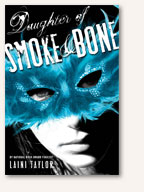
Daughter_of_Smoke_and_Bone This is a little embarrassing. Kinsey has recommended this book multiple times on this blog, and even gave me a copy, but it took me three tries to get through it. It is actually very good, but it starts with some of the most Mary Sue you’ve ever read. Our heroine, Karou:

  • Is 5’ 6” but seems taller because of her willowy ballerina’s build, with slender neck and long limbs
  • Has long hair that grows out of her head a bright blue
  • Has a gorgeous, older ex-boyfriend, who wants to get back together and over whom all the other girls sigh
  • Attends a high school for the arts in Prague, where she paints such imaginative images that all of the other students gather around each morning to see her daily sketchbook

Multiple times, I gave up in the face of such blinding impressiveness right off the bat. I couldn’t imagine what else the author had left to unveil down the road, and I wasn’t sure what she could do to make me actually like Karou. It turned out that her being attacked by a killer angel did the trick!

So, once I got over sulking over the heroine, I was intrigued by the very unusual hidden world that slowly reveals itself over the course of the book. And while I stayed a little aloof from Karou herself, I was charmed by the wide variety of other characters. For people who don’t have as big an issue with Mary Sue-ism as I do, I can unreservably recommend this book; for those that do, I still recommend the book, actually – I did eventually enjoy the whole story, though sort of grudgingly throughout, and I admit that was entirely due to personal bias.

—Anna

Non-Post-Apocalyptic YA Omnibus

We are big fans here at Biblio-therapy of YA books, and we’re big fans of sci-fi/fantasy/urban magic/werewolves and vampires/teenagers living in a post-apocalyptic wasteland books. And after The Hunger Games, the publishing industry turned out so many YA fantasy novels that you could have used them all to build a compound to protect yourself from the inevitable zombie hordes. There’s even a parody Twitter account–Dystopian YA Novel, brought to you by them same writer as the genius Guy in Your MFA account that Anna mentioned recently–gently mocking some of the Katniss stereotypes that have popped up. I have read many many many of these books, and the recent Divergent movies have reminded me of my love for world problems that can only be solved by teenagers. But sometimes you don’t want to read about the savior of the remains of the human race and her love triangle, you just want an old school YA romance book. I’ve recently read three YA books that are, well, it’s not fair to call them simple, because they’re all well-constructed, thoughtful books, so let’s say straightforward. Teenage boys and teenage girls and high school and parents and all that stuff we’ve all dealt with, minus any future overlords or factions or teenage warriors.

How To Love by Katie Cotugno tells the story of Reena and Sawyer, long-time family friends, who get together in a terribly romantic fashion, but she gets pregnant, and he leaves homes without realizing that she’s having the baby. Two years later he shows up again–how will Reena and Sawyer and their complicated, prickly families put all these messy pieces back together? (The story moves around in time, so this isn’t really spoiling anything.) My favorite thing about this story is that it would be very easy for the book to be judgmental about Reena getting pregnant as a teenager. And there are characters who judge her for it, and she sometimes judges herself, but the book itself is very neutral and (thankfully!) does not turn into an anti-teen pregnancy PSA.

Althea and Oliver by Cristina Moracho first won my love by being set in the mid-1990s, time of my youth. But that’s really secondary to the plot, about two childhood friends who might be moving towards more. There’s a whole thing where Oliver has a weird sleep disorder, and Althea might have another boyfriend, but their relationship is the heart of the book and it rings true. Althea and Oliver also both feel real, while at the same time being unlike other teenager characters I’ve read.

Finally, All the Bright Places by Jennifer Nevin is the book I am wariest of recommending for a couple of reasons, but I’m including it because I’ve kept thinking about it days after finishing. This is another boy-meets-girl story, but it starts out from a darker place that you might expect and doesn’t get much brighter, despite the title. The point of view alternates between high-school students Violet and Fitch. Violet, in particular, came across as a very cool girl I would like to be friends with, and the politics of high school were felt painfully accurate. But I also found the character of Fitch unbelievably annoying–like, every smart-ass guy I have ever hated all rolled into one. I also hesitate because something happens at the end of the book that I found very upsetting. I know not everyone is a delicate flower like I am when it comes to books, but I hate to recommend something that will be disturbing to readers. I don’t want to give away any critical elements of the book, but if anyone wants more spoiler-y details, I’m happy to be more specific in the comments. So, as long as you’re prepared for things to turn a bit dark and Afterschool Special, the writing and characters definitely stand out.

I should say here that all of the books get pretty R-rated. Characters have sex. I mean, I’d rather my hypothetical children read any of these well-written, full-of-heart stories than Twilight or the Sweet Valley High books that I read as a kid. But I probably wouldn’t give these to any of the children I know without making sure their parents had read them first.

Finally, have you read Eleanor and Park by Rainbow Rowell yet? If you haven’t read Eleanor and Park, go start your YA reading with that, since it remains one of the best things–YA or anything else–that I have read in years.

The Darkest Part of the Forest

darkest partThe Darkest Part of the Forest
By Holly Black
2015

Since I really enjoyed The Coldest Girl in Coldtown, I started paying more attention to Holly Black. This book didn’t hit me quite the same way, but it is still a fun read. There’s something really pleasing about her heroines in both books: they know what they want and they go after it. Even when they flounder about a bit, there’s a certainty to them that I like.

Hazel, the main character here, occasionally (okay, more than occasionally) makes idiotic decisions, but she does so with a purpose. It’s always understandable and I’m often left wondering if maybe she’s right. And when she’s wrong, she acknowledges it, which is another rare and attractive quality. I didn’t feel much of a connection with Hazel (it’s possible I’m aging out of YA, at least a little bit), but I liked her.

The book also provides an interesting look at how easily some pretty horrific things can be normalized such that both the characters in the book and the reader reading the book don’t think too much about it… until someone points out that, wait, no, what you had been accepting for so long is actually not acceptable.

Only the most obvious example of this is how cruel, tricky and magical the fae are, but also how accepted they are in the town of Fairfold. They’re a dangerous and disturbing part of life in this town. People just carry on… until they can’t anymore.

Mortal Heart

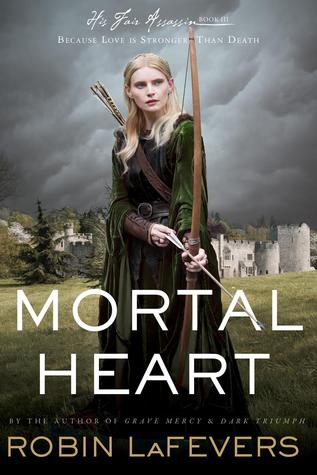
MortalHeartMortal Heart
by Robin LaFevers
2014

I started reading the His Fair Assassin trilogy after Kinsey reviewed the first book, and since Anna reviewed the second book, it seems fitting that I review the third book.

This is a fun series and I enjoyed all the books, each of which focuses on a different main character. However, of the three main characters, Annith, the focus of Mortal Heart is the one I find the most annoying. For all her capabilities, she’s really extremely naïve, especially given her history. I continually reminded myself that she was just 17 and a lot of people are gullible at that age. As the book progresses and there are plots and reveals, I would routinely see the issue significantly before the main character even though we’re seeing the same evidence. I also felt a bit of a letdown at the end because I saw a potential way for one of the plot arcs to be resolved in a really fabulous way and instead it was sort of semi-resolved in an okay way.

One thing I really enjoyed about this book was the look it gave into what the other eight gods of the old religion have been up to and how their chosen people are marked and what they do with them.

While the grand political conflict seems to have mostly worked itself out over the course of the three books, what happens next regarding the actual convent of assassin nuns is left so very open-ended that it makes me wonder if there might be a fourth book in the planning stages. I haven’t been able to find any mention of one though.

It was an okay book, but I did like the previous ones in the series a lot more. If there is a fourth book, though, I’ll definitely read it to see what happens.

The Poison Eaters and Other Stories

poisoneatersThe Poison Eaters and Other Stories
by Holly Black
2010

I checked this book out of the library less because I actually wanted to read it and more because I was testing out the ability to check out kindle books. (It works! I love it! I can get books when the library is closed, when it is snowing out, and without getting dressed for the day.)

It also wound up being an interesting book of short stories. This is clearly the author experimenting with different characters and plot points. Some of them work better than others, but they’re all quite interesting. It makes me think that I need to read more of her Black’s books, because I really do think these stories were testing grounds for her books, and I want to see what she made of the more successful stories.

I thought it was pretty funny that one short story, The Coldest Girl in Coldtown, is set in the same universe as the author’s book, The Coldest Girl in Coldtown, but has an entirely different set of characters and plot arc. There’s a single throw-away line in the book that references the events of the short story. I really liked both the book and the short story, but I am left wondering: who does the author think is the coldest girl in Coldtown?

I’m virtually sure that The Land of Heart’s Desire is set in the same universe as Black’s Modern Faerie Tales series, using characters that I would recognize if I had read those books. And it probably would have made more sense if I had recognized them and thus knew their various backstories. I might need to go ahead and read at least one of those books to see.

I liked the short stories, The Night Market and The Coat of Stars, both of which are complete in and of themselves in a way that most of the other stories in this compilation are not. The rest tend to be character studies (Going Ironside) or plot summaries (The Dog King and The Poison Eaters) or single interludes from larger universes (Virgin). So while they’re interesting, they don’t really stand on their own. I enjoyed them, but I don’t necessarily recommend them.

Books You Already Knew I Was Going To Tell You To Read

I was on the road quite a bit in December and read a whole pile of books I enjoyed. But none of them quite seemed to warrant their own review, since none of them are going to come as a surprise to anyone who’s spent any time here. So a list seems appropriate, so I get to mention a few things that I heartily, if predictably, recommend:

1) Landline by Rainbow Rowell. I saw Rainbow Rowell speak in person earlier this fall, and that woman is made up entirely of curly hair and charisma, and the stories she told about writing this book had the audience literally screaming with laughter. This is no Eleanor and Park, but I’m not sure my heart could handle another one of those, so this story about a marriage and a magic telephone will do just fine.

2) Dreams of God and Monsters by Laini Taylor. Quite a while back on the blog I mentioned the first book in this trilogy, Daughter of Smoke and Bone. That book was your fairly standard YA, magical realism, independent female narrator, star-crossed lover sort of story. And then book two, man, book two took a turn. It got dark and weird and tragic and bloody, and I actually put off starting the third one for months because I was scared of where things might go. But I ended up really liking how the story resolved, and I promise you, you have not read anything like this.

3) One Plus One by Jojo Moyes. I’ve already raved about Me Before You and The Girl You Left Behind, so it shouldn’t be any surprise that Moyes’s latest was equally heart lifting/breaking. (Note, because I know my readers: don’t worry too much about the dog. It will work out.)

4) The Secret Place by Tana French. This wasn’t my favorite of the Dublin Murder Squad novels–that would be The Likeness–but it was a compelling read. While the plot and mystery of this one didn’t grab me the way some of them have, it still delivered on the two things I think Tana French does best–unsympathetic but fascinating characters, and a romance-free vision of modern-day Ireland.

Mermaid in Chelsea Creek

By Michelle Tea

Book CoverWhew, this is a good book. This is how good it is – I actually started reading slower at the end to stretch it out longer.

Mermaid in Chelsea Creek is basically my favorite kind of book: metaphorical fairytale. And it is a fairy tale, but kind of a grimy one, if that makes sense. Thirteen-year-old Sophie starts getting visions of a mermaid who tells her that she is destined to save the world. Sophie, however, is your average young teenager, cranky, stubborn, and self-centered, trying to figure out her place in the world and her relationship with the people around her. She lives with her overwhelmed single mother in the economically struggling city of Chelsea, MA, where everyone seems to be hanging on by a thread.

It truly is this real-ness where the book really shines. The titular mermaid just puts a mystical filter over the growth every teenager must go through, and how difficult it can be even if you don’t have a grand prophesy to fulfill. Even the various magical creatures are trying to find their places in a decreasingly magical world. The themes of how full of pain and anger and sadness the world is, and how easy it can be to give up in the face of it all, but also how important it is to fight it with kindness and understanding, in whatever small ways are available to you — well, those struck a cord with me right now.

The mermaid is the most fantastical character, for sure, but the pigeons are the best, which is why they are on the cover. I hate to even mention anything that might make someone hesitate to read this, but I do feel that I have to extend a couple of warnings: there is some animal harm, which is pretty devastating, of course, and the book ends on an utter and complete cliff hanger.

The one problem with metaphorical fairy tales, if it can even be considered a problem, is that with things like cliff hangers, you never know whether it means there will be a sequel or if it just serves to show that there are no true endings where everything gets wrapped up. I’m okay with that, actually, but I’m rooting for a sequel because I would love to read it. (Edited to add: there is a sequel – Girl at the Bottom of the Sea comes out next year!)

Incidentally, the hardcover edition is published by McSweeney’s, and is a gorgeous volume, with an embossed cover, thick paper, and lovely line illustrations.

— Anna

Spooky Graphic Novels

In honor of the approaching Halloween, I’ve been reading some extremely good graphic novels, that seemed seasonally appropriate. Although possibly more thematic to a more traditional concept of All Hallow’s Eve than to the modern concept of Halloween, per se. This is a time when the barriers between the living and the dead are the weakest and who knows what could be roaming the streets… you’d better prepare to be scary, too, to fit in.

Anyway, the artwork for all three of these are just gorgeous, which can possibly go without mention, since I don’t read graphic novels if I don’t like the art. But still, the art is really gorgeous.

East of West
written by Jonathan Hickman
drawn by Nick Dragotta
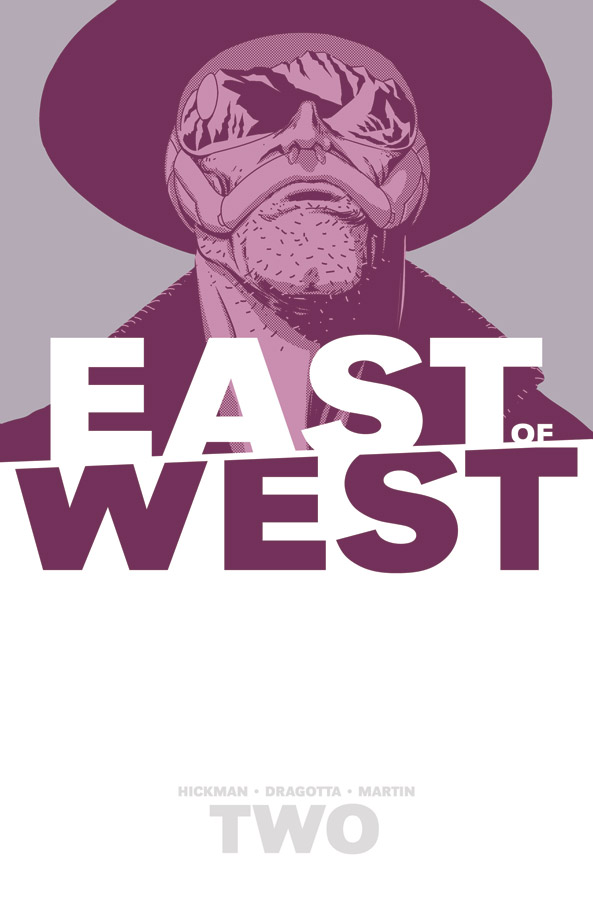
200px-East_of_West  east-of-west-vol02  East of West 3

This is a futuristic western based on an alternate past with a whole lot of mystical beings thrown in for good measure. I love it.

One of the main characters is Death. The three other horsemen of the apocalypse are also wandering around, and there’s some sort of evil prophesy that a scary number of the world leaders are fanatical believers of. No one is really good or nice in this, by they’re all really dedicated to their various (and generally conflicting) causes. And there’s something very appealing about competency, good or evil, and something fascinating about manipulative people attempting to manipulate each other.

The back sums it up well:

“We would tell you to pray. But it wouldn’t do any good. You have earned what is coming to you.”

Anna gave the first one of these to me for Christmas last year and then I bought the second one for myself last month, and the third one has just been released a couple of days ago but I haven’t gotten it yet. I’m still going to review this whole series as awesome.


Pretty Deadly
written by Kelly Sue Deconnick
drawn by Emma Rios

PrettyDeadly_Vol1-1

This is another mystical western, although minus the science fiction aspect of East of West. Instead, the whole story has a surreal quality as it is structured as a fairytale told by a bunny (or rather the skeleton of one) to a butterfly (who might be part of death’s daughter) and there are stories within stories. I still need to read it again (probably a few more times) to really track down who all is who and what their intents are, but it’s fascinating. It’s also a complete story, which is nice. There are plenty of other characters who can be developed in the next volume, whenever it comes out (and that I’m looking forward to getting when it does), but the main plot arc following the girl in the vulture cloak is resolved at the end of this volume, and thus ends the story told by bunny to butterfly.


Peculia and the Groon Grove Vampires
by Richard Sala

Peculia

This is a stand-alone single story, and a much quicker read than the others. The story-line is extremely straight-forward without any real surprises. The plot-line sort of reminds me of a Nancy Drew story, although with even fewer surprises. In that way, it seems like something for a fairly young reader.

On the other hand, a lot of characters die, some in relatively gruesome ways. The focus on the gruesome deaths is actually the opposite of gratuitous, though. They’re shown quickly and casually and it all comes across as fairly light. It reminds me of the some of the older Grimm’s fairytales where, say, children push witches into ovens and then go home to celebrate with their families. So, you know, maybe it is intended for youngish children, but cheerfully bloody-minded young children.

And me, too, because I liked it a lot.

The art is also interesting in the way it’s all in black and white, with the appearance of woodprints.
Queen Victoria’s Book of Spells

Edited by Ellen Datlow and Terri Windling

Book CoverThis anthology is collected by the same editors and many of the same authors as Teeth, which I read and reviewed previously. It is described on the cover as “an anthology of gaslamp fantasy,” and having the setting be the common factor instead of the characters allowed for a greater range in the stories, which I appreciated.

The Victorian Era, too, is an excellent setting to pick, since so much was going on! There was the very first world’s fair, an explosion of technology, science, and manufacturing, and a return to romance in the arts. It was an era of lots of contradictions, as well: most well-known for extreme wealth, it also had predominant extreme poverty; the British Empire was both strongly xenophobic and driven to colonize; and Queen Victoria herself was both a pretty and lively young girl, and a solemn and joyless widow.

Though, once again, I checked out the book for the short story by Genevieve Valentine, I was pleased that the anthology also included Elizabeth Wein and Caroline Stevermer. My favorite stories ended up being “The Governess” by Elizabeth Bear, in which a governess takes a position in a very troubled household, and “Phosphorus” by Veronica Schanoes, about the strike of the women who worked in the match factories. Don’t those two alone reveal the wide scope of the book?

Can I also describe how ridiculous I can be? I had always had a vague feeling that I didn’t care for Elizabeth Bear, because I believed that she had written Clan of the Cave Bear (because “Bear”) and/or Women Who Run with Wolves, or some amalgamum of both books that only exists in my head. In addition to the fact that Elizabeth Bear did not write either of those books, I have not actually read either of those books, or any books that Elizabeth Bear has actually written. No reality will keep me from my pointless prejudices!

— Anna

Code Name Verity ALERT

YOU GUYS. THERE IS A FOLLOW-UP TO CODE NAME VERITY. I have no idea how I missed this, but Elizabeth Wein’s Rose Under Fire is a companion to one of the best, and most heart breaking, things I read last year. I’m starting it tonight and fully expect to be crying tomorrow. I guess I could have waited until I finished the book and reviewed it, but I felt like this was a discovery you needed to hear about immediately. MORE CODE NAME VERITY, PEOPLE!