Detroit Zine Fest 2025

I hadn’t been quite sure what to expect from the Detroit Zine Fest, but was delighted to discover that it was like a local mini Small Press Expo. Maybe somewhere between 50 and 80 vendors? Thus, it was still slightly overwhelming to browse through all the stalls, but was also delightful and I bought a number of really good zines:

Michigan Cryptids by Shi Briggs
A Michigan Unnature Journal by Shi Briggs
These are two books, 12 pages each, about cryptids natives to Michigan, with absolutely gorgeous illustrations and short descriptions. I don’t actually know much about cryptids, so I’m not sure how much these were researched versus created, but I did recognize the Michigan Dogman as a thing. But the black and white illustrations are so beautiful and creepy and inspiring.

Thank You by Eddie Roberts
2023
This is a gorgeous and pointed poem about the culture of consumerism and the push-pull of gratitude for getting things you desire with the discomfort of always having more pushed upon you. It described many of my own conflicting feelings. The author also experiments with some really interesting typography effects.

Passages by Liana Fu
2019
Is a series of poems and musings on being Chinese diaspora going to visit Hong Kong and trying to learn Cantonese, struggling to figure out where they fit in the world where all their native cultures see them as other, and how this intersects with the ongoing cultural struggle of Hong Kong itself under an increasingly oppressive Chinese government.

Of Course I’d still love you if you were a worm, but like we might have to renegotiate certain aspects of our relationship, y’know? It’s a big adjustment: A guide to safely and responsibly loving your partner post wormification by Seth Karp
This is hilarious and also the best kind of crack-treated-seriously brochure. It’s clearly a take-off of the “Would you still love me if I were a worm?” meme, but reminds me even more of an elaborate version of the Jack Harkness test meme. It’s got advice and perspective on what to do if your significant other spontaneously turns into a worm. (Step one: ask what kind of worm? There are different kinds of it will effect your decision.)

Helianthus by Jone Greaves
There is Something in the Basement by Jone Greaves
Instructional Musings for Encounters & Summoning by Jone Greaves
Intent to Carcinize by Jone Greaves
I spent some time trying to figure out which of Jone Greaves’ zines to get since they were all such fascinating titles and wound up getting four of them, each of which is unique and fascinating and thought-provoking. I’ve been getting into short-story writing competitions recently and I feel like these are all examples of how it’s done: to create a world and a concept and maybe a character in just a few pages.

Gentle Laundry by India Johnson
2023
This is a surprisingly fascinating non-fiction 24-page zine about laundry. As someone who mostly learned to do laundry to the extent of put clothes in a machine with detergent and it will come out Officially Clean regardless of any evidence to the contrary, this zine opens up whole new worlds of understanding about what is actually happening and what detergents, soaps, bleaches, etc actually do. It’s also tonally very approachable, although by about halfway through I was feeling somewhat overwhelmed by the all the options and decision branches. But it’s valuable information to know and I have a few ideas for changes I want to try when doing my own laundry. Once I’ve tried a few things, I’ll need to re-read it to see what else.
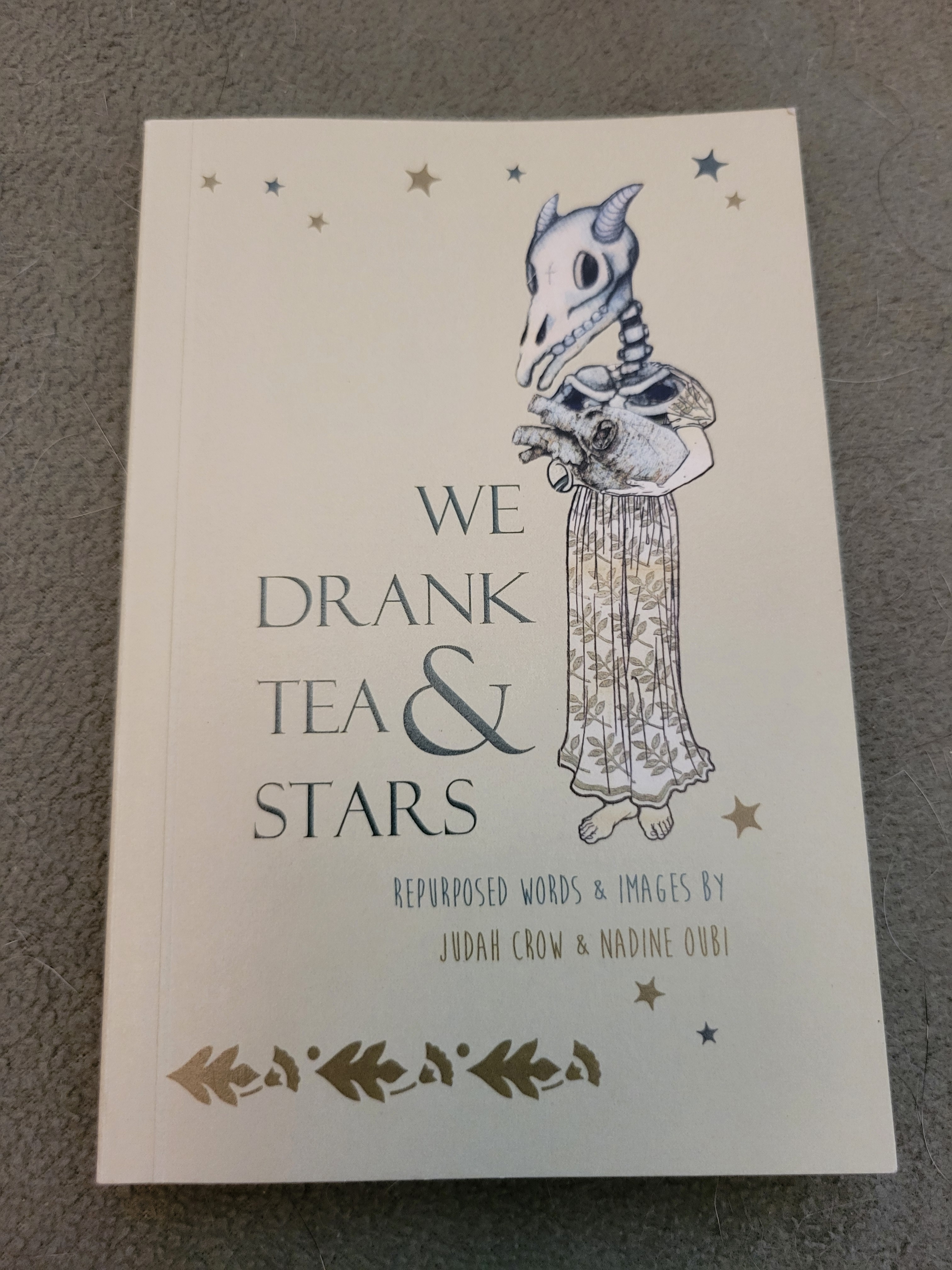
We Drank Tea & Stars by Crow & Oubi

We Drank Tea & Stars
by Judah Crow & Nadine Oubi

This is a fascinating little independent publication that I can’t find listed anywhere online, but ran across on my uncle’s bookcase, after he had apparently found it in a little free library. Poems by Crow and illustrations by Oubi, the really fascinating part is that they’re all collages, both the visual and the text.

I’m familiar with collage art and immediately recognized it when I saw it, and these were fascinating and fun examples of that. But I hadn’t even heard of collage poetry before, the closest I’ve come is erasure poetry: using found text and erasing everything except the words the new artist wants to highlight for their poem. Instead of that, this collage poetry samples lines from other written works and combines them in new ways. Crow also points out that there’s an extra level of collaboration that came from the way most of the samples were from translated works: so there’s the original author, the translator, and then Crow, each providing a different context.

Poetry isn’t really my reading genre of choice, but I do love seeing people do new and interesting things with text. And while I could admire the poetry without any particular understanding or critical thinking, I really enjoyed the afterward talking about the process, and also the Sources list, which ranged between works I’ve never read to works I’ve never even heard of.

Appalachian Elegy

By bell hooks

First, let me apologize for the spam post(s?) that have appeared on this blog (I was honestly mortified). I’m not sure how it happened; I’ve been working with WordPress to bolster the security, but I’m not fully confident it won’t happen again. I guess the only assurance I can offer is that it was probably fairly obvious that we are not trying to advertise Romanian casinos to you?

But also, I’ve been in a bad case of reader’s block lately. I’ve started three different books, and stopped less than halfway through each one, losing interest just to doomscroll twitter, tumblr, and reddit instead. I wasn’t sleeping all that well either, and it felt like part of the same thing: just a little too nervy to really relax.

In desperation to actually finish anything, I picked up the copy of bell hook’s Appalachian Elegy that a friend had given me for Christmas, hopefully last year though I can’t swear to it. I don’t really understand the vast majority of poetry but figured it might work as a palette cleanser of sorts for my brain. It is a very short volume: only 66 one-page poems total, but I took my time with it.

She covers the natural beauty of the Appalachians, and ties it into the people there, both past and present, and the opportunities and oppressions that those people have faced. It is a lot to cover, and yet the poems feel airy and lyrical at the same time. I only read 5 or 6 poems each night, stopping when I felt myself either zoning out or trying to rush through the words, and slowly felt like I was starting to unwind. I still struggled with feeling like I was missing the deeper meaning, and I very likely am, but just the words and rhythms became enough for me. I am still struggling to concentrate on anything longer, but this has certainly helped and I hope to remember to turn to poetry in the future as well.

Let Us Do The Best That We Can, by Cawein and Heller

Let Us Do The Best That We Can
Written by Madison Cawein
Illustrated by Helen West Heller
1915

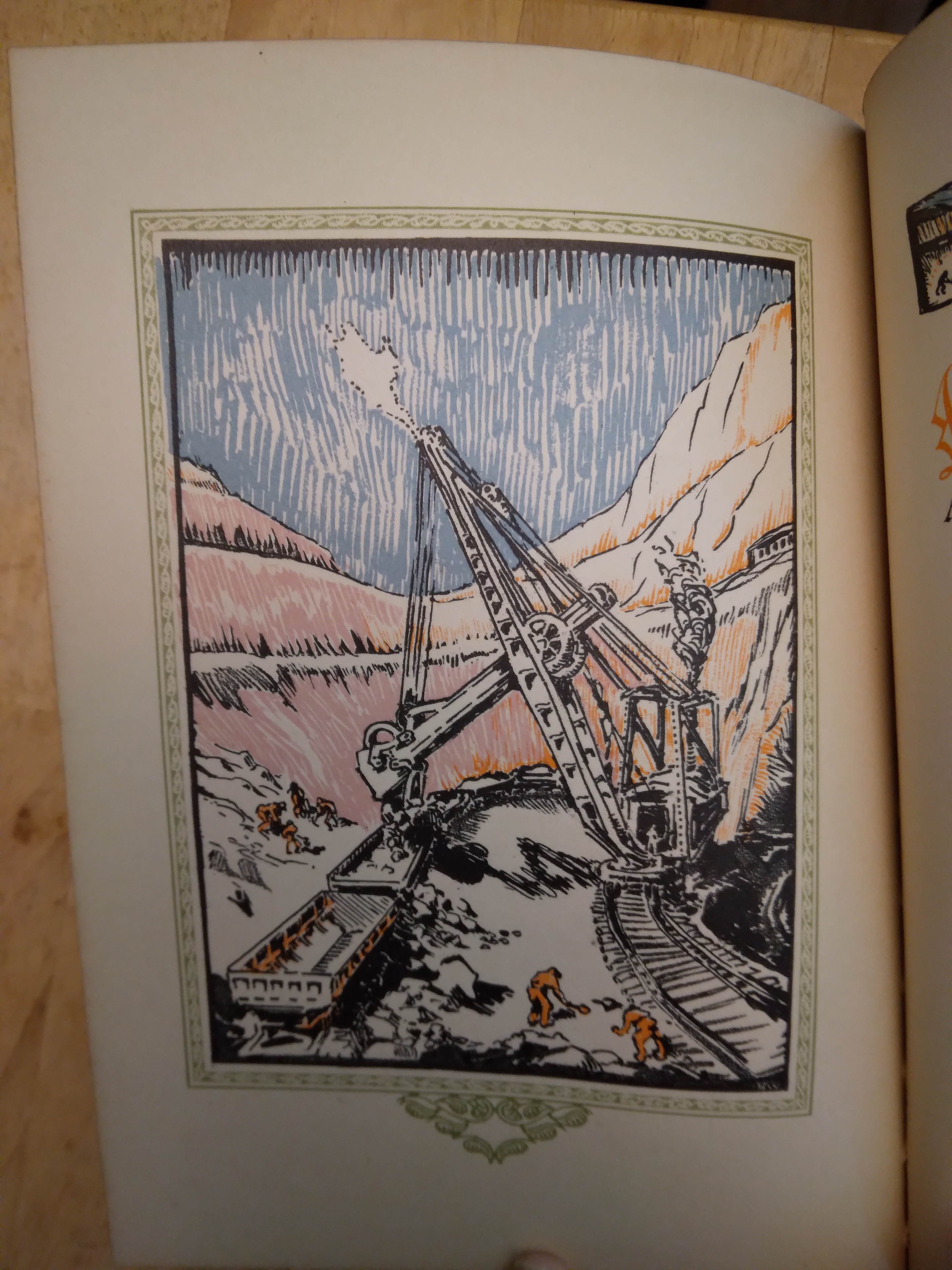
I bought this book for $8 in an online auction, sight-unseen, because the pictures looked really cool. And then I saw it in person and it’s adorable! Physically, it’s 5”x6.5”x0.25” and in not great shape, but uses thick paper to make up for the fact that it’s only 10 pages long — 5 verses of a poem and 5 wood cut illustrations – plus a handful of opening and closing pages.

The illustrations are beautiful woodcuts. It’s going to join Gods’ Man in my small collection of beautiful old illustrated novels.

The poetry is… sweet. It feels like something out of one of the red bound Children’s Hour books. It’s lovely and motivational about doing the best one can and being happy regardless of the results because you did the best you can. The message is how everything will work out in the end if you just do your best. It strikes me as an excellent poem for children.

I just have to remember that it was written at the beginning of the first world war. This is the innocent version of Ayn Rand’s dream world: everyone does their individual best and it’s enough.

In today’s economic climate of corruption, stock prices before product quality, and massive corporations setting employees against one another, the impact of this poem feels more like propaganda against taking the larger view or addressing systemic inequalities and injustices. And, frankly, I suspect that there was both similar propaganda and the need for it in the early 1900s, as well.

But it still is a sweet poem about enjoying the pleasure and pride of a job well worked and I do appreciate that. Plus, just physically adorable as a book. This publisher was like: yes, I will publish a beautiful little book with ten pages!

The 1619 Project: Born on the Water, by Hannah-Jones, Watson, and Smith

The 1619 Project: Born on the Water
written by Nikole Hannah-Jones and Renée Watson
illustrated by Nikkolas Smith
2021

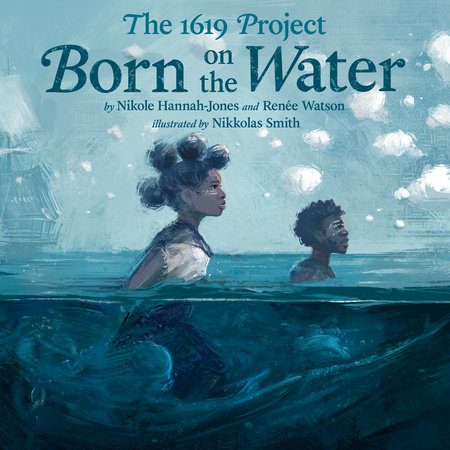
This is a children’s picture book that was part of The 1619 Project and it is beautifully written, gorgeously illustrated, and addresses a difficult but vitally important topic in an age-appropriate manner.

The framing story starts with a young child being given a class assignment to write out their family tree. However, while their white peers are able to go back many generations and list which countries their families came from, this black student can only list three generations and feels ashamed. The main focus of the book is the history of that student’s family that starts with joy and culture and rich history in Africa, goes through great suffering and hardship with kidnapping and enslavement in America, but still perseveres, fights, and survives to live on in the student today. It gives a message that survival in the face of trauma is to be celebrated. Black Americans have a great deal to be proud of in their African roots and their American survival and their achievements – past, present, and future.

I’m particularly impressed with the way this book shows centuries of American slavery as the middle part of the history of the student’s ancestors. Slavery was long and harsh and transformational, but it was not the start of their history and it was not the end of it.

This is clearly intended for a young audience, but I highly recommend it for adults as well, not just for the pure artistry of the writing and illustrations, but also for the soft discussion of a difficult topic.

They Can’t Kill Us Until They Kill Us

By Hanif Abdurraqib

They_Cant_Kill_UsHanif Abdurraqib is very smart and funny on twitter and instagram, but I was unprepared for just how deep his collection of essays would go. When Rebecca asked what it was about, I said “essays discussing different musicians and albums,” which is such the tip of the iceberg as to be completely misleading.
Abdurraqib is first and foremost a poet, and it shows in these essays. Every word is carefully chosen, which leads to very dense and evocative prose, and slow but engrossing reading. Just about every essay starts with a musician or album (ranging from Carly Rae Jepsen to Future*), and uses that music as an access point to discuss something about humanity or society that the music is trying to address.

As a black boy growing up in Ohio and super into the punk scene, and then an esteemed music critic trying to sell all his friends on Jepsen, Abdurraqib is well experienced in finding his own place in scenes that are not often created with people like him in mind. He talks about the tension that often exists between the artist, the art, and the audience, any of which can be alternately be welcoming or alienating. The funny thing is that Abdurraqib talks about music in such a way that I got all excited to actually listen to it, but then it inevitably wasn’t as interesting or complex as his analysis. So, while I didn’t get introduced to any new favorite musicians, I’m definitely keeping tabs on Abdurraqib’s future writing.

*It took me a good five minutes of flipping through the book to select two, since I kept being like, oh, I should mention The Weeknd; no, My Chemical Romance; no wait, Migos; or Fleetwood Mac, etc. etc. Abdurraqib has an awe-inspiring range of interests!

Antigonick

By Sophokles and Anne Carson

AntigonickBuilding off of Rebecca’s post, here’s another very interesting novella in verse. I was chatting with a friend about the new translation of The Odyssey, for the first time by a woman (which I had first heard about from Kinsey), and the friend asked if it was the same author that did this translation of Antigone. It’s not (The Odyssey, which I look forward to reading, is translated by Emily Wilson, in beautifully crafted plain prose), and I had never heard of Anne Carson, so my friend lent me her copy, and I have to say, it blew me away!

Antigonick is only 44 pages (including the introduction, which I highly recommend reading), and I read almost the whole thing on my commute, practically missing my stop in the process. It is not a straight-forward translation; my best description is that it is a post-modern study/satire of the play. The characters reference their own theater, anachronistically quoting Hegel, Beckett, and Brecht. It is also surprisingly snarky for a millennia-old Greek tragedy!

You also don’t need to be fully up on your classics to be able to follow along and enjoy it. I’d actually confused it with Medea, and had a couple of pages of confusion over the lack of dead children before I realized my mistake. While not a strict retelling, Carson quickly got me up to speed, and the humor and cleverness kept it from being a bummer.

Novels in Verse

Are novels in verse coming back into fashion? Because while I’m not a big poetry reader, I do think it would be kind of awesome, and I’m beginning to see some evidence of it. I just ran across this article about a new imprint that will be focused on YA books with a strong verse element:

I’ve also been following with interest the discussions of the newest translation of the Odyssey by Emily Wilson that is making waves in certain circles by it’s going back to the roots of the original language and retranslating it for meaning that speaks to current society rather than to Victorian society.

And I’m reminded of a Stargate Atlantis fanfic “Free Verse” by Dasha that includes the line: “They built their laboratories to look like temples. Of course they wrote their text books to read like poetry.” And references the poem “The story of Schroedinger’s cat (an epic poem)” from The Straight Dope.

So despite not being a great fan of poetry in general, I’d be really interested in modern epic poetry coming back into fashion and seeing what modern authors do with it.

The Undertaking

By Thomas Lynch

UndertakingThomas Lynch describes himself as an internationally unknown poet, though my impression is that is fake modestly for the sake of the mild joke, since from his own accounts he seems relatively well-regarded in poetry circles. More importantly to this memoir-of-sorts, he is a third-generation undertaker in a small Michigan town. I was looking for some insight into how undertakers view death when they deal with it daily and in such a practical way. Lynch kicks the book off with a treatise on funerals that can be summed up with his repeated phrase, “the dead do not care.” It is occasional humorous, but more often, uh, bracing, like cold water or a slap in the face. It isn’t really a pleasant read, but it is an interesting one.

That is, until he goes off on tangents on wider subjects, and his old-white-maleness starts showing. Sympathizing with a friend’s divorce, he bemoans how the ex-wife seemed to just callously stop appreciating poetry idolizing her body. I started side-eyeing the author a bit there, but he really gets going at the end of the book. A lengthy screed against assisted suicide, stemming from a more interesting description of his brother’s post-mortem cleanup service, veers way off course into anti-abortion territory with a wide variety of willfully ignorant arguments that made me dislike the author quite heartily. The glib snarkiness that had seemed darkly funny at the beginning became pretty nasty towards the end.

Gabriel: A Poem

By Edward Hirsch

Perhaps I should add a tag for “mourning” here? I feel like I readreadread as much escapist nonsense as I can take in, but then suddenly get jerked to a stop by some book that looks like it might address my reality in an important or useful way. I saw this headline from NPR on my facebook feed: “A Poet On Losing His Son: ‘Before You Heal, You Have To Mourn’”, and I thought, that sounds promising; I don’t feel like I’m healing much at all yet – maybe I just need to mourn some more.

I’m actually not that big on poetry, either; I have great respect but little understanding for it. The following excerpts caught ahold of me, though:

Some nights I could not tell
If he was the wrecking ball
Or the building it crashed into

*****

Like a spear hurtling through darkness
He was always in such a hurry
To find a target to stop him

Turns out this…was not an easy read. It has taken me two months to get through 78 pages of short lines of poems (and an additional month to post about it). I’ve been reading other books, too, of course, because I couldn’t bear to take this one on my commute with me. So, I read a few pages at home until I needed to stop and then I waited until the next day.

I truly don’t really get poetry. Even reading this, I don’t understand how Hirsch has managed to capture so much of what I’ve been going through more accurately in like 15 words than the various prose books have in pages and pages of text.

Hirsch dedicates the majority of the poem to describing Gabriel and their history together. And there were so many similarities: Gabriel was adopted like Thomas, was raised in an upper middle-class and highly academic family, and had serious teenage rebellion that included drug use and short stints of homelessness.

Toward the end of the poem, Hirsch describes his own mourning, and there were even more similarities: the desperate practicalities that have to be done even though you are barely holding yourself together, the agonizing over what you were doing the exact moment your loved one died, what you were doing just before that when you could maybe have done something to prevent it instead.

Yeah, this was a tough read, but a lot of the lines continue to echo in my head, and I know that I will read it again in a year or two, as well, when hopefully things are a little better.

—Anna