The Reason I Jump

By Naoki Higashida

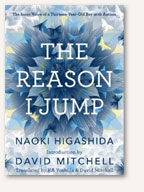
Book Cover: The Reason I JumpJon Stewart interviewed the translator for this book, and then continued to rave about this book in subsequent shows, so I figured I’d give it a shot. That the book itself exists is amazing: the thirteen-year-old author with autism answers questions that he frequently hears. It is a fascinating look into a viewpoint that is usually inaccessible, and I imagine it is an immeasurable benefit to those who interact with people with autism. For myself, I found it very interesting—it is a short book, but not a quick read, since I kept putting it down so I could think more about what Higashida was saying—but occasionally a bit repetitive, which makes me sound like the worst person ever, since that is clearly one of the traits of autism. I try to justify my criticism by saying that Higashida is so mature and perceptive that it is easy to forget that he is working with quite a severe handicap.

My only previous insight into autism was the sporadic postings by one of my favorite bloggers, Matthew Baldwin, aka Defective Yeti, on raising his autistic son. He hadn’t posted in several months, so I’d gotten out of the habit of checking, but this book reminded me to check back in, and it turned out he spent all of October posting each day about his son. His love and delight in his son are evident in each post and make the posts such a pleasure to read.

And, finally, while I’m bringing up blogs about interesting parenting situations, I ran across Gender Mom just about a month ago, and have been completely caught up in it ever since. Gender Mom’s five-year-old daughter was born male, but announced she was female at age three, and a year later they decided to raise her female. It is a truly fascinating look at a mother trying her best in fairly new territory.

—Anna

Marching Powder

marching-powderMarching Powder
By Rusty Young
Read by Adrian Mulraney
2003

This was a fascinating book, but, once more, this was a book that I would not have managed to get through in anyway other than an audiobook. Even as an audio book, I almost quit it multiple times.

It’s essentially the memoirs of Thomas McFadden, a young British drug smuggler, about his years in Bolivia’s San Pedro Prison. I say “essentially” because I’m a bit unclear on why this book isn’t listed with two authors: it’s written in the first person and there are direct descriptions of how Rusty came to the prison and recorded McFadden’s story on audio cassettes.

The hardest part of getting through this book is that there was no one in the book that I liked. There were better and worse people. And there were definitely situations that no one should have to live through, no matter how nice or not they are, but being a victim doesn’t always make a person innocent. I went into this book knowing it was about a prison and a drug smuggler, but he’s described as being very personable, and I guess he is? But it came across to me as a highly manipulative, almost psychopathic type of personability where I couldn’t actually feel a connection and, through his recounting, couldn’t feel a connection to anyone else, either. As the book described actions, reactions, and motivations, I found myself just generally disliking both Thomas (the narrator) and Rusty (the author) and most of the other people too, regardless of whether Thomas was trying to present them in a good or bad light.

Surprisingly, while the people made the book difficult to get through, the events recounted were not as difficult. I’d gone into this book prepared by Hollywood and stereotypes to hear the conditions of a third-world drug prison (ie, awful, awful, awful conditions). I was surprised that while, yes, at some points in time and in some circumstances, it did live up to those expectations, at other times and in other situations, the prison as a whole acted more like a small city-state with strict immigration laws: ie, you couldn’t leave, but it wasn’t a half-bad place to settle down, start a business, and raise a family.

The corruption described is so prevalent that the it struck me that this wasn’t a corrupt justice/prison system at all, but was something entirely different, merely masking itself to the outside eye as a justice/prison system. It seemed like more of a state-run hostage business or some other money-making scheme that I don’t quite understand, but certainly wasn’t interested in either justice, rehabilitation, or even punishment. This is not is a justice/prison system marred by corruption, because the corruption has taken over. The corruption is so prevalent that it creates it’s own structure, completely replacing the structure that might otherwise have been there.

I’ve been trying to think of a good simile and the best I can come up with is that calling this part of a justice system with some corruption would be like calling a fishing net a sailboat sail with some holes. They can’t really be compared.

To sum up, I’ll steal Kinsey’s three-word review style and say, this book was: informative, interesting, off-putting.

Nonfiction Graphic Novels

I previously read Pyongyang and Shenzhen by Guy Delisle, and really enjoyed them, and when I saw that he also had books on Jerusalem and Burma, I was very interested in reading those, as well. I was living in Boulder at the time, though, and the local library didn’t have copies, so I backburnered it and of course forgot about it until a couple of weeks ago, when I thought to try my new library system, which happily had both! Jerusalem was available first, and when I went to go pick it up, I browsed the other offerings in the adult travel graphic novel section (a small section, certainly). I picked up Joe Sacco’s Palestine and Waltz with Bashir: A Lebanon War Story as well.

Being your typical clueless American, I hadn’t quite put together that all three books were pretty much talking about the exact same region. I had just figured that I am generally sort of confused over issues in the Middle East, and perhaps a graphic novel or three would be able to break some of the issues down in a way that I could understand. If libraries weren’t stringently against keeping rental records (for exactly this reason), I’m sure I’d be on some list somewhere.

Jerusalem

By Guy Delisle

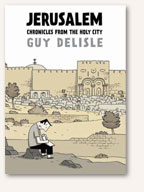
Book cover: JerusalemJerusalem is about twice as long as Delisle’s previous books, which is explained toward the beginning when he describes how he and his family are moving to Jerusalem for an entire year for his wife’s work for Doctors Without Borders. By this point, he has made enough of a name for himself as an author that he is spending the year solely working on this graphic novel, while also taking care of the children and doing the occasional lecture.

Delisle’s style is quiet and nonjudgmental. His strength as an author and illustrator comes from showing the reader these foreign cultures through his eyes as a traveling Westerner (he’s French Canadian), so it feels very personal. Several times, I laughed out loud, which is somewhat unusual in a visual media such as graphic novels, and two specific pages related to the other two authors of this blog: 1) Kinsey, apparently you are not alone in playing the game “Hipster or Priest”, and 2) Rebecca, I believe you, too, own some of the Helsing manga?

Like his previous books, this one focuses primarily on his own small, daily experiences trying to navigate a new culture, only referring to more global politics when it touches on him directly. For instance, a recurring theme throughout the book is him attempting and failing to get permission to travel into Gaza to lecture at a university there. In fact, after his fourth and final failure, he wonders if perhaps he is being mistaken for Joe Sacco, a reference that pleased me since I was reading his book next.

Palestine

By Joe Sacco

Book Cover: PalestineI have to admit that after Guy Delisle, Joe Sacco came as a bit of a shock and I was initially quite turned off. Like Delisle, Palestine is an autobiographic account of Sacco’s experience in Palestine, but where Delisle is quiet and personable, Sacco is loud, crude, and in-your-face. He is very clearly influenced by the R. Crumb school, which is not my favorite either, and I found his bold lines and clustered text boxes aggressive and claustrophobic. Sacco portrays himself as a bit of an asshole, self-centered and cowardly, and I initially took his word for it, but slowly began to think it is defense mechanism on his part, protecting himself emotionally from so many needy people that he is not in a position to help.

What finally sold me on the book is the sheer amount of information he has managed to pack into it. While I enjoyed Jerusalem more, Palestine gave me a much better understanding of the current situation, and the history that brought about it. As the title might reveal, the book is very much in support of an internationally recognized Palestine, which is not a perspective we hear much here in the United States, and it seems to me that it is an important perspective to hear.

Once I got over my initial bias, too, I started to notice that Sacco is a beautiful illustrator when he wants to be, drawing very detailed and delicately inked vistas depicting the scope of the conditions in the settlements.

Waltz with Bashir: A Lebanon War Story

By Ari Folman

Book Cover: Waltz with BashirI had initially picked this one up because the illustrations are beautiful, like little paintings in each panel. I was not real clear on where Lebanon is (I may or may not have thought it was in South America, the Texas public school system at work.) I had certainly never heard of Bashir before.

It turns out Waltz with Bashir was actually an animated film first (you can see the trailer here) and the graphic novel is made up of frames from the film. It also turns out that Lebanon is just above Israel, and Waltz with Bashir centers around the Israel Defence Force’s invasion of Lebanon. I figured that after the previous two pro-Palestine books, this would be my Israeli perspective.

The book (and film) is an autobiographical account of Folman attempting to recreate memories of his experience as a young soldier in the Israel Defense Forces during the 1982 Lebanon War, when Israel invaded Lebanon in order to install a pro-Israeli Christian government headed by the titular Bashir Gemayel. Folman knew that he had been stationed near the horrific Safra and Shatila Massacre (Christian soldiers under Israeli protection slaughtered between 762 and 3,500 Palestinian and Lebanese civilians), but had no memories at all of that time or place.

A friend of Folman’s, also stationed nearby, began having nightmares 20 years later, which inspires Folman to begin to dig into his own past. Clearly, it is not a happy book, and it, too, is quite critical of the Israeli military, so I am three-for-three on the pro-Palestine front. (If anyone wants to recommend a solid pro-Israel book on the subject, I’d be happy to check it out, though I’d prefer a graphic novel, clearly.)

Which brings me to my conclusion: while nonfiction graphic novels seem a little odd at first, they are palatable media for communicating very complex and charged information. There is no way that I would read a multi-hundred-page book, or even a dozen-page article, on the Israel/Palestine issue, but I happily and quickly ran through several hundred pages of these three comic books combined. They only made me marginally more informed, but they made me a lot less ignorant, if that makes sense. I don’t think that I could instruct someone else on the nuances of the various issues, but I know enough now not make pat judgments, either.

Burma Chronicles

By Guy Delisle
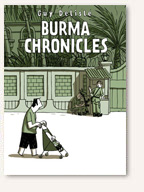
Book Cover: Burma ChroniclesDelisle’s Burma Chronicles came as a welcome relief after the building heaviness of the Israel/Palestine books above, though it is also Delisle’s most political book. He still writes very much in his first-person perspective, but Burma (or Myanmar, depending on your politics) has such a restrictive government that it interfered quite a bit in his daily life. Burma Chronicles takes place after Pyongyang and Shenzhen, but before Jerusalem; Delisle, his wife, and their infant son travel to Burma for his wife’s work in Doctors Without Borders. For the nine months that they are there, Doctors Without Borders attempts to reach outlying minority groups, with the government blocking their efforts until they eventually pull out altogether. This book highlights Delisle’s main charm for me: at the same time as he lightly touches on global politics, he shows us individuals in a very real light, so it becomes easy to look past the cultural differences and see the basic humanity underneath it all.

—Anna
I Can Barely Take Care of Myself: Tales from a Happy Life Without Kids

By Jen Kirkman

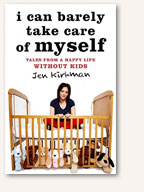
Book Cover: I Can Barely Take Care of MyselfSo, I struggled a bit writing this review because this is a book-reviewing blog, not an autobiographical blog. But, clearly, I didn’t just pick up this book out of the blue, thinking, boy, I’d like to read more about comedian Jen Kirkman’s personal views on pregnancy and childhood.

Much like Kirkman, I have never felt a strong desire for children or even envisioned children in my future. Also like her, I have been told by people older than me, in very decisive tones, that I will change my mind when I get to be that age, and I guess I sort of believed them. I knew that I didn’t want children at the time, but accepted that I could change my mind (I’m a big fan of spinach now, and I wouldn’t have anticipated that when I was a kid, so, sure, tastes change) and that would be fine.

However, if I may put this delicately, I’ve come to the age, where perhaps sooner rather than later is a good time to plan for children, and I have experienced no change in my feelings. This really does seem to be a somewhat shocking aberration in our current society, and I thought it would be comforting to read someone else’s struggles with the same outlook.

So, I approached this book wanting a philosophical discussion on what it means to be a woman in our society who simply chooses not to have children. I was slightly disappointed right off the bat because it was no different than many other comedic memoires I’ve read, an overview of her childhood and young adulthood and what drew her to comedy; she’s funny and an engaging author, but it wasn’t what I was looking for in this particular book. About halfway through, though, she really delves into the subject of not wanting kids and her immediate surrounding’s reactions to that, and it was exactly what I wanted. I even understood that she had to set the stage before: that she was a normal kid, from a loving, intact family, with siblings who have happily chosen to have kids. There is no childhood trauma to be used as an excuse, and her lifestyle choice cannot be called a symptom of anything.

The most important thing that came out of the book for me is that she doesn’t ever explain exactly why she doesn’t want children, and I believe the truth is that she can’t. I certainly couldn’t, either. Can parents truly describe why they wanted children? I get that there are concrete reasons; I have concrete reasons, too, for not wanted children, but they aren’t really the whole story, or even most of it, are they? It is simply something deep down inside you that desires something, or does not. I have a million reasons why I don’t want kids, but reading this book helped me come to the understanding that they are all just extraneous excuses and it all boils down to the very basic truth that I simply don’t want them.

I have had various conversations about it with family, friends, and acquaintances, and found them all to be much more accepting than the conversations that Kirkman relates. Towards the end of the book, she goes on a bit of a screed about parents wanting to push everyone else to be parents, too. For me, though, reading this book made me more comfortable with my choice, but also more comfortable with people who chose to have children, as well. If my choice to not have children is deeply embedded in who I am (and it is), then their choice to have children is, too, and that is certainly something to respect and admire.

—Anna

P.S. – Jen Kirkman wrote a short column for Time Magazine, giving a brief overview of her book here.

P.S.2 – Jen Kirkman was also featured in the Boston episode of Drunk History, which I just love and you should definitely watch (but not at work)!

P.S.3 – A few days after reading this, I had a super realistic dream that I was pregnant and it was awful. Even in the dream, I thought “how ironic that after coming to a comfortable acceptance of not wanting children, now I will have one for the rest of my life.”

Predictably Irrational

Predictably IrrationalPredictably Irrational: The Hidden Forces that Shape Our Decisions
by Dan Ariely
2008
read by Simon Jones

I took a couple of courses in grad school about the information business, which is a growing industry that deals with the interesting paradox of having to use information as both a marketing tool and a product. It’s fascinating and complex, but was also my first introduction as an adult to standard economic theory.

Both my immediate and ongoing reaction is: standard economic theory is idiotic. It’s just blatantly false, based on two assumptions: 1. All decisions made by individuals are rational. 2. All those rational decisions are made with the primary goal of increasing that individual’s personal financial wealth.

Standard economic theory has a real hard time trying to explain nonprofits. Or, you know, families and friends.

Ariely is one of the active researchers opening up a new field of study: Behavioral economics. This is a field that comes out of psychology more than economics, and it looks at how people actually make decisions. (And is something of a balm to my soul after trying to comprehend what regular economics think.)

How do biases work, or habits form? How do our decisions change when we have an audience or not? Rather than always acting rationally, how do we rationalize some of our less acceptable behaviors?

He studies this, and he does so through a series of small experiments. (His students at MIT should really have started to be suspicious of some of his odder requests.  And I imagine the neighborhood kids roll their eyes at this point.)

It’s an excellent book, with a great deal of humor to it, but also caused a certain amount of introspection as I thought about how I make my own decisions, and a certain amount of horror, given the current political state of my country, in regards to how politicians make their decisions.

I highly recommend this book. My three word review: funny, fascinating, and important.

Rather Outspoken: My Life in the News

Rather_OutspokenRather Outspoken: My Life in the News
By Dan Rather and Digby Diehl
2012
read by Dan Rather

I almost quit this book several times, as I struggled to make it through the first three CDs of the ten-CD audiobook. Not because it was bad (I wouldn’t have had a problem quitting if it were just bad), but because it was very well done recounting of a couple of very hard stories. In the first two chapters, Rather recounts breaking the Abu Ghraib scandal and the Bush National Guard scandal, and having to deal with the push backs and the attempts both external and internal to CBS to squash those stories.

In my imagination, the news business is run by the type of irascible fictional news editors like J. Jonah Jameson of the Daily Bugle (from Spiderman) and Perry White of the Daily Planet (from Superman). They’re gritty and obnoxious abut are all about getting the news out there and aren’t going to put up with anyone trying to quash a story:

 “I’ve got a story,” I said. “My source has leaked a lot of highly classified information, and the paper could get in a lot of trouble if we run it. But if we don’t, my source is going to keep trying until he finds someone who’ll print it.”

Jameson’s face lit up like Christmas. “That’s just about my favorite thing in the world to hear,” he said, and chomped on his cigar for emphasis. “What’s the story?”

The Scoop (an Avengers fan fiction) by Hollimichele

And yes, I realize that’s a highly romanticized notion of how investigative reporting works, and yet, it is the image I have in my head. From Rather Outspoken, I got the impression that Dan Rather has a similar idea of how the news should run. News, by it’s very nature, is something new and the people who are currently in power, happy with their power, and happy with the status quo, are not going to want told. If no one is offended or angry about the news, then it’s probably not very useful news. A news organization, then, should know that it’s setting itself up to fight a series of battles, and those organizations who ignore stories and refuse to fight are failing at their jobs.*

With this vision in mind, for Rather, seeing CBS cave in to political pressure is a personal betrayal as well as a professional one and just… hard. For me, it’s painful to see that betrayal and to realize that, as a member of a very different generation, it doesn’t really surprise me at all. I have an idealized vision of news reporters, but I don’t actually believe it’s real.

Luckily, after that, Rather turns to looking with a more large-scale perspective on his life and career and goes back over events of the past. I do wonder though, if it becomes easier for me because he begins to discuss events that happened before I was born and if they would remain difficult to hear for people who had lived through them and could feel those traumas again in the recounting, of the Kennedy assassination, the civil rights movement, the Watergate scandal…

Anyway, it was a very good book, and while I didn’t always agree with Rather on his politics or his interpretations, I do whole heartedly agree with him on the importance of an informed public and the dangers of a progressively more corrupt news industry.

* Speaking of people who are failing at their jobs: I’m going to take a moment to call out the U.S. Congress: if they can’t keep the government running, then maybe we need to get a new Congress. Is there a way to make a vote of not confidence? This is the type of dirty politics that Rather managed to immerse himself in so he could report on it, but that I find so distasteful that I can barely stand to listen to.

The Men Who Stare at Goats

men-who-stare-at-goatsThe Men Who Stare at Goats
by Jon Ronson
2004
read by Sean Mangan

This book is awesomely hilarious. Hilarious, if, you know, you can get past the very real horror that is mixed in with the craziness. Apparently, I can. In many ways, the book as a whole reminded me of Keller’s Catch-22, an awesomely hilarious comedy all about the inhumanity of war.

And unfortunately, I once more have to warn for animal harm. Given the intent (by the men who stare at goats) of doing harm, I shouldn’t be surprised, but given the proposed method (i.e., staring), I found I was surprised after all. (It hadn’t occurred to me to ask: where are these goats coming from?) Plus, once we’re past the animal harm, we then move on to torture of prisoners.

Somehow it still manages to be super funny.

Jon Stewart on the Daily Show called Jon Ronson’s writing “investigative satire” and that’s pretty much what it is. This book is also an illustration of the phrase: “Truth is stranger than fiction, (because fiction has to make sense.)” In the final chapter of this book, Ronson sums it up by explaining that this is the story of how, in the aftermath of the Vietnam War, the discouraged and demoralized U.S. army attempted to incorporate some of the “New Age” culture that was developing, but in true military style, rather than seeking new ways to find peace, they looked for new ways to make war.

Ronson himself is also quite the character: a soft-spoken, somewhat nebbish guy. He’s gone on The Daily Show with Jon Stewart, twice, so you can see him for yourself. It’s worth seeing him for yourself, especially if you’re planning on listening to the audiobook version of this book, because, in stark contrast to Ronson, Sean Mangan reads the text with a deep intent and melodrama that just adds an extra layer of hilarity to it all.

There are a lot of conversations in which the various interviewees are saying something either crazy or horrifying or both, and Ronson is recounting the conversation:

So-and-so said: some crazy and/or horrifying thing

I said, “hmm.”

Now imagine that spoken in a deeply melodramatic fashion.

“I said,” Mangan intones, “hmm.”

I, the listener, can’t help but giggle.

To use Kinsey’s practice of a Three Word Review: funny, informative, disturbing

Simplexity

SimplexitySimplexity:
Why Simple Things Become Complex (and How Complex Things Can Be Made Simple)
By Jeffrey Klugger
2009
Read by Holter Graham

This was a fascinating book, although it wasn’t quite what I had expected. The subtitle is a bit of a misnomer as the book doesn’t really address why things become complex or how they can be made simple. Instead, it shows that many simple things actually are quite complex and many apparently complex things actually are quite simple. So I suppose it does tell you how, if only by showing you how to shift your perspective.

The book is essentially composed of a series of case studies. The studies range from the evacuation of the Twin Towers on 9/11 to regular New York traffic patterns, from stock market fluctuations to cholera outbreaks to Jackson Pollok paintings. All of these are used as examples of the simplicity-complexity continuum, in which both extreme regimentation and extreme chaos are conceptually simple, while in between these two extremes is the place where some extremely complex patterns form.

As is, perhaps, appropriate for a book on this topic, I’m not quite sure what else to say about it. It would be easy to recount some of the interesting details, of which there were many, but the premise itself was quite simple: some things are simple, other things are complex, but it is not always obvious which is which.

Kluger presents a different way to examining the world, and I enjoyed it a great deal.

Yes, Chef by Marcus Samuellson

Yes-Chef-Marcus-Samuelsson-Random-House-Audio-booksYes, Chef
By Marcus Samuellson
2012
read by Marcus Samuellson

Now, Marcus Samuellson is a successful celebrity chef. Way back when, he was a toddler in Ethiopia dying of tuberculosis, and then a kid in Sweden determined to become a professional soccer player, and then a young man in Europe and America trying to get a job and work his way up the career path. This is the story of how he got from there to here, and it’s an excellent story.

One thing that really impresses me with this book is how he manages to not only tell about his actions and experiences in the past, but also to portray his perspective and thought process in the past. When he was writing about his childhood, he wrote as an adult recounting his childhood, but as he was writing about his experiences as a young adult growing into a mature adult, his writing also changed to reflect the change from being driven young man with an overriding ambition to being a much more socially aware adult who didn’t take family for granted.

I was really glad that I experienced this as an audiobook, not because it would have been at all bad as a standard book, but because the audio version is read by Samuellson himself. He doesn’t have the perfect elocution of a professional audiobook reader, but he does have real emotional connection to the story he’s telling. As an autobiography, it gains even more power by being told, literally, in his own voice.

Also, his descriptions of food make me wish that I was more of a foodie. I like food, but I also like simple flavors. Samuellson’s descriptions of the rich and complex flavors that he loves are tantalizing.

The one problem I had with the book is that some of the transitions are pretty abrupt, and a couple of times abrupt enough to be confusing, where I wasn’t quite sure what happened. Also, I got the distinct impression that he was living by the same parental advice I got, that “if you can’t say something nice, don’t say anything at all.” Not that all of his experiences were good by any means, or even that all the people were nice (not at all!) but no one and nothing is presented as unmitigated badness, and that is something I appreciate. Sometimes that might mean skipping over a period of his life, maybe, but for the most part Samuellson seems to genuinely like and respect people. Even the most difficult people (and there are apparently a lot of difficult people in the cooking community, good grief – I’m extremely glad that I don’t have to put up with that) have something good about them and Samuellson sees that.

Anyway, I enjoyed this book a great deal and I definitely recommend it so that you can enjoy it, too.

Books and Food: Two of My Favorite Things

Although I’m currently in the middle of about five different books, my reading for the last month hasn’t been particularly blog friendly, as it’s been heavy on sequels, things Anna or Rebecca have already reviewed, and books that I didn’t like enough to spend any time writing about. But was thinking about cookbooks recently when I gave a couple of new ones as birthday presents (It’s All Good by Gwyneth Paltrow and the Joy the Baker Cookbook by Joy Wilson–I’m hoping Anna or Cara might pop into the comments to report on how they like those). Considering that I don’t actually cook all that much, it’s possible that I have a small cookbook problem, since I have two shelves full of them and another box in storage. I love getting them as gifts, I love browsing through them, and on occasion I even cook things. Despite my small cookbook library, there are few key ones I come back to again and again.*

More-With-Less Cookbook by Doris Janzen Longacre
My family calls this “the Mennonite cookbook” since it’s really a collection of recipes from Mennonites around the world. These are very basic, hearty, healthy recipes that focus on economy, using what you have, and feeding the world. (The Mennonite were into sustainability and unprocessed foods before those things were cool.) And because Mennonites so often work as missionaries, there are a surprising number of recipes with Indian, Asian, or South American origins. This was the first real cookbook I ever used as an adult, and the easy curry, golden eggplant casserole, and eggplant Parmesan recipes were standbys in my early 20s.

Chocolate from the Cake Mix Doctor by Anne Byrn
At the opposite end of the spectrum from the Mennonites. Byrn has a whole series of books on how to use modern convenience foods as shortcuts in recipes. I know that sounds a lot like Sandra Lee (and not in a good way) but her cake mix books are quite smart. All the recipes start with a cake mix, but then add things like sour cream, yogurt, fruit, flavorings, puddings, etc. The processed cake mix makes the recipes practically foolproof, but all the additions make them taste fabulous. I’m quite a good baker and I don’t have problems making cakes from scratch, but I will admit here and now that this book contains the recipe for the single greatest cake I have ever baked or eaten–a white chocolate lemon cake with lemon curd filling.

The Homesick Texan Cookbook by Lisa Fain
I’m from Texas, so I can tell you with authority that the things you cook from this book taste right. I am a particular fan of the cheese enchiladas with chili con carne, the Ranch oyster crackers, and the Texas sheet cake.

How to Eat by Nigella Lawson
The pictures in How to Be a Domestic Goddess or Forever Summer might be better, but Lawson’s first book is packed with not just recipes, but ideas for how to put food together. This is the book that helped me figure out how to roast vegetables, and her sticky toffee pudding is so, so good. I am big Nigella fan and have lots of her books, but this is my favorite.If you have a cookbook that you love, tell me about it in the comments!

*My actual favorite cookbooks are those Kinkos-produced, spiral-bound ones that churches sell, where each recipe lists the name of the nice church lady who contributed it. I have a collection of those dating back to the 50s, and I use them more than you might think.