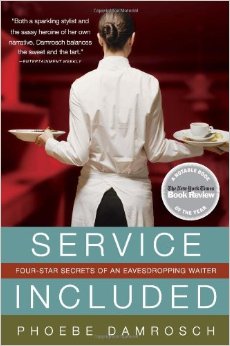
Service Included by Phoebe Damrosch

ServiceIncludedService Included: Four-Star Secrets of an Eavesdropping Waiter
by Phoebe Damrosch
2007

The subtitle is misleading: while there was one chapter that told some stories about some of the wacky customers, the focus was really on the professional (and sometimes personal) life of a high-end waiter. It’s fascinating. It’s eye-opening, nonfiction, and really makes me reassess my experiences at various restaurants. I don’t tend to go to the high-end restaurants like Per Se, where Damrosch worked, but I imagine much of the same structure is true in a watered-down fashion in other restaurants.

Also, the food descriptions are mouth-watering. Even when the descriptions were of food that I don’t generally care for, wow, I wanted to try them out because it sure sounds like this place would be doing them in a way that all people would like. I want to try these dishes! And I really want to visit Per Se to experience them.

I could have done without the sections focused on Damrosch’s adventures in dating, but it was still well written with humor and humility. I just found it somewhat soap-opera-like and an unwanted break from the intricacies of the high-end service industry. It’s possible and even likely that other readers will enjoy those sections, though.

I still don’t understand the interconnected budgets of the restaurant, the service staff, and New York living, but I assume it’s all based on the incomes of the regular clientele who apparently might spent $20,000 on dinner. (After reading this book, I looked up the Per Se website and confirmed that a regular dinner without wine is a fixed price of $310, which is within the realm of possibility if I save, in contrast to the $20K that is just not.)

Damrosch also includes tips on how to interact with service staff, most of which I already knew, and some of which I (rather embarrassingly) did not.

Anyway, this is a fabulous book and I definitely recommend it.

Being Mortal

By Atul Gawande

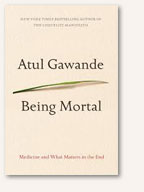
Book Cover: Being MortalI wish this book had been written two years ago.

My mother told me recently that when Thomas was ill, it was very clear that I was in denial, much more so than Thomas himself. I wish so much that any of the many doctors and nurses had broken through my denial to force me to face the reality, but I can only be so mad at them because maybe some tried but just couldn’t reach me.

This book is all about how important it is to face the end our lives, whenever that time comes, honestly and directly, and offers suggestions for easing the fear and pain at the end for ourselves and our loved ones. Gawande talks very openly about how difficult this can be for both the patient and the physician, and his own failures and successes as both a patient and a physician. (Some of the many anecdotes in the book are about his family coping with his father’s terminal illness and eventual death.)

So, the subject matter is upsetting at some times and comforting in others. He reveals ways in which the medical and elder care industries have disconnected from treating actual people – with much higher priority being given to longevity over quality of life. He also showcases some incredibly innovative solutions that are currently being attempted, with some very funny stories about the trial and error process, including a delivery of 100 cageless parakeets in one instance (this turned out to be a success).

All in all, Being Mortal is just an incredibly important book. I am quickly turning into an Atul Gawande fanatic because I remember feeling the same just after reading his earlier book, The Checklist Manifesto. He has this way of taking material that should be incredibly boring or unpleasant to read about and approaching it through a very human way that makes it easily accessibly and engaging.

—Anna

For a quick laugh: 3 Fanfiction plus 1 Nonfiction

It’s been a while since anyone’s posted, so I’m going to recommend four short stories that are crazy good for a laugh. Two of them are so short that they don’t even have titles, but still, go read them!

LINK for FIC
by kyraneko

Fandom: crossover between State Farm Insurance Commercials and All State Insurance Commercials

Original Inspiration for Fic: “Like a good neighbor, State Farm is there” we chant, and another agent appears in the pentagram. He screams. The Dark Lord feasts tonight.

LINK for FIC
by paginationline

Fandom: Marvel’s Avengers comic books

Original Inspiration for Fic: “Clint.”
“I know—“
“You have the army after you and no health and you’re falling out of a crashing plane.”
“I know, Nat—“
“It’s a bass fishing simulator, Clint.”
“I know! It just—it just happens!”

LINK for FIC: Your Highnessness
By shadydave

Fandom: crossover between Guardians of the Galaxy and Jupiter Ascending

Summary: A long time ago, in a galaxy far, far a—
Yeah, I know that’s not when it happened, but that’s how you start this kind of—
I don’t know, do I look like George Lucas?
No, he made the movie. No, it doesn’t have Kevin Bacon. Not everything has Kevin Bacon!
Of course it’s still good!
Fine, you dicks. If you think you know better than one of the greatest stories of the human race:
A short time ago, in this galaxy…

LINK for FIC: So I used to be a martial artist
By textuallyaroused

Fandom: nonfiction, autobiographical

Example paragraph: Now, Sensei Diven was not a stupid man and he hated high-ranking kids that showed a bad attitude. This kid had a bad attitude. So he must have seen the evil gleam in my eye from a mile away and decided it was time for a little improvisation.

Thug Notes

Like Anna, I’m a bit embarrassed to make this next recommendation during Black History Month because while this is awesome and by black creators and celebrating black culture, it shouldn’t be restricted to just the one month. This isn’t just awesome within the context of black culture, it’s just plain awesome.

Thug Notes is a YouTube series of videos and it is AWESOME! And I really wish it had been available when I was in high school. These videos take classic books and, in about 5 minutes each, summarizes the plot and talks about the main literary analysis.

  • Great Expectations, which I slogged through in high school and just got entirely bogged down in the details, laid out nice and neat in 5 minutes.
  • Lord of the Flies, which I never managed to get past the first page of, broken down for me and presented.
  • Pride & Prejudice, which I have read way too many times and absolutely love, getting shown in a new light that I hadn’t noticed before.

What makes them particularly funny is that they’re all narrated by Sparky Sweets, PhD, coming at you from the Houston Rap subculture and he is keeping it real about what these homeboys of literature are up to, from a set straight out of Master Piece theater with all of its proper British overtones.

The implied culture clash is hilarious mostly because no clash is ever actually realized. As Jared Bauer, one of the creators, says:

The idea behind Thug Notes was always that ‘the joke is that there is no joke…’ because the analysis is just so accurate and so smart.

There are 64 of them (so far) and they are just brilliant. Go check them out!

How To Be Black

By Baratunde Thurston

Clearly I’m not so much the intended audience for this book, though author Baratunde Thurston was very kind of include a welcome to non-black readers in his introduction:

Book Cover: How To Be BlackIf you are not black, there is probably even more to be gained from the words that follow. They may help answer the questions that you’d rather not ask aloud or they may introduce a concept you never considered. You will get an insider perspective, not only on “how to be black” but also on “how to be American,” and, most important, how to be yourself. This book is yours as well.

He does provide a caveat though:

If you purchased the book with the intention of changing your race, I thank you for your money, but there will be no refunds. None.

This made me laugh and also feel better about reading about it, though not enough to read it in public. (In fact, Rebecca told me that it made a list of poorly-chosen books to read in public.) Then, I felt worse when I realized when I was reading it. Another excerpt:

Now, more to the heart of the matter, the odds are high that you acquired this book during the nationally sanctioned season for purchasing black cultural objects, also known as Black History Month. That’s part of the reason I chose February as the publication date. If you’re like most people, you buy one piece of black culture per year during this month, and I’m banking on this book jumping out at you from the bookshelf or screen. Even if you’re reading this book years after its original publication, it’s probably February-ish on your calendar.

And so I am. Sigh. I actually heard about the book through Samantha Irby on her blog bitches gotta eat, (which I’m slowly reading all entries backwards in order to catch up) in which she talks about getting to open for Thurston at his Chicago show.

Anyway, the book is a combination of his personal memoirs, thoughts on the black culture in the United States, and interviews with a group of other writers and artists. It is just really funny (as it should be—Thurston works for The Onion), and really informative.

This is making me very uncomfortable to write, but I think it is important. It is very easy to fall into the liberal trap of ‘black people aren’t scary, just culturally different’ while still keeping them very much grouped as one solid entity and separate from yourself. I was continually surprised at how many similarities there were between my childhood and Thurston’s.

First off, my mom and his mom would have gotten along like gangbusters, both outspoken and often radical feminist professionals in large urban areas (Boston and DC, respectively) with long-standing hippy tendencies. We were both the first ones in our peer group to know what tofu was and to have eaten, if not enjoyed, it regularly for dinner. Both of our parents struggled with the idea of sending us to underfunded public schools, before deciding to send us to the local private Quaker schools (of course, his turned out to be Sidwell, so he won this round).

The funny thing is that some real disconnect for me happened around college, when Thurston describes going to Harvard, and while he mentions certainly having to deal with entrenched racism, the experience was overwhelmingly positive and his main take-away was that anything was possible for him and his fellow Harvard grads. At which point, the grubby little communist in me rose up to bitch about how these rich college boys think they can just have whatever they want whenever they want, which was certainly not a response I thought I would have to this book.

Honestly, though, the biggest take-away for me, the thing that was the most important lesson and revealed some hidden racism on my part, was just how funny I found the book to be. Because a lot of humor is shared experiences and personality, and I guess I’d figured that Irby and I are both women, so I relate to her humor in that way, but I just hadn’t expected to relate to Thurston so much. I’m glad I did, of course, and more than a little ashamed that I assumed I wouldn’t.

—Anna

Maya Angelou

I read I Know Why the Caged Bird Sing in high school after my particularly awesome English teacher won her stare-down with the school board. Unfortunately, I don’t actually remember it all that well and didn’t remember much about the author either, for all her name recognition. Clearly that needed to change.

So for my Christmas road trip, I picked up (thank you public libraries!) three of Maya Angelou’s audio books, each of which she read herself. I like audio books that have been read by their authors. All readers add their own nuances to texts and when the authors read them you know it’s the intended nuance. Maya Angelou has the added benefit of actually being a professional performer and reciter.

Curiously, her speech pattern reminded me of William Shatner’s, and I wonder if he modeled his after hers. Very well enunciated, and with frequent, intentional pauses. She carries the style off better, though.


asongflunguptoheavenA Song Flung Up To Heaven
2002

Maya Angelou had a pretty amazing life with many ups and downs. Where before my impression of her was as this iconic individual almost out of sight on a pedestal, this autobiography shows her as fully human with all the attending strengths and weaknesses. One of her many strength is surely her willingness to show the world her weaknesses.

Rather than a single long book, this felt like a themed collection of short stories. Rather than telling the story of her life, she’s telling stories from her life, giving the reader a look at different times and events. Each chapter could potentially stand alone and be well worth reading.


momandmeandmom2Mom & Me & Mom
2013

Wow. Maya Angelou’s mother, Vivian Baxter, sounds like a truly amazing woman who lived her life to the fullest. As tumultuous as Maya Angelou’s life has been, her mother’s seems to have been that much more so. This book focuses on Maya’s relationship with her mother, which was excellent, but I also wish there was a full biography of Vivian Baxter, because just the glimpses we see into her life as it intersected with her daughter are pretty amazing. She was strong and determined and opinionated and just an amazing woman but she was not necessarily a comfortable woman to be around. She seems to have been utterly and completely herself and lived out loud.


lettertomydaughterLetter To My Daughter
2009

This struck me as pretty much a perfect graduation gift (highschool? college? some other major life transition where you’re not sure what you’re going to be doing next?). Many of the chapters are slightly edited versions of chapters from her other books, but they’re collected here for a reason. The overall message of this book is that life is going to throw a lot of different things your way, some wonderful opportunities and some awful experiences, so stay strong and try your best to take advantage of the first and get through the second.


I recommend all of these.

The Man Who Loved Books Too Much

The-Man-Who-Loved-Books-Too-Much-937489The Man Who Loved Books Too Much
By Allison Hoover Bartlett
2010
Read by Judith Brackley

This was an interesting look into the both the rare book collecting community and the criminal mentality as a journalist recounts her research into an unrepentant book thief and the book seller who tracked him down to bring to justice.

It reminded me of a combination of Mr. Penumbra’s 24-Hour Bookstore, with its quirky book lovers, and The Art of the Steal, with its discussions of how con jobs and thefts are both implemented and guarded against. With a side of Marching Powder, with it’s unpleasant main character who just gets less sympathetic the more he tries to explain his perspective.

And actually, regarding that last bit, Gilkey’s (the thief) attempts at gaining sympathy and explaining his rational is so crazy that even the Bartlett (the journalist) is completely taken aback by it. But she’s still more accepting of it than I am, to the extent that her writing almost reads like an unreliable narrator as she first recounts a conversation verbatim and then describes how he still seems like such a nice, polite guy… and I’m going: nope!

But it’s still quite fascinating and does make me want to visit a rare book convention and see the stalls where different book sellers set up with their books with prices that range from less than a $100 to more than $100K.

Lean In: Women, Work, and the Will to Lead

By Sheryl Sandberg

Book Cover: Lean InSo, clearly, there has been a ton of buzz about this book, which tends to turn me off a bit, but when it came up at Rebecca’s work, we decided to bite the bullet and read it (I just beat her to it here on the blog). I entered with super low expectations—I had imagined some sort of 80’s powersuit, dog-eat-dog type of guide—but I have to admit that I very quickly changed my mind.

After reading the introduction, where Sandberg directly addresses how complicated and potentially problematic it can be to try to give blanket professional advice to women across all lifestyle choices and financial situations, I thought, okay, this might not be so bad. After the first couple chapters, I started to find points relevant to my own work behavior, and by a third of the way through, I was completely sold on Sandberg.

Now, I did have to tailor the advice to my own situation, of course. I am not a particularly aggressive or ambitious person, pretty much directly opposite to Sandberg herself, but one of the most important take-aways for me was guidance on how to work with aggressive and ambitious people (especially being vigilant about not letting cultural indoctrination lead me to react poorly to women in particular being this way).

So, I guess I’m just jumping on the very crowded bandwagon to say that this book is both a worthwhile read and actually a pretty entertaining one, as well. (In the acknowledgments page, she thanks her editor “who never heard an anecdote that couldn’t be expanded on” and I’d like to extend my thanks to her, too, since I love a good anecdote!) So even if you don’t think it is your type of book, you may very well enjoy it.

—Anna

How To Cook a Wolf

I can’t remember why I requested How to Cook a Wolf from the library. It must have been recommended online somewhere and I’m sure that the kick-ass title caught my eye, but by the time it came around on my library holds list all I could remember is that it was about cooking during World War II. And I guess you could describe it that way, but that summary really does a disservice to an entertaining, funny, and thoughtful book. No interest in cooking or history is required here–the writing is enough.

MFK Fisher was one of America’s premier food writers (and was also, based on the portrait on the front of the edition I read, a stone fox) was published in 1942, right as food rationing was kicking in, in order to offer readers advice about how to make the best of their meals during the war years. However, she never mentions the war directly, talking instead about how cooks can work to keep away the wolf of poverty, always sniffing at the door. As a result, the book has a timeless feel–she could be talking about about any hard times that stretch to the kitchen, and a lot of her suggestions fit remarkably well into out post-recession world. Especially since the book is not so much about the specific how-to-cook-things instructions, but is more about a philosophy or a way of approaching food that is frugal and reasonable, but also hopeful. So her chapters are called things like How to Rise Up Like New Bread, How to Be Cheerful Though Starving, and How to Comfort Sorrow.

There are recipes involved here and you could definitely cook from this book, although I suspect that the dishes Fisher describes are made for the palates of a previous generation (she wants you to add tomato juice to A LOT of things that I don’t think should have tomato juice anywhere near them). But even when she is talking about specific dishes, her writing reminds you that food is not just about the ingredients, but that it speaks to how we feel about ourselves and about life. For example, before offering her minestrone recipe, she says, “Probably the most satisfying soup in the world for people who are hungry, as well as for those who are tired or worried or cross or in debt or in a moderate amount of pain or in love or in robust health or in any kind of business huggermuggery, is minestrone.” And some of the recipes sounded pretty good–I was tempted by something she recalled from her childhood as War Cake, and at least one blogger out there made this with great success.

The other awesome thing about the edition of the book I read is that it was a re-release from the 1950s, and Fisher had gone back through and added notes throughout the book either agreeing with her original statements or offering an updated perspective. Here’s an example from the How Not To Boil an Egg chapter:

“Probably one of the most private things in the world is an egg until it is broken.

Until then you would think its secrets are its own, hidden behind the impassive beautiful curvings of its shell, white or brown or speckled. It emerges full-formed, almost painlessly {The egg may not be bothered, but nine years and two daughters after writing this I wonder somewhat more about the hen. I wrote, perhaps, too glibly.} from the hen.”

I think I would have liked having cocktails with her. Anyway, it’s a quick read and it’s quite funny, while also reminding the reader how different things were not all that long ago, and that there are likely still tough times to weather ahead. Also, if you would like the read a sexist but otherwise entertaining original 1942 review of How to Cook a Wolf from the New York Times, you can find that here.


Kinsey’s Three Word Review:
Wonderful historical snapshot.

You might also like:
For more great food writing, you can check out Julia Child (obviously and forever) or Ruth Reichl. But if you’d like to read some fiction of the era with a similar voice, try the Mitfords or Barbara Pym.

The Gift of Fear

By Gavin De Becker

Book CoverSeveral years ago, Kinsey introduced me to Ask A Manager, a blog in which an experienced HR professional offers job advice and answers reader-submitted questions. It sounds like it should be dry, but she has a very entertaining writing style, and some of the letters are downright crazy. Reading through some of the older entries, someone had written in about the possibility of a coworker stalking her. She wasn’t sure about it, so she wanted advice about whether to talk to HR.

The advice was a resounding “talk to HR now” and also read Gavin De Becker’s The Gift of Fear, which many of the comments then seconded. They all said that it does a great job of advising when to actually be afraid of violence and what kind of action to take. I thought this would be really helpful to me, since I suspect that I’m often afraid in situations I need not be, and then not at all afraid in situations in which I should at least show a bit more caution.

I found the book both more entertaining than I had expected and less instructional than I’d hoped. Gavin De Becker himself is truly fascinating: his childhood in a violent home has led him to dedicate his life to predicting and preventing acts of violence, and he runs a corporation that provides security for politicians and celebrities. The book is chock full of tabloid-like stories, which reinforced a lot of the same themes (fame leading to complete loss of privacy and increased vulnerability to the people around you) from The Cuckoo’s Calling, which I was reading concurrently.

After the majority of the book details individual cases and De Becker’s analysis of them, the final chapter is a general summation, and was more of what I’d expected from the entire book: advice to the average reader on how to live safely and without unreasonable fear. My main takeaway was that we, as people, tend to put a lot of our energy toward general anxiety, which both exhausts us and does nothing to keep us safe. If we trust our natural sense of fear enough to ignore it until it alerts us, and then pay attention when it does alert us, we would have a much better ability to keep ourselves safe.

My main criticism of the book is that while I think this is excellent advice, I bet this is easier said than done, and most of the book is spent trying to convince the reader of this fact instead of instructing how to change to this way of thinking. I would have even liked some mind exercises, perhaps, that could help with training yourself to a general alertness. He does have several follow-up books so perhaps they go more into that. I am interested in continuing with his books, though perhaps after some more fiction.

Some other interesting asides from the book:

  • The life of a celebrity is INSANE! I truly don’t think that all the fame and money is worth the lack of privacy and the entitlement that the general public feels toward them. He has a story toward the end about a particular celebrity, which I’m not going to spoil, but just believe me that it is crazy.
  • De Becker claims that traffic jams caused, not by accidents themselves, but by people slowing down to gawk at them, are due not to our macabre fascination, but  to an instinctual need to analyze potential danger. I’m not sure I agree, but it makes me slightly less annoyed at those traffic jams.

—Anna