Thug Notes

Like Anna, I’m a bit embarrassed to make this next recommendation during Black History Month because while this is awesome and by black creators and celebrating black culture, it shouldn’t be restricted to just the one month. This isn’t just awesome within the context of black culture, it’s just plain awesome.

Thug Notes is a YouTube series of videos and it is AWESOME! And I really wish it had been available when I was in high school. These videos take classic books and, in about 5 minutes each, summarizes the plot and talks about the main literary analysis.

  • Great Expectations, which I slogged through in high school and just got entirely bogged down in the details, laid out nice and neat in 5 minutes.
  • Lord of the Flies, which I never managed to get past the first page of, broken down for me and presented.
  • Pride & Prejudice, which I have read way too many times and absolutely love, getting shown in a new light that I hadn’t noticed before.

What makes them particularly funny is that they’re all narrated by Sparky Sweets, PhD, coming at you from the Houston Rap subculture and he is keeping it real about what these homeboys of literature are up to, from a set straight out of Master Piece theater with all of its proper British overtones.

The implied culture clash is hilarious mostly because no clash is ever actually realized. As Jared Bauer, one of the creators, says:

The idea behind Thug Notes was always that ‘the joke is that there is no joke…’ because the analysis is just so accurate and so smart.

There are 64 of them (so far) and they are just brilliant. Go check them out!

How To Be Black

By Baratunde Thurston

Clearly I’m not so much the intended audience for this book, though author Baratunde Thurston was very kind of include a welcome to non-black readers in his introduction:

Book Cover: How To Be BlackIf you are not black, there is probably even more to be gained from the words that follow. They may help answer the questions that you’d rather not ask aloud or they may introduce a concept you never considered. You will get an insider perspective, not only on “how to be black” but also on “how to be American,” and, most important, how to be yourself. This book is yours as well.

He does provide a caveat though:

If you purchased the book with the intention of changing your race, I thank you for your money, but there will be no refunds. None.

This made me laugh and also feel better about reading about it, though not enough to read it in public. (In fact, Rebecca told me that it made a list of poorly-chosen books to read in public.) Then, I felt worse when I realized when I was reading it. Another excerpt:

Now, more to the heart of the matter, the odds are high that you acquired this book during the nationally sanctioned season for purchasing black cultural objects, also known as Black History Month. That’s part of the reason I chose February as the publication date. If you’re like most people, you buy one piece of black culture per year during this month, and I’m banking on this book jumping out at you from the bookshelf or screen. Even if you’re reading this book years after its original publication, it’s probably February-ish on your calendar.

And so I am. Sigh. I actually heard about the book through Samantha Irby on her blog bitches gotta eat, (which I’m slowly reading all entries backwards in order to catch up) in which she talks about getting to open for Thurston at his Chicago show.

Anyway, the book is a combination of his personal memoirs, thoughts on the black culture in the United States, and interviews with a group of other writers and artists. It is just really funny (as it should be—Thurston works for The Onion), and really informative.

This is making me very uncomfortable to write, but I think it is important. It is very easy to fall into the liberal trap of ‘black people aren’t scary, just culturally different’ while still keeping them very much grouped as one solid entity and separate from yourself. I was continually surprised at how many similarities there were between my childhood and Thurston’s.

First off, my mom and his mom would have gotten along like gangbusters, both outspoken and often radical feminist professionals in large urban areas (Boston and DC, respectively) with long-standing hippy tendencies. We were both the first ones in our peer group to know what tofu was and to have eaten, if not enjoyed, it regularly for dinner. Both of our parents struggled with the idea of sending us to underfunded public schools, before deciding to send us to the local private Quaker schools (of course, his turned out to be Sidwell, so he won this round).

The funny thing is that some real disconnect for me happened around college, when Thurston describes going to Harvard, and while he mentions certainly having to deal with entrenched racism, the experience was overwhelmingly positive and his main take-away was that anything was possible for him and his fellow Harvard grads. At which point, the grubby little communist in me rose up to bitch about how these rich college boys think they can just have whatever they want whenever they want, which was certainly not a response I thought I would have to this book.

Honestly, though, the biggest take-away for me, the thing that was the most important lesson and revealed some hidden racism on my part, was just how funny I found the book to be. Because a lot of humor is shared experiences and personality, and I guess I’d figured that Irby and I are both women, so I relate to her humor in that way, but I just hadn’t expected to relate to Thurston so much. I’m glad I did, of course, and more than a little ashamed that I assumed I wouldn’t.

—Anna

Maya Angelou

I read I Know Why the Caged Bird Sing in high school after my particularly awesome English teacher won her stare-down with the school board. Unfortunately, I don’t actually remember it all that well and didn’t remember much about the author either, for all her name recognition. Clearly that needed to change.

So for my Christmas road trip, I picked up (thank you public libraries!) three of Maya Angelou’s audio books, each of which she read herself. I like audio books that have been read by their authors. All readers add their own nuances to texts and when the authors read them you know it’s the intended nuance. Maya Angelou has the added benefit of actually being a professional performer and reciter.

Curiously, her speech pattern reminded me of William Shatner’s, and I wonder if he modeled his after hers. Very well enunciated, and with frequent, intentional pauses. She carries the style off better, though.


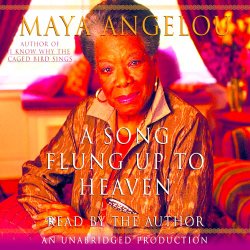
asongflunguptoheavenA Song Flung Up To Heaven
2002

Maya Angelou had a pretty amazing life with many ups and downs. Where before my impression of her was as this iconic individual almost out of sight on a pedestal, this autobiography shows her as fully human with all the attending strengths and weaknesses. One of her many strength is surely her willingness to show the world her weaknesses.

Rather than a single long book, this felt like a themed collection of short stories. Rather than telling the story of her life, she’s telling stories from her life, giving the reader a look at different times and events. Each chapter could potentially stand alone and be well worth reading.


momandmeandmom2Mom & Me & Mom
2013

Wow. Maya Angelou’s mother, Vivian Baxter, sounds like a truly amazing woman who lived her life to the fullest. As tumultuous as Maya Angelou’s life has been, her mother’s seems to have been that much more so. This book focuses on Maya’s relationship with her mother, which was excellent, but I also wish there was a full biography of Vivian Baxter, because just the glimpses we see into her life as it intersected with her daughter are pretty amazing. She was strong and determined and opinionated and just an amazing woman but she was not necessarily a comfortable woman to be around. She seems to have been utterly and completely herself and lived out loud.


lettertomydaughterLetter To My Daughter
2009

This struck me as pretty much a perfect graduation gift (highschool? college? some other major life transition where you’re not sure what you’re going to be doing next?). Many of the chapters are slightly edited versions of chapters from her other books, but they’re collected here for a reason. The overall message of this book is that life is going to throw a lot of different things your way, some wonderful opportunities and some awful experiences, so stay strong and try your best to take advantage of the first and get through the second.


I recommend all of these.

The Man Who Loved Books Too Much

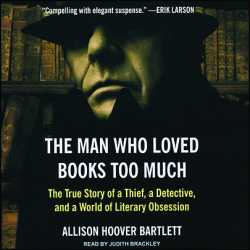
The-Man-Who-Loved-Books-Too-Much-937489The Man Who Loved Books Too Much
By Allison Hoover Bartlett
2010
Read by Judith Brackley

This was an interesting look into the both the rare book collecting community and the criminal mentality as a journalist recounts her research into an unrepentant book thief and the book seller who tracked him down to bring to justice.

It reminded me of a combination of Mr. Penumbra’s 24-Hour Bookstore, with its quirky book lovers, and The Art of the Steal, with its discussions of how con jobs and thefts are both implemented and guarded against. With a side of Marching Powder, with it’s unpleasant main character who just gets less sympathetic the more he tries to explain his perspective.

And actually, regarding that last bit, Gilkey’s (the thief) attempts at gaining sympathy and explaining his rational is so crazy that even the Bartlett (the journalist) is completely taken aback by it. But she’s still more accepting of it than I am, to the extent that her writing almost reads like an unreliable narrator as she first recounts a conversation verbatim and then describes how he still seems like such a nice, polite guy… and I’m going: nope!

But it’s still quite fascinating and does make me want to visit a rare book convention and see the stalls where different book sellers set up with their books with prices that range from less than a $100 to more than $100K.

Lean In: Women, Work, and the Will to Lead

By Sheryl Sandberg

Book Cover: Lean InSo, clearly, there has been a ton of buzz about this book, which tends to turn me off a bit, but when it came up at Rebecca’s work, we decided to bite the bullet and read it (I just beat her to it here on the blog). I entered with super low expectations—I had imagined some sort of 80’s powersuit, dog-eat-dog type of guide—but I have to admit that I very quickly changed my mind.

After reading the introduction, where Sandberg directly addresses how complicated and potentially problematic it can be to try to give blanket professional advice to women across all lifestyle choices and financial situations, I thought, okay, this might not be so bad. After the first couple chapters, I started to find points relevant to my own work behavior, and by a third of the way through, I was completely sold on Sandberg.

Now, I did have to tailor the advice to my own situation, of course. I am not a particularly aggressive or ambitious person, pretty much directly opposite to Sandberg herself, but one of the most important take-aways for me was guidance on how to work with aggressive and ambitious people (especially being vigilant about not letting cultural indoctrination lead me to react poorly to women in particular being this way).

So, I guess I’m just jumping on the very crowded bandwagon to say that this book is both a worthwhile read and actually a pretty entertaining one, as well. (In the acknowledgments page, she thanks her editor “who never heard an anecdote that couldn’t be expanded on” and I’d like to extend my thanks to her, too, since I love a good anecdote!) So even if you don’t think it is your type of book, you may very well enjoy it.

—Anna

How To Cook a Wolf

I can’t remember why I requested How to Cook a Wolf from the library. It must have been recommended online somewhere and I’m sure that the kick-ass title caught my eye, but by the time it came around on my library holds list all I could remember is that it was about cooking during World War II. And I guess you could describe it that way, but that summary really does a disservice to an entertaining, funny, and thoughtful book. No interest in cooking or history is required here–the writing is enough.

MFK Fisher was one of America’s premier food writers (and was also, based on the portrait on the front of the edition I read, a stone fox) was published in 1942, right as food rationing was kicking in, in order to offer readers advice about how to make the best of their meals during the war years. However, she never mentions the war directly, talking instead about how cooks can work to keep away the wolf of poverty, always sniffing at the door. As a result, the book has a timeless feel–she could be talking about about any hard times that stretch to the kitchen, and a lot of her suggestions fit remarkably well into out post-recession world. Especially since the book is not so much about the specific how-to-cook-things instructions, but is more about a philosophy or a way of approaching food that is frugal and reasonable, but also hopeful. So her chapters are called things like How to Rise Up Like New Bread, How to Be Cheerful Though Starving, and How to Comfort Sorrow.

There are recipes involved here and you could definitely cook from this book, although I suspect that the dishes Fisher describes are made for the palates of a previous generation (she wants you to add tomato juice to A LOT of things that I don’t think should have tomato juice anywhere near them). But even when she is talking about specific dishes, her writing reminds you that food is not just about the ingredients, but that it speaks to how we feel about ourselves and about life. For example, before offering her minestrone recipe, she says, “Probably the most satisfying soup in the world for people who are hungry, as well as for those who are tired or worried or cross or in debt or in a moderate amount of pain or in love or in robust health or in any kind of business huggermuggery, is minestrone.” And some of the recipes sounded pretty good–I was tempted by something she recalled from her childhood as War Cake, and at least one blogger out there made this with great success.

The other awesome thing about the edition of the book I read is that it was a re-release from the 1950s, and Fisher had gone back through and added notes throughout the book either agreeing with her original statements or offering an updated perspective. Here’s an example from the How Not To Boil an Egg chapter:

“Probably one of the most private things in the world is an egg until it is broken.

Until then you would think its secrets are its own, hidden behind the impassive beautiful curvings of its shell, white or brown or speckled. It emerges full-formed, almost painlessly {The egg may not be bothered, but nine years and two daughters after writing this I wonder somewhat more about the hen. I wrote, perhaps, too glibly.} from the hen.”

I think I would have liked having cocktails with her. Anyway, it’s a quick read and it’s quite funny, while also reminding the reader how different things were not all that long ago, and that there are likely still tough times to weather ahead. Also, if you would like the read a sexist but otherwise entertaining original 1942 review of How to Cook a Wolf from the New York Times, you can find that here.


Kinsey’s Three Word Review:
Wonderful historical snapshot.

You might also like:
For more great food writing, you can check out Julia Child (obviously and forever) or Ruth Reichl. But if you’d like to read some fiction of the era with a similar voice, try the Mitfords or Barbara Pym.

The Gift of Fear

By Gavin De Becker

Book CoverSeveral years ago, Kinsey introduced me to Ask A Manager, a blog in which an experienced HR professional offers job advice and answers reader-submitted questions. It sounds like it should be dry, but she has a very entertaining writing style, and some of the letters are downright crazy. Reading through some of the older entries, someone had written in about the possibility of a coworker stalking her. She wasn’t sure about it, so she wanted advice about whether to talk to HR.

The advice was a resounding “talk to HR now” and also read Gavin De Becker’s The Gift of Fear, which many of the comments then seconded. They all said that it does a great job of advising when to actually be afraid of violence and what kind of action to take. I thought this would be really helpful to me, since I suspect that I’m often afraid in situations I need not be, and then not at all afraid in situations in which I should at least show a bit more caution.

I found the book both more entertaining than I had expected and less instructional than I’d hoped. Gavin De Becker himself is truly fascinating: his childhood in a violent home has led him to dedicate his life to predicting and preventing acts of violence, and he runs a corporation that provides security for politicians and celebrities. The book is chock full of tabloid-like stories, which reinforced a lot of the same themes (fame leading to complete loss of privacy and increased vulnerability to the people around you) from The Cuckoo’s Calling, which I was reading concurrently.

After the majority of the book details individual cases and De Becker’s analysis of them, the final chapter is a general summation, and was more of what I’d expected from the entire book: advice to the average reader on how to live safely and without unreasonable fear. My main takeaway was that we, as people, tend to put a lot of our energy toward general anxiety, which both exhausts us and does nothing to keep us safe. If we trust our natural sense of fear enough to ignore it until it alerts us, and then pay attention when it does alert us, we would have a much better ability to keep ourselves safe.

My main criticism of the book is that while I think this is excellent advice, I bet this is easier said than done, and most of the book is spent trying to convince the reader of this fact instead of instructing how to change to this way of thinking. I would have even liked some mind exercises, perhaps, that could help with training yourself to a general alertness. He does have several follow-up books so perhaps they go more into that. I am interested in continuing with his books, though perhaps after some more fiction.

Some other interesting asides from the book:

  • The life of a celebrity is INSANE! I truly don’t think that all the fame and money is worth the lack of privacy and the entitlement that the general public feels toward them. He has a story toward the end about a particular celebrity, which I’m not going to spoil, but just believe me that it is crazy.
  • De Becker claims that traffic jams caused, not by accidents themselves, but by people slowing down to gawk at them, are due not to our macabre fascination, but  to an instinctual need to analyze potential danger. I’m not sure I agree, but it makes me slightly less annoyed at those traffic jams.

—Anna

The Opposite of Fate

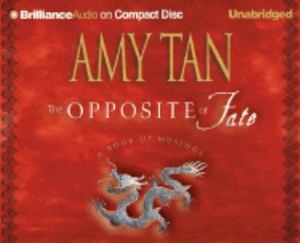
TheOppositeOfFateThe Opposite of Fate
written by Amy Tan
read by Amy Tan
2004

This was a really interesting set of nonfiction essays by the writer Amy Tan, author of The Joy Luck Club and The Kitchen God’s Wife. Since it’s a collection, rather than a single piece, there was a great deal of overlap in the topics being discussed, and that actually made it more interesting for me, rather than less. Because the topics were often the same or similar but the writing time and intended audience varied, it gave very different perspectives on some of the events in her life. And she has had a quite eventful life.

While Tan’s fiction is very much fictional, I can see why so many of her readers think these stories are true. Tan’s real life would fit right in with that of her fictional characters.

I particularly liked her perspective on minority authors, and how they don’t need to be and shouldn’t be required to be minority spokespeople. The best stuff speaks to the human condition, not just the minority condition.

I was reminded of reading The Thousand and One Nights, the set of recursive stories that Scheherazade tells to her husband over the course of three years so as to postpone her execution. Her husband believes that all women and certainly all wives are evil and deceptive and deserve to die before they get the opportunity to betray their husbands. So Scheherazade tells story within story about people being people: men and women and husbands and wives and children and lovers who are variously good or evil or strong or weak or smart or stupid or silly. Because while Scheherazade’s husband believes all women are evil, the lesson Scheherazade is trying to teach him is not that all women are good, but that women are people just like men and each individual must be judged by their own merits.

Anyway, I enjoyed this book, but also think that I will probably not read any of her other books. I like to keep a certain amount of distance when looking at the human condition, and Tan seems to dive right in to look at the difficult and the gritty parts of being human.

The Secret Rooms

I have been in a reading rut since January–I haven’t been able to get into anything, the things I do read are so slow and dragging I don’t want to recommend them, it’s all been very meh. But I recently ran across The Secret Rooms: A True Story of a Haunted Castle, a Plotting Duchess, and a Family Secret by Catherine Bailey–it’s not a perfect book, but I enjoyed it and it gave my reading a kick start.

Bailey is a historian who was granted access to the extensive records maintained by one of England’s aristocratic families so she could write a book about the experience of British soldiers in World War I. But as she starts her research, she find strange gaps in the records, gaps that were clearly deliberately created. She gets drawn into researching these gaps and learning what one of the former Dukes was trying to conceal. The story is told chronologically from Bailey’s perspective, so the reader is discovering what’s missing and what it might mean right along with the author. Am I making this sound boring? It’s actually a page turner, and I found myself thinking things like, “It’s midnight and I have to work in the morning, but I have to read one more chapter to read what she found in the attic!” (Full disclosure: I was a history major, so I might have been predisposed to find a description of primary source research fascinating.)

The reason I’m not jumping up and down and telling everyone to go find this immediately is that I  found the actual solution to the mystery a bit of a let down. This was partly because I’m not sure the mystery could live up to all the hype (spoiler: when the subtitle talks about a haunted castle, it’s being metaphorical). But also, I’m not sure the book did enough to put the Duke’s secret into context for the modern reader. I had to draw on my own knowledge of 20th century British history to understand why the big reveal would have been so scandalous, and I wish the book had included one more chapter that could have better placed the whole situation in its time. (I’m trying not to give away the mystery, but I’ll be happy to discuss more spcific details in the comments.) Also, there were some very detailed descriptions of World War I battles, which really bogged things down and left me feeling like Bailey was determined that the initial research she did on WWI wouldn’t go to waste. But those are really small quibbles. I really enjoyed this and was impressed with Bailey’s ability to make a book about archival research read like a thriller. If you’re feeling a bit of Downton Abbey withdrawal, this might hit the spot.

Kinsey’s Three Word Review:
Intriguing, if anti-climatic.

You might also like: The Daughter of Time by Josephine Tey. This is one of my favorite books ever, and the real reason I wrote this post. Tey wrote a series of books set in the early 1950s about a Scotland Yard detective named Alan Grant. In most of them, he’s out solving mysteries as usual, but in this one, he’s stuck in a hospital bed recovering from a back injury. He’s wildly bored, so a friend decides to occupy him with historical mysteries, and he gets fixated on finding out whether Richard III really killed the two princes in the tower. The entire book is basically him, in traction, thinking, while the folks helping him describe the things they have found in the library. And it is SO GOOD. Really, go read this.

The Rest of 2013

As I said at this time a year ago, when I really love a book I generally write about it here, mostly so I can tell as many people as possible what to do. So you’ve already read here about the best books I read in 2013: Code Name Verity, Eleanor and Park, Me Before You, and Mr. Penumbra’s 24-Hour Bookstore. But there were plenty of other books that I enjoyed but never got around to reviewing on the blog for one reason or another. Rather than let those slip through the cracks, here are the five best books I read in 2013 that I didn’t already mention on the blog:

1) 11/22/63 by Stephen King.

I am not a Stephen King fan, and this didn’t make me want to read anything else by him. However, I love books about time travel, John Kennedy, the 1960s, and Texas, so it’s like this was written especially for me. It’s way too long, and there are some annoying factual errors–some of them might not be noticeable if you’re not from Texas, but at one point he mentions JFK’s daughter, “Carolyn.” Where was his editor? But it was engrossing and I really enjoyed it, even if if weighs a ton and took forever to finish.

2) Miss Buncle’s Book by D.E. Stevenson

Did you know that you can give someone a book via Kindle, and it will appear on their device as if by magic? I love my Kindle. Anyway, one day I got an email saying that my friend Jocelyn had given me this book I had never even heard of, and it is completely delightful. Written in the 1930s, the book is set in a tiny, picturesque English village where Barbara Buncle has written a book based on the people she knows in town. When the book is published, anonymously, and becomes a hit, the townspeople are not too happy to see themselves in print. The whole thing is just charming.

3) You Don’t Have to Say You Love Me and Unsticky by Sarra Manning

The night before I was leaving for vacation this summer I realized I didn’t have enough to read to carry me through my whole trip, so I frantically got on Twitter looking for cheap e-book recommendations. Someone (I can’t remember now who, but thank you, whoever you were!) said that these were $2.99 on Amazon and were entertaining, and I bought them without knowing anything else about them. And I loved them both! I guess you’d call them chicklit–they’re both romances that involve cool, young, urban (London-based) 20-somethings. But I found them unpredictable, and all the characters were much more complex than I was expecting. I think Unsticky was my favorite, but they were both fun.

4) Going Clear by Lawrence Wright

I am OBSESSED with Scientology. As in, I read blogs and message boards where people who’ve left the church hang out, and follow the gossip like it’s about people I know. It’s all just so INSANE. I’ve read a bunch of books about the church, and this one is definitely the best. It swings between detailing L. Ron Hubbard’s life  and the beginnings of the church, and current day leadership and scandals. It a long, detailed book, and I found every word of it FASCINATING.

5) The Good Nurse by Charles Graeber

Do you ever watch those true-crime TV shows, like Dateline ID or 48 Hours? I love those, and this is like a really, really good one in book form. It’s about a nurse who killed people–maybe dozens, maybe hundreds–during his career, and how he was ultimately caught. A quick, but riveting read, that may make you terrified of even the idea of being in the hospital.

And now I’ve started a new list of Books Read for 2014 and am looking forward to a year of more awesome reading.