The Dead Authors Podcast

By Paul F. Tompkins

So, I’m still atoning for my recent lack of posts, but haven’t read any new books to review, so here’s a link instead.

I first heard about this podcast in the comments section of a pop culture blog I follow regularly, and several people there recommended it. I’ve only just started getting into following podcasts, primarily because my job currently entails checking long documents page-by-page to make sure nothing screwy happened during the saving process.

The Dead Authors Podcast is a live performance at the Upright Citizens Brigade Theatre in Los Angeles, and the premise is that H. G. Wells uses his time traveling machine to bring famous, now deceased authors from a variety of times to be interviewed on his talk show.

The actor playing H. G. Wells, drops interesting true-life biographical details of the various authors into the interviews, which are quite interesting. The actors playing the guest authors have done variable jobs of research, so some seem more in character (H. P. Lovecraft) than others (P. G. Wodehouse), which for me makes the podcasts varyingly entertaining. However, in each episode the actors/comedians are having such a good time doing it that it is very infectious.

Of the nine episodes currently available, I’ve listened to four, and “Appendix B: Friederich Nietzsche and H. P. Lovecraft” was by far my favorite, just for the bat-shit-crazy verve that the actors bring to those two authors. It was also the first one I listened to, and each subsequent one seemed to get a little less funny for me (Emily Dickinson, P. G. Wodehouse, Dorothy Parker), which might mean that the podcast doesn’t exactly match my personal sense of humor or that I was getting increasingly grumpy about my current work document. Those two possibilities seem equally possible, quite frankly.

I am still looking forward to listening to the chats with Aesop and Charles Dickens later this week, though.

— Anna

Wait Wait…Don’t Tell Me!

Every Saturday morning, I go grocery shopping, and on the drive I listen to either Car Talk or Wait Wait…Don’t Tell Me!, depending on how early I’ve gotten up (yes, I know, my life is full of glamor and excitement). This morning, I turned on the radio part way through Wait Wait…Don’t Tell Me! where they were chatting with a guy they introduced as the most prominent children’s book author who is also a felon. I’d missed the part where they actually said his name, which may have made it even more engrossing.

He starts by telling his story and it’s like when you are at a party and everyone is chatting, but as one person keeps adding anecdotes that get stranger and stranger, everyone else gradually stops talking and are just hanging on this one guy’s words. I don’t want to give any of it away because it is really worth it to hear it in his own words here.

(Looking up the link, the author is Newbery Honor recipient Jack Gantos, who I’m not actually familiar with, and the interview is a recast from January, but if you haven’t heard it before, it is well-worth a listen and is only 11:22 minutes.)

—Anna

The Edible Book Festival

The Edible Book Festival
An Annual International Festival
April 1st

This is a collective review and an introduction to a whole genre of books that you may not be aware of. These books are not necessarily intended to be read, but rather to be eaten.

The annual Edible Book Festival is an international celebration that always falls on April 1st, i.e. April Fools’ Day. Each city holds its own competition for the most impressive, the most creative, the wittiest, or the puniest “edible books.”

These edible books range from simple puns with food names to elaborate craft creations by pastry chefs and book binders. Amateurs and professionals alike show off their creations and compete for various prizes. They range from hilarious to awe-inspiring.

Some entries are books made of edible material. I entered my local competition with a book made of crepes, and perfect bound with melted cinnamon chips.

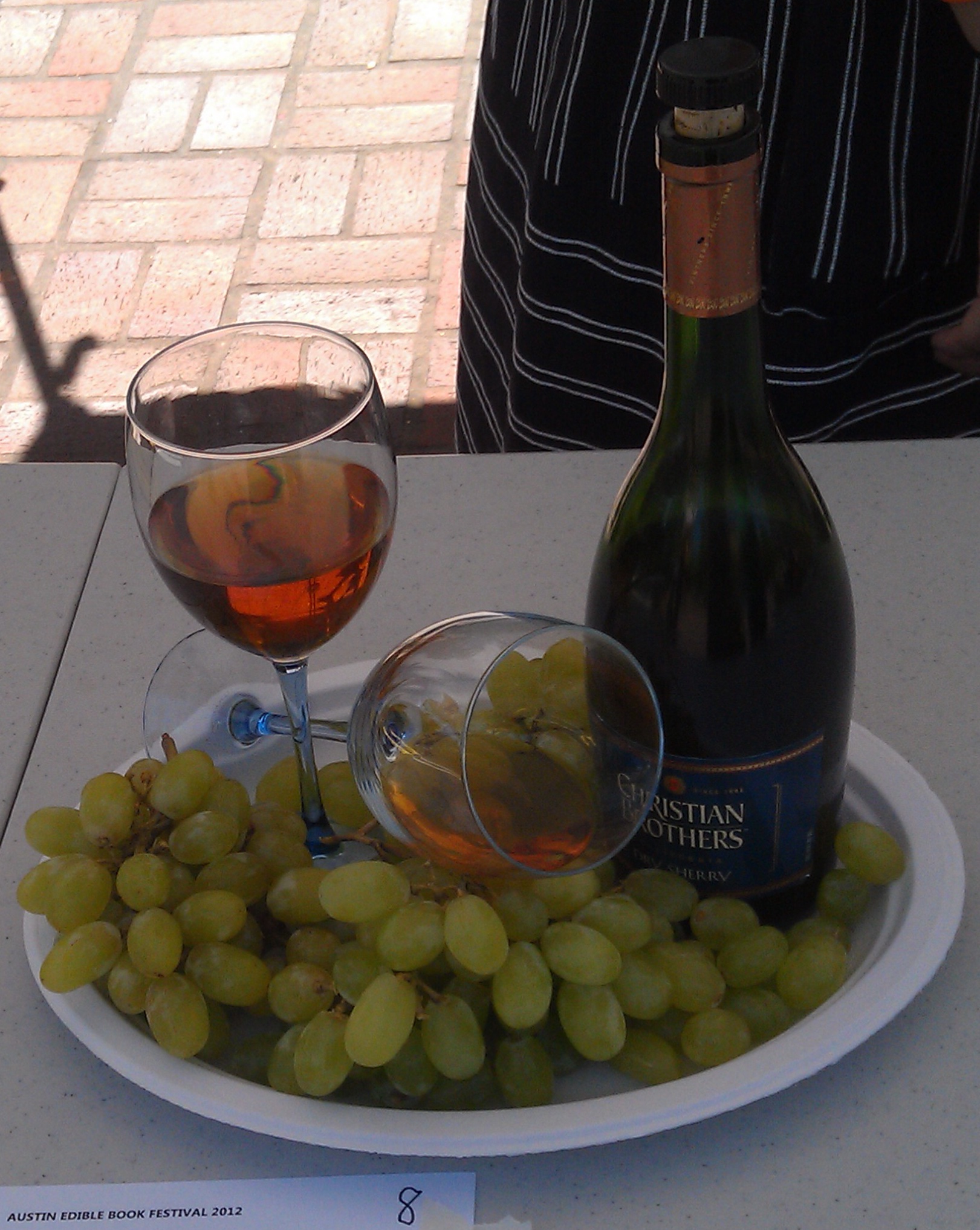
Other entries are puns based on famous book titles. My second entry was “Grape Expectations,” created by a still life of a cluster of grapes, a bottle of dry sherry, and two wine glasses.

I didn’t win any of the prizes, because there were some pretty excellent other entries. Some of them were:
• Tart of Darkness
• War and a Piece of Cake
• A Separate Pea
• Pride and Pretzles
• The Grill with the Flagon of Pink Goo
• A Wrinkle in Lime

It was lots of fun. I mostly ate War and a Piece of Cake afterwards with a few grapes from Grape Expectations. It could be said that I devour books on a regular basis, but normally this is said metaphorically. Not today though.

When was the last time you ate a book?

Jennifer Weiner

I mentioned in a comment on Anna’s post on A Reliable Wife that I should talk about how much I love Jennifer Weiner on Twitter, so let me do that now: I love Jennifer Weiner on Twitter. Weiner is a best-selling author who has been publishing up a storm for the last 10 years or so, and I really enjoyed her first two books, Good in Bed and In Her Shoes. Her later books haven’t done much for me–although I am 99% sure I’ve read all of them I cannot remember the title, plot, or anything else about anything past those first two. Regardless, I think that Weiner is one of the smartest writers out there and I hang on her every tweet. I have the sense that writers today are expected to be on social media and interact with people online as part of their marketing strategy, whether they enjoy it or not. Weiner does social media better than any other writer I’ve seen and she always seems to be having a good time, whether she’s talking about going to the gym or gender discrimination in book reviews.

Weiner certainly spends time on Twitter talking about her kids and live-tweeting The Bachelor (her Bachelor tweets are way more entertaining than the show itself), but she also manages to talk about some very complicated issues in the publishing industry in 140-character chunks. For example, the easiest way to classify Weiner would be to call her a “chick lit” writer, but that’s a loaded word. Saying that something is chick lit immediately conjures up the image of a pink book with shoes on the cover, and a silly story about a silly young woman falling in love in a cute way. The word also has the whiff of bad writing about it. Weiner has addressed this issue head on and has been one of the strongest female voices pointing out the women who write about relationships are disparaged as “chick lit” while men who write about relationships are commenting on modern life. (Example: why wasn’t One Day considered chick lit? If that had been written by a woman, I promise you it would have had a pink cover.) She also argues that books can be well-written but fun at the same time, and points out when authors speak down to their readers by implying that anyone not interested in serious, weighty, depressing modern literary novels written by men is just an uncultured dolt. (She is the one who coined the Twitter phrase “franzenfreuede,” in honor of a much-celebrated writer who seems to have a fair amount of disdain for the reading public.) I always get the sense that Weiner respects her readers, and that she is willing to fight for respect for her work and for the people who enjoy it.

Following Weiner on Twitter is also a good way to keep up on publishing world gossip. She came up in the first place because she’s had an on-going discussion on Twitter about Fifty Shades of Grey, which started as Twilight fanfic. She’s raised a lot of interesting questions about who owns characters and how much authors are (both legally and morally) required to acknowledge when they are inspired by someone else. Weiner also points out the blatant sexism in the New York Times (and other) book reviews, showing how male authors get multiple reviews and glowing profiles while female authors get ignored. She gets a surprising amount of crap for some of these stands, but seems to handle all the flack with a good deal of grace.

Plus, I saw her do a reading once and she was adorable and her husband and baby were there, and they were adorable, and I generally just sort of wanted to be her friend. And while that may not mean I am going to love all her books (although both the book and the movie versions of In Her Shoes are both quite good), I can wholeheartedly recommend keeping up with her on Twitter. She’s fun and smart, and following her makes me feel more fun and smarter.

Words on the Internets

I’m in an odd reading place right now, halfway through a bunch of different books and not feeling like any of them are things I want to review. So I thought instead I’d talk about the other main kind of reading I do: online stuff. Yes, I read Twitter and tiny bits of grammatically-incorrect blog content like everyone else, but there is also great, long-form writing to be found on the Internet. Some is just the online presence of traditional print magazines (like the Texas Monthly article I’m about to recommend) but lots of it is unique to the web and you shouldn’t miss it just because it is not on paper. Here are three of the best long-form pieces I’ve read online lately:

1) The Body on Somerton Beach by Mike Dash

The Smithsonian
blog posted this fabulous article about the decades-old mystery of a body found on an Australian beach. I watch enough 48 Hours Mystery and Dateline episodes to know that most murders are just not that complicated. The murderer is generally a spouse or someone that the victim owed money to, and the stories generally don’t get more exciting than that. I came away from this article convinced that the (still unknown!) truth behind this mystery man is way more exciting than anything I will ever come up with.

2) Winona Ryder’s Forever Sweater by Sarah Miller

It’s an article about . . . a sweater? And friendship? And becoming an adult? I don’t know how to describe it, but I found it sweet and funny and insightful.

3) The Lost Boys by Skip Hollandsworth

Okay, the last two articles were comparatively light and non-traumatizing, so let me warn you that this one is not. This is sad and features a lot of dead and missing children. (That sentence was for my friend Liz. She and I recently went to see The Woman in Black and agree that it needed some sort of warning that the central plot point involved MULTIPLE dead children.)  This Texas Monthly article about a serial killer who operated in Houston back before any one talked about serial killers, is amazing and heartbreaking. It specifically focuses on how, prior to the Internet and social media and easy communication between law enforcement agencies, it was almost impossible for the Houston police or the community to connect a series of disappearances of young boys. Instead, the police dismissed the individual cases as runaways and grieving families were left with no answers for decades.

Finally, I know I just said that I hate watching videos on the computer and I do, but this one about the what books in bookstores do at night when no one is around is worth making an exception for.

some readings about readers

I’ve run across a couple of readings this past month, celebrating readers (sort of).

The first was an article in Scientific American Mind magazine, titled “In the Mind of Others,” and subtitled “Reading fiction can strengthen your social ties and even change your personality.”

The article initially left a bit of a bad taste in my mouth, seeming to say, “You know that weirdo that is always reading alone? They might not be as dumb as we all thought!” The intro to the article spends a bit of time describing insulting assumptions about readers that I hadn’t totally realized were common (“people who read a lot of fiction are socially withdrawn bookworms who use novels as an escape from reality”), and then debunking them.

After I got over my initial bristling, though there were some interesting accounts of the experiments themselves. One tests viewers’ abilities to recognize emotions from just photos of eyes, with the premise that fiction-readers are more empathetic to other people’s emotions and will thus get better results.

Over the holidays, my whole family took it (being a very quiz-happy group), including one nonfiction reader and one non-reader, and all six of us fell comfortably in the average zone, so our very small pool did not demonstrate significant results, but did make for an interesting hour as we all compared our results. (There was some extensive joking that men seemed to read almost all female expressions as “desiring” or “flirtatious.”)

The main conclusion I took from reading this article was that I am not partial to reading scientific articles. (The four-and-a-half page article took me three days to actually get through.)

The second reading, forwarded to me by a friend who had also sent it on to her son, was a blog entry. Called “A Girl You Should Date,” it cuts through all the scientific pedantry that I’d previously been struggling through in Scientific American Mind, to create a very poetic epistle celebrating female readers. I don’t agree with every single thing it says (I do not like to be asked what I’m reading while I’m currently engrossed in a book), but it makes me feel good about myself and I’m glad that it got put out there.

—Anna

All These Things I’ve Done

I think I’ve mentioned here how much I love young adult books, but just to reiterate: I love them a lot. There are loads of YA books out there and, as with any genre, it’s key to have a trusted source to help you sort out the pearls from the muck. My favorite YA source is Kidliterate, which reviews picture books for little kids but is also a fabulous place to learn about new and upcoming books for teens (and grownups). The site’s creator works for an independent bookstore, so she reviews things from a bookseller’s perspective, meaning you sometimes get interesting inside information on the expected audience or potential controversies. But she never spoils the books, so there’s no need to worry about getting too much information. I was thrilled to see that the Kidliterate folks have posted a whole flurry of holiday recommendations, including a list of YA books with “awesome teen girls” as the main character. I’ve immediately put every one of those on my library list, but until they start coming in I can talk about Gabrielle Zevin’s All These Things I’ve Done.

Zevin has written a number of other YA books, including 2005’s Elsewhere. That one is about a girl who dies and ends up in the afterlife, where you age backwards until you’re a baby and you are born again back into the world. Which sounds dumb, frankly–when I heard the description of this books I remember thinking clearly that it was Not a Book for Me. But a friend with a solid YA track record recommended it, and I found it charming. It was a bit like reading a fairy tale or a fable, but at the same time had a very matter-of-fact attitude towards death and the afterlife that never made me, as an extremely nonreligious reader, uncomfortable.

All These Things I’ve Done is about Anya Balanachine, a teenager living in New York City in 2083. In this particular dystopian future there are shortages of everything, the city is rife with crimes–the standard. More specifically to this universe, coffee and chocolate have been outlawed and Anya’s father made their family fortune as a crime boss in the chocolate underground. Both her parents are now dead, so underage Anya is responsible for keeping her family together and trying to keep them out of trouble and out of the family business. It’s YA, so there’s also a cute boy and a school dance.

I enjoyed the book and it had some lovely touches. Although it’s set in the future, Anya’s world feels very accessible, close enough to our world to be easy to imagine and different in believable ways. For example, producing new materials is so difficult that the teenagers wear vintage clothes when they go out–this is both logical and let me imagine that Anya and her friends were wearing clothes from my closet. And the New York the characters live in is certainly different, but still recognizable. I also really like the matter-of-fact way the book handles how Anya feels about her father’s organized crime involvement and how it affects the way other characters treat her. It’s clearly something she struggles with, especially as the book goes on, but not something she can afford to get overly dramatic about. Anya’s relationships with her sister and brother also feel very real–loving, but occasionally irritated.

I had one major issue with the book, however: I didn’t realize until I was nearly halfway through that this is first book in a series (the Birthright series) and it reads that way. As much as I enjoyed All These Things I’ve Done, it felt like a really long introduction to a story. Just when I started thinking to myself, “All right, NOW we can get going!” the book ended. Which bodes well the book two, whenever it comes out, but leaves book one as an unfinished story in my mind. I know this is probably my own fault for not researching enough before I started reading, but am I going to have to start assuming that every YA book is part of series unless I am specifically told otherwise? Look, I love being able to read two or three or more books about characters that I love, but I do need for those books to stand alone. The Hunger Games may have always been planned as the first in a trilogy, but it is a complete, satisfying story with a sense of conclusion and ending. Or, you know what, it doesn’t necessarily even have to stand alone. The second two Hunger Games books can’t stand by themselves, and I adore the Mortal Instrument books by Cassandra Clare, which are not  independent stories and are full of cliffhangers. Maybe the real issue is that I need to feel like I got my money’s worth, so to speak, out of the book. I want to feel like it was a piece of writing worth my time. And this one felt like a very long introduction to characters who are going to get to the real action later.  I think my suggestion here is to go read Elsewhere now, and then come back and read the Birthright series in a few years when more books are out and the story feels more like a meal and less like an appetizer.

And now I am off to wrap a million presents and celebrate with my family. Happy holidays to all of our tens of readers and here’s to a 2012 full of good books!

Christmas Reads

Now that Thanksgiving is over I can officially start one of my annual holiday traditions: the rereading of the Christmas books. I don’t tend to decorate much, but there’s a certain set of books that makes it feel like Christmas to me.

Miracle and Other Christmas Stories by Connie Willis
I am alternatively thrilled and aggravated by Connie Willis. To Say Nothing of the Dog is one of my favorite books, but Blackout and All Clear were interminable (this does not mean that I didn’t cry at the end, because I totally did). But I adore this book of Christmas short stories and read it every year. Each story has at least a hint of science fiction about them, but the stories span the range of emotions. There’s a romantic comedy that involves aliens invading at Christmas and a haunting thriller about three modern-day wise men driving across the U.S. in a blizzard. In my favorite story, Mary and Jesus accidentally stumble through time into a modern day church during Christmas preparations, and a busy mom has to help them get back to Bethlehem. Plus, the forward to the book includes Willis’s own list of favorite holiday books and movies.

The Lost Art of Keeping Secrets by Eva Rice
This one is not overly Christmas-y–although it does feature a Christmas scene–but  for some reason it puts me in a cozy, holiday state of mind. Perhaps because the story about British teenagers in the 1950s is so pretty and candy-colored that it feels like a fairy tale. I’ve read about a trillion books set in WWII England, but hardly any about the generation that came of age immediately after the war, so this offers a slightly different perspective.

Olive, the Other Reindeer
Yes, it’s a kids’ book, but it’s got a small dog! Named Olive! It’s just charming.

Comfort and Joy by India Knight
This just came out last year, but it immediately earned a permanent place on my list of holiday books. There’s not a lot of plot here, it’s just the story of a modern-day, many-branched English family trying to sort out how to celebrate Christmas. I adore India’s blog and love following her on Twitter because her writing makes you feel like you’ve just sat down with her to have a cup of tea and tell scandalous stories about all your mutual friends. This book feels exactly the same way and is full of all sorts of wonderful family and holiday details. I had to order mine from Amazon.co.uk last year, but now you can can get a nice, affordable American version.

Also, I think all of us would happier people if we all rewatched While You Were Sleeping during this time of year.

I Am a Zombie Filled With Love

by Isaac Marion

A friend sent me a link to a short story available online, which she found from The Bloggess:

I Am a Zombie Filled With Love is the sweetest, zombie-perspective love story you will ever read! It isn’t very long, so jump over there and read it right now! I was thrilled to read at the very end that it has become a full-length book called Warm Bodies that will be available in the U.S. in March. It is definitely going on my to-read list. I can’t wait!

Amended: It is out right now! It is being shelved at my library at this very moment, according to their website! I’ll have to run over there as early in the morning as I can drag myself out of bed (which probably means right at the crack of noon). I’m usually pretty frugal in my use of exclamation marks, but I’m just so excited!

More links, and why I sometimes don’t listen to people

I’m not quite ready to talk about The Magicians yet (although it’s still awesome), so it’s links again. This time I thought I’d share another review site I like: Asking the Wrong Questions by Abigail Nussbaum. She reviews books and movies and TV, focusing mostly but not exclusively on science fiction. Her reviews are tremendously detailed and thoughtful, and I appreciate that she’s in Israel and provides a non-American, non-European point of view that I don’t come across that often. I have to admit that I sometimes choose not to read her when she’s reviewing something I really love (Doctor Who, Persuasion, Community), because she doesn’t pull any punches. I’ve been known to describe her as “not liking anything,” but that’s not really fair. She just expects a lot of her media and isn’t willing to give anything, even a show or book she likes, a pass when its lazy. Which is great, but I’m not very good at disregarding something once I’ve read it, and sometimes I just want to watch a Doctor Who episode without worrying about the character inconsistencies. But I am always interested to see what she’s reading and watching and you can damn sure that if she gives something a good review, it is a really solid piece of media.

Today I specifically want to point to a review she did at Strange Horizons comparing Mechanique: A Tale of the Circus Tresaulti by Genevieve Valentine and The Night Circus by Erin Morgenstern. I haven’t read Mechanique yet but I love Valentine’s blog. (Her movie reviews are priceless, as are her critiques of Miss Universe contestants’ costumes and her theory that Keanu Reeves is immortal.) I did recently finish The Night Circus and I thought about reviewing it here, but could never quite figure out what I wanted to say about it. I enjoyed reading it. It was very well constructed and featured some beautiful set pieces. But even after reading hundreds of pages, I didn’t have any stronger reaction to it than that. Abigail captured it perfectly in her review when she said that The Night Circus doesn’t inspire much emotion because the characters don’t feel like human beings. And it’s true, at no point did I feel overwhelmingly invested in the characters (with the exception of Bailey and I ended up being worried about how his story ended–join me in the comments if you’ve read this and want to talk about my concerns about Bailey!). At one point Abigail says the book has a sense of “weightlessness” and I think that’s perfect. The Night Circus has some really stunning imagery in it, so I’d recommend it to people who enjoy that sort of it-paints-a-picture writing, but based on the Strange Horizons review I’m thinking that I’ll move on to Mechanique.