The Grandmaster of Demonic Cultivation by: Mo Xiang Tong Xiu

mdzs coverThe Grandmaster of Demonic Cultivation 
Written by: Mo Xiang Tong Xiu
Translated by: K.san
2018-2019

This is a phenomenon.

I first discovered this because someone I follow on tumblr was posting a steady stream of amazingly beautiful screencaptures of beautiful people and scenes from the show, The Untamed, showing on Netflix.
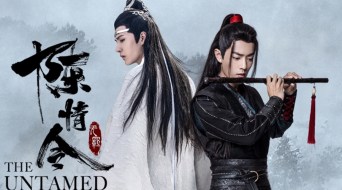
theuntamed

I convinced Anna to try it out with me, and we were quickly enthralled and had to watch all 50 episodes even though the plot was confusing enough that we had to read the episode summaries before watching each episode and then discuss the events to make sure we understood what was going on.

It wasn’t helped by the fact that we were dealing with names that we weren’t used to, so mostly gave everyone a nickname: Protagonist, Beloved, Beloved’s brother, Protag’s brother, Protag’s sister, Red girl, Red guy, Fan guy, Douche, Psycho, Douche’s Cousin who makes Douche look better in comparison… etc.

It says something about how charismatic the acting is that we were drawn in despite the initial confusion.

So, we watched all 50 episodes and it was done. There was an amazing and beautiful conclusion. But also: what was I going to do with my evenings now????

I mean, the answer is clearly: fanfic. But before that, I discovered was that the tv show was based off a book, Mo Dao Zu Shi, that has a freely available online fan translation, Grandmaster of Demonic Cultivation by K.san, of all 113 chapters plus 13 “extras”.

There is action and adventure and mystery and intrigue and magic and it is so freaking funny. What was funny in the tv show is ten times funnier in the book because we get the internal monologue of our main character. What was subtext in the tv show is very much text in the text. On the other hand, what was known-but-unspoken by the characters in the tv show is dumb-ass boys being absolutely terrible at communication in the book.

Anyway, this is an east asian fantasy world with swords and magic and ghosts and a variety of supernatural spirits that are probably more culturally known in China but easy enough to just go with as an American reader.

The basic premise, is that a much reviled and yet also much respected character was killed some sixteen years before the start, but has been brought back to life as part of a revenge (on someone else) plot. Wei Wuxian finds himself alive again, somewhat insulted that his reputation after death had gotten so bad that someone brought him back to life to kill their family. And things quickly spiral from there, because sixteen years is just long enough for the next generation to start dealing with the world but not enough for the earlier generations to have forgotten Wei Wuxian or moved on.

There’s a lot of flashbacks in the book as we alternate between seeing what’s going on now, with the newly alive Wei Wuxian, and what happened prior to his original death, and how it got the point where he was killed in a coordinated attack. Meanwhile Wei Wuxian and Lan WangJi have the most slow-burn, mutual-pining, idiot-boys-cannot-communicate, romance going on in both time periods.

It also starts off quite funny, and gets progressively darker as it goes along, even as it maintains some of the humor, and finally breaks through into lightness again at the end.

All this goes to say, I loved this and I want to recommend it to everyone who thinks they might like this kind of fantasy action shenanigans, but if the genre is not your thing, then I’m not sure if the book is good enough to break through. But maybe give the tv show a try just to see.

However, a couple of warnings:

Warning #1: the translation is very, very good for an amateur, but is rough for a professional. I did find the translator notes quite interesting as she discussed some of the word choices she made. And since she was posting the translated chapters as she went, it’s also interesting to see how the translations changed and improved over the course of the full book.

Warning #2: there is explicit sex near the end of the book and even more in the “extra” chapters after the story arc is complete. The scenes say more to me about the author’s kinks rather than staying true to the characters. Since the kink in question, playing with consent issues, is kind of my anti-kink, even when it’s clearly desired by both, I didn’t care for it and look forward to fanfic fixing that particular aspect.
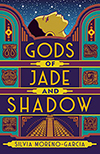
Gods of Jade and Shadow

By Silvia Moreno-Garcia

Gods_of_Jade_and_ShadowOoh, this book is so good (and how gorgeous is that cover)! It really does stand as uniquely its own, but all the descriptors I can think of are derivative of other books: it’s like American Gods but gentler, funnier, and somehow just more feminine; it’s got elements of both The Last Unicorn and The Labyrinth, a couple of my favorite pieces of media. Basically, they all have common motifs of mortals discovering the unexpected power they have to either help or resist immortals.
Set in 1920s Mexico, Casiopea is the poor relation in a wealthy family, in her own words: treated like Cinderella, but without the sweetness of character that earns Cinderella her eventual reward. She instead balances duty and resentment in a very recognizable way and chafes at her endless days of drudgery until she accidentally releases a God of Death from imprisonment. At which point, she is basically conscripted in his search for vengeance against those that imprisoned him, leading her from her small town, where her family at least was a large fish in a little pond, into progressively larger cities and exposing her to an array of beings, both natural and supernatural.

This is where it gets tricky. Our heroine is human in the most empathetic way, trying to do what is right while struggling with all the human weaknesses of anger and anxiety, while the god is charming in his own aloof, uncompromising way. The two are supernaturally connected for the duration of this quest, to the peril of both. There is a predominate theme, similar to in The Last Unicorn, of how lengthy exposure to mortals and the mortal world weakens/tarnishes immortals so that they are never as pure as they were to begin with, and that is very effective suspense for me.

A serious trigger warning, however: this is a God of Death we are talking about here, so there is plenty of death abounding, including animal sacrifice and suicide. Now both of those are things that I’m pretty sensitive to, and I was able to read it without trouble because they happen quickly and matter-of-factly instead of really delving into the gritty details, but take care.

While I was reading this, Rebecca sent me a link to a Tumblr post, which gives a variety of excellent recommendations for “Adult fantasy books not by straight white men!” The poster organized it by general tone, which is so, so useful. Under “Urban Fantasy,” one of my favorite sub-genres, she recommends a vampire noir in Mexico City by Moreno-Garcia, so that’s definitely on my to-read list!

Similarly, Rebecca then also sent me a list to “Become Very Well-Read Without Reading Anything by a Man” where you can see how many well-known (not necessarily classics) books by female authors you’ve read, and I love an opportunity to show off my reading! This was not that opportunity because I’d only read 36 out of the 250 books, but it did give me a lot of additional recommendations to look forward to!

— Anna

The 1619 Project

I wasn’t planning to borrow from Kinsey’s occasional tendency of reviewing something that everyone has already read and talked about, but Rebecca assured me that it hadn’t crossed her path until I told her about it.

So…the 1619 Project:

In August of 1619, a ship appeared on this horizon, near Point Comfort, a coastal port in the British colony of Virginia. It carried more than 20 enslaved Africans, who were sold to the colonists. No aspect of the country that would be formed here has been untouched by the years of slavery that followed. On the 400th anniversary of this fateful moment, it is finally time to tell our story truthfully.

The more I read as an adult, the more I realize just how sanitized the history I was taught was, and most particularly when it comes to slavery. This project is a collection of writing looking at the history of slavery, how it has roots in every sector of our country, and the ongoing harm it does today. It includes over a dozen pieces – mostly written essays but also poems, short works of fiction, and photo essays. It is large in scope, both in size and range of topics, and it is a daunting read that I honestly wasn’t sure I could manage.*

Then I started seeing some of the buckwild responses from conservatives who very clearly had not read any of it, and decided that I had to read it, out of spite if nothing else (for proof of what I’ll read out of spite, see Atlas Shrugged). And no lie, it is a hard read, though I suspect less difficult for black readers, who may mostly feel relieved to see published acknowledgement of what they already knew. I’ve set myself to read just one of the entries each day, so I’m only four in at the point of this review, but I feel like every sentence hits me like a ton of bricks:

This violence was meant to terrify and control black people, but perhaps just as important, it served as a psychological balm for white supremacy: You would not treat human beings this way. The extremity of the violence was a symptom of the psychological mechanism necessary to absolve white Americans of their country’s original sin.

— from “Our democracy’s founding ideals were false when they were written. Black Americans have fought to make them true.” by Nikole Hannah-Jones

Continue reading

eNewsletters

I promise that I’m going to review an actual book eventually, but in the meantime, here’s some more links!

We’ve all mourned the closing of The Toast on this blog (though thank god for the archive!), and before it closed, the editors tried multiple ways to make it financially sustainable but not exclusive without success. E-newsletters may be the answer! Both Nicole Cliffe and Daniel Mallory Ortberg, founding editors of The Toast, have ones that mirror their respective writing styles. Both newsletters are primarily for a paid subscription, though include periodic public posts for people who either cannot afford the subscription or want to read some samples first.

Nicole Cliffe’s daily newsletter, Nicole Knows, lists interesting reads from around the web, including long-form articles, YouTube videos, tweets, advice column letters, and my favorite, particularly juicy reddit posts. She also recently published an interview with Alanis Morissette in Self Magazine, and I’ve never been a huge fan of Morissette’s music, but reading these two smart and compassionate women talk about feminism and motherhood and individuality was a real inspiration.

Daniel Mallory Ortberg’s newsletter, The Shatner Chatner, is not as regular as daily, but several times a week, and my best idea is that it spans whatever he happens to be thinking of that day. It is often very funny, often very insightful, and sometimes so educational on trans issues that I’m scrambling to keep up.

And finally, this isn’t really a newsletter in the same way as the above, but R. Eric Thomas, an incredibly funny writer for Elle.com, writes a weekly tinyletter, in which he collects his 3-4 articles for Elle.com with some additional commentary or personal anecdote. They are free to subscribe to, and I look forward to them every Sunday as the only thing making current politics even remotely bearable.

—Anna

Running from COPS

So, I’ve moved to Michigan! My life got increasingly frantic leading up to the move, and now I’m surrounded by boxes, but things are calmer. I’m currently reading Rewind, the fourth in the Pinx Video mystery series, which continues to be a delightful mix of noir-ish detachment and absurdist humor. It is a perfect counterbalance to the stress of packing all of one’s belongings up in boxes and then having to unpack them again.

Running_from_COPSHOWEVER, have I got a podcast recommendation for you! It is fascinating, intense, and disturbing, and I have to take it a little at a time. “Running from COPS” is a widespread look at the show COPS, which I was shocked to realize has been on for 30 years and has aired more than a thousand episodes.

I was never a huge fan of the show, but also didn’t think very hard about it, assuming it was just a normal look at law enforcement, and how you viewed the show depended on how you viewed law enforcement in general. Which, according to the podcast, is an entirely intentional impression created by the show and has had truly insidious effects on the evolution of law enforcement.

The podcast interviews the creators of the show, network producers, retired police, lawyers, and most importantly the “criminals,” who are often found not-guilty after the cameras have turned away but will forever be “the person on COPS”. The creators ask a lot of very good questions and then follow up with the people that can answer them, which is the very best of critical-thinking media these days.

I think, like a lot of complacent, middle-class, white people, I had generally bought the argument that while flawed, law enforcement was generally trying its best, and the last decade or so has been a continual waking up to a very different reality. This podcast, for me, has been yet another wake-up call on how methodically the institution of law enforcement has been normalizing and even celebrating human rights abuses. It is not always an easy listen (honestly, in this day and age, just listening to the audio from episodes is upsetting), but I highly recommend it, not only because it is an important eye-opener but it is just great podcasting!

Great Literary Takedowns

HunterSThompsonI can’t remember what social media recommended this, but a while ago, someone linked to this truly incredible ‘eulogy’ that Hunter S. Thompson wrote for Nixon on his death:

Some people will say that words like scum and rotten are wrong for Objective Journalism — which is true, but they miss the point. It was the built-in blind spots of the Objective rules and dogma that allowed Nixon to slither into the White House in the first place. He looked so good on paper that you could almost vote for him sight unseen. He seemed so all-American, so much like Horatio Alger, that he was able to slip through the cracks of Objective Journalism. You had to get Subjective to see Nixon clearly, and the shock of recognition was often painful.

It is also shockingly reflective of the current president, as well. In these terrible times, I’ve been really missing the political writers like Molly Ivins, who could make me laugh while exposing the most outrageous politics, and we need more of them. I hope to God someone writes something similar about Trump on his demise (or sooner).

* * * * * * * * *

MarkTwainWhen I was relating this to my mom as perhaps the best literary take-down I’d ever read, she reminded me of Mark Twain’s savaging of Fenimore Cooper, which if you haven’t read, you need to go do right now:
We must be a little wary when Brander Matthews tells us that Cooper’s books “reveal an extraordinary fullness of invention.” As a rule, I am quite willing to accept Brander Matthews’s literary judgments and applaud his lucid and graceful phrasing of them; but that particular statement needs to be taken with a few tons of salt. Bless you heart, Cooper hadn’t any more invention than a horse; and don’t mean a high-class horse, either; I mean a clothes- horse. It would be very difficult to find a really clever “situation” in Cooper’s books, and still more difficult to find one of any kind which has failed to render absurd by his handling of it.

Honestly, is there anything better than a truly skilled author using their gifts for maximum snark?

* * * * * * * * *

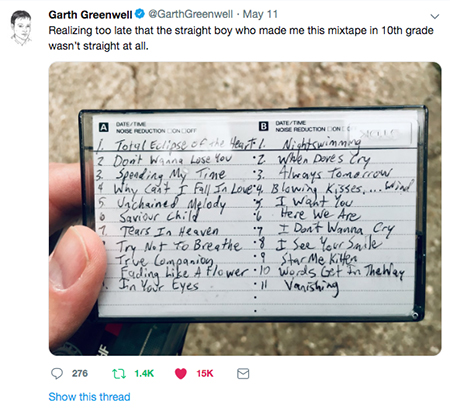
Unrelated, but since I’m linking to things, I’ve been obsessed with this tweet all week:

GarthGreenwell

Some good samaritan put together a spotify list that I’ve been listening to all week, and just mulling over how hard it is to feel vulnerable in your teens, trying to make meaningful connections with other people. And, of course, it is just a total shot of pure 90s teenage longing!

— Anna

short stories on tumblr

Since the management of tumblr appears to be going insane as they implement rules to destroy their own user base, I’m going to recommend these stories while they’re still around to link to. None of these are fanfic, but they’re very much in that mode, ie, much more character driven than plot-driven.

How to Bury a Gentile
by Tentacular Investigations

This is a really interesting short story in the intersection of religion and supernatural fantasy, that strikes me as similar in tone to Manly Wade Wellman’s short stories in Who Fears the Devil?. If you haven’t read those, then you absolutely should as well. But in this as well as in Wellman’s stories, spirits and humans have intersecting needs and if you’re lucky, you can deal with the situation that occasionally arise without ever learning what the consequences of failure would have been.

In response to the prompt: You are the wind’s interpreter. What’s it saying? 
by CaffeineWitchcraft

This is hilarious and while I wouldn’t mind a full novel about it, it’s also a very cute if somewhat sketchy short story of high fantasy style with kings and castles and swords and sorcery. And it opens with the line, “Tell Miles, the wind whispers, that he’s a little bitch.” Which just cracks me up.

In response to the prompt: With all the instances of people getting retrieved from the fae, I think it would be pretty interesting to free a person that you aren’t looking for. 
by ElsewhereUniversity

This is really quite short, less than a full scene even, maybe half a scene?, that is pretty much exactly what the prompt says. And it’s hilarious!

The Tomato Thief by Ursula Vernon

The Tomato Thief
by Ursula Vernon
2016

Some time ago I bookmarked this short story, intending to read it later, and then mostly forgot about its existence until I was searching through some old bookmarks wondering why I had so many of them.

It’s really good! It’s sort of magical-realism, fairy-tale like, with a cranky old woman as the main character and is a delight.

It reminds me of Zen Cho’s short stories, including “Prudence and the Dragon” which Anna reviewed previously, and the stories in “Spirits Abroad” which apparently I never got around to reviewing here, but are also fabulous.

But you should go ahead and read The Tomato Thief here.

Zooniverse

Wildwatch_KenyaAs the days get colder and the nights get longer, treat yourself to some beautiful, sunny vistas of the Kenyan safari. I can feel my blood pressure sinking with each photo, regardless of whether they include any giraffes or not.

Zooniverse is a site that features projects in need of crowdsourcing large amounts of data. Wildwatch Kenya, the one I’ve gotten particularly attached to, is tracking giraffes in a research project for conservation. They have thousands of photos taken by motion-sensor cameras. Most of the photos have nothing in them, being triggered by wind or a bug or something, but the scenery is gorgeous, and the excitement of finally seeing a giraffe, zebra, or elephant is a bit ridiculous.

There are dozens of other wildlife-photo-based projects, but I also got interested in transcribing historical documents. You know various novels, like Jane Austen’s, where some character is complaining about another’s handwritten letters? I’m now full of sympathy! The transcribing also gives such a realistic look into the time periods from a more everyday perspective than is usually shown in the history books.

I started with some letters from Boston Public Library’s Anti-Slavery collection, and while it wasn’t as historically inspiring as I’d hoped, it was actually pretty thrilling to read the more trivial and petty infighting among the famous abolitionists of the day. That particular project is currently being updated, so I switched over to transcribing handwritten surveys from soldiers in WWII, and it is also fascinating, but grimmer.

All of the projects are particularly addictive because they’ve taken the Netflix approach: when you’ve finished identifying a photo/transcribing writing and submit it, the next one just pops right up! I’ve had many late nights this past week trying to tear myself away from “just one more”.

art history from The Met

I wasn’t particularly aware that The Met (aka The Metropolitan Museum of Art) had its own publishing house, but I’m certainly not surprised. It focuses on art history books.

What does amaze and delight me is that they’ve apparently decided to put their out-of-print books online for free, available to read online or download.

Sweet!

As of writing this, there are 569 books available in their entirety. From just a random pass, they include:

The Academy of the Sword: Illustrated Fencing Books 1500-1800

Peruvian Featherworks: Art of the Precolumbian Era

Words and Images: Chinese Poetry, Calligraphy, and Painting

I haven’t read any of them yet, but having discovered this small archive of amazing books, I figured I needed to spread the word. Cheers!