Sin City Series

By Frank Miller

So, after reading Frank Miller’s A Dame To Kill For, I rewatched the movie “Sin City” and then decided to read ALL the Frank Miller Sin City graphic novels. I went on a wild reserving spree at the library; the library rental system just sort of lists “Sin City Frank Miller” for each of the volumes, so I had to do scattershot holds on all the books. I ended up reserving multiple copies of some volumes and no copies of the first volume until about a month after all the rest. So, I’ve been reading them as they come, completely out of order, but I’m going to quickly review them all in order here.

Quick caveat upfront: Frank Miller is not to everyone’s taste, so while I love the comics, I can’t indiscriminately recommend them to everyone. If you don’t like broad noir stereotypes and ultra violence, it doesn’t matter how well it is done, this is not going to be for you. For the rest of us, here’s my rundown, with semi-spoilers (revealing a character is in volume 5 sort of spoils that he doesn’t die in volume 4, I guess? Although, actually, only sort of. I was reading them out of their published order, but the volumes weren’t written in strictly chronological order, either):

Volume 1: The Hard Goodbye

The first panel of the book and the series:
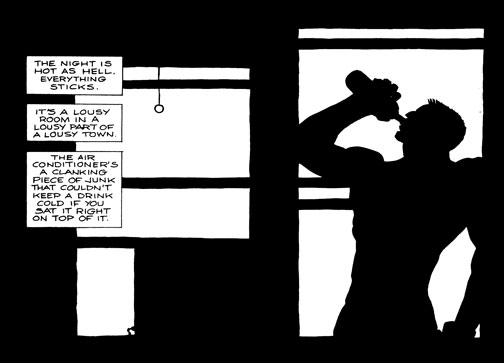
First Panel: Sin City

It doesn’t get more classically noir than that. Most noir mysteries are sweltering hot; sometimes they are bitter cold, but mostly roasting. Reading this issue last, I can tell that it was Frank Miller’s first (he is still finding his style for this series) and I can understand why it made such a splash in the comic book world. Everything is just so in-your-face: the violence, the machismo, the sex – I think it was probably unlike anything else people were reading at the time.

Book Cover: Sin City Volume 1

The Hard Goodbye is Marv’s (Mickey Rourke) story from the “Sin City” movie, the plot line with the most action but the least explanation, so I was happy to get more of the backstory this time around. With a couple of well-placed lines, The Hard Goodbye also gives a very quick overview of the origins of Sin City itself, which was most welcome after reading the other six volumes. At the end of this volume, too, I realized that The Hard Goodbye bookends at least several other volumes, with several of the subsequent volumes occurring to other characters within the span of time of this volume.

Volume 2: A Dame to Kill For

Previously read and reviewed here, inspiring this extended post.

Volume 3: The Big Fat Kill

Book Cover: Sin City Volume 3

The Big Fat Kill is Dwight’s (Clive Owen) story, starting with him in Shelly’s (Brittany Murphy) apartment while she argues with her ex-boyfriend (Benicio Del Toro). I kept thinking that I had already read this one, but then realized that it is literally the same as the movie, frame by frame, line by line. It’s really quite impressive.

It also made me appreciate the movie even more. By entwining volumes 1, 3 and 4, they made for a diverse group of characters and quick pace that the original comics seem to lack a bit in comparison.

Volume 4: That Yellow Bastard
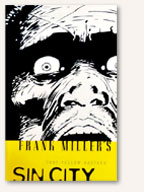
Book Cover: Sin City Volume 4

That Yellow Bastard is the Bruce Willis/Jennifer Alba story line from the movie. This is probably the most…problematic of the Frank Miller stories (and that is saying something). Spoilers for both the book and the movie, of course:
Continue reading

Femme Fatales: Femme and A Dame To Kill For

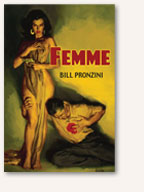
Femme

By Bill Pronzini

Book Cover: FemmeAh, Bill Pronzini. You were one of my early introductions to pulp mysteries, and I have a lot of left-over affection for you, but I’m afraid I may have outgrown your nameless detective.

I hadn’t read a Bill Pronzini novel in at least 15 years, but I ran across this very short novella in the new releases shelf at the library and picked it up, as I do love a femme fatale! I also had very fond memories of Pronzini’s nameless detective series from high school; they are somewhat run-of-the-mill novels, but are told in first person by a detective who is never named (I was also at the time watching Clint Eastwood’s “The Man with No Name” series, so it was a bit of a theme).

I read Femme in the space of one delayed flight, so probably over 3 hours total, and it was the fluffiest of fluff. I have a bit of a problem with novellas, actually. Whereas authors seem to put extra effort into short stories to be concise and compact as independent entities, novellas have a tendency to just come off as reading like general outlines for a future novel, and this one was no exception.

The plot, characters, and setting were quite generic, which is especially problematic when it comes to a femme fatale. A woman who uses her very femininity to lure men to death and destruction really needs to stand out. This particular femme seemed no different than the average murderess on any given Law & Order episode. I get that it is more difficult to make violence stand out in this modern age, but that’s what makes writing a femme fatale such a challenge.

Now, if you want someone who is up to that challenge:

A Dame To Kill For

By Frank Miller

Book Cover: A Dame to Kill ForFrank Miller’s A Dame To Kill For is the basis for the new Sin City movie coming out next year, and coincidentally the only Frank Miller graphic novel that Rebecca owns. I really enjoyed the first Sin City movie and was torn over whether to read the graphic novel for the second one, and thereby “spoil” it for myself, but finally decided that part of the fun of the movie is seeing what a brilliant job it does of bringing to life each individual illustrated panel. (I saw in a “making of Sin City” that they actually used the graphic novel as the original story boards for the movie, which makes a lot of sense, given Frank Miller’s very cinematic style.)

While it is no spoiler that Frank Miller loves a femme fatale (or ten), I’m going to go ahead and spoil this particular book (and upcoming movie), so proceed with caution. Continue reading

Parecomic and That Lovely Horrible Stuff

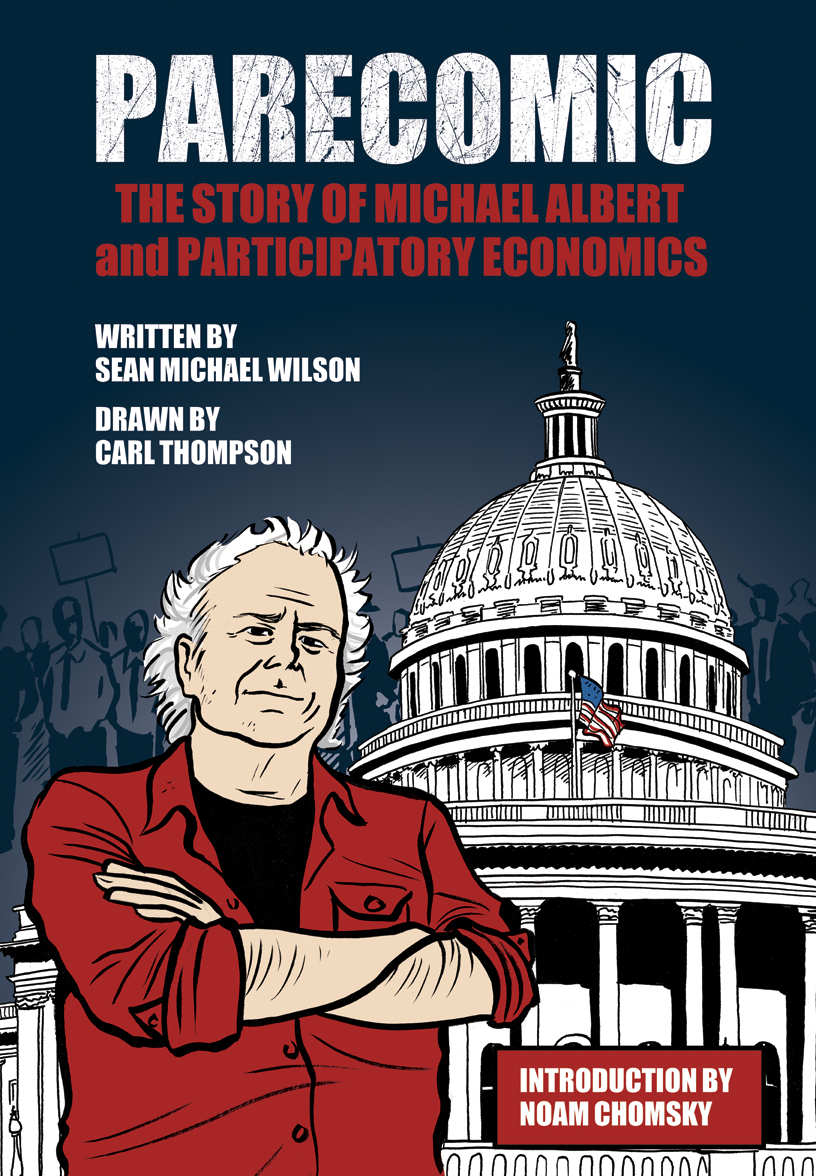
parecomicParecomic: The story of Michael Albert and Participatory Economics
Written by Sean Michael Wilson
Drawn by Carl Thompson
2013

Not liking the current economy very much, a book about an alternate way for an economy to run seemed like an excellent opportunity for me. Especially since it’s a graphic novel and thus likely to be at least slightly livelier than other books about the economy.

However, while it wasn’t a terrible book, it wasn’t a particularly good one either and I was really not impressed with participatory economics as it was described.

The first two-thirds of the book were more a biography/personal history of the civil rights era. I found this portion extremely interesting, even if it wasn’t saying much about participatory economics. The people and the times were interesting enough that it was okay that I didn’t find the main character (or any of the other characters) very sympathetic.

The later third of the book did discuss participatory economics, but did so very poorly. This is the closest I’ve ever come to feeling like I might understand why Ayn Rand was so down on liberals and socialists. Given that this book was written in Albert’s words, defending his ideals, presumably to the best of his ability, I have to admit that maybe Rand wasn’t entirely making up her annoying “liberal” characters as I’d assumed.

Albert wants to save the working class and the poor, but he sure doesn’t respect them. He argues that white-collar workers aren’t any better than blue-collar workers but assumes that it’s obvious that white-collar work is better and more empowering than blue-collar work. He assumes that everyone will like the same things and dislike the same things and generally have the same opinions if only they really understood. Thus, in his view, business meetings can reach consensus quickly and easily, and if you don’t agree with him, then you just don’t understand the situation.

It started out interesting, but ended up mostly irritating. On the other hand, it was well-illustrated, the first part was interesting, and the book as a whole wasn’t that long. So, faint praise, but still praise.

FinalCOmpsThat Lovely Horrible Stuff
By Eddie Campbell
2012

This was in the nonfiction new-release section at my library and it seemed to be a graphic novel about currency, which I thought would be interesting. Instead it was mostly some biographical ramblings of the author about his money troubles. It did have a section about the stone money of the island Yap, which was really interesting. I wish the whole book had been like that. Instead I mostly got annoyed at Campbell for being whiny. Like Parecomic, it was interesting and well-illustrated (and really quite short), but the main character was even more off-putting.

Comic Book Glut

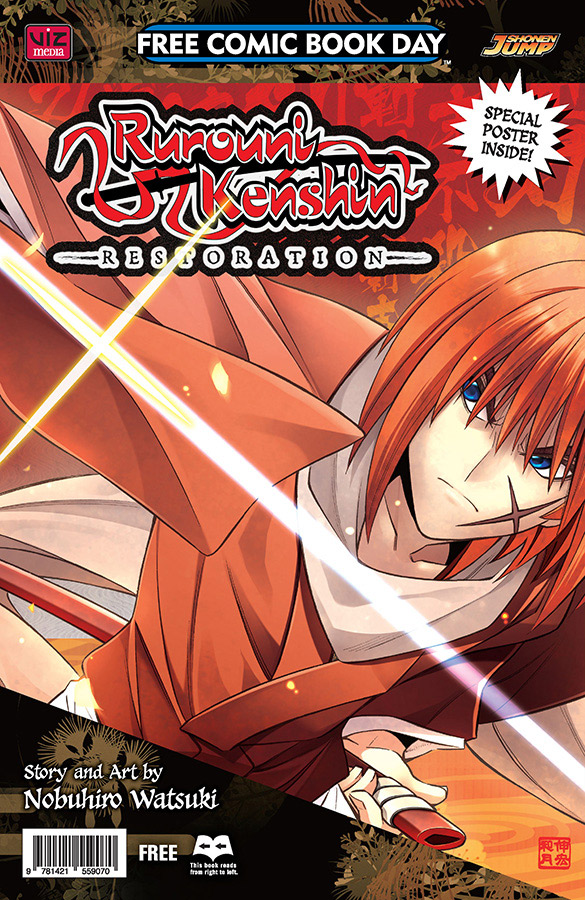
RurouniKenshinRurouni Kenshin: Restoration
By Nobuhiro Watsuki
2013

This was one of the free comic books that I picked up at Free Comic Book Day. It is a teaser for an AU (alternate universe) version of Rurouni Kenshin by the original author. It was fun, but mostly I enjoyed it because it reminded me how much I love this series. The actual teaser itself wasn’t all that great. It reintroduced the characters and held their first meeting at an arranged illegal fighting/gambling event, which just seemed like a bit of over-the-top, idiotic, self-indulgence.

While the reboot wasn’t so great, I definitely recommend the whole original series of Rurouni Kenshin, following Himura Kenshin, an amazing swordsman who, after a bloody past during the civil war, made an oath to never kill again but still manages to find and be found by a whole lot of trouble. The anime series based on the manga is also really good, and the recent live-action movie was excellent! (The animated movies, branded “Samurai X”, however, should be avoided.)

Anyway, seeing more of these characters written and drawn by the original author made me bounce around grinning with excitement. But the actual thing wasn’t all that good. It was a it of self-indulgent fluff, and while there’s nothing wrong with self-indulgent fluff, if you actually want to read a good AU take on this series, fandom (in the person of Vathara) has provided several better options, including the urban fantasy Blades of Blood and it’s sequel Witchy Woman, the Star Wars-crossover Shadows in Starlight, or the historical fantasy Gargoyles-crossover All I Need is a Miracle (which is a direct response to the awfulness of the animated movies).

So this series is awesome, and I highly recommend it, but this particular comic book is not the best example of it.


HawkeyeHawkeye: My Life as a Weapon
By Matt Fraction, David Aja, and Javier Pulido
2013

I’ve never really followed any of the Hawkeye comic books, but I enjoyed The Avengers movie a lot and the characters cameo in the Thor movie made me grin. So a new stand-alone comic book about Hawkeye at my library caught my eye. It was a whole lot of fun.

It’s a look at what Hawkeye, aka Clint Barton, is doing when he’s not out being a superhero Avenger… which is mostly getting into other types of trouble and going out being a secret agent for SHIELD. But it also involves hanging out with his neighbors at a rooftop barbeque/potluck.

Anna pointed out that the stories in this collection are all a bit grim, which I was going to argue with, except, okay, yes, they are a bit grim. But it left me happy. I liked it. Even though it does kind of imply that one of the main requirements of being a superhero is the ability to take a beating.


the-book-of-five-rings-a-graphic-novelThe Book of Five Rings
By Miyamoto Musashi, Sean Michael Wilson, Chie Kutsuwada, and William Scott Wilson
2012

I picked this book up because I have struggled to read The Book of Five Rings for a while now. It was highly recommended by a seventh-don black belt that I was training with. And yet, I found it super uninteresting and unhelpful. In some ways it read (to me) like The Art of War, except without the value. The graphic novel version makes up for some of that lack by being really well illustrated. And from everything I’ve read, Musashi himself was a fascinating character and I wouldn’t mind reading more about him, despite not caring for his writing.

Anyway, I actually highly recommend the graphic novel as a precursor to the plain unabridged text of The Book of Five Rings. It will give you a taste of the text while making subject more accessible. It’s readable in about an hour. Then, if you find the graphic novel appealing, maybe you should try reading the original text in its entirety.

Although, really, I mostly recommend Sun Tzu’s The Art of War instead.


Elektra_Lives_Again_00-1book_coverElektra Lives Again
By Frank Miller
2002

I read a couple of Daredevil series before and really enjoyed them (Frank Miller’s Daredevil: The Man Without Fear is excellent, as is David Mack’s Daredevil: Vision Quest although it largely focuses on a different character), but over all the quality of Daredevil comics varies wildly, so I also read a couple of Daredevil series before that I didn’t enjoy at all. Elektra is Daredevil (aka Matt Murdock)’s tragic girlfriend, a zombie-ninja-assassin who has her own spin-off series, but I had never read any of her comics that were any good at all… until now. This collection really brought her to life (haha!) as a character, despite her being a zombie ninja assassin. I liked the writing and the illustrations and just the whole feel for it. Well done.

Plus, there are two more Elektra graphic novels by Frank Miller for me to look forward to.

Free Comic Book Day

Free Comic Book Day Comic: The TickIt’s that most wonderful time of the year (tomorrow)! On the first Saturday of May each year, comic book stores around the country host Free Comic Book Day, where they offer free special edition comics from the various publishers, as well as store-wide sales and raffles. The free editions aren’t the best stories, of course, but they can be good introductions to new series, and if you are a comic book fan, it is just a fun community event. The official website has a store finder, and I definitely recommend just stopping by your local store if you have any interest in comic books.

—Anna

Codex Seraphinianus

codexCodex Seraphinianus
By Franco Maria Ricci
1981

In honor of April Fool’s Day, I am reviewing the Codex Seraphinianus. No, this is not a prank or a lie, at least not on my part. The book exists. Just, well… it’s more like it’s a prank or a lie on the author’s part.

The Codex is an incredibly beautiful and extremely peculiar biology/sociology text in a foreign language. Yeah. Think on that for a bit.

Also, I recommend it.

Regardless of what languages you may be fluent in, this book is in a language foreign to you. It’s actually an alien language constructed as either a code or simply a very detailed doodle by the author, such that the written text is just as much an illustration as any of the actual color illustrations.

The color illustrations, of which there are many, are beautifully done, likely with oil pastels or some such.

codex03  codex7  codex_09

The subject of the book is the biology and sociology of an alien world… an extremely peculiar alien world, with a very complex biology. In some ways it reminds me of a steam-punk universe with cyborgs/implants/etc., except that such mechanical additions are intrinsic to the biology of the plants and animals rather than intentional additions later. (Sort of like WTF-Evolution’s even crazier, acid-tripping brother.)

In other ways it reminds me of the biology from Vernor Vinge’s A Fire Upon the Deep or Orson Scott Card’s Speaker for the Dead. Except more so than either Vinge or Card went.

It also reminds me a great deal of the Voynich Manuscript, a document that I have yet to actually see a good copy of, but which is another biology text written in an unknown language. But the Voynich Manuscript has had professional and amateur codebreakers trying to break it for nearly a century at this point and variously manage to “prove” is (a) a complex code that we just don’t have the key to yet, (b) a brand new language that would need to be translated rather than uncoded, or (c) complete gibberish that contains no meaning and can thus be neither uncoded nor translated. Its provenance is also deeply questionable. It has the potential to be (a) a secret alchemical manuscript from the 1200s, (b) a forgery created in the late 1500s and sold to Emperor Rudolf II as a secret alchemical manuscript from the 1200s, or (c) a forgery created in the early 1900s perpetrated either by or on the book dealer Wilfrid Voynich.

But back to the Codex Seraphinianus, it is vibrant and gorgeous and inspiring and confusing.

If you can get your hands on a copy, it’s a lot of fun.

Or, for a more easily accessible book, check out Chris Van Allsburg’s The Mysteries of Harris Burdick, and try to figure out what the plots are of those stories.

The Battle of Blood and Ink by Axelrod and Walker

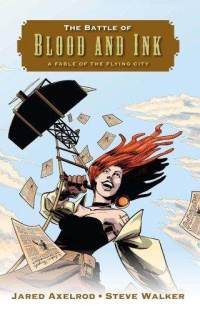
The Battle of Blood and Ink: a Fable of the Flying City
Jared Axelrod and Steve Walker
2012

This book has my qualified approval. Without the time (or ability to concentrate) for reading a full book, I recently read a graphic novel instead. Given the adage “a picture is worth a thousand words,” if all of your descriptions can be replaced by images, a graphic novel can be read a whole lot faster than a traditional novel and in fact I read The Battle of Blood and Ink in about forty-five minutes.

On the up-side, it was wonderful to just relax with a book and this one had fun characters and interesting intrigue and really beautiful illustrations. The art is both lovely and lively and was what first attracted me to the book. Then, the characters drew me in, as well as how the authors addressed moral issues regarding ethics versus pragmatics and personal versus political responsibility. It was both beautiful and interesting.

The story is about a woman, Ashe, who grew up as a street kid on a flying city and now makes her living printing a newsletter regarding city events and happenings. The city is a place of wonder, but from Ashe’s perspective, we see some of the gritty underpinnings of how things actually work, and so too does her readership. This gets her into trouble with the city ruler and events progress. Since the role of information and censorship are currently particular interests of mine, this plot was just right for me.

On the down-side, the climactic scene relies on a lot of world building that wasn’t actually presented previously in the book. Given the setting is a flying city, the universe is obviously a science-fiction/fantasy one, but the physics of the world isn’t really explained at all, and the climax depends on certain premises that I hadn’t expected.

Having read and enjoyed the book but feeling a bit bemused by the ending, I discovered that the book was intended as a stand-along sequel to a set of 44 online pod casts (i.e., audio recordings). I listened to the first two of them and was not nearly as impressed by them as by the graphic novel. The world building issues may or may not be addressed in these pod casts, but of the two that I listened to (each about 15 minutes), both times the speaker rambled for a significant period of time before getting to the story and then the story was filled with poorly written descriptions that were much better presented as images in the graphic novel.

So, on the whole, while there are serious flaws in this graphic novel, it’s still lovely, fun, interesting, and well worth the half-hour to an hour that it would take to read. If you want to get a taste of it, the first twenty or so pages are available online.

Daytripper

By Gabriel Ba and Fabio Moon

Confession #1: Daytripper is the only comic that has ever made me cry.

Book cover: DaytripperAfter reading the review of it on NPR’s Monkey See blog, I had sort of vaguely put this on my list and then forgotten about it until I ran across it in the library a couple of months ago.

I promptly picked it up but read it over the span of a week or so, which is pretty unusual for me with  graphic novels. It reads like poetry, really, where a little goes a long way and after every ‘chapter’ of the book, I had to put it down and think about it for a little while. The plot, such as it is, is tough to describe; it is really more of a philosophical exploration of life, death, and the relationships that make up our lives.

It took me a while to write a post about it, because it is unlike any other graphic novel I’ve ever read. Glen Weldon at Monkey See described it way better than I could as “the way death, whenever and however it comes, retroactively imposes a shape on a person’s life.”

Confession #2: I read comics almost primarily for the illustrations; I mean it has to be well-written, too, but if the illustrations aren’t to my liking, I won’t read it no matter how well-written it is.

And Daytripper is absolutely gorgeous. The inking is expressive of the mood of each panel but the coloring is where it really stands out, with gorgeous, watercolor-like spreads. It is set in Brazil, and beautiful, expansive spreads showcase the city- and country-scapes of the region.

Seriously, check these out:

Illustration from Daytripper

Illustration from Daytripper

—Anna

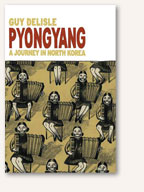
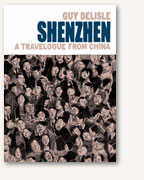
Pyongyang: A Journey in North Korea; Shenzhen: A Travelogue from China

By Guy Delisle

Kinsey, these may be the comic books for people who don’t really like comic books. They are really more travel journals that use the illustrated panels to give atmosphere in a way written descriptions can’t quite capture.

The author is an animator who gets sent to various sites to oversee the outsourced animation, so in addition to the interesting locales, he also throws in a few details about the animation business, which is equally interesting to me.

Book Cover: PyongyangPyongyang: A Journey in North Korea was published in 2005. A couple of pages in, I realize that this is Eloise for adults! He lives out of a hotel for the entire trip, and has a guide and translator who serve as nannies for him, escorting him anywhere he travels outside of the hotel. The atmosphere he describes in North Korea also sounds very similar to that in Eloise in Moscow, first published in 1959.

Shenzhen: A Travelogue from China, published in 2006, is a disconcerting contrast to Pyongyang, still very foreign, but in an almost diametrically opposite way. After being immersed in the very communist North Korea, every mention of Rolexes and Gold’s Gyms comes as a bit of a shock.

Book Cover: ShenzhenAt the beginning of Shenzhen, Delisle says that he has trouble starting the writing/drawing process, and I have to say that it shows. It is much more a collection of vignettes and is a little disconcertingly random, while Pyongyang has a much tighter story narrative. I think that Delisle found his stay in Pyongyang not more enjoyable, exactly, but more interesting, just due to the foreignness of it all. He finds Shenzhen a bit of a grind, and it shows. I would recommend reading both back to back like I did, since I think they are good companion pieces, but if you are only going to read one, go with Pyongyang.

(From my quick amazon.com research, he has also done graphic chronicles of Jerusalem and Burma, both of which I very much look forward to reading.)

Finder Library: Volume 1

By Carla Speed McNeil

Finder is my favorite graphic novel. Period.

As much as I defend graphic novels and truly believe that they can be equal to any novel, most of them aren’t. Finder, however, blows most novels out of the water. When I first stumbled across one of the graphic novels, Sin-Eater, at a library years ago, I was entranced; her stories and characters stayed with me in all the years since then, and last week, I was overjoyed to see that Dark Horse has published an anthology of her Finder novels, including Sin-Eater.

It is hard to even describe the scope of Finder. McNeil builds an entire world with a blend of futuristic technology and mysticism, and populates it with dozens of different tribes of people, many of whom borrow attributes from various real-world cultures, such as ancient Egyptian, Chinese, and Native American. Our protagonist is from the tribe most like Native American, and he is a “finder” by trade, which is a bit of a cross between tracker and private detective. Through his adventures (and each book-length graphic novel follows just one) we explore the entire world, traveling to the different lands and meeting peoples of different tribes.

Every single panel of the 600+ page anthology adds details to the cultures and histories. Many of them include references to our real-world culture (though it is clearly not set in our world; or possibly our world many millenia in the future). Ones I caught included The Last Unicorn, Neil Gaiman, and Masquerade, and they were just enough for me to recognize that for each reference I caught, there were no doubt dozens that I missed.

For some of the ones I missed, McNeil has endnotes in the back (of both this anthology and the original graphic novels) in which she explains some of the references and elaborates on many of the characters and places. I had already been impressed with the expanse of the book, but the endnotes were where I really began to feel awe toward the author. She has back stories for characters that only feature in a single page and names for characters that only have a single panel!

The book is insidious, really—you pick it up thinking to read an adventure story about a lone-wolf character, but the density of it all gets in your brain and has you picking at it for days afterward, trying to unravel it all.