Web comics

I have been bingeing so many web comics! There are so many, and cover such a range! And I know I’ve read web comics before and even recommended some of them on this blog, but previously I was discovering them on their individual websites and now I have discovered that there are phone apps that give you access to some untold numbers of web comics all through a single searchable interface.

Admittedly, the vast majority are pretty darn schlocky, and my first impression was that they were like harlequin romances for fantasy fans. (“His Majesty’s Proposal”, “The Remarried Empress”, and “Justice for the Villainess” are all real titles of webcomics I’ve tried.) But on the one hand, I do enjoy some schlocky fantasy romances, and on the other hand, there are other genres represented, and some really good stories, as long as you’re willing to go searching.

Many of the stories are on-going with weekly updates which remind me of why I stopped following comics in individual issues and waited for trade paperbacks instead. I find the individual updates frustratingly short. But having just discovered these collections, there are a lot of issues to catch up on before I’m current, and there are some great stories that have been completed.

Manta is one of the apps I downloaded on my phone, although it’s also available as a website. I now have a monthly subscription that gives me full access to any story in their collection. Some of the completed stories that I recommend are:

  • Shall We Pole Dance? is a 12-issue nonfiction story about a woman’s experience improving physically and mentally through joining a pole dancing class, that’s just sweet and delightful.
  • The Night Market is a 12-issue fantasy story about a magical market that is an intersection of worlds, where you can buy anything at all, but once you enter, you must buy something, and everything has a cost.
  • Unbreakable Master is a 141-issue fantasy gay romance about a guy who breaks everything he touches discovering that there is a hidden world of magical beings fighting a war for control of the world, and what role his powers might have in this struggle.
  • Traces of the Sun is a 96-issue fantasy gay romance about a guy who has the magical power to fix things, a job fixing destroyed buildings, and a secret: that when his childhood friends were killed in an attack, he tried to fix them, but only raised them as zombies that he can neither bring fully to life nor settle into peace. (This is based on a book and I want to read the book so bad, but it’s in Korean and there’s no translation available.)

Webtoons is the other app I now have installed on my phone, which charges a certain number of “coins” per recent issue, with coins being sold for real money, however, as long as you’re willing to wait a few weeks, the backlog of older issues are free. None of the stories I’ve read on this app have been completed, but there are several that I’ve enjoyed the backlog and updates for:

  • Eleceed is currently at 262 free issues of a fantasy adventure story about a kid who has a superpower discovering that there’s a whole society of “awakened ones” with superpowers and working up the ranks of power via an endless series of dramatic duels, which is a tedious premise, but the growing cast of characters are so darn delightful! The sweet kid, Jiwoo Seo, discovers an injured cat, who is actually a person, Kayden, who had semi-accidentally transformed himself into a cat, but proceeds to mentor the kid. This story made me realize that for a society that’s essentially lawful evil, the chaotic neutral of Kayden is a net benefit.
  • Cleric of Decay is currently at 30 free issues of a fantasy adventure story where our protagonist has been sucked into a video game he was playing, but only after he’d both selected a particularly difficult/weak character class AND installed cheat codes to make it viable. So now he’s wandering around as the last living cleric of an evil goddess who was killed and dismembered years ago trying to collect objects of power at the demand of a mummified hand of a goddess while staying unnoticed by the various paladins and clerics of more accepted deities.
  • Paranoid Mage is currently at 11 free issues of a fantasy adventure story about a young man who discovers he has magic powers shortly before being discovered by a secret society of magic users who are strictly hierarchical and do not think he is allowed to opt out of joining their society on a low rung. He escapes, and is now on the run/in hiding, while trying to learn to use his powers, and also stumbling across parts of magical society.

These stories are a delight and an addiction.
Comics written by women

I ran across a thread on Twitter listing out comics and manga by women, and there were a number I hadn’t heard of, so I promptly went on a hold spree on my library’s website.

The Good

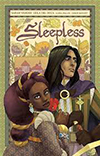
Sleepless by Sarah Vaughn and Leila del Duca

Ooh, this was a delight! The beautiful illustrations and realistic dialogue work together to draw the reader into this diverse Renaissance-type world of heraldry, politics, and magic. Lady Pyppenia or “Poppy” is the beloved though illegitimate daughter of the late king, trying to find her place in the court once her uncle takes the thrown. Her sworn knight, Cyrenic, is one of the ‘sleepless,’ guards who have magically sacrificed their need for sleep in order to offer around-the-clock protection, and the only one she can trust when assassins come for her.

The world building is expansive enough that it reminds me a bit of Game of Thrones, though much more family friendly, of course. The variety of fantasy cultures borrow elements from Europe through the Mediterranean and down into North Africa, represented with different fashions, manners, and magic, and all trying to navigate the various political alliances. At the same time, it is an intimate look at the relationship between a young woman in a precarious position of power and the man that serves her. The first volume ends on a cliffhanger, and the second picks up immediately, so get them together if you can.

Black Cloak by Kelly Thompson and Meredith McClaren

Another phenomenal story! I knew it was likely to be a good one for me from the various raves describing it as fantasy shot through with noir mystery/police procedural. There’s not much better way to my heart, and it is excellently done.

Set in a futuristic fantasy world, where elves, dragons, and humans all jostle for political power in the last standing city, Black Cloak balances the writing and illustrations beautifully in its “show, don’t tell” approach. When two bodies wash ashore from the mermaid lagoon, our protagonist, a ‘black cloak’ cop, must investigate. The world-building unfolds with the mystery as the bodies lead to secrets through all levels of the society.

Continue reading

The Mysteries

By Bill Watterson and John Kascht

I first heard about Bill Watterson’s latest publication from Midnight Pals’ twitter thread, which is funny, a little mean, and pretty accurate. I wasn’t sure what to expect, but the extremely slim volume with one sentence and one picture per page still took me by surprise. It’s described as a “fable for grown-ups” and it is a very quick read — my whole family read it in an afternoon.

It is very much a departure from his Calvin & Hobbes work, though some family thought they could recognize trace similarities in the illustrations. I wasn’t previously familiar with John Kascht, apparently a renowned caricaturist, but per the afterward, both art and writing were a collaborative effort. Whatever each of their roles were, it is clear that they are both fairly fed up with the cultural discourse over the last few decades and perhaps humanity itself. Though it is overall a hopeful message, it reminded a number of us of this comic.

It’s a lovely little book that would probably make a nice gift for a fan or completionist; everyone else should also check it out, but perhaps from the library.

Ruined by Vaughn, Searle, and Smith

Ruined
written by Sarah Vaughn
pencils and colors by Sarah Winifred Searle
inks by Niki Smith
2023

This is a regency romance graphic novel and it’s delightful and well-done and extremely fictionalized. It’s not so much set in the British regency era as it is in the universe of the Bridgerton TV show, not explicitly but pretty obviously, as it mostly maintains the fashions of the historical era while ignoring the social and political issues.

In this universe there is no racism or homophobia. Sexism is alive and well in the systemic way that drives so many romance novel plots, especially arranged marriage ones such as this one, but not in the individual way. Systemic classism is also highly present but largely ignored. If this book had been trying to be historical fiction, it would be a failure, but as a romance with aesthetic, it’s a delight.

Our heroine has been compromised! She must marry immediately in order to avoid a terrible scandal! Our hero has inherited an estate that’s in terrible repair and near bankruptcy! He must marry for money! They must give up all hope of a love match and have an arranged marriage!

The story opens at their wedding, and then they proceed to get to know each other and fall in love. There’s also a number of secondary characters with at least two other couples who get together with their own intersecting shenanigans. The book is very cute, beautifully illustrated and everyone makes ridiculous decisions regarding their love lives. It’s also got a couple of explicit sex scenes, which are very much part of the story and character arcs, but were surprising to me since otherwise the story telling feels very general audience and open to all ages.

Apocalyptic Travel graphic novels

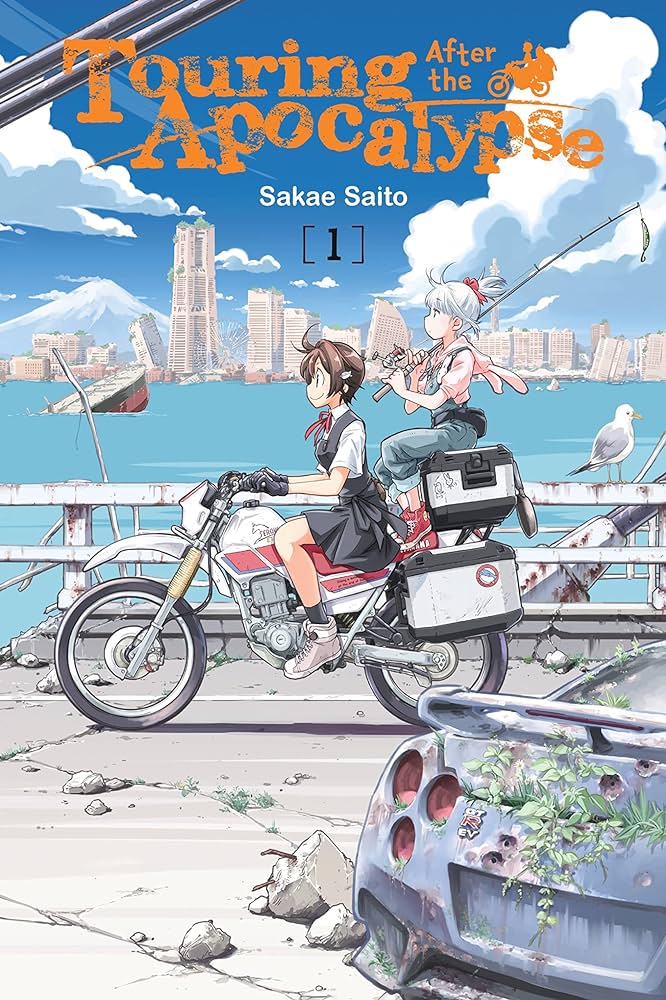
Touring After the Apocalypse, Volumes 1 – 3
by Sakae Saito
translated by Amanda Haley
2022-2023

I randomly checked these manga out from the new release section of my local library and they’re adorable. Youko and Airi are (or at least appear to be) two teenage girls who are traveling via motorsbike around Japan, seeing the sights, following Youko’s older sister’s previous touring schedule, but while the pictures and social media posts that the sister posted look (more or less) like regular posts we might see today, Youko and Airi are seeing the sights after they’re long abandoned and worn down and completely absent any other people. But they’re so excited to see everything!

In each volume, there’s some discovery that to me-the-reader acknowledges the whole tragedy of the empty and crumbling infrastructure of society and what it means that there are so many people not there. To the two girls, it’s fun and interesting and then they move on to the next thing. It keeps the whole mood light-hearted, while also highlighting how much society changes in a single generation as kids who didn’t live the history are accustomed to their lives as being the norm.

There’s a slowly building reveal that something else is going on with these two, but while there are various hints and teases so far, I haven’t figured it out yet.

I’m also really impressed with the translation job since there’s a lot of pop culture references and word games that flow perfectly naturally while I’m reading the English and I can only imagine were incredibly difficult to transpose from the original Japanese.

The Electric State
by Simon Stålenhag
2017

Oof, this is beautiful and moody and horrifying and dark, and it ends in such a way that there’s just enough hope for the future that I think “maybe…”, even though it’s very clear that there’s no real hope. But, just, maybe…?

My first thought when looking at this book was that it was an art book, full of beautiful full page and two-page spreads of various post-apocalyptic scenes. And it is! But it’s also a novella with a story, written in text and full paragraphs and absolutely no text boxes or the like, so it’s more of a picture book than a graphic novel in the way the text and the images interact.

The story is about the narrator Michelle and her companion Skip making a cross country trip in a thoroughly failed cyberpunk society. The setting is intra-apocalyptic rather than post, and oof, does it dip into all sorts of horror, with the implication that at least three types of apocalyptic disasters were all happening at once: war, environmental, and technological. It was reassuring that the events were set in the 1990s with a different history prior to that because this book would have been even more horrifying if it was set in the 2040s. There are a series of flashbacks that reveal the narrator’s backstory, but it’s only in the final third of the book that the reason for trip and Skip’s story are finally revealed, and it’s such a magnificent twist that just twists my heart and stomach.

The differences between these two titles is kind of amazing, just in tone and visualization, especially given how similar the premise and frameworks are. It very much highlights how two people can tell the same story in such different ways that they become two different stories. Reading these two so soon one after another reminds me very much of the Holy Shit! Two Cakes! meme.

graphic novels

It’s Okay That It’s Not Okay
by Christina Tran
2022

I got this book from the Small Press Expo and it’s really good and also really emotional, about the process of dealing with grief after too long trying to push past it. Trans’ mother died in 2003, but the story is set in 2011, as she deals with the results of never fully allowing herself to grieve before, and not feeling able to grieve anymore. It’s really beautiful and well done, using the graphics to show both how busy she kept herself for years and also how hard the depression hit when she was no longer able to push the emotions away. There were definitely parts I recognized in myself and others. I highly recommend it.

Cat Burglar Black
by Richard Sala
2009

This is an adorable classic gothic mystery with gangs of orphaned street thieves, mysterious secret organizations, orphans, previously unknown aunts, mysterious illnesses that require full face bandages, hidden treasures, and a lot of just-off-screen gruesome deaths. There was also a lot of info dumping about the various backstories, but the action was really well done. The deaths had a certain Edward Gorey quality to them. I expect kids and teens would love this, but I might be too old to properly appreciate the many macabre deaths.

Thistil Mistil Kistil
by Sarah Schanze
2015

This is gorgeous. It’s another Small Press Expo acquisition that I bought entirely for the illustrations which are amazing, and only then did I pay attention to the story which is also really good. The plot is about a viking kid who has died honorably in battle, but due to circumstances has been blocked from Valhalla and given the mission to find three pieces of famous weapons that Loki has stolen and return them to Odin before he will be allowed to enter. So he goes to Loki to try to figure out what he did with them. Loki is more or less curious about how is all going to play out and probably has motives of his own to go along with this quest to find whatever happened to those pieces. Stuff happens. After reading this, I discovered that it is only the first five chapters, and while the story is not yet completed, the first twenty-two chapters are available online: https://www.tmkcomic.com/archive/ Yay! So I am now all caught up and wow, did things get complicated and I really hope the rest comes soon! But also, just wow, the illustrations are so beautiful and so significant to the story telling.

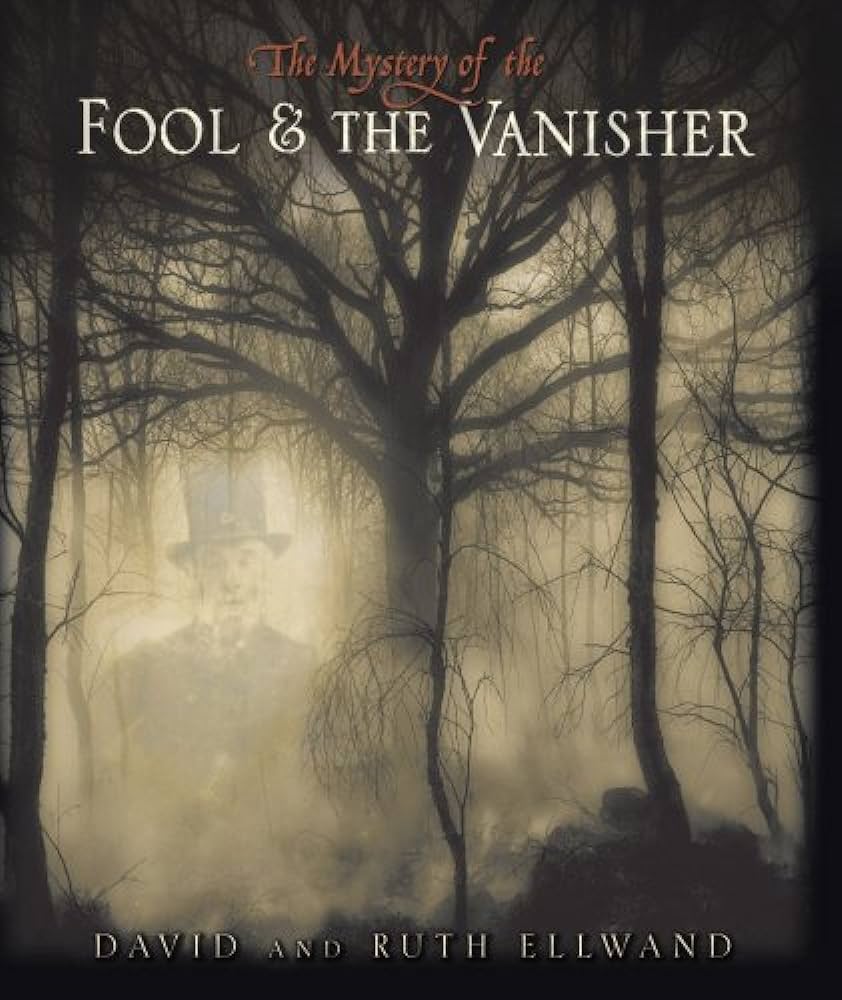
The Mystery of the Fool & the Vanisher
by David and Ruth Ellwand
2008

This book is less of a graphic novel and more an extensively illustrated short story. (“Picture book for adults” was how I first phrased this but then thought that sounded pornographic, which this is decidedly not.) The plot is a Victorian gothic mystery about a photographer, an archaeologist, and the pixies who do not appreciate archaeological digs in their territory. The illustrations are all photographs, including photographs of photographs, as the framing story is about a photographer who finds an abandoned locked trunk that contains documentation of a much earlier photographer who tried the prove the existence of the fae folk. (I was much reminded of Arthur Conan Doyle’s attempts to prove such.) It is extremely atmospheric.

The Body Factory by Héloïse Chochois

The Body Factory: from the first prosthetics to the augmented human
by Héloïse Chochois
translated by Kendra Boileau
2021

This is another book I bought from Graphic Mundi at the Small Press Expo and it feels a bit like a Mary Roach book, in that it looks at the history and development of a fascinating but somewhat disturbing topic, in this case amputation and prosthetics. This being a graphic novel* came with some pros and cons in that the illustrations were extremely helpful in following the topic, but also kind of disturbing as the topic started with dismemberment. But it covers a lot of ground very quickly, using a framing story of a young man who loses his arm in a motorcycle accident and is getting through the recovery process.

The book is divided into four main chapters:

  1. Amputation
  2. Phantom Limb
  3. Prostheses
  4. Transhumanism

This book is very much a basic introduction to the topic and concepts that can give you a foundation from which to look into more details, and I found this fascinating and sufficient for the first three chapters discussing history and anatomy but less so for the final chapter which seems a more niche philosophical perspective than a mainstream overview. The mention of how “Eugenics is a matter of great debate among transhumanists who recognize that there are negatives but also positive aspects to eugenics” was a major red flag for me.

So this book is fiction (framing story), nonfiction (first three chapters), and philosophy (fourth chapter.) In some ways this reminds me of Sophie’s World by Jostein Gaarder (a book I only read once, decades ago, so take with a grain of salt) in the way it’s framed, but I didn’t care for that book and I did enjoy this one. Although upon reflection, Sophie’s World was all about philosophy and the one section I didn’t care for in this book was the philosophy chapter.

I did enjoy this book, and I do recommend it, but with some caveats: be prepared for some casual medical gore and expect the fourth chapter to be the author’s take on philosophy rather than the nonfiction of the previous chapters.

* I’ll reiterate a pet peeve of mine that this type of book gets called either a “graphic novel” or a “comic book” and both of those are misleading terms when it comes to books like this one. But I don’t have a better term for it. Sigh.

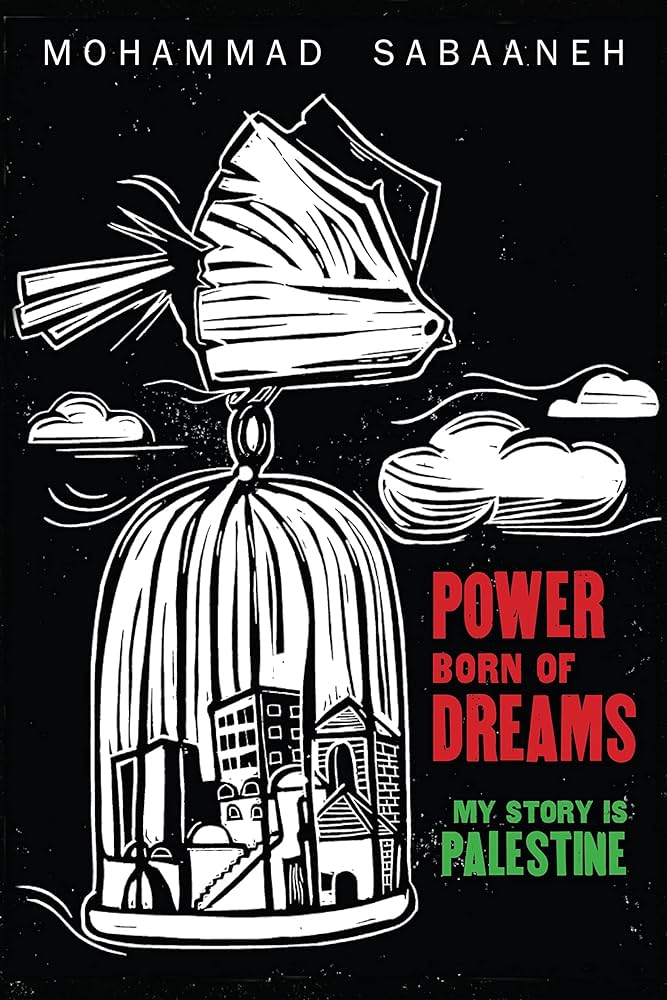
Power Born of Dreams by Mohammad Sabaaneh

Power Born of Dreams: My story is Palestine
written and illustrated by Mohammad Sabaaneh
2021

This reads more like prose poetry than a standard graphic novel, and it’s gorgeous and also devastating. Sabaaneh is an artist, journalist, and political cartoonist who lives in the West Bank but wrote this book while getting his masters degree in London and reflecting back on his time as a political prisoner in Israel and his life in general as a Palestinian. It’s about his life and the life of his community in tiny snippets and stories about oppression and holding onto hope because there’s no other recourse than to hope and dream for better.

I bought this book from the Street Noise Books publisher stall at the Small Press Expo before the most recent series of attacks from Hamas on Israel and from Israel on all of Palestine, but only read it after that was already in the news. The two sets of stories, from reading this book and hearing the news, gave each other context and break my heart. This book is not fictional, for all that it’s structured around a man hearing news from a bird who’s flying through his prison window, and the headlines in the news are not just statistics but real people living and dying and struggling to be free.

The main book is about Sabaaneh’s experience in prison and the small amount of news he was able to hear about what was happening with everyone else, but the afterwards are six single pages with basic introductions to significant historical events, locations, and laws effecting Palestine from 1967 to 2020.

The illustrations are all linocuts (images carved in linoleum and then printed), which are both beautiful and increasingly rare because they’re so time consuming to make. I’m pretty sure the only other book I have that’s similar are the wood cuts in Gods’ Man which was written in 1929.

This book is beautiful and heart-breaking but important, about a current political topic (which is rare for me) and I highly recommend it. Just be prepared to take the emotional hit.

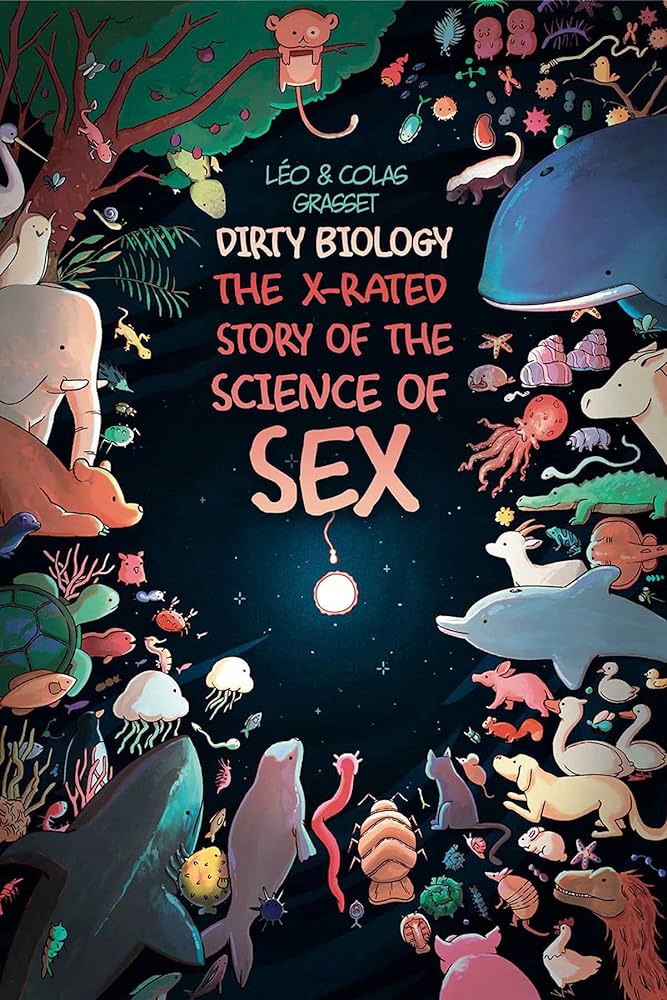
Dirty Biology by Léo & Colas Grasset

Dirty Biology: The X-Rated Story of the Science of Sex
written by Léo Grasset
illustrated by Colas Grasset
2021

This is a fabulous and hilarious non-fiction graphic novel* about the biology of procreation through time and across species, on both theoretical and practical levels, and gives a really good basic introduction to the topics and peculiarities, with lots of great examples. The book is narrated by a small cast of cartoon figures that keep the discussion very conversational, and the cartoon nature of the illustrations keep the discussion amusingly raunchy without being unpleasantly graphic (in my humble opinion.)

I bought it at the Graphic Mundi stall at the Small Press Expo and the woman there said that it was frequently used in biology classes, and I believe it. This made biology really accessible. At the same time as reading this, I was also reading Evolution’s Rainbow by Joan Roughgarden (I haven’t finished that yet) but reading Dirty Biology was helpful in giving me some context to understand Roughgarden. And in a time when trans issues and gender identity are controversial political topics, I find it useful to have an understanding of what “sex” means in biology jargon, which, as it turns out, is completely unrelated to any political talking point I’ve heard.

For the most part, I find graphic novels much quicker reads than the equivalent books, and this was no different, but it still took some time to get through, to properly follow the discussion even with extremely helpful illustrations. I was even slower in the occasional sections delving into topics that weren’t easily illustrated, such as the pros and cons of sexual reproduction versus cloning and the effects of genetic recombination.

Anyway, I highly recommend this as a fun introduction to a complex topic.

*I really wish that there was a term for this kind of book that wasn’t “graphic novel” or “comic book” because those terms just seem really misleading when it comes to nonfiction.

Nonfiction Graphic Novels

For several months this summer, my local library ran a reading rewards program for both children and adults, and I should definitely be too old for this, but I was thrilled to be able to read a book and get a little treat for filling out a quick review. After the first few times, I tried to maximize my treats by checking out a bunch of graphic novels, and then didn’t get to them until after the program ended. Even though I didn’t get a chocolate for either of these, I still recommend them quite a bit (and also strongly recommend public libraries)!

The Magical Life of Long Tack Sam

By Ann Marie Fleming

This book, called an “illustrated memoir” caught my eye because it is a really interesting mix of comics panels, photographs, and printed copy, all from the author’s research into her great grandfather. Long Tack Sam was the most famous Chinese acrobat and magician in the US vaudeville circuit in the early 1900s, but he’s basically unheard of today. Fleming pieces together what she can from archival records around the world, and the story she puts together is fascinating.

What is almost as interesting, though, is what she isn’t able to find: Long Tack Sam had told at least three distinct “origin” stories of his upbringing and introduction to acrobatics, all of them about equally likely or unlikely, and with no evidence anymore to substantiate any of them.

In addition to being the story of her great grandfather, it is also the story of Fleming’s search for her ancestry, and also a look at what is preserved and what is lost in history and documents. I occasionally wished the book had explored that last more deeply, but Fleming is already packing a lot into a relatively short book.

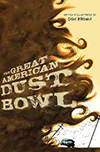
The Great American Dust Bowl

By Don Brown

My brother was telling me about the Saharan dust hitting Texas over the summer, and I asked whether that had contributed to the 1930s Dust Bowl. Upon being assured it wasn’t, I realized that I was woefully ignorant of any real knowledge about it and jumped on this very short graphic novel when I saw it at the library. Only 77 pages, and many of them sprawling full-page illustrations, this book is still chock full of facts that seemed to me to give a concise but comprehensive overview of the causes and effects.

The illustrations really captured the horror and scope of it better than the verbal descriptions or numbers. Whole pages of deep brown watercolor splashes enveloping tiny cars in the bottom corner, tall vertical panels with the dust hovering high above the minuscule Washington monument, and 14 panels of storm after storm really give you a sense of how badly the farmers of the plains were pummeled.

Don Brown stays very factual and almost entirely limited to the historical events of the 30s, but still ends the comic ambivalently, that such crises (or worse) could definitely be on the horizon today.