Saha

By Cho Nam-Joo

I’m not even sure what genre to give Saha: novel seems too bland, and while it is certainly dystopian, it is neither futuristic scifi or magical fantasy. It is nominally a mystery as the protagonist searches for her missing brother after his girlfriend is found dead, but there’s little hope of a pat solution for either Jin-kyung or the reader. It is also a searing indictment of capitalism and the corporatization of society.

The novel mostly takes place in Saha, a block of decaying apartments that are the only home permitted to those not granted citizenship in the corporate-owned Town. Though Jin-kyung and her brother kick off the novel, it jumps around between different characters and time-periods at breakneck speed. Many of the scenes reflect bits and pieces of real news stories in haunting detail: a ship full of refugees/deportees ‘disappearing’ into the sea and being forgotten as the news cycle changed; ‘free’ medical treatment but with insurance premiums so high they bankrupt people; the non-citizens only permitted to scrabble for the most difficult and dangerous jobs:

“A life of doing repetitive menial labor without any assurance of compensation was like walking down a path backward. Life was terrifying and tedious. Every time they paused to take stock of their lives, they found themselves unfailingly worse off than before; Saha residents thus grew more childish, petty, and simpleminded.”

I think I’ve mentioned before that I’m not particularly affected by horror novels, but Saha’s scenes were so gripping that I struggled to put the book down and then carried the tension of the book with me through several restless nights. It is not a comfortable book, but it is an excellent one.

About two-thirds through the book, I had an inkling of the thesis: the majority of the society of trapped into these strict castes, and the people are either uninterested or unable to combat the systemic structure. A few people try, though: one of which, without spoilers, is a do-gooder upper caste Citizen who tries to help the lowest caste of illegal Saha, but through her own inexperience and ignorance of their life, oversteps and makes things worse for herself and those around her. At the same time, scenes from the book that seemed to jump around time and place all start to circle around how the Saha slowly built up their society for themselves, based on mutual aid between what each needed and could offer.

It’s such a difficult theme to discuss and dissect, that outsiders often can’t help at all, no matter how well-intentioned, while those inside the oppressed group are prevented as much as possible from helping themselves—that this is how systemic oppression works, and it is very, very hard to deconstruct. It is perhaps more accessible to read about in an allegorical novel set in a fictional setting than to try to delve into the many real-world examples. On a more hopeful note, it does also portray that those who fight the oppression from within, even if they don’t manage to accomplish all that they’d hoped, can push progress forward in ways they wouldn’t have imagined.

Slumdog Millionaire by Vikas Swarup

Slumdog Millionaire
by Vikas Swarup
2005

This is a difficult review to write because I did enjoy the book a lot, but also have so many warnings to give before actually recommending it. For example: there is a lot of sexual violence. And also a distinct current of poverty porn (sort of on the level of Oliver Twist). And the dog dies. Also a lot of people die. There’s racism, sexism, classism, homophobia, and general normalized corruption. But it’s also really fun?

The book reminds me of the movies Being There and Forest Gump. Our main character, Ram Mohammad Thomas, is not simple-minded like Gardner or Gump, but he is uneducated, and the premise of all three stories is that the main characters live these wild lives that fit together perfectly by pure providence.

The premise of this book is that Ram has just won a game show by correctly answering thirteen increasingly difficult trivia questions in a row. The game show accuses him of cheating because there’s no way for him to have the level of education to know the answers. The over-all structure of the book is divided into a chapter per question, with Ram telling his lawyer about the portion of his life that led to him knowing the answer to the specific question even if he didn’t know the subject in general. He’s only eighteen, but his life is just this wild ride of being an orphan raised by a priest, sent to an orphanage, acquired by a beggar gang, working as a servant, working as a waiter, running from the police, and meeting all these different people with their own wild stories. 

There’s this huge cast of idiosyncratic characters and while many of the experiences are either traumatic or end in tragedy or both, Ram rolls with it all in a “this might as well happen” way. There’s also a strong thread of situational humor to go along with the horror that makes for a delightful if somewhat boggling experience.

Plus, there are some amazing plot twists, both in the individual chapters and in the overall book plot arc.

I really enjoyed this book, and it covered rough ground extremely lightly, but any potential reader should decide for themselves if they’re up for trying it.

I did wonder if I needed to watch the movie, if only to see how they dealt with all the trauma and also how they would cover so many stories without being at least ten hours long. Since I’d just read the book, I went ahead and read a summary of the movie and the movie solved both problems by sharing only the premise and structure of the book while changing the character and life history completely to something a lot more generic. Which, in my opinion, really misses the point.

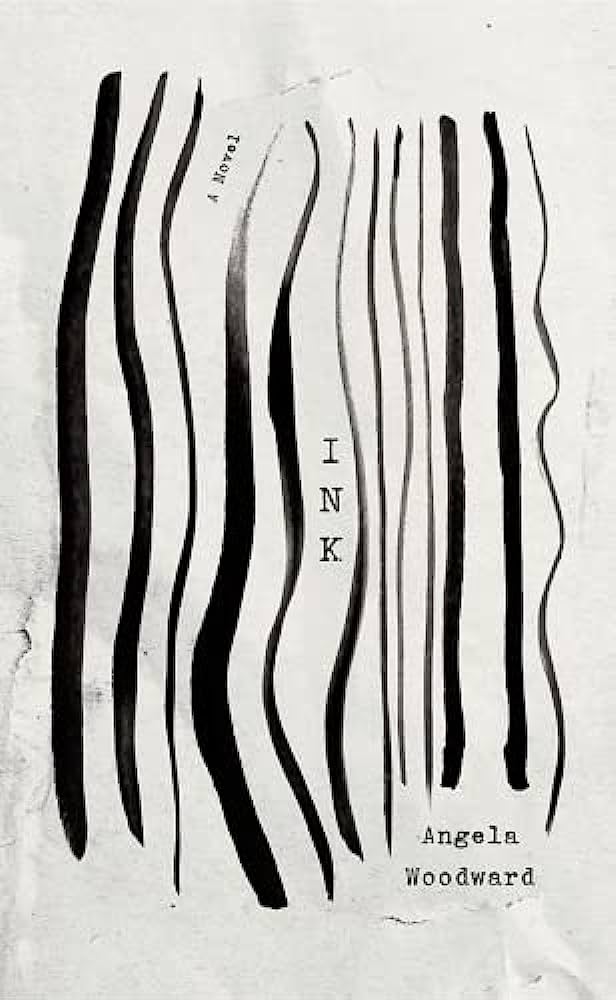
Ink by Angela Woodward

Ink: a novel
by Angela Woodward
2023

Every so often I try reading a literary work and relearn why I don’t read that genre. Woodward is a skilled wordsmith and her writing is lyrical, but her worldview is distasteful and her world-building is poor. Both the characters and the narration are unpleasant in an undeserving way.

I was reminded of a time when I went on a walk with a work friend: we were having a good time mostly window-shopping and chatting in a walking district, when I tripped: stumbled over my own feet, fell to my hands and knees. A few passersby paused but I was fine, I got back up and we continued to walk. The only reason I remember the instance at all is that my work friend said that if that had happened to him, it would have ruined his whole day. He lived in a world where tiny meaningless mistakes could overwrite hours of enjoyment, and the attention of strangers meant critical judgment and inspired shame.

That was his lived experience and I imagine something similar is also Woodward’s experience, and it is certainly her characters’ experience, and it’s such a miserable world to live in: constant judgment both internal and external and no freedom to just enjoy what you can. As Anna pointed out when I complained to her about it: there’s also the meta aspect of Woodward and her characters expecting to be criticized for everything and here I was criticizing them. So it’s not necessarily wrong, but just overly weighted in that direction.

This book is trying to do something interesting, with three different threads: the expected thread of the novel with it’s characters and events, a series of digressions into the history of ink as a substance, and a first-person account of the author discussing her life and writing process for this book.

I found the history of ink fascinating, but untrustworthy. I wish I had read it in a nonfiction book. The first-person accounts I found mostly confusing as to it’s purpose. Perhaps to differentiate Woodward from her even more unhappy characters?

The novel section is what had inspired me to read the book (and not just because that’s the only part that’s in the blurb): it’s about two women who are transcribing the Abu Ghraib detainee statements in the early 2000s. That was around the same time I was doing freelance transcription for various studies in academia: nothing as terrible as first-person torture accounts but enough difficult subjects that I understand some of the impact it can have.

Unfortunately, the book treats the subject as a simple conceit and doesn’t otherwise address it. There are a few short recurring excerpts from those interviews interspersed for shock value, but that was it. At the beginning I thought it was an interesting demonstration of how the mind can shy away from horror by considering more minor aspects: Here’s a single sentence about torture, let us now read several pages on the history of ink. But by the end of the book, as the few repeated excerpts came up, they were treated more like intrusive thoughts to be entirely disregarded, rather than parts of stories that the women were spending days, weeks, months, listening to.

The experience of listening to stories of trauma for hours on end, or even the experience of straining your ears to hear exactly what is said, the click-whirr of the machine, the delight in slow speakers and the difficulty of quick speakers, or the shear physicality of typing all day… None of it was addressed. The characters’ experience was so completely different from mine that it seemed unlikely that Woodward had ever tried transcribing. Or maybe her body, ears and hands all work as differently from mine as her worldview does. 

Woodward explicitly states that she was imaging what these people who must have existed would be like, but increasingly it frustrated me that this isn’t at all what they would be like, starting with being English-speaking only. Woodward wrote a novel about two women in an office environment who both have various levels of unpleasantness in their home lives, but the details of their job appeared to have no impact on them whatsoever.

This book had so much potential: a fascinating premise by a talented wordsmith, and it’s really irritating how poor the results were.

Hench

Ages and ages ago, Rebecca reviewed a funny romance novel called Love for the Cold-Blooded, which peeked behind the scenes of life as a super-villain’s sidekick. That story felt so fresh because it subverted the ubiquitous hero/villain tension by making the heroes seem kind of dumb and the villains seem reasonable, if perhaps a little dramatic. It also featured a surprisingly sweet romance. If you’re interested in a book that flips the traditional script on superheroes but with a very different feeling, Hench by Natalie Zina Walschots avoids all the sweet predictability of a romance.

In Hench, Anna Tromedlov (even she knows this name is a little silly) is a data analyst scraping by doing temp jobs for small-time villains. She’s not overly ambitious or too concerned with the morality of her work, until she becomes collateral damage when a hero sweeps in to save the day. As she recovers from a serious injury that no one will admit was caused by a “good guy,” she becomes obsessed with the damage that heroes can do. She starts applying her intellect and skills to the problem, and she gets drawn right into the heart of the hero/villain conflict. What seemed like just an ethically-dubious desk job is suddenly a much more dangerous proposition.

I appreciated that Anna was never overly concerned with whether she was fighting on the right side or not–her alliances are clear from the beginning. Rather, she has to figure out just how much she’s willing to put into her job, what allegiance we owe to the people we follow and what we expect from them in exchange, and how all her villain-izing will impact the rest of her life.

There is a lot of overlap between this story and The Boys on Amazon, which is a good, interesting show addressing some of these same issues. I do like The Boys, but I also find it grosser than I can handle at times, and awfully overloaded with a bunch of loud white guys. I think the fact that Hench is a book (so I can skim over some of the grosser stuff) and is the internal story of a smart, take-no-shit woman (who also has no patience for overbearing dudes), made it more compelling and enjoyable for me.

Kinsey’s Three-ish Word Review: Darkly-funny villain adventure

You might also like: This is a tough one, because Hench has such a specific voice. But a few other books that put a twist on some traditional situations/tropes include Sign Here by Claudia Lux, Vampire Weekend by Mike Chen, and Everyone in My Family Has Killed Someone by Benjamin Stevenson.

Woman, Eating

By Claire Kohda

Uh, this novel is very strange. It’s a dark, often melancholy, coming of age story, as Lydia, a sheltered 23-year-old, is on her own for the first time after placing her mother in a care home. She’s awkward and shy, trying to find herself in her internship at an art gallery and her studio at a young artists’ collective. She’s also a vampire.

But still a very, very young vampire, who is struggling with her identity, as well as to ethically source blood in London. For the majority of the book she is starving (thus the title), and obsessed with human food she can’t digest. This wouldn’t be a great book for anyone with any sort of eating disorder. In fact, there are a few different content warnings (sexual assault, imagined animal harm), and I read a lot of the book in a state of low-level dread.

But I also read the book in rare complete focus because the writing is just so beautiful. It is very literary – most of the narrative is Lydia’s thoughts and feelings, and they could sometimes be exasperatingly self-indulgent in a very accurate 23-year-old way. But the backcover blurbs weren’t wrong when they raved about a completely new perspective on vampire mythos. Once I started reading each night, I only put the book down again at the end of each of the three parts that divide the relatively short book (227 pages).

The end, too, is a viscerally joyous release of all the built-up tension that truly fulfills Lydia’s coming of age. I wouldn’t necessarily say that I enjoyed the experience of reading this throughout, but I’m very glad that I did nonetheless.

The Screwtape Letters by C.S. Lewis

The Screwtape Letters
by C. S. Lewis
1961

Having enjoyed The Great Divorce and found it extremely thought-provoking and had a casual book club with various members of my family, it was proposed that we read The Screwtape Letters next. It was just as thought provoking, if not more so, although somewhat less enjoyable. It consists of 31 chapters/letters plus one toast, and it’s all told from the perspective of a demon, the titular Screwtape, who is giving advice on how to lure humans into sin.

Despite having been written 80 years ago, it is decidedly timely today, as it addresses the devil’s goal of keeping humans constantly focused on doom scrolling and headlines and thoughtless denigration of anyone who disagrees with you, while avoiding humility, charity, respect, or thoughtful consideration. I felt decidedly called out at various points. I should be better! I will try to be more thoughtful and focused and enjoy the pleasures that are available to me in the present and worry less.

At other points, however, it feels dated in the way that it appears to be arguing about social trends that I’m not even aware of. At one point the devil is recommending that people should stay focused on government policies rather than prayers since those are so much less important and I really hope that Lewis had no expectation of “thoughts and prayers” becoming such a catch phrase for politicians refusing to update policies. As Screwtape presents himself as the arbiter of what is evil, Lewis comes across as an arbiter of what is good, and that is, occasionally, rough. Historians, modern artists, and unions are all mentioned as being misleading to Good Christians.

Lewis definitely takes the opportunity to call out some of his personal most and least favored theologians, placing them either as godly agents or thoroughly controlled by the devils’ temptations to sin. This book also has a nearly Ayn Randian Objectivist perspective on the world: what is Good is very clear and natural and unaffected by different lives, perspectives or understandings. Devils provide temptation and people provide false information but a Good Christian will just know what is right due to God, much the same way that Ayn Rand’s protagonists will know what is right due to Logic, despite any lack of education or resources for either. Peak individualism, despite the differences in both methods and goals.  

I found that I needed to read this book one chapter at a time and take at least a little break between. They were thought provoking and inspiring and occasionally quite funny, but they were also quite dense and more than occasionally rather florid.

This book also made me think that I should get around to reading Lolita, at some point, as the only other book I can think of that has the protagonist/narrator also be the unrepentant villain of the story. I did wonder how many people read this book and think Screwtape is an anti-hero instead. Some of his advice came across as fitting right in with big business and some of my least favorite managers at my job, so it’s not out of the question.

I got a lot out of this book and enjoyed talking about it with Anna as we progressed through, but the book started out strong and then got progressively more wearying as it continued. It’s worth reading, but be prepared to decide what you take seriously. (Note: Cherry-picking what to take seriously is also advice that Screwtape would offer a human and C.S. Lewis specifically rejects when it comes to religious contemplation. So, you know: Enjoy!)

The Screwtape Letters

By C.S. Lewis

Rebecca and I both enjoyed The Great Divorce so much that we decided to read The Screwtape Letters, another Christian fantasy by C.S. Lewis (her review to follow). This novel is a collection of letters from Screwtape, a demon, giving guidance to his nephew on how to corrupt people’s souls. And it comes out of the gate swinging!

“Your business is to fix his attention on the stream [of immediate sense experiences]. Teach him to call it ‘real life’ and don’t let him ask what he means by ‘real’.” (p. 2!)

C.S. Lewis is scolding me for wasting time on social media from beyond the grave!

“But the best of all is to let him read not science but to give him a grand general idea that he knows it all and that everything he happens to have picked up in casual talk and reading is ‘the results of modern investigation’. (p. 3)

80 years ago, C.S. Lewis was dunking on do-your-own-research guys!

So, it’s been a real eye-opening seeing the ever-green traits of humanity that I used to ascribe to the digital age. I initially enjoyed the novelty of it, but the narrative structure of letters leads to far more proselytizing than The Great Divorce, which took a more show-don’t-tell approach. As Screwtape enumerates all things that can lead a person to hell, the path to heaven becomes narrower and harder to define. The reader gets all sorts of negatives (just going through the religious motions will surely lead you to hell, but so too will interrogating your faith too thoroughly), and no positive directions, as far as I can tell.

Of course, this falls in well with the conceit of letters from a demon. Lewis even gives himself a clever and all-encompassing disclaimer in his preface by saying that all demons lie and even have their own bias, so any issues with the letter lie solely with the fictional demonic letter-writer. So, while it’s hard to argue with this, Lewis clearly intends the book for Christian instruction, and for me, at least, this type of negative direction is not so helpful.

After a while, as the ways humans stray kept piling up, I started bracing myself for some ugly prejudice or another to rear its head. However, nothing overt emerged, though Lewis is pretty dismissive of women, when he gives them any thought at all, and it’s probably all for the best that he doesn’t give any thought to anyone non-white, non-Christian, or even non-English. It was hard to escape the feeling of just being constantly scolded, though.

The book contains 31 letters in all, each only being 3-5 pages, and it made me wonder if it was intended to read one letter a day, to allow the reader some time to really think through each one. But Rebecca read that they were originally released in serial on a weekly basis, which is an even better, longer break between each one! It ends with a longer essay, Screwtape Proposes a Toast, which Lewis wrote years later, and in which Screwtape is addresses a new graduating class of demonic tempters. In it, Lewis once again expresses a surprisingly current sentiment, though more retrograde with a “kids these days, with their participation trophies” hack.

The Half Life of Valery K

By Natasha Pulley

I really like Natasha Pulley, but man, it feels like she is in a challenge to make her readers root for the most problematic character possible. I had some serious issues with her previous book The Kingdoms, but I think she might have outdone herself this time. (Unlike her other books, The Half Life of Valery K doesn’t include any magical realism and is even based on real events, which makes it worse, quite frankly.)

The protagonist, the titular Valery K, is a radiation scientist in Russia in the 1960s, which simply can’t be anything but problematic given the field of study and time period. When the novel starts, Valery has been in a Siberian work camp for 6 years, and has only survived that long due to some lucky circumstances. The description of the work camp is devastating, especially given how well researched it seems to be. Valery has every expectation of starving to death in the following year when he is released and brought to ‘City 40’ to help study the effects of radiation on the general ecosystem. City 40 is kept in deep secrecy to hide it from the western countries (the US in particular), and once in the city, no one leaves.

Valery quickly befriends the head KGB officer that holds them all there, another strangely sympathetic but deeply problematic character. It is a much more comfortable imprisonment than the work camps, so Valery is content until he discovers deeper secrets that even his very compromised morals cannot accept.

And that gets to the crux of the book – it is all about the evils that people have to accept to survive in impossible situations. And also when people reach a breaking point where they can’t accept any more, and fight back, often becoming evil in their own opposing way. This obviously makes for a very difficult read, and I think I’ll be wrestling with the questions this book raises for a while.

I haven’t read much about the Soviet Union, so this book more than any other I’ve read gave me insight into what the Soviet communist government was trying to achieve as an ideal and some of the ways it failed so badly in practice. Anti-west Soviet propaganda is a pervasive background throughout the novel, with most characters living in constant fear of US bombing, especially after Hiroshima. Soviet citizens would ascribe most unexplained explosions to US bombing, and I realized that I had no idea if the United States had bombed the USSR in the 50s and 60s, and that I likely wouldn’t know.

Though the US is somewhat more sophisticated in how it influences its citizens,* it made me really interrogate the degree to which I’ve bought into western propaganda (the Soviet characters are shocked by the strict gender roles imposed in western cultures, for instance). Awareness is all well and good, but there’s no clear answer for how individual citizens can combat this ideological warfare, which left me feeling a little hopeless about the state of humanity in general.

*I was reminded of a joke I’d heard a while ago: A Russian and an American get on a plane in Moscow and get to talking. The Russian says he works for the Kremlin and he’s on his way to go learn American propaganda techniques.

“What American propaganda techniques?” asks the American. “Exactly,” the Russian replies.

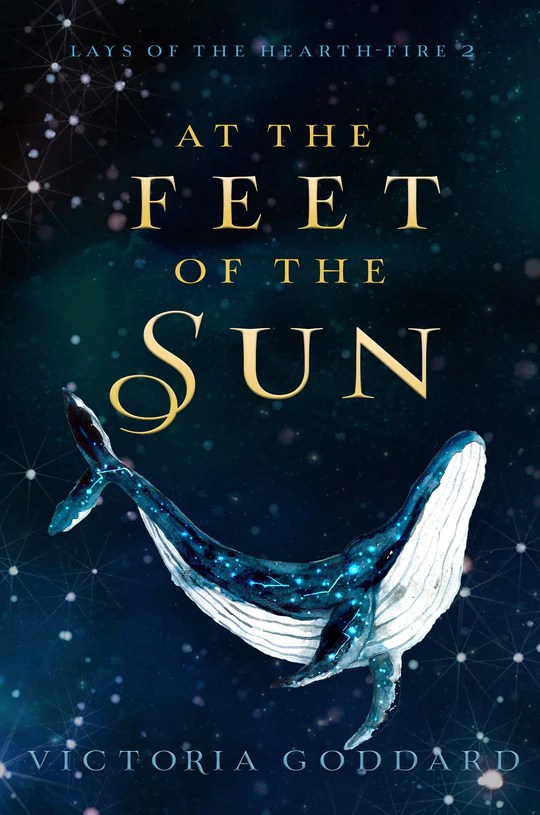
At the Feet of the Sun by Victoria Goddard

At the Feet of the Sun
Lays of the Hearth-Fire, Book Two
by Victoria Goddard
2022

If I had any sort of self-control, I would not have finished this book quite so quickly, because it’s essentially five books all presented together in one omnibus. Which I’m glad of! Because otherwise there would have been some real cliff-hangers. But, it’s really long with multiple interlinked plot arcs and side quests that are massive enough to be regular quests all on their own. And, also, the book (that’s really five books) does come to a satisfying emotional conclusion at the end, but it doesn’t actually conclude the original plot that was set up at the end of the first book. So I’m already looking forward to Book 3, but am glad enough to have a breather before presumably reading another 1000+ pages.

This book starts up soon after the end of Book 1: The Hands of the Emperor, and the first part runs parallel to The Return of Fiztroy Angursell, and then just keeps going with the adventures and development of Cliopher “Kip” Mdang. Kip is a wildly successful bureaucrat who has spent his life successfully dismantling an empire and replacing it with a more egalitarian system of government. And now he’s retiring. He’s not yet officially done, but he’s transferred the majority of his work and responsibilities to others and has the space to figure out who he is now that he’s not so driven anymore, and that’s not an easy path. And also, this whole universe is an amazing creation where there are nine interconnected worlds, magic and gods are real, religion is complicated and diverse, and time fluctuates wildly. Kip’s career is somewhere between 45 and 1100 years long, depending exactly where you stand, and his own personal experience varied as well as he experiences long periods of timeless effort. The story moves seamlessly between practical struggles and legendary adventures; travels on the sea around Kip’s home archipelago and travels on the Sky Ocean between the stars; searching for Kip’s lost cousin Basil and going to get a new fire from the Palace of the Sun.

Kip is amazingly and wonderfully competent in achieving his goals for the greater good of the world, but still struggles to find his place and self-promote when it’s about him and not some greater achievement. And figuring out how to communicate with his emperor as a person whom he loves after spending decades/centuries working with him as an untouchable god is an ongoing struggle, even as they both want equality between them. Through all the struggles, there’s a sense of certainty that it will all work out, or if it doesn’t, then it will be a loss of what could have been but what already is, is still sufficient.

It’s a beautiful and optimistic book, and I really enjoy it immensely.

A Short History of Tractors in Ukrainian

By Marina Lewycka

“Extremely funny” says The Times.
“Mad and Hilarious,” Daily Telegraph.
“Uproariously funny” from The Economist

Guys, this was one of the most mean-spirited books I’ve read in a long time. Sisters Vera and Nadia hate each other and seem contemptuous of their elderly widowed father. When he becomes attached to a much younger woman, they try to intervene, seemingly more out of immediate hatred for this new woman than any concern for their father. Their father, in turn, disdains his daughters for a variety of reasons, and fights their intervention, even as the new woman turns out to be despicable and abusive.

The back blurb teased that this struggle uncovers long buried family secrets, which is what hooked me (as well as the unusual title). And the central story is interspersed with background vignettes on the parents’ and grandparents’ lives in Ukraine, though there is no big reveal or epiphany. Instead, by spending just a little more time talking about their different experiences growing up, the two sisters reach a basic level of empathy for each other that they probably should have managed a long time ago. Oh, and there are also passages from a short book the father is writing about tractors. The history of mechanical invention is not really my thing, but I actually welcomed the breaks from the central characters.

I wanted to quit a couple of times, but was too embarrassed after the librarian had looked so intrigued by the title when I was checking it out and made a note to check it out herself. Plus, I feel like I’ve been losing interest in books halfway through lately, and that I should really see one through to the end. That said, the ending was surprisingly satisfactory and even a little touching after all the meanness, so that was kind of nice.