The Poppy War by R. F. Kuang

The Poppy War
by R. F. Kuang
2018

Some years back, I first heard of this book in a recommendation list that had tagged it as grimdark. That’s not a subgenre I appreciate at all, and so I didn’t read it then. More recently, I ran across a recommendation somewhere else, and it looked interesting so I gave it a shot, and for the most part it slots pretty neatly into a lot of fantasy and YA war books that deal with horrible situations. However, out of 530 pages, there are about 30 at the 400 page mark that are absolutely horrifying and I wish I hadn’t read.

While the book is set in a fantasy world, it’s clearly inspired by China and Japan and the Japanese invasions of China. And those 30 pages are inspired by the Rape of Nanking, aka the Nanking massacre of 1937-1938. If you ever want nightmares, look up that bit of history. As a piece of fiction, it comes across as a series of gratuitously detailed descriptions of physical and sexual abuse on a massive scale; as a reminder of the depths of horror that humans perpetuate upon each other, it made me wonder why I was reading fiction and not somehow doing something to stop any of the current genocides taking place, and how horrible is it that none of them are as horrifying as Nanking was.

But, you know, other than that, the book felt like a combination of The Magicians (which I didn’t care for) and Iron Widow (which I did). The plot focuses on Rin, a young orphan girl being fostered by drug runners who’s determined to get out of an arranged marriage by passing the entrance exam for the premier military academy (which come with an automatic full scholarship) and going on to do great things.

The book is organized into three parts, the first part of which is basically an extremely long training montage. I do love a good training montage, so this isn’t a bad thing from my perspective, although some of it broke my suspension of disbelief. (Forcing yourself to stay awake for days on end to rote memorize texts you don’t understand is unlikely to actually lead to a good test grade.)

The next two parts are the war. And also where the characters get increasingly full of themselves even as they make increasingly questionable decisions. The training montage section dealt with a lot of cool world building and magic theory, but not much about military structure, strategy, tactics, or logistics, all of which they could have been helpful later on.

There is an extremely dramatic conclusion with Rin coming into her power and rather conclusively ending the war, while also setting up for an even more dramatic sequel. However, it also falls a bit flat as it tries rather quickly to address the philosophical question of whether or not atrocities in response to atrocities are ever acceptable.

So over all, this was well written, but I didn’t actually like it, and while I’m curious to know what happens in the next book, I don’t think I’m going to read it.

Ruined by Vaughn, Searle, and Smith

Ruined
written by Sarah Vaughn
pencils and colors by Sarah Winifred Searle
inks by Niki Smith
2023

This is a regency romance graphic novel and it’s delightful and well-done and extremely fictionalized. It’s not so much set in the British regency era as it is in the universe of the Bridgerton TV show, not explicitly but pretty obviously, as it mostly maintains the fashions of the historical era while ignoring the social and political issues.

In this universe there is no racism or homophobia. Sexism is alive and well in the systemic way that drives so many romance novel plots, especially arranged marriage ones such as this one, but not in the individual way. Systemic classism is also highly present but largely ignored. If this book had been trying to be historical fiction, it would be a failure, but as a romance with aesthetic, it’s a delight.

Our heroine has been compromised! She must marry immediately in order to avoid a terrible scandal! Our hero has inherited an estate that’s in terrible repair and near bankruptcy! He must marry for money! They must give up all hope of a love match and have an arranged marriage!

The story opens at their wedding, and then they proceed to get to know each other and fall in love. There’s also a number of secondary characters with at least two other couples who get together with their own intersecting shenanigans. The book is very cute, beautifully illustrated and everyone makes ridiculous decisions regarding their love lives. It’s also got a couple of explicit sex scenes, which are very much part of the story and character arcs, but were surprising to me since otherwise the story telling feels very general audience and open to all ages.

Apocalyptic Travel graphic novels

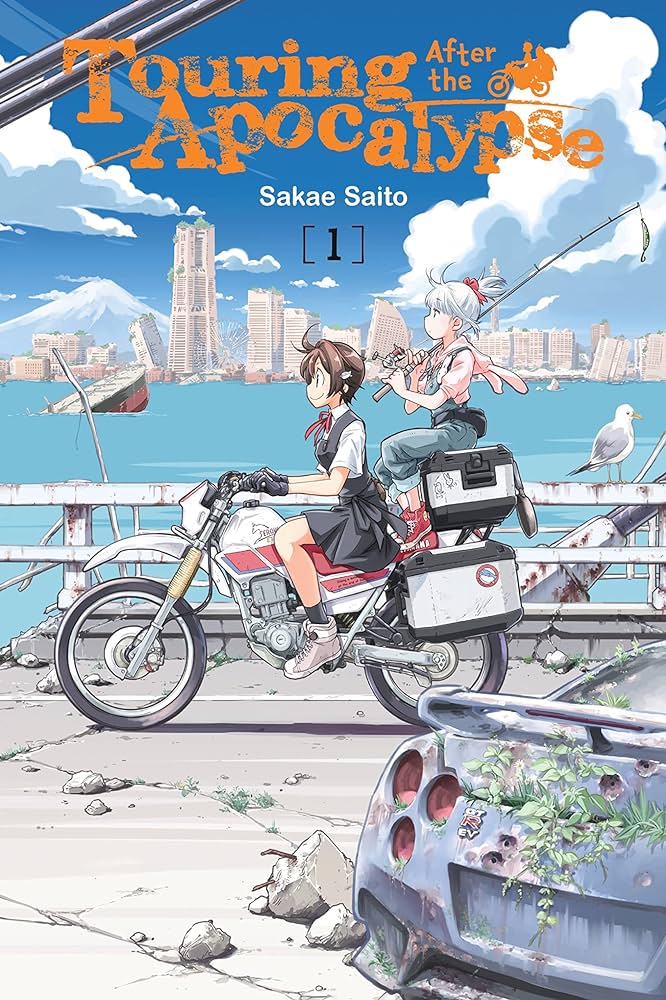
Touring After the Apocalypse, Volumes 1 – 3
by Sakae Saito
translated by Amanda Haley
2022-2023

I randomly checked these manga out from the new release section of my local library and they’re adorable. Youko and Airi are (or at least appear to be) two teenage girls who are traveling via motorsbike around Japan, seeing the sights, following Youko’s older sister’s previous touring schedule, but while the pictures and social media posts that the sister posted look (more or less) like regular posts we might see today, Youko and Airi are seeing the sights after they’re long abandoned and worn down and completely absent any other people. But they’re so excited to see everything!

In each volume, there’s some discovery that to me-the-reader acknowledges the whole tragedy of the empty and crumbling infrastructure of society and what it means that there are so many people not there. To the two girls, it’s fun and interesting and then they move on to the next thing. It keeps the whole mood light-hearted, while also highlighting how much society changes in a single generation as kids who didn’t live the history are accustomed to their lives as being the norm.

There’s a slowly building reveal that something else is going on with these two, but while there are various hints and teases so far, I haven’t figured it out yet.

I’m also really impressed with the translation job since there’s a lot of pop culture references and word games that flow perfectly naturally while I’m reading the English and I can only imagine were incredibly difficult to transpose from the original Japanese.

The Electric State
by Simon Stålenhag
2017

Oof, this is beautiful and moody and horrifying and dark, and it ends in such a way that there’s just enough hope for the future that I think “maybe…”, even though it’s very clear that there’s no real hope. But, just, maybe…?

My first thought when looking at this book was that it was an art book, full of beautiful full page and two-page spreads of various post-apocalyptic scenes. And it is! But it’s also a novella with a story, written in text and full paragraphs and absolutely no text boxes or the like, so it’s more of a picture book than a graphic novel in the way the text and the images interact.

The story is about the narrator Michelle and her companion Skip making a cross country trip in a thoroughly failed cyberpunk society. The setting is intra-apocalyptic rather than post, and oof, does it dip into all sorts of horror, with the implication that at least three types of apocalyptic disasters were all happening at once: war, environmental, and technological. It was reassuring that the events were set in the 1990s with a different history prior to that because this book would have been even more horrifying if it was set in the 2040s. There are a series of flashbacks that reveal the narrator’s backstory, but it’s only in the final third of the book that the reason for trip and Skip’s story are finally revealed, and it’s such a magnificent twist that just twists my heart and stomach.

The differences between these two titles is kind of amazing, just in tone and visualization, especially given how similar the premise and frameworks are. It very much highlights how two people can tell the same story in such different ways that they become two different stories. Reading these two so soon one after another reminds me very much of the Holy Shit! Two Cakes! meme.

The Housekeepers

By Alex Hay

I only realized after starting this novel that heist stories usually dovetail into two very disparate directions, either clever and glossy (à la Ocean’s Eleven or Leverage) or gritty and desperate (Six of Crows, for one). I enjoy both in general, but currently have more of the emotional capacity for the first, and The Housekeepers decidedly falls into the second.

The recently dismissed housekeeper from a wealthy household gathers together a team to strip the house of all its valuables. The team is all women, most of whom have served in domestic positions, with all the poverty and humiliation that entails. Each woman has her own private motivations and ambitions, and the cooperation of the team always feels like a very fragile agreement that could break at any time.

None of them are particularly likeable, though I sympathized with all of their positions and the actions they felt forced into. It reminded me a little of Parasite, where the extreme inequality is a prison for everyone involved, whether on the luxurious side or not. I could see a solution where all the characters find true purpose and satisfaction, but given the world they lived in, it was impossible, and instead I read in dread of who would get hurt the worst.

And that world, the society they live in, created a more finely pointed, subtle dread than just the suspense of the heist itself. These women who had once been domestic servants are now in much more precarious financial positions, but also have more personal freedom on their own. When they go back into service to set up the operation, the grind of the drudgery becomes its own obstacle, as manual labor and exhaustion take their toll.

The whole thing became a bit much for me at times, honestly—at times I couldn’t put the book down, but other times I had to take a break after a few pages—and the book carries it right to the end. There was no satisfying wheeling out of the perfect plan, just nail biting, and I was hanging onto the blurb raving about “a sensational triumph and the ultimate takedown of those in power” to ensure a happy ending.

The Secret Life of Albert Entwistle

By Matt Cain

The quoted praise for this book all included words like heartfelt, heartwarming, and heartbreaking, and they aren’t wrong—I laughed, cried, and aww’ed—but it all felt a little heavy handed. Not emotionally manipulative exactly, but not as effortlessly immersive as I’d hoped.

The novel follows Albert Entwistle, a postman nearing mandatory retirement, who is finding himself faced with how narrow his life has become. Intertwined with flashbacks to his youth, Albert’s early experiences with homophobia was so painful and traumatic for him that it turns into pretty severe social anxiety in general. The novel emphasizes how if you can’t be yourself in one way, it tends to bleed into closing off any sort of real relationships with people. That said, Albert’s early experiences are in no way uncommon or extraordinarily brutal, so no content warning needed for those. I get the impression that Matt Cain was more concerned with filling the lack in literature of stories with happy ending for older gay people, so understandably uninterested in delving deep into trauma, which I appreciated.

At times the book feels a little simplistic, in a sort of Forest Gump kind of way. Albert’s search for his secret high school boyfriend from 50 years ago follows a linear step-by-step trail that stretched my suspension of disbelief. On an individual level, though, Albert follows the same path that greater society has taken over the last five decades, his own self-acceptance mirroring the wider cultural progress. Cain is very purposefully walking the reader through an easily accessible guide to LGBTQ+ history.

In fact, he ends the book with some short interviews with gay men in their 60s from small Northern British towns like Albert’s, explicitly because he worried that the history was getting lost. So much has changed in such a relatively quick time, due to the very hard work of activists, that younger generations might not realize how much had to be fought for over the last few decades. Seeing Albert as a stand-in to personify a movement helped make sense of parts of his personality that seemed a little too flat or smoothed over.

Saha

By Cho Nam-Joo

I’m not even sure what genre to give Saha: novel seems too bland, and while it is certainly dystopian, it is neither futuristic scifi or magical fantasy. It is nominally a mystery as the protagonist searches for her missing brother after his girlfriend is found dead, but there’s little hope of a pat solution for either Jin-kyung or the reader. It is also a searing indictment of capitalism and the corporatization of society.

The novel mostly takes place in Saha, a block of decaying apartments that are the only home permitted to those not granted citizenship in the corporate-owned Town. Though Jin-kyung and her brother kick off the novel, it jumps around between different characters and time-periods at breakneck speed. Many of the scenes reflect bits and pieces of real news stories in haunting detail: a ship full of refugees/deportees ‘disappearing’ into the sea and being forgotten as the news cycle changed; ‘free’ medical treatment but with insurance premiums so high they bankrupt people; the non-citizens only permitted to scrabble for the most difficult and dangerous jobs:

“A life of doing repetitive menial labor without any assurance of compensation was like walking down a path backward. Life was terrifying and tedious. Every time they paused to take stock of their lives, they found themselves unfailingly worse off than before; Saha residents thus grew more childish, petty, and simpleminded.”

I think I’ve mentioned before that I’m not particularly affected by horror novels, but Saha’s scenes were so gripping that I struggled to put the book down and then carried the tension of the book with me through several restless nights. It is not a comfortable book, but it is an excellent one.

About two-thirds through the book, I had an inkling of the thesis: the majority of the society of trapped into these strict castes, and the people are either uninterested or unable to combat the systemic structure. A few people try, though: one of which, without spoilers, is a do-gooder upper caste Citizen who tries to help the lowest caste of illegal Saha, but through her own inexperience and ignorance of their life, oversteps and makes things worse for herself and those around her. At the same time, scenes from the book that seemed to jump around time and place all start to circle around how the Saha slowly built up their society for themselves, based on mutual aid between what each needed and could offer.

It’s such a difficult theme to discuss and dissect, that outsiders often can’t help at all, no matter how well-intentioned, while those inside the oppressed group are prevented as much as possible from helping themselves—that this is how systemic oppression works, and it is very, very hard to deconstruct. It is perhaps more accessible to read about in an allegorical novel set in a fictional setting than to try to delve into the many real-world examples. On a more hopeful note, it does also portray that those who fight the oppression from within, even if they don’t manage to accomplish all that they’d hoped, can push progress forward in ways they wouldn’t have imagined.

Slumdog Millionaire by Vikas Swarup

Slumdog Millionaire
by Vikas Swarup
2005

This is a difficult review to write because I did enjoy the book a lot, but also have so many warnings to give before actually recommending it. For example: there is a lot of sexual violence. And also a distinct current of poverty porn (sort of on the level of Oliver Twist). And the dog dies. Also a lot of people die. There’s racism, sexism, classism, homophobia, and general normalized corruption. But it’s also really fun?

The book reminds me of the movies Being There and Forest Gump. Our main character, Ram Mohammad Thomas, is not simple-minded like Gardner or Gump, but he is uneducated, and the premise of all three stories is that the main characters live these wild lives that fit together perfectly by pure providence.

The premise of this book is that Ram has just won a game show by correctly answering thirteen increasingly difficult trivia questions in a row. The game show accuses him of cheating because there’s no way for him to have the level of education to know the answers. The over-all structure of the book is divided into a chapter per question, with Ram telling his lawyer about the portion of his life that led to him knowing the answer to the specific question even if he didn’t know the subject in general. He’s only eighteen, but his life is just this wild ride of being an orphan raised by a priest, sent to an orphanage, acquired by a beggar gang, working as a servant, working as a waiter, running from the police, and meeting all these different people with their own wild stories. 

There’s this huge cast of idiosyncratic characters and while many of the experiences are either traumatic or end in tragedy or both, Ram rolls with it all in a “this might as well happen” way. There’s also a strong thread of situational humor to go along with the horror that makes for a delightful if somewhat boggling experience.

Plus, there are some amazing plot twists, both in the individual chapters and in the overall book plot arc.

I really enjoyed this book, and it covered rough ground extremely lightly, but any potential reader should decide for themselves if they’re up for trying it.

I did wonder if I needed to watch the movie, if only to see how they dealt with all the trauma and also how they would cover so many stories without being at least ten hours long. Since I’d just read the book, I went ahead and read a summary of the movie and the movie solved both problems by sharing only the premise and structure of the book while changing the character and life history completely to something a lot more generic. Which, in my opinion, really misses the point.

Ink by Angela Woodward

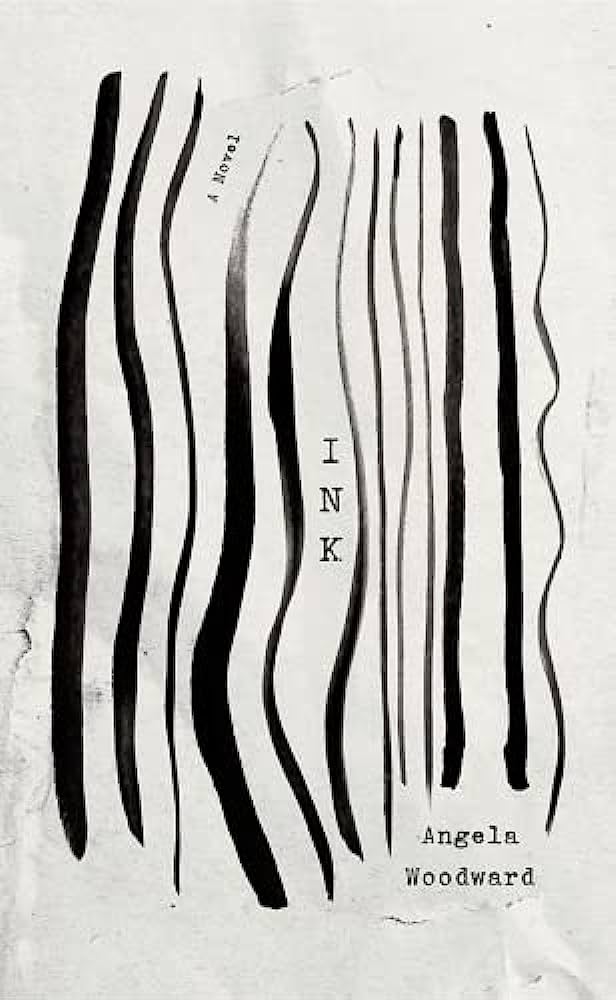
Ink: a novel
by Angela Woodward
2023

Every so often I try reading a literary work and relearn why I don’t read that genre. Woodward is a skilled wordsmith and her writing is lyrical, but her worldview is distasteful and her world-building is poor. Both the characters and the narration are unpleasant in an undeserving way.

I was reminded of a time when I went on a walk with a work friend: we were having a good time mostly window-shopping and chatting in a walking district, when I tripped: stumbled over my own feet, fell to my hands and knees. A few passersby paused but I was fine, I got back up and we continued to walk. The only reason I remember the instance at all is that my work friend said that if that had happened to him, it would have ruined his whole day. He lived in a world where tiny meaningless mistakes could overwrite hours of enjoyment, and the attention of strangers meant critical judgment and inspired shame.

That was his lived experience and I imagine something similar is also Woodward’s experience, and it is certainly her characters’ experience, and it’s such a miserable world to live in: constant judgment both internal and external and no freedom to just enjoy what you can. As Anna pointed out when I complained to her about it: there’s also the meta aspect of Woodward and her characters expecting to be criticized for everything and here I was criticizing them. So it’s not necessarily wrong, but just overly weighted in that direction.

This book is trying to do something interesting, with three different threads: the expected thread of the novel with it’s characters and events, a series of digressions into the history of ink as a substance, and a first-person account of the author discussing her life and writing process for this book.

I found the history of ink fascinating, but untrustworthy. I wish I had read it in a nonfiction book. The first-person accounts I found mostly confusing as to it’s purpose. Perhaps to differentiate Woodward from her even more unhappy characters?

The novel section is what had inspired me to read the book (and not just because that’s the only part that’s in the blurb): it’s about two women who are transcribing the Abu Ghraib detainee statements in the early 2000s. That was around the same time I was doing freelance transcription for various studies in academia: nothing as terrible as first-person torture accounts but enough difficult subjects that I understand some of the impact it can have.

Unfortunately, the book treats the subject as a simple conceit and doesn’t otherwise address it. There are a few short recurring excerpts from those interviews interspersed for shock value, but that was it. At the beginning I thought it was an interesting demonstration of how the mind can shy away from horror by considering more minor aspects: Here’s a single sentence about torture, let us now read several pages on the history of ink. But by the end of the book, as the few repeated excerpts came up, they were treated more like intrusive thoughts to be entirely disregarded, rather than parts of stories that the women were spending days, weeks, months, listening to.

The experience of listening to stories of trauma for hours on end, or even the experience of straining your ears to hear exactly what is said, the click-whirr of the machine, the delight in slow speakers and the difficulty of quick speakers, or the shear physicality of typing all day… None of it was addressed. The characters’ experience was so completely different from mine that it seemed unlikely that Woodward had ever tried transcribing. Or maybe her body, ears and hands all work as differently from mine as her worldview does. 

Woodward explicitly states that she was imaging what these people who must have existed would be like, but increasingly it frustrated me that this isn’t at all what they would be like, starting with being English-speaking only. Woodward wrote a novel about two women in an office environment who both have various levels of unpleasantness in their home lives, but the details of their job appeared to have no impact on them whatsoever.

This book had so much potential: a fascinating premise by a talented wordsmith, and it’s really irritating how poor the results were.

Hench

Ages and ages ago, Rebecca reviewed a funny romance novel called Love for the Cold-Blooded, which peeked behind the scenes of life as a super-villain’s sidekick. That story felt so fresh because it subverted the ubiquitous hero/villain tension by making the heroes seem kind of dumb and the villains seem reasonable, if perhaps a little dramatic. It also featured a surprisingly sweet romance. If you’re interested in a book that flips the traditional script on superheroes but with a very different feeling, Hench by Natalie Zina Walschots avoids all the sweet predictability of a romance.

In Hench, Anna Tromedlov (even she knows this name is a little silly) is a data analyst scraping by doing temp jobs for small-time villains. She’s not overly ambitious or too concerned with the morality of her work, until she becomes collateral damage when a hero sweeps in to save the day. As she recovers from a serious injury that no one will admit was caused by a “good guy,” she becomes obsessed with the damage that heroes can do. She starts applying her intellect and skills to the problem, and she gets drawn right into the heart of the hero/villain conflict. What seemed like just an ethically-dubious desk job is suddenly a much more dangerous proposition.

I appreciated that Anna was never overly concerned with whether she was fighting on the right side or not–her alliances are clear from the beginning. Rather, she has to figure out just how much she’s willing to put into her job, what allegiance we owe to the people we follow and what we expect from them in exchange, and how all her villain-izing will impact the rest of her life.

There is a lot of overlap between this story and The Boys on Amazon, which is a good, interesting show addressing some of these same issues. I do like The Boys, but I also find it grosser than I can handle at times, and awfully overloaded with a bunch of loud white guys. I think the fact that Hench is a book (so I can skim over some of the grosser stuff) and is the internal story of a smart, take-no-shit woman (who also has no patience for overbearing dudes), made it more compelling and enjoyable for me.

Kinsey’s Three-ish Word Review: Darkly-funny villain adventure

You might also like: This is a tough one, because Hench has such a specific voice. But a few other books that put a twist on some traditional situations/tropes include Sign Here by Claudia Lux, Vampire Weekend by Mike Chen, and Everyone in My Family Has Killed Someone by Benjamin Stevenson.

Woman, Eating

By Claire Kohda

Uh, this novel is very strange. It’s a dark, often melancholy, coming of age story, as Lydia, a sheltered 23-year-old, is on her own for the first time after placing her mother in a care home. She’s awkward and shy, trying to find herself in her internship at an art gallery and her studio at a young artists’ collective. She’s also a vampire.

But still a very, very young vampire, who is struggling with her identity, as well as to ethically source blood in London. For the majority of the book she is starving (thus the title), and obsessed with human food she can’t digest. This wouldn’t be a great book for anyone with any sort of eating disorder. In fact, there are a few different content warnings (sexual assault, imagined animal harm), and I read a lot of the book in a state of low-level dread.

But I also read the book in rare complete focus because the writing is just so beautiful. It is very literary – most of the narrative is Lydia’s thoughts and feelings, and they could sometimes be exasperatingly self-indulgent in a very accurate 23-year-old way. But the backcover blurbs weren’t wrong when they raved about a completely new perspective on vampire mythos. Once I started reading each night, I only put the book down again at the end of each of the three parts that divide the relatively short book (227 pages).

The end, too, is a viscerally joyous release of all the built-up tension that truly fulfills Lydia’s coming of age. I wouldn’t necessarily say that I enjoyed the experience of reading this throughout, but I’m very glad that I did nonetheless.