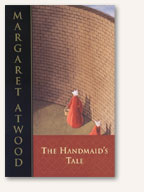
The Handmaild’s Tale

By Margaret Atwood

Book cover: The Handmaid's TaleWarning: this is going to be a blatantly and quite politically biased post. As everyone, left- and right-leaning, has been saying, Tuesday is going to be quite a deciding factor for our country, and will take us in one of two very different directions. (I’m feeling a bit guilty myself for having moved my vote away from a key swing state this year.)

Early on in the campaigns, I was so taken aback by the backlash against Sandra Fluke and the willingness of conservative women to outrageously slut-shame other women with no awareness of how such language could eventually come back to bite them as well. In discussing this very fact, I read the below comment on Videogum, one of the blogs I read daily:

Has everyone read “The Handmaid’s Tale”? It’s a. GREAT, and b. set in a future America where a very repressive regime that is pretty shitty to women has taken over. There is a passing moment where the narrator talks about how a woman she knows used to be a great big televangelist who would always talk about how a woman’s place should be at home is turned into a chattel slave like every other lady once the new regime takes over, and how she seems mad that someone “took her at her word”.

After reading this comment, I thought perhaps The Handmaiden’s Tale could give me more insight into this kind of mindset.

This book is terrifying, far scarier than any horror story I could have picked for Halloween. My only comfort was that it seems unrealistic that such a drastic change could happen all within one generation. In the novel, the narrator went to college, got married, and had a daughter, all before she was restricted to being a “handmaiden,” a fertile woman supplied to couples unable to have children in order to surrogate for them by government orders, in her mid-30s. Although maybe Atwood’s point is that if you aren’t paying attention or participating in politics, it could run right over you before you even notice.

In addition to terrifying, though, the book is enthralling; I couldn’t put it down. I’d worried that it would be painful to read, but the narrator takes such a matter-of-fact tone that even the most stressful scenes had a comfortably numb tone that both made them easier to read and reflected the mental state one would have to be in to survive. I’d thought about ‘live-blogging’ my progress through it, but I devoured it in a matter of days, and then spent the next couple of weeks trying to write a post that encapsulates all of my feelings about it, which turns out to be impossible. Instead I’ve compiled a little game for you – it will be fun!

Here is a list of quotes, some from The Handmaid’s Tale and some from a variety of political leaders and pundits; can you tell the difference?

  1. “If you look at the Scriptures, I believe it’s clear that God has designed men to exercise authority in the home, in the church, in society, and in government.“
  2. “Our country might have been better off if it was still just men voting. There is nothing worse than a bunch of mean, hateful women. They are diabolical in how than can skewer a person.”
  3. “Money was the only measure of worth, for everyone, they got no respect as mothers. No wonder they were giving up on the whole business. This way they’re protected, they can fulfill their biological destinies in peace. With full support and encouragement.”
  4. “Nature demands variety, for men. It stands to reason, it’s part of the procreational strategy. It’s Nature’s plan. Women know that instinctively.”
  5. “The problem with women voting is that women have no capacity to understand how money is earned. They have a lot of ideas on how to spend it. And when they take these polls, it’s always more money on education, more money on child care, more money on day care.”
  6. “What we’re aiming for is a spirit of camaraderie among women. We must all pull together.”

Answers after the break.
Continue reading

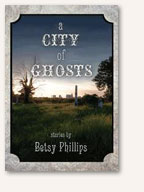
A City of Ghosts

By Betsy Phillips

Since it is very possible that all three authors of this blog will lose power due to Sandy for the next week, I’m posting my Halloween post a few days early.

Book Cover: A City of GhostsKinsey and I were discussing the blog, sort of roughing out upcoming posts, and I mentioned how I like to read something spooky in honor of Halloween, but that I couldn’t actually remember ever reading a book that truly scared me, like so scared I don’t want to turn out the lights. (After more thought, the story of “The Monkey’s Paw” made me very unhappy at the time of reading it, though didn’t interfere with my sleep at all, and Steinbeck’s The Pearl has given me a lifetime phobia of scorpions, so those seem to be as close as I get to scared.)

Anyway, Kinsey lent me A City of Ghosts, which is a collection of ghost stories set in Nashville, self-published by the author in 2010. I was somewhat dubious about this book for a couple of reasons: 1) I am a huge snob about self-published books; and 2) I am a huge skeptic; not only do I not believe in ghosts, I can’t even imagine any evidence that would make me believe in them, up to and including seeing one for myself.

However, it was really, really good! Not spooky, but just super interesting. It was a comfort to me that the author notes in several places at the beginning of the book that this is a work of fiction, since then I could just enjoy the stories without picking apart the possible truth behind them. Although, Phillips writes in such an easy, first-person, conversational style that I had to reconfirm for myself several times that she did indeed state upfront it is fiction.

I read it more like a book of poetry, especially since the stories were very short, mostly ranging between one to three pages long. Phillips uses the small vignettes to flesh out (so to speak) aspects of Southern society, like the shadow of slavery and the ongoing racism and classism, that are hard to encapsulate in concrete terms on their own. I interpreted the ghost stories as metaphors for how events can become permanently embedded in our social consciousness and dictate how our lives are led even decades later.

The book is dividing into two sections, the first titled “April,” and the second titled “October.” The stories in “April” are a bit lighter in tone, reading a bit more like traditional ghost stories and addressing more individual cases; “October” has several stories that include flood waters, very clearly dealing with post-Katrina recovery. Even while typing this, I can see how ghost stories about the victims of Katrina sounds like it could be incredibly insensitive, but the stories instead describe the hurricane as a specter itself that hangs over the survivors with nightmares of the flood waters and grief over the victims.

I just found it very poignant, and in that way, much more lastingly enjoyable that I would more traditional ghost stories.

— Anna

Slaughterhouse-Five

By Kurt Vonnegut

Banned Books Week 2012Book cover: Slaughterhouse-FiveWhen I decided to read Slaughterhouse-Five for this year’s Banned Books Week (and the couple weeks following, as well, apparently), I was a little baffled that I hadn’t already read any of Vonnegut’s books because I like science fiction and I’ve had Vonnegut recommended to me multiple times. I even vaguely recalled meaning to read some books but never getting around to it.

Then, I got a couple of chapters in, and remembered that I hadn’t just meant to read his books before, I’ve actually started several of his books in the past, and put them down again. I just cannot get started into Vonnegut’s books, which is so frustrating because I really enjoy both sci-fi and social satire, and he is a king of both. So, I bring you this review in three Acts: Dismissiveness, Grudging Respect, Zealous Appreciation.

Act I: Dismissiveness

I spent roughly the first half of the book trying to put my finger on the problem. It isn’t as though I especially disliked it or thought it was a bad book; I just felt that I didn’t totally get what he was trying to say and that his writing style wasn’t one that speaks to me. When Tom asked if I was enjoying it, I had to admit that I wasn’t, and when he looked a bit disappointed, I followed up by saying that I thought it was a little too philosophical for me, like Vonnegut is communicating a theory about life, instead of sharing a concrete facet of life, and I get impatient with that. Tom nodded, because he has despaired of my disinterest in philosophy before, but I continued to mull over my answer.

And I think it was something even further, that his people weren’t interesting to me as characters. That they seem more like placeholders in his philosophical argument; their actions only serve to augment the message of the book. So, I didn’t have any vested interest in the future of the characters, which is especially true in this non-chronologically-linear novel where the future is all spelled out early on, and even the characters in the book don’t have much interest in it, either.

Acts II and III with spoilers and excerpt after the break…

Continue reading

Every Day

As with Gone Girl, I feel like I’m making a fairly unoriginal recommendation here, but Every Day by David Levithan is so good that I will be the latest in a long line of people saying how awesome it is. In fact, when Anna and I saw John Green speak recently, he even specifically recommended this book to the audience. (He and Levithan wrote another awesome book together called Will Grayson, Will Grayson, so they’re clearly friends, but it’s a good recommendation nonetheless.)

Okay, stay with me here, because this is going to sound odd. Every Day is about a teenager who wakes up every morning in the body of someone else. Sometimes it’s a boy, sometimes it’s a girl, but it’s always a teenager, and always someone within a few hours of the person the day before. On one day the main character (who has no name and no gender) falls in love with a girl, and after a lifetime of floating through bodies without leaving a trace, there is suddenly a reason to try to take control and get back to this girl.

Now, this sounds pretty high-concept and I held off reading this book for a while–it sounded sort of overdone and like it would be a slog. But the writing is clean and elegant, and the conceit of changing bodies every day comes to feel normal very soon, allowing the reader to focus on the story. Levithan not only makes his central idea functional, but by the end of the book it seems almost normal–plausible, even.

It’s not a cheery book–I’m going to call it “tinged with sadness”–but it’s both a good story and an impressive feat of writing. Made even more impressive because reading it doesn’t feel like it takes any effort at all.

Attachments

I’ve mentioned Linda Holmes of NPR and the fabulous Pop Culture Happy Hour podcast here before–both the blog and the podcast are wonderful places to hear intelligent talk about movies, TV, music, other podcasts, and all sorts of other good pop culture-y things. I wouldn’t have said that they talked about books that much, but I’ve gotten a couple of good recommendations from them lately. Gone Girl was something I was probably going to read anyway, and their recommendation just encouraged me, but I would never have found Attachments without Linda’s recommendation on a recent episode, so I am passing it along.

Written by Rainbow Rowell (who has maybe the best author name ever), it’s the story of a guy working in IT at a small-town newspaper during late 1999. His job is to read the employee emails that have been flagged as inappropriate content and issue warnings to the employees, but he finds himself so interested in the emails that two women at the paper are exchanging that he can’t bear to stop them. In fact, he finds himself falling in love with one of them–but can anything ever come of a relationship with such a beginning?

Does that make the book sound creepy? It’s not at all, it’s sweet! The main character knows he’s in a potentially creepy situation and spends a lot of the book trying to figure out how to make it less so. And the emails between the two women are fun, and give the book a very epistolary feeling. Plus, all the references to Y2K are sort of charmingly retro. Remember when were so worried about that? Remember when email was so new and fun? I would describe this book as light, but thoughtful–it’s a sweet romance, but the lives of the people involved feel very real and important.

So at this point, I’ve got a 100% satisfaction record with Pop Culture Happy Hour recommendations and I will do whatever they tell me to do. (But even they can’t make me read comic books.)

Required Reading

In the comment section of Rebecca’s post on 40 Modern Nonfiction Books Everyone Should Read, she and Anna and I got into a discussion about the list of books she was reviewing. I said that I thought the list was dull. Most of the books on it are self-help or management books, which may be informative but aren’t particularly interesting or inspiring. (To me at least–maybe you find The 7 Habits of Highly Effective People riveting!)  Of course, the guy who wrote that list didn’t call it the Most Exciting Nonfiction Books Everyone Should Read, but I like to think that if I were giving people a list of books they should read, those books would be entertaining as well as useful. I made a couple of suggestions along those lines in the comments, and was then challenged to write a post on it.

So I made a list of the eight books I think everyone should read–the eight that immediately jumped to mind as the ones that have most powerfully influenced how I live my life. As I said to Anna and Rebecca in the comments, these aren’t necessarily books that are going to help anyone get a job or buy a house or whatever, but they are the books that I find myself going back to again and again for advice on how to function in the world.

1) The Happiness Project by Gretchen Rubin
This is the book that has had the greatest impact on my day-to-day life. It’s half general ideas and research about happiness and half practical advice. The book is based on Rubin’s super-popular blog and in some ways the daily reinforcement of the blog is probably more powerful, but the book is very good. I have given stacks of these as gifts.

2) This is Water by David Foster Wallace
Wallace’s commencement speech at, I think, Kenyon College, used to be available out there on the internet, but then someone decided to publish it in book form and make people take down the free versions. But it’s well worth buying (and hard to begrudge his family the money). It presents a very kind, thoughtful, gentle way of moving through the world. Good advice for new graduates, good advice for those of us who graduated long, long ago.

3) Take the Cannoli by Sarah Vowell
I first heard Sarah Vowel on This American Life and of late she’s published a great string of books on American history, but my favorite work of hers is still these essays. There’s one, in particular, where she talks about how she doesn’t believe in God, but she does believe in all these other things, that I really love.

4) Tiny Beautiful Things by Cheryl Strayed
A newcomer to the list! This collection of Strayed’s Dear Sugar advice column for the Rumpus just came out, but it’s a powerful one. These aren’t your standard requests for advice and they’re not your standard responses. I read this in a restaurant, while I was out of town on a business trip, and it made me cry in public.

5) Paula Spencer by Roddy Doyle
The only fiction on the list, even though I wasn’t really thinking about that when I made the list. This is an odd sort of stream of consciousness story about an Irish woman who is, well, living her life. It’s about how she makes it through the day and tries to relate to her kids and tries to improve her lot. The style, and the Irish vocabulary, can be a bit challenging, but for me this reads like a handbook on how to find joy and satisfaction in everyday life.

6) The Spirit Catches You and You Fall Down by Anne Fadiman
The amazingly detailed, thoughtful story of a young Hmong girl with epilepsy and the challenges that meshing traditional Hmong beliefs with modern medicine created for the girl’s family and her doctors. This one story was the best explanation I have ever read of cross-cultural communication issues, and just in general shows how well-meaning people with the same goal can still have to work terribly hard to understand each other.

7) Operating Instructions by Anne Lamott
Lamott can be a little Jesus-y for me sometimes, but this journal of the first year of her son’s life, where she tells the story of being a scared single mom barely hanging on to sobriety and sanity, is a wonderful example of faith.

8) In Defense of Food by Michael Pollan
The politics of food and eating are so fraught and political I hate to even include this, but I did find it really useful, so it goes on the list. Michael Pollan can be awfully preachy and kind of oblivious to some of the baggage that food carries for many people, but this book presents an extremely straightforward, simple, actionable philosophy of how to eat. If you want something similar but with more of a narrative story and a call to action, you could also read Animal, Vegetable, Miracle by Barbara Kingsolver.

And an honorable mention, although I know I’ve mentioned it on the blog before, The Miraculous Journey of Edward Tulane. This is such a powerful, heart-breaking book that I think everyone should read it as a personal version of the psychopath test–if you can read this without crying, you should probably do something to address your lack of a soul.

Gone Girl

I am fully aware that recommending Gone Girl at this point is like making sure that everyone knows that Apple makes a nice phone. Gone Girl, by Gillian Flynn, seems like the book of the summer and everyone has read it/is reading it/is recommending it. Well, that’s because it’s AWESOME. I picked it up to read on a business trip, thinking that it was a sizable enough book it should last few though a few days of work and travel. I started it when I got to the airport, read like a mad person, and finished it before I even got to my destination. It made summer afternoon air travel–which included thunderstorm delays, a drunk guy getting escorted off the plane, and a transfer in Charlotte (haaaate)–all seem enjoyable.

I don’t want to give away too much of the plot, but it’s the story of a woman who has gone missing, a la Dateline or 48 Hours or one of those awful-true crime shows. Did her husband do it? He claims to be innocent, but each chapter reveals a new bit of information that makes the reader swing back and forth between being sure he’s guilty and having no idea what happened. I believe that people call books like this “literary mysteries” or “literary thrillers,” maybe to try to make themselves feel better about reading a really exciting, plot-driven book? But there’s no need to worry on that front–it is a thriller, but what makes the book stand out are the really finely-drawn characters and focused writing. Even though your perceptions of the husband and wife are constantly changing, they feel like very complete, real people, and there is not an unnecessary word in the book. And the plot twists make the reading experience a bit like a roller coaster. The fabulous Linda Holmes from Pop Culture Happy Hour said that when she read this there was a point at which something happened, and she actually closed the book and hugged it. And I know exactly what point she’s talking about because I DID THAT TOO. My airplane seatmate thought I was crazy. I don’t care how many thrillers and mystery novels you’ve read, this one takes you to new places and does it in new ways.

I should say that this is not a happy books, and you end up spending hours of time with unlikeable people doing despicable things. I felt sort of icky when I had finished, but I was enthralled the whole time. If you have a plane flight or jury duty or just a free weekend day coming up, and you need a book that will make eight hours feel like nothing, Gone Girl should be at the top of your list.

The Lizzie Bennet Diaries

The Lizzie Bennet Diaries
By Hank Green and Bernie Su
2012

I would not have thought it was really possible to transpose Pride & Prejudice into a modern setting, but then I watched some of the episodes of The Lizzie Bennet Diaries and was amazed. This is the Bennet family in the current time as told through Lizzie Bennet’s online video blog. And it’s delightful!

It’s also still a work in progress, still being updated twice a week with new episodes. So far there are 30+ episodes, each between 2.5 and 5 minutes long, and Lizzie and Jane are staying at Netherfield, visiting Bing Lee, his sister Carolyn, and friend Darcy.

The translation of the story from the 19th century to the 21st century is both really well done and kind of fascinating. What changes and what doesn’t change is pretty awesome.

While the majority of the story is told diary-fashion about off-screen events, some of the events take place while Lizzie is recording the videos and seven characters have directly appeared on camera (so far): Lizzie Bennet, of course, but her also her friend Charlotte who helps with the video editing, her sisters Jane and Lydia, Bing Lee and Caroline have appeared a couple of times, and, in one memorable episode, Mr. Collins.

It’s really well done, and it’s a bit like potato chips: each episode is short and quickly watched and yet you can’t just watch one. There’s more to watch and you want to watch them all!

Thus, you should go start watching! Here’s the first one.

Too Hot to Read

I’ve been struggling to write an entry the past couple of weeks. It’s been so hot and miserable that I’m hardly motivated to do anything more than slowly sip a cold beverage while staring into the middle distance–even reading seems like a lot of work–and nothing I’ve read lately has been inspiring. I want to tell you about books that I love, but recently every book I come across is one I am basically okay with, they’re all fine, whatever. But other people seem to like all of these books, so let’s do a quick round-up:

Rules of Civility by Amor Towles–This has gotten rave reviews and it seems like something I should love–bright young things in New York City in the 1930s! And I did love the descriptions of what it was like to work as a secretary and eat at the Automat. But the main male character (who I guess I was suppose to be pining over?) was a total blank to me and the best friend seemed like a terrible friend that the main character was better off without. Plus, I felt like we were eternally on the edge of a more interesting story that we never quite got to–the book kept making allusions to the fact that the main character was Russian but had Anglicized her name to get ahead in the world, but we never learned anything about her family or why she did that or what the costs were. I wanted more. If you know the perfect glittering 30s book, let me know.

The Pirate King by Laurie King–This is the latest in the Mary Russell/Sherlock Holmes mystery series (short version: after Holmes retires to the country, he teams up with a young girl and they end up solving mysteries together). I ADORE the first three, but the later ones have seemed lightweight, like generic mysteries that could be solved by any generic characters. The first few books were so enjoyable because Holmes and Russell and their relationship was so clearly drawn, and I feel like that’s been lost a bit. Only for diehards.

Shape of Desire–Remember when I was talking about how much I love Sharon Shinn? I do still love her, but please don’t read this one. I think this is her attempt to get on the Twilight bandwagon, not with vampires, but by setting a supernatural romance-type story in this world. I am on board with supernatural romance, but this one felt like a twenty-page short story blown out into a whole book. Go reread the angel books instead.

Slow Love by Dominique Browning–A memoir about a woman who gets laid of from her job and finds herself seemed like it would be right up my alley. It’s subtitle is “How I Lost My Job, Put On My Pajamas & Found Happiness,” and doesn’t that sound fun? Eh. Way too much of the book was taken up by her whining about a relationship that ANYONE could have told her was pointless, and as far as I could tell, her happiness consisted of her using her enormous severance to retire to the vacation house she already owned. Less inspiring than I had hoped.

Here’s hoping that my upcoming beach vacation results in a whole stack of books I love and can heartily recommend.

The Cranes Dance

I am fascinated by any sort of TV show that shows people behind-the-scenes at work. Deadliest Catch? Ice Road Truckers? Dirty Jobs? Any of those 24 Hours in the ER things? I’m in. I love watching people do their jobs. So it was predicable that I would get completely sucked into Breaking Pointe, an extremely cheesy summer reality show on the CW. It’s set behind the scenes at a ballet company in Salt Lake City, following a number of young dancers and they fight for roles and get ready to perform their big ballets of the season. Unfortunately, Breaking Pointe spends way too much time on the dancers’ (completely dysfunctional) relationships, and not enough time letting us watch them get yelled by Russian teachers in rehearsals. Luckily, The Cranes Dance by Meg Howrey was there to meet my needs.

The Cranes Dance is fiction, told from the perspective of Kate, a twenty-something professional ballerina in New York City. Kate’s younger sister Gwen is a more successful dancer in the same company, but it’s clear from the very start of the book that Gwen has had some sort of mental breakdown and has been taken back home to the Midwest by their parents to recover. Left by herself in New York, Kate has to sort out how she feels about her caretaker role as the big sister, where she fits into the ballet world without Gwen, and whether she is still the “sane” one if there’s no one there to compare herself to. Oh, and all this is happening while she’s rehearsing for performances and dealing with a serious neck injury, partner problems, and other assorted daily ballet annoyances.

I initially picked this up because I wanted to read all the behind-the-scenes stuff about bleeding toes and eating disorders and ballet company politics, and all that is there in spades. Howrey was a dancer and you can tell. But I ended up being much more moved by the emotional story of the book than I expected. Kate is a really compelling character, smart and capable and funny even when she’s making terrible decisions. I’ve seen reviewers compare this book to Black Swan and there are similar elements, but they feel very different. While Black Swan was about someone falling apart, I found The Crane’s Dance to be more about Kate fighting her way out of the darkness. The book does fall somewhat into that category of first-person stories that show the main character going crazy by making the writing crazier and crazier (the two books like this that jump to mind are The Egypotologist and House of Leaves, both of which I found disturbing). I’m not usually a fan of that technique, but this only does a tiny bit of it and it works well.

My one quibble with the book, when I first finished it, was that things wrapped up awfully swiftly at the end and it felt a little jarring. But the more I think about it, the more true to life the ending feels–sometimes there’s not a huge event that helps snap us out of a cycle, it’s just the forward momentum of life, and that’s what The Crane’s Dance describes.