This novel is less about telling a story than evoking a place and time, but it does that so well that I didn’t mind the slight plotting at all. In fact, with everything currently going on, a sort of gentle pastiche of the past might be exactly what I needed.
Daniel Lavery, a favorite author of mine, can just really turn a phrase that had me giggling at basically just clever nonsense (which I mean as a high compliment). Almost every sentence is packed with both witticisms and what I assume is meticulously-researched details of the period, and though it could make for an occasionally dense style, it is also a most welcome distraction from everything in the present.
I’ve seen some low-star reviews complaining that you must love the narrative voice, because there’s not much else going on, and while I suppose I agree, I absolutely love the narrative voice! For me, Lavery does a great job of recalling the absurdist comedy of Three Men in a Boat and Wodehouse. And even with the very light touch, he fits in some poignant themes of personal responsibility, social responsibility, and the frequent conflict between the two, which is very relevant today and helpful to hear, like a gently prodding pep talk. This book won’t be for everyone, but for those of us it is for, it is marvelous!
I almost skipped the Ann Arbor Comic Arts Festival, held in the downtown branch of the Ann Arbor District Library, because I was tried and busy and distracted and when I went to double-check the time and location, the website was definitely geared towards families with young kids.
I’m really glad that I went though! There were probably about 50 artists’ booths and while the content was all family friendly (some of the artists had left some of their creations at home in order to keep the selection family friendly) there was still plenty of things that I found interesting. I forgot to come with a suitable amount of cash, but a number of the vendors did take credit cards, and I acquired a few more fascinating items.
100 Demons Dialogues by Lucy Bellwood This is a sweet little book that has some serious emotional impact, as Bellwood personifies her internal critic as a little demon that follows her around, and she refutes its arguments as she continues to work on her art. It’s remarkably inspiring.
to and fro by kat tuesday This is a short (24 pages) compilation of three of the author’s works, including Peek and Plover in Another Blasted Cave, and is just generally kind of adorable. In some ways it feels like the kind of sketch/doodle story that you might create when you’re bored in a meeting with only your note pad available, except that it’s both really well done and finished.
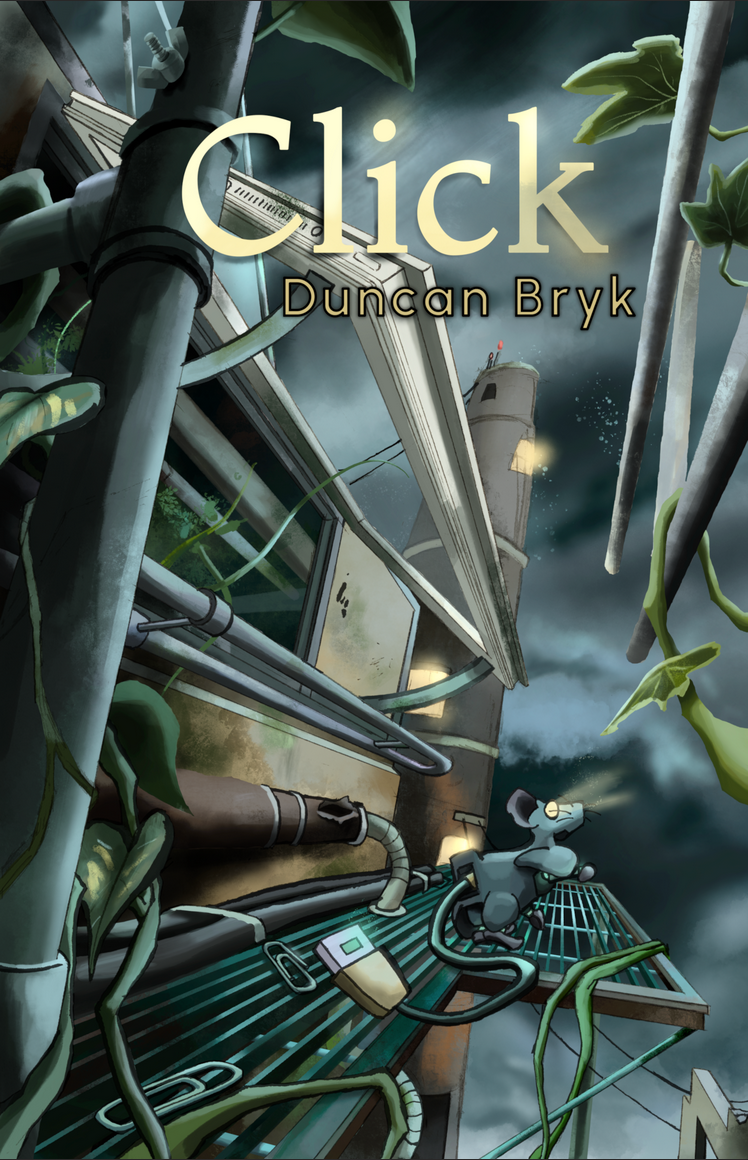
Click by Duncan Bryk This has some fascinating background world-building of some sort of magical-realism steampunk post-apocalyptic situation, except that it’s all through the point of view of a mouse that only explores within the one odd mansion and only interacts with the very strange caretaker of that mansion. The caretaker clearly knows more about the situation than the mouse, but the mouse is their only companion as well. The overall sense is a combination of intrigue and melancholy.
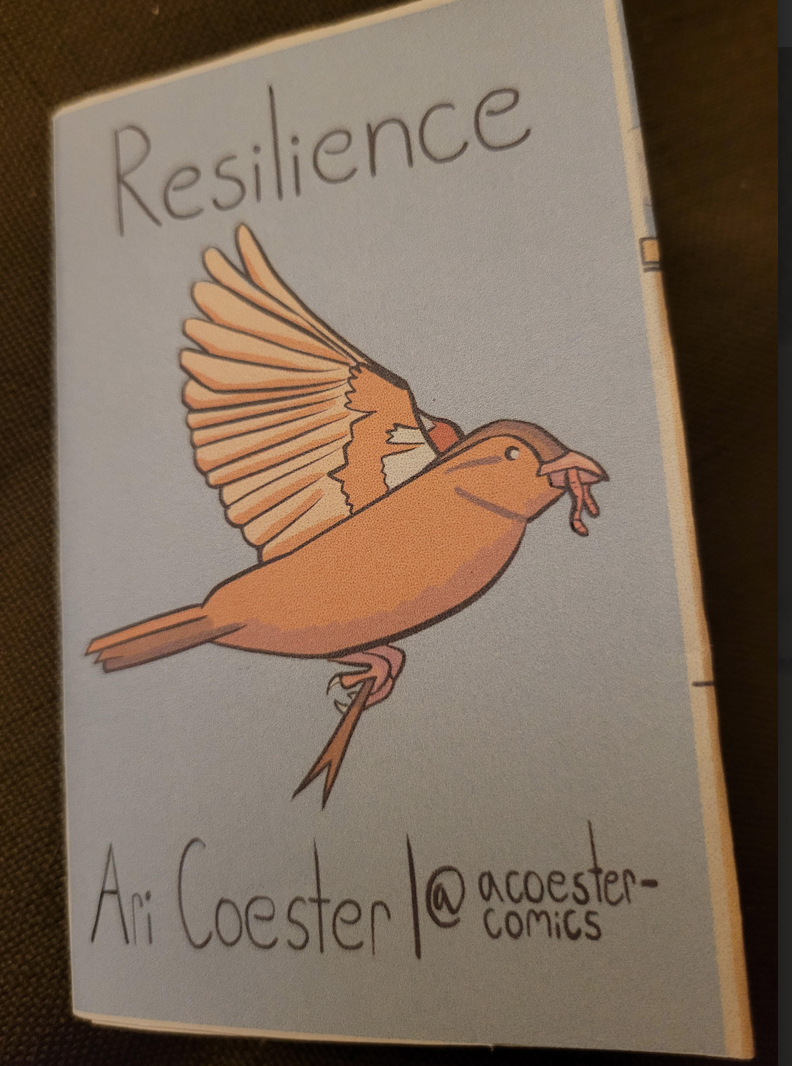
Resilience by Ari Coester This is a tiny zine (ie, an 8.5×11 paper folded to create an 8-page booklet) about the anti-bird spikes that corporations install in their signs and how the birds build their nests right on top of those spikes. Adorable!
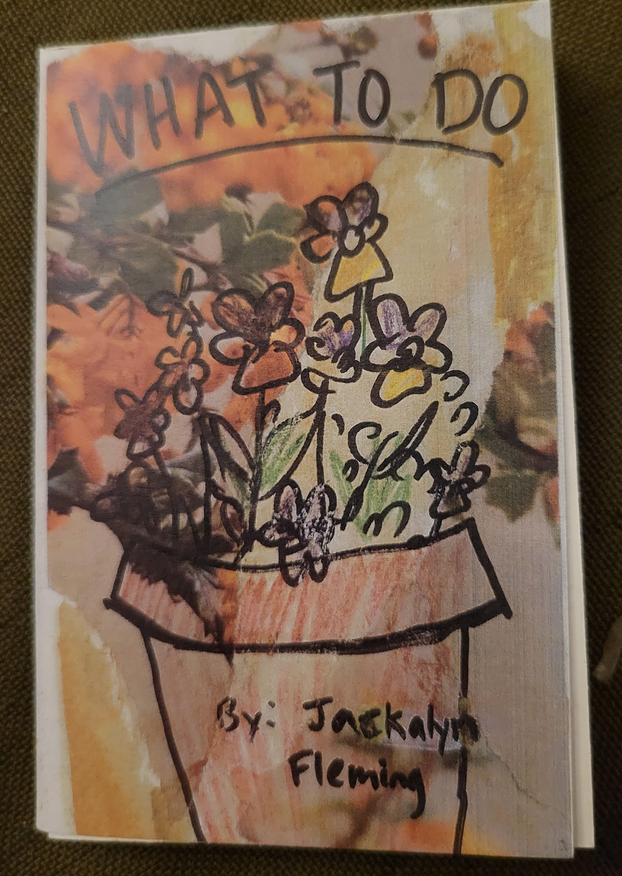
What To Do by Jackalyn Fleming This is another tiny zine that consists of a flower wondering what it’s purpose in life is. Having bloomed, it wonders what’s next and asks the people around it. It turns out that the bee has opinions but the bird doesn’t care. It’s both hilarious and feels timely.
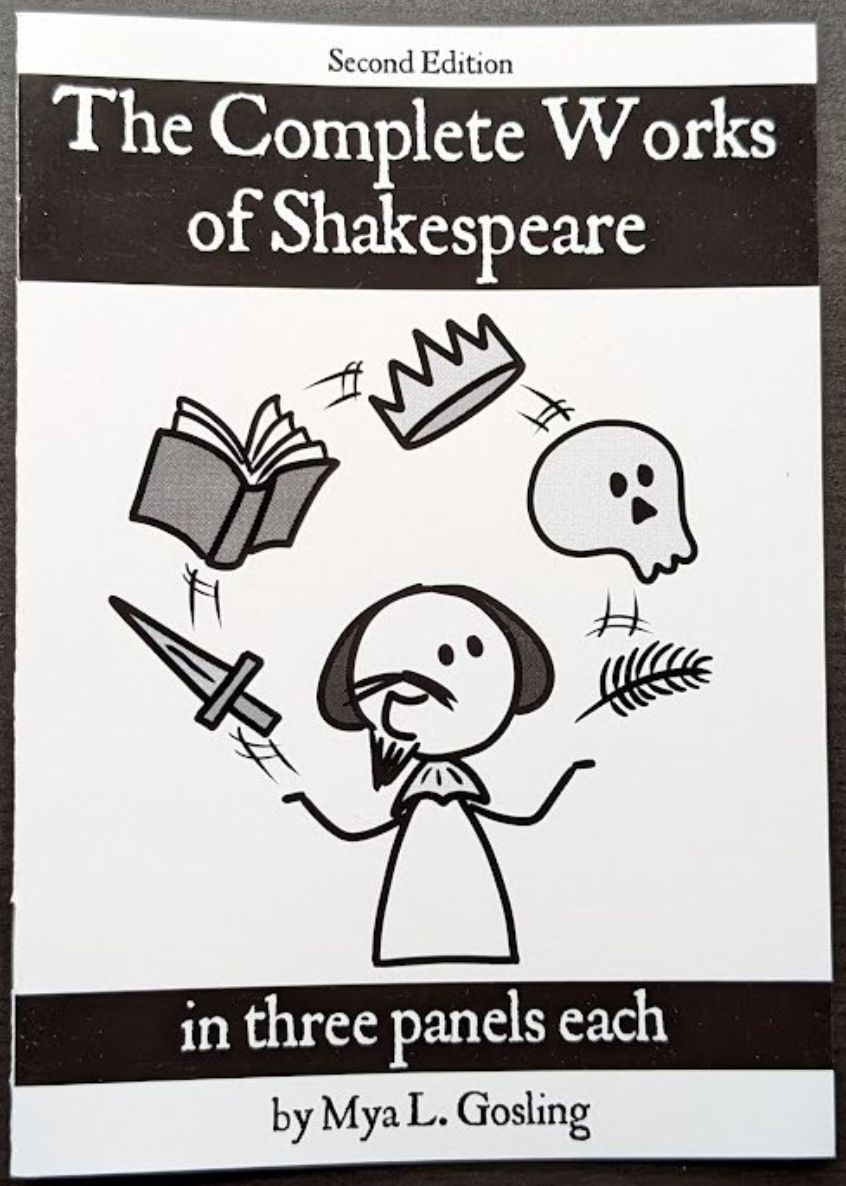
The Complete Works of Shakespeare in three panels each by Mya L. Gosling I’ve followed this artist’s work for years and was delighted to get a physical copy of some of her work. It’s hilarious, and also really well done. Just, taking each of Shakespeare’s plays and stripping them down to the bare minimum (and perhaps significantly beyond) of plot points. It feels a bit like poetry and a bit like a series of teasers.
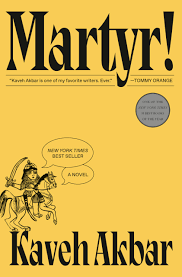
This is capital-L Literary novel about a depressed young poet searching for the meaning of life and death, and I should absolutely hate it, but I was riveted! I guess that’s a testimony to the writing. The protagonist is still quite annoying, the sort of drug-fueled tortured artist that intrigued me in my 20s and just exhausts me now. But even within the first few pages, I ran across lines that I knew would stick with me for a while.
I never would have even picked it up if it hadn’t been recommended by what is becoming one of my favorite e-newsletters, Death by Consumption.* The recommendation includes this quoted passage:
Everyone in America seemed to be afraid and hurting and angry, starving for a fight they could win. And more than that even, they seemed certain their natural state was to be happy, contented, and rich. The genesis of everyone’s pain had to be external, such was their certainty.
And I thought to myself, well, yes, of course we all want to be happy, contented, and rich; who doesn’t? So I felt like I needed to read the book to find the counter argument. I didn’t really get an answer, but instead got a lot to think about over the next few days and weeks. (Danny also calls it “short but expansive” and I believe his definition of short has been warped by the enormous tomes he usually reads, since this comes to a healthy 331 pages, but it was a quick read, with short chapters from rotating viewpoints that pull you in for ‘just one more.’)
Also, about halfway through the book, there’s a surprise twist that adds a significant mystery that I wasn’t expecting at all, but helped balance the tortured artist side of it all. That said, I found the ending both confusing and upsetting, which could have been intentional but I got the sense that I was getting caught up in details and missing the big point of it all. I was incredibly grateful to google for autofilling my search of “Martyr! Kaveh Akbar…” with “ending explained” and finding an hour-long lecture on youtube, as well as a decent sized reddit thread.
*Side recommendation: I first started following Danny Gottleib’s writing when he was doing a tongue-in-cheek Julie & Julia thing called Danny & Gweneth, where he tried to make all of Gweneth Paltrow’s recipes with ingredients he could find locally in the Midwest. He ended up moving to NYC and switched to a general media recommendation newsletter that I look forward to every week.
This author has a way of using language to create worlds like lucid dreams. She makes metaphors so strong and pervasive that they’re world-building. It lives in the space between poetry and prose, and reading it feels like a way to slow the frantic pace of my thoughts and set my brain to a reasonable rhythm. I’m in awe of her writing.
This story is a retelling/re-imagining of the classic folk song, The Two Sisters. And of all the versions I’ve read/heard, I like this one best. It’s not a long book, only 100 pages, and includes many beautiful black-and-white illustrations.
El-Mohtar is one of the co-authors of This Is How You Lose the Time War, which was extremely good but also complicated in a way that required more focused concentration than this book did. This story feels closer to Nghi Vo’sThe Singing Hills Cyclebooks, which is also a high complement.
Love, Death + Robots: The Official Anthology: Volume One 2021, audiobook 2025
I have not watched the animation series, but I’ve heard good things about it and I saw that this audiobook existed and so I got it and listened to it on my work commute. And I didn’t quit halfway through, though I was extremely tempted. It has some of the worst writing I’ve ever read/heard. Like, at least one story that’s right up there with Eye of Argon, and others that were close runners up. What’s also crazy is that, as I was listening, increasingly appalled with each new story, I realized that they were managing to cover a wide range of ways in which writing can be poorly written.
In retrospect, I realized that there were two entries that are explicitly screenplays and thus can be forgiven (I suppose) for going into details about exact camera angles, and scene changes, and repetitions of the exact time of day even though it didn’t change, but wow was it hard to get through on my commute. The fact that one of those screenplays (“The Witness” by Alberto Mielgo) literally opened with “a beautiful woman is naked in front of a mirror, applying make-up” felt like such a stereotype/cliche that I wondered if it was intended as a spoof. Sadly, if it was intended as satire, it never made any particular point.
A lot of the stories (“Suits” by Steve Lewis, “Sucker of Souls” by Kirsten Cross, “Shape-Shifters” by Marko Kloos, “Blind Spot” by Vitaliy Shushko, “The Secret War” by David W. Amendola) had men with overwrought machismo fighting slavering aliens, with the type of clinical descriptions of violence and gore that I might expect from an audio-description of a visual media, but not from even a book adaptation of a movie. (“Lucky Thirteen” by Marko Kloos, has a woman with machismo fighting human soldiers, but the rest remains the same.) Text and video are different types of media and text is better served trying to describe the impact of violence/gore on the characters rather than just a description of a picture. However, most of them couldn’t even make their violence impactful. Plus, a really eerie pattern I noticed was how in these stories, there was all this extreme violence between the “main characters “good guys” who feared for this lives but stayed strong through it all because they needed to protect their people, versus the “bad guy” alien others who were mindless killing monsters with no thought or culture of their own, only an endless desire to kill humans. But their actions were the same, extreme violence towards one another: just one side was good and one side was bad. It felt like video games for armchair warriors, who wanted to feel powerful and liked gun statistics and weren’t at all interested in the source of any given conflict.
Some of the stories (“Sonnie’s Edge” by Peter F. Hamilton, “The Witness” by Alberto Mielgo, “Beyond the Aquila Rift” by Alastair Reynolds) had an interesting concept and/or twist that I would have enjoyed seeing presented better and with less of a look at the authors’ sexual issues.
“Beyond the Aquila Rift” was actually the first story (ie, the seventh story) that I thought was genuinely well-written. And then it swerved into focusing on a middle-aged dude’s feelings about his extra-marital affair and it mostly stayed there for the rest of the story, pushing aside the interesting science fiction scenario and reminding me of the stereotypical English professor writing a novel about having an affair. The author tried his best to make the affair plot-significant and mostly managed to make the protagonist so self-centered he came across as a sociopath.
There were some decent stories. (“The Dump” by Joe R. Lansdale, “Fish Night” by Joe R. Lansdale, “Ice Age” by Michael Swanwick, “Alternate Histories” by John Scalzi.) It’s too easy to forget them when I think back on the book. But they were there. They were short, but interesting and fun and funny.
There were two genuinely good stories that I enjoyed a great deal and actually recommend. Luckily, I can even provide links to them (the written versions, not the audio):
“Good Hunting” by Ken Liu is excellent and heart-breaking and heart-warming and all that about China losing it’s magical culture during the British colonial period and then regaining it in a steampunk fashion.
“Zima Blue” by Alistair Reynolds is fascinating and thought-provoking and I have so many thoughts about it but also don’t want to provide any spoilers, because the story itself is so well laid out in the way it presents the situation and slowly makes the reveal, and then leaves the reader to continue to thinking about all the implications for days afterwards. It’s about an artist who went through extreme body modifications in order to have experiences no one else could, and the reporter who interviewed him about his final piece.
I hadn’t been quite sure what to expect from the Detroit Zine Fest, but was delighted to discover that it was like a local mini Small Press Expo. Maybe somewhere between 50 and 80 vendors? Thus, it was still slightly overwhelming to browse through all the stalls, but was also delightful and I bought a number of really good zines:
Michigan Cryptids by Shi Briggs A Michigan UnnatureJournal by Shi Briggs These are two books, 12 pages each, about cryptids natives to Michigan, with absolutely gorgeous illustrations and short descriptions. I don’t actually know much about cryptids, so I’m not sure how much these were researched versus created, but I did recognize the Michigan Dogman as a thing. But the black and white illustrations are so beautiful and creepy and inspiring.
Thank You by Eddie Roberts 2023 This is a gorgeous and pointed poem about the culture of consumerism and the push-pull of gratitude for getting things you desire with the discomfort of always having more pushed upon you. It described many of my own conflicting feelings. The author also experiments with some really interesting typography effects.
Passages by Liana Fu 2019 Is a series of poems and musings on being Chinese diaspora going to visit Hong Kong and trying to learn Cantonese, struggling to figure out where they fit in the world where all their native cultures see them as other, and how this intersects with the ongoing cultural struggle of Hong Kong itself under an increasingly oppressive Chinese government.
Of Course I’d still love you if you were a worm, but like we might have to renegotiate certain aspects of our relationship, y’know? It’s a big adjustment: A guide to safely and responsibly loving your partner post wormification by Seth Karp This is hilarious and also the best kind of crack-treated-seriously brochure. It’s clearly a take-off of the “Would you still love me if I were a worm?” meme, but reminds me even more of an elaborate version of the Jack Harkness test meme. It’s got advice and perspective on what to do if your significant other spontaneously turns into a worm. (Step one: ask what kind of worm? There are different kinds of it will effect your decision.)
Helianthus by Jone Greaves There is Something in the Basement by Jone Greaves Instructional Musings for Encounters & Summoning by Jone Greaves IntenttoCarcinize by Jone Greaves I spent some time trying to figure out which of Jone Greaves’ zines to get since they were all such fascinating titles and wound up getting four of them, each of which is unique and fascinating and thought-provoking. I’ve been getting into short-story writing competitions recently and I feel like these are all examples of how it’s done: to create a world and a concept and maybe a character in just a few pages.
Gentle Laundry by India Johnson 2023 This is a surprisingly fascinating non-fiction 24-page zine about laundry. As someone who mostly learned to do laundry to the extent of put clothes in a machine with detergent and it will come out Officially Clean regardless of any evidence to the contrary, this zine opens up whole new worlds of understanding about what is actually happening and what detergents, soaps, bleaches, etc actually do. It’s also tonally very approachable, although by about halfway through I was feeling somewhat overwhelmed by the all the options and decision branches. But it’s valuable information to know and I have a few ideas for changes I want to try when doing my own laundry. Once I’ve tried a few things, I’ll need to re-read it to see what else.
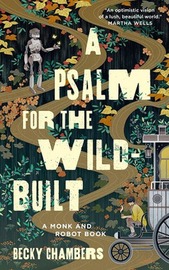
This is a charming book that struck me immediately as a mixture of Nghi Vo’s The Singing Hills Cycle and Peter Brown’s The Wild Robot series with a bit of Mai Mochizuki’s The Full Moon Coffee Shop thrown in for good measure. It is also the first of a two-book series and I definitely need to check out the second book. Our main character is Sibling Dex, a monk who has been a gardener for many years but decides at the beginning of this book that they have received a new calling to be a tea monk: someone who travels around the countryside with a pop-up tea stall to provide the populace with tea and comfort. I do love fictional religious explorations and narrow focus narrations too about the tea and the carriage and the villages.
The setting is a quiet futuristic post-industrial utopia on a moon, several hundred years after the Great Awakening when the robots that manned the factories spontaneously developed awareness and declared that they were going to depart human society to explore nature and they didn’t want to be followed. In response, humanity had a Great Transition where they found a balance with nature and since have lived in essentially bucolic comfort. The exact details are not delved into, but it’s against this backdrop that Sibling Dex finds themselves yearning for something more than they have while being confused about how they can be dissatisfied with what they have. And yet.
And it is Sibling Dex, in the midst of their struggles to identify what they need that’s more than what they already have, who makes the first contact between humans and robots in centuries, with a robot who has come to see how humanity is doing. It is very much a culture clash of individuals who are both trying their best but also thoroughly confusing and confused by the other.
No solutions are found by the end of this book, but conversations are had and explorations of both ideas and locations. But overall it was very sweet and extremely relatable.
The Archer by Paulo Coelho illustrated by Christoph Niemann translated by Margaret Jull Costa 2020
I picked this up randomly at the library when I was searching for something else, and I’m glad I did. It’s a short book (only 160 pages) with beautiful illustrations, and it feels like a combination of Zen and the Art of Archery by Eugen Herrigel and Sun Tzu’s The Art of War. The text is not quite poetry, but I want to refer to the verses rather than paragraphs, due to the care and curation that has gone into the prose. It’s a short book but not a quick read, not because it’s difficult but because it leads me to slow down and take breaks and think about what it’s saying.
It has an extremely basic framing story where a boy discovers that the local carpenter in his little village is a famous archer, and asks him how one masters archery. The archer says that he can tell the boy how in an hour, but doing so takes years. The bulk of the book is made up of the short descriptions on what it takes to master a skill and thus master oneself. It’s essentially a book of meditations, with the skill of archery being itself a framework for self improvement.
The framing story sets this book as fictional with characters and events — that was what had originally drawn me to it and I enjoyed both the opening and the closing chapters — but it feels more like nonfiction to me. This book consists of the advice man gives to a boy about how to live a good life: how to be a bow, aim an arrow, pick a target, and be respectful of it all.
Also, the illustrations really are gorgeous, in a very simple style.
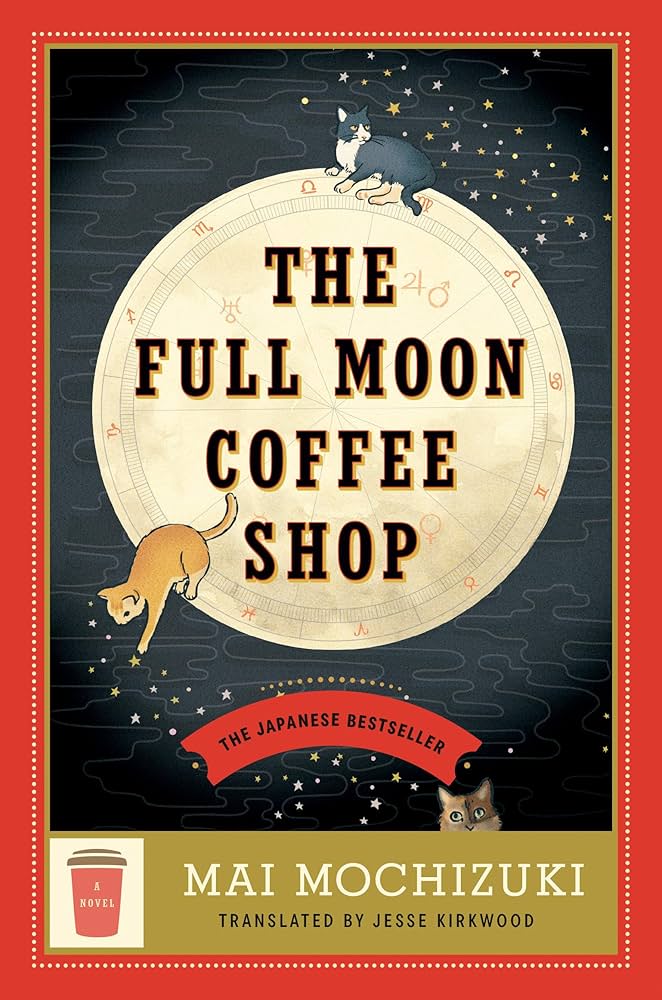
The Full Moon Coffee Shop by Mai Mochizuki 2020 translated by Jesse Kirkwood 2024
This is a charming story about interconnected characters facing difficulties in their various careers getting their lives sorted out and on a better path, via dreams of a little pop-up coffee shop run by cats/gods who explain their astrology charts to them.
So, to break that down:
It’s charmingly written. Kudos to both the author and the translator!
The characters are all adults struggling with adult issues, which I definitely appreciated.
I also really enjoyed the magical-realism that merges very real world issues with mystical coffee shop: it’s hilarious as each character has their own approach to responding to having a magical experience in an otherwise non-magical world.
The explanations of the astrology charts got a bit repetitive for me as the reader and that was not helped by the characters responding with complete confusion at first but then quickly agreeing that now they understood where they had gone wrong with their lives and what changes they needed to make given what the planets said about them.
I was reminded of the Mrs. Piggle Wiggle series, which I last read as a grade-schooler so my memory could easily be faulty, but had the same structure applied to kids having bad habits and a mystical person with powers teaches them to be better. A very cute series of morality tales, targeted young.
However, I did really enjoy the seemingly random interconnections of the characters, where each vignette includes as a side character the protagonist of the next vignette, as well as a reference to how much better the prior protagonist is doing having implemented the changes they needed.
The epilogue explaining why this all happened and how these character were connected by a good deed as children and thus earned the gratitude of the cat gods felt both unnecessary and contrived, as well as a bit disappointing, in that it restricted the possibilities of who might wind up finding this mystical pop-up coffee shop to just that one group.
But I did really enjoy the softness of showing characters struggling with failing career paths, finding a way forward into success and happiness.
All that to say: I enjoyed it but not without qualifications. I recommend it to readers looking for some soft reassurance and willing to put up with some basic lessons in astrology.
I love going to the Small Press Expo every year and seeing what new and unusual things are available and buying a whole stack of comics/graphic novels, and hanging out with a really fun crowd of creators. This was the first year that I attended some of the workshops in addition to the panels and vendor market, and they were so much fun and extremely inspiring. I bought a stack of new comics and have already read a number of them:
Garibaldiology: Japan Travelogue 1 by Garibaldi, 2014 This is an extremely cute little travelogue/drawn journal about the artist going on a trip to Japan, and is quite funny in a day-in-the-life manner about exploring a new place and meeting new people being a little gremlin. What particularly struck me is how non-judgemental, good or bad, it is in narration even as the person is judging the things around them. Their opinions are their personal opinions and not to be taken as anything greater than that. The over-all effect is just: wow, this is a thing that happened. And it’s just very cute.
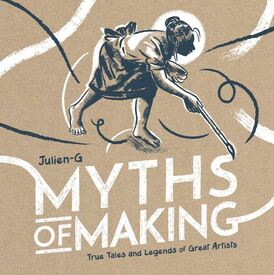
Myths of Making: True Tales and Legends of Great Artists by Julien-G, 2024 The art is really striking restricted pallet of only three colors, that works to excellent effect, with retelling 25 stories and legends from pre-64,000 BCE, up to 2022. I really enjoyed both the art and the stories, but what really caught my eye was the book binding, which is beautifully done sewn pages onto a fabric spine with heavy board covers, such that a quite thick volume can be opened to lay flat without any concern for the gutters. I do have an appreciation for the artistry in bookbinding.
No Pants Revolution #8: Acceptance by Andrea Pearson, 2024 This is the eighth issue in a series for which I haven’t ready any of the preceding issues, but it’s okay because each one is a stand-alone auto-biographical collection of thoughts and experiences. In this particular issue, the author is contemplating acceptance as in a stage in grief, a prayer for serenity, and part of self-care.
I Got a Tattoo Every Month of 2023 and Now I’m Broke, by Clau, 2024 I got this at the same stall as No Pants Revolution, because it is very small accordion format zine and I liked the way the artist used a cartoon kewpie figure to show where the tattoos were located. It also seemed like a representation of how many people are struggling to get through the year, finding their own methods for motivation.
Body Issues: Comics About Body Image, art by Babs New, 2022 One of the workshops I went to at this small press expo was a life drawing (ie, nude model) class hosted by the artist/author of The Cadaver Diaries, which I’d bought and enjoyed last year, and modeled by Babs New, the non-binary artist for this book. This book is composed of short accounts by people talking about their struggles with feeling comfortable with their own body and societal perception, and illustrated by this artist. Each speaker has a little cartoon animal representative and then concludes with a simple line drawing of them in the nude, revealing the body they’ve been struggling with.
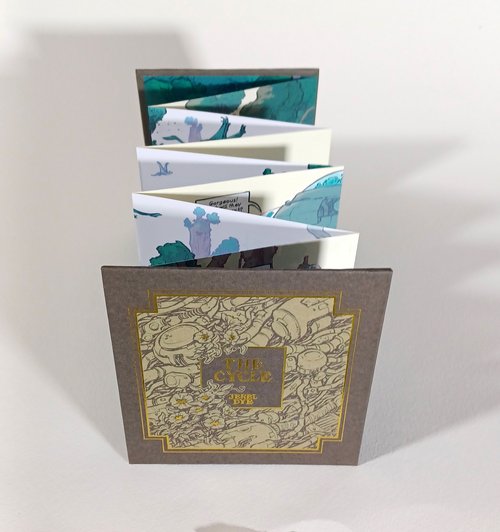
The Cycle by Jerel Dye, 2023 This is gorgeous little accordion book that is so beautifully crafted that I bought it without even really considering the story, but the art is lovely and the story is both simple and increasingly deep as I continue to think on it. I do love the use of gold foil on the cover. It’s drawn as a single scene in both the front and the back but it’s also a timelapse of events, scanning over a scene. The author makes excellent use of the different ways the book can be read.
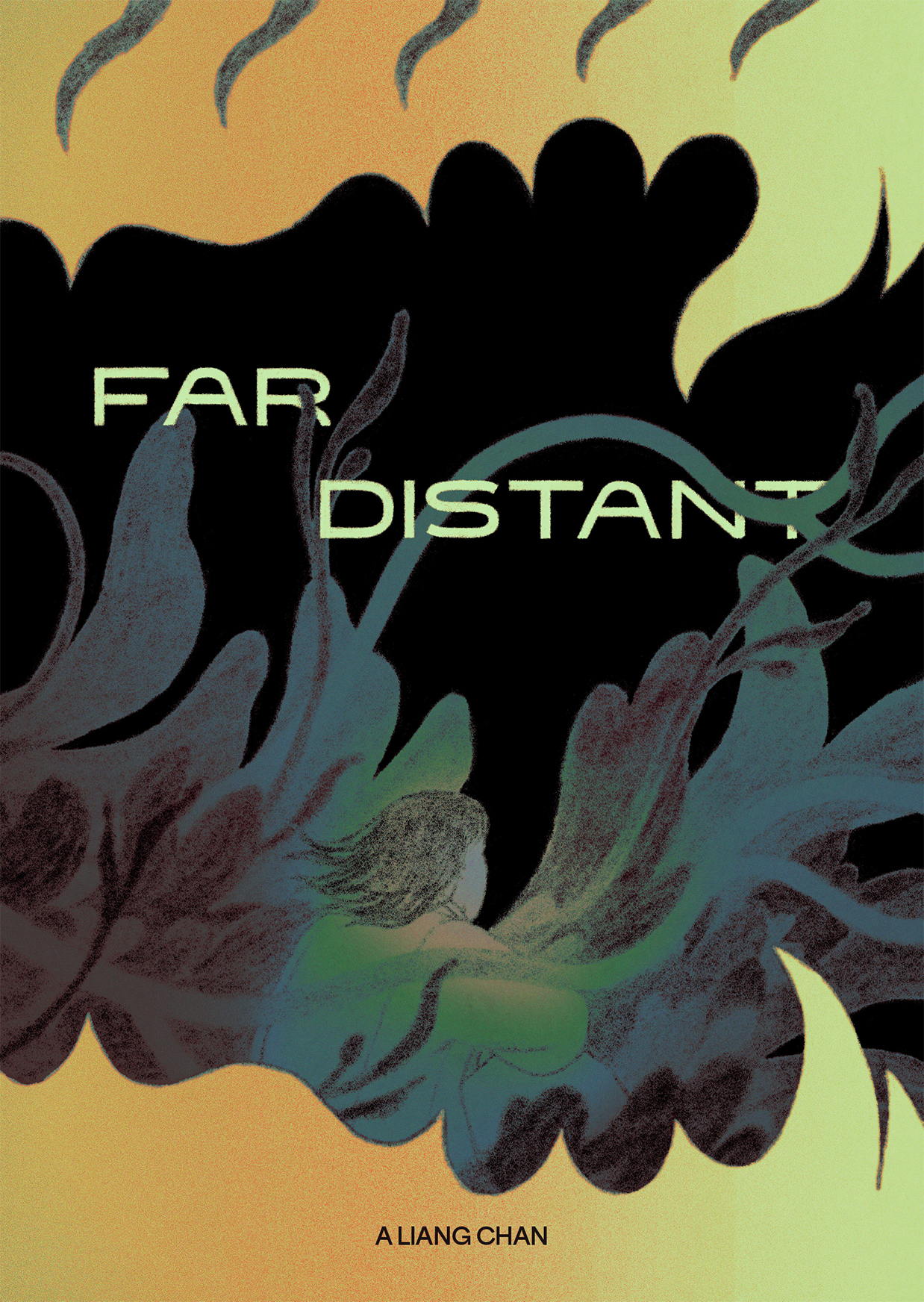
Far Distant by A Liang Chan, 2023 This is a beautifully illustrated stand-alone short story graphic novel about a researcher stationed alone on a distant outpost in charge of managing some transmissions, but receives a series of transmissions that at first seem to simply be corrupted, but instead are a communication from something else entirely. This is a really excellent example of stories that require thought to tease out the implications rather than having everything be explicitly told, and I really enjoyed it. It also felt like a good companion piece with The Cycle, although they are completely unrelated.
Devil in the Pines by Natasha Tara Petrović This is a beautifully illustrated “short comic about the tragedy of the Jersey Devil“, which I hadn’t particularly known about before, but this is beautiful and tragic, and makes me sad for a little devil who’s own mother cursed it. It’s just 16 pages long, and feels like it sits in the middle ground between a comic book and a picture book. It’s just a little devil who was born that way, does no harm, and is lonely being it’s own unique self.
Coextinct by Edea Giang, 2024 This is just 12 pages in black and white, a short but direct manifesto about how extinction events are happening across all species, not just the cute and beautiful ones, and how important it is to not ignore the small and unsightly. It looks specifically at the louse that lived exclusively among the feathers of a single species of bird that was also going extinct. The rescue workers who successfully managed to pull the bird species back from the brink of extinction, were also the ones who killed the the last examples of the louse. There was no evidence it actually hurt the bird at all, merely that it lived among the feathers. And no one knows what the relationship was between the louse and the bird.
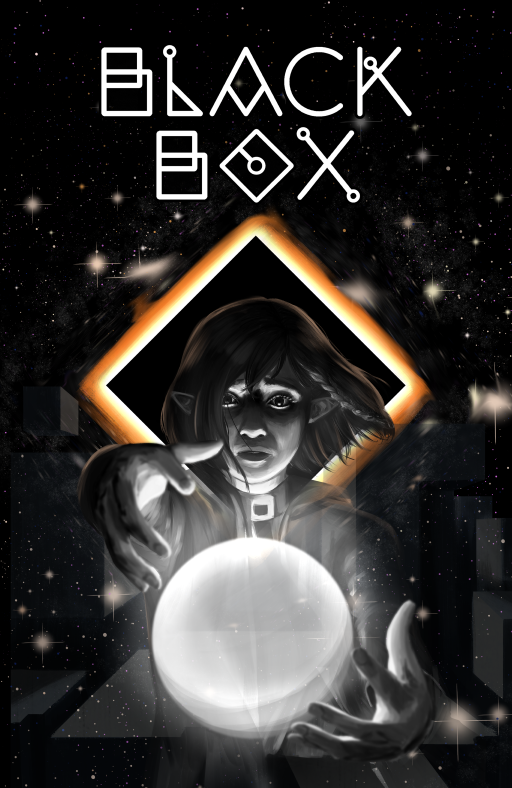
Black Box by Carlos Chua and Regina Chua, 2024 This is the first issue in a proposed comic book series, so it’s just setting the premise but the premise is both a delight and a horror: it’s a fantasy world based on magic, but it’s also a modern world with capitalism and stock exchange, and our main character is an oracle who’s feeling burnt out after years of running prophesies about how stocks will fluctuate, and finally quits after she prophesies a major disaster and her boss reams her out for not suppressing that in her report. It felt remarkably realistic.
2020 was HELL but the KPOP was good! by Kori Michele The first workshop I attended at small press expo was held by this author, about making extremely small zines, with simple folding techniques: teaching us how to make them and showing us examples of artists who had used them to good effect. This isn’t an example of those folding techniques, but is an example of her philosophical approach, which was to just make a zine as a way to give information to her friends and families: such as a playlist of the songs she was enjoying. The workshop was both fun and inspiring, and I got one of the authors larger books as well, but I haven’t read it yet. I also got this little zine, because it was a fun introduction to a music genre I’m not particularly into. I have since watched/listened to all the music videos, and it was a fun intro, even though it’s still not my music genre of choice. But it remains an inspiration of a fun way to create a modern mix-tape, leaving it to the reader to actually acquire the songs.
And, of course, these are just the relatively short comics that I’ve already read in the week since I got them. I have another stack of five larger and more extensive graphic novels that I need to read. But just, I do love the Small Press Expo and the whole range of people and creations that I see there.











 Biblio-therapy