The Poison Eaters and Other Stories

poisoneatersThe Poison Eaters and Other Stories
by Holly Black
2010

I checked this book out of the library less because I actually wanted to read it and more because I was testing out the ability to check out kindle books. (It works! I love it! I can get books when the library is closed, when it is snowing out, and without getting dressed for the day.)

It also wound up being an interesting book of short stories. This is clearly the author experimenting with different characters and plot points. Some of them work better than others, but they’re all quite interesting. It makes me think that I need to read more of her Black’s books, because I really do think these stories were testing grounds for her books, and I want to see what she made of the more successful stories.

I thought it was pretty funny that one short story, The Coldest Girl in Coldtown, is set in the same universe as the author’s book, The Coldest Girl in Coldtown, but has an entirely different set of characters and plot arc. There’s a single throw-away line in the book that references the events of the short story. I really liked both the book and the short story, but I am left wondering: who does the author think is the coldest girl in Coldtown?

I’m virtually sure that The Land of Heart’s Desire is set in the same universe as Black’s Modern Faerie Tales series, using characters that I would recognize if I had read those books. And it probably would have made more sense if I had recognized them and thus knew their various backstories. I might need to go ahead and read at least one of those books to see.

I liked the short stories, The Night Market and The Coat of Stars, both of which are complete in and of themselves in a way that most of the other stories in this compilation are not. The rest tend to be character studies (Going Ironside) or plot summaries (The Dog King and The Poison Eaters) or single interludes from larger universes (Virgin). So while they’re interesting, they don’t really stand on their own. I enjoyed them, but I don’t necessarily recommend them.

Not Actually Fanfiction

As should be obvious, I really enjoy fanfiction. They are (often) fun stories by (presumably) amateur authors who can sometimes do amazing things unconstrained by thoughts of salability. They write because they have ideas they want to get out. And sometimes, it’s not actually fanfiction. Sometimes an amateur author, in the same spirit of fanfiction, will write an original story and post it online for anyone and everyone to enjoy.

There are even a few archives specifically for these types of short stories, presented like fanfiction except for being entirely original. The parallel for Fanfiction.net is FictonPress.com. ArchiveOfOurOwn simply added a category for Original Fiction.

Here are a few recommendations for original short stories presented online:

Suite for the Living and Dead
By Inland Territory
Summary: When he was twenty three years old, Mike Lafayette took it on himself to write an oratorio for a people without a god.
Why I like it: This is just beautiful. A beautiful concept and beautifully written, but also speaks directly of the particular pain of seeing a deadly and important conflict happening in front of you and, for one reason or another, not joining the fight.
Extra comment: This feels a bit like a fanfiction story in that it references a much more epic story with main characters who are minor characters here. It makes me wonder if there is a book out there this is connected to but I haven’t been able to find. My current assumption is that it is that the author of this short story has an idea for a book and maybe she’s even half-written it, but it’s not available anywhere.

Toad Words
By Ursula Vernon
Summary: Terri Windling posted recently about the old fairy tale of frogs falling from a girl’s lips, and I started thinking about what I’d do if that happened to me, and…well…
Why I like it: One of the problems with traditional fairytales that I (and many other women) are increasingly aware of is how they often reward young girls for being quiet, polite, beautiful, and awaiting rescue, while punishing young girls for being outspoken, ugly, and actively attempting their own rescue. This takes one such fairytale and shows the repercussions, and how a curse can ultimately be made a reward and a blessing can ultimately be a punishment.

Never the Same
By Polenth Blake
Genre: science fiction
No summary, but the first paragraph: Everyone thinks my brother is nice. He set up a rescue centre for birds, after the terraforming accident poisoned the lake. That’s always the image of him, holding a bird covered in sludge. The birds are never the same after they’re cleaned, but the gossips never talk about that.
Why I like it: This is a lovely little mystery, with a main character with mental health issues. With a somewhat unreliable narrator investigating a situation in a highly biased community, the story looks into the difference between right and wrong actions and right and wrong motivations.

The Emperor’s Last Concubine
By Yamanashi Moe
Warning: this has explicit sex in it
No summary, but I bookmarked it as: a story of love and politics
Why I like it: This story has the standard Cinderella structure but focuses on what happens after the handsome prince whisks his beloved away and the difficulties faced by both prince and beloved as they both become aware of the golden cage the palace makes.

The Best of the Rest of 2014

I’ve said here before that when I read a really great book, I am so excited to share it with people that I immediately write a blog review. Hence, my short list of the best things I read this year would be The Goldfinch, The Signature of All Things, Love, Nina, and Americanah. (I was looking at the list of the books I read this year and wondering why it was so much shorter than last year–I read about 45 books this year, rather than my typical 80-100. Maybe it’s because I spent half the year reading giant doorstop literary novels that took forever? At least most of them were good; let’s just not talk about The Luminaries.)
But  I did read a few other things in 2014 that I loved but that never made an appearance here. So before this year runs away from us entirely, let me put in my vote for a few more things:

1) Bridget Jones: Mad About the Boy

I have a love for the first Bridget Jones book that I cannot explain. I just think it’s brilliant and is working on about four different levels and I still reread it once a year. Even Helen Fielding would probably admit that the second one went off the rails a bit, but I really, really enjoyed this third Bridget installment. Rather than picking up where things left off, the book ages Bridget and puts her in an entirely different situation. Bridget is still recognizable, but she’s gown up a little, and as predictable as the book was, I found it charming and surprisingly touching.

2) Mastering the Art of Soviet Cooking

I am kind of obsessed with the Soviet Union, but I find it really difficult to find things to read about it. Nonfiction books tend to be incredibly dense, academic tomes along the lines of “and then that other diplomat issued a statement that countered the previous statement  . . . ” And fiction tends to be unbearably dark, which is understandable but difficult to read (Child 44, you still give me nightmares). This memoir uses food–from pre-revolutionary excess to the siege of Leningrad to Soviet institutional cafeterias–to show how the Soviet state affected the everyday life of it’s citizens. And it shows how one family rebelled against that state, at least partly through food. Really charming, although I’m not likely to cook any of the recipes provided.

If you are not already reading the website Bitches Gotta Eat, you should go do so immediately, because it is one of the funniest things on the Internet (assuming you’re over 18–if you’re not, please go look in our YA tag for something more appropriate, because this sure isn’t). Meaty is a collection of essays by Samantha Irby, who writes the site, and it is equally funny. However, I should warn you that she uses the essay format to also tell some less funny stories about her life, including one about her mother that was so sad it made me put the book away in a drawer for several months so I could recover. But the funny stories are really funny, the sad stories are stunning, and Irby definitely deserves a bigger outlet than she’s gotten so far.

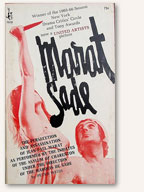
Marat/Sade

The Persecution and Assassination of Jean-Paul Marat as Performed by the Inmates of the Asylum of Charenton Under the Direction of the Marquis de Sade

A Play by Peter Weiss

Book Cover: Marat/SadeI’d heard of this play years ago, and not to put too fine a point on it, it sounds like a complete clusterfuck, and I have been curious about it ever since.

The premise is based on the historical facts that Marat was assassinated during the French Revolution in 1793, that Sade participated in the revolution and even made the memorial address at Marat’s funeral, and that Sade later put on plays with the other inmates during his internment in Charenton Asylum from 1801-1814.

In this fictionalization, Sade is producing a play about the assassination of Marat, casting the various other asylum inmates. It is quite short, just two acts that together are just 102 pages, and it starts off surprisingly funny, with sort of slapstick humor around the extremely amateur production. I was pleasantly surprised, and thus lured quite capably into the subsequent ugliness surrounding the French Revolution and Sade’s personal philosophies.

Both the revolution and Sade committed horrific atrocities, though they came from opposite justifications: the French Revolution declaring that some violence must be committed for the improvement of society (so, basically, a regrettable side effect in the search for good), and Sade declaring that the only way to understand the human condition is to explore the very worst of it (the search for evil as humanity’s defining feature). This basic disagreement is explored through debates between Marat and Sade that appear to happen outside the play-within-the-play, and possibly only occur in Sade’s head.

The back blurb advertises that “It is total theatre: philosophically problematic, visually terrifying…. The play is basically concerned with the problem of revolution. Are the same things true for the masses and for their leaders? And where, in modern times, lie the borderlines of sanity?” My main take-away, however, was to wonder how much of the political and philosophical grandstanding by Marat and Sade was purely self-serving to justify their own personal indulgences. Sade likes to rape and torture, but he wants to see himself as something greater than just a violent sociopath, so he claims that all of humanity has these same urges, but only he has the courage to explore them honestly. And, though I am more sympathetic to Marat’s ambitions, he clings to his ideal of how the revolution will be played out, with himself as the people’s savior, and any deviation from that is treason and must be eradicated violently and completely.

I would pay quite a bit to see this live, actually – the descriptions of the sets, with a rudimentary stage and props within an asylum, the inclusion of a four-person chorus to punctuate points throughout the play, and the wide variety of players, often wandering on their own would make it quite the spectacle. (I would also like to see the movie from 1967, but the library doesn’t have it, and I don’t want to swing $38 for it, which is amazon’s very cheapest offer.)

—Anna

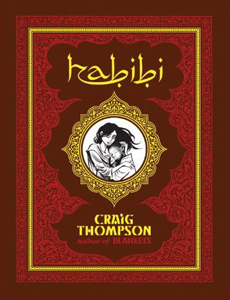
Habibi

HabibiCoverHabibi
by Craig Thompson
2011

Wow. This is a graphic novel that really earns both of those words: it’s definitely a novel, and it’s definitely graphic (in every sense of the word.) It is most definitely not a comic book.

I’d noticed this book in passing for a while now, because it’s beautifully bound and the illustrations are gorgeous. Just, it’s a really beautiful book. It also has an obvious theme of exploring religion, which is something I often enjoy. On the other hand, it was struck me as trying really hard to be high literature by means of showing a life fraught with hardship, pain and suffering, and yet perseverance through it all.

Then I found myself waiting for a couple of hours in a library for which I didn’t have a library card. So I settled down to read this. And sure enough, I was absolutely right.

It shows a grim world filled with caricatures of characters who still have a bit of individuality to bring them to life and make them interesting. It’s really obviously trying very hard, and yet it largely succeeds in being that story about strength of will and perseverance and the times when there are no good options and so you just carry on. The characters are heartbreaking.

It makes me think of the story of Scheherazade, the narrator of the 1,001 Arabian Nights, and think of what her life must have really been like. After all, she was literally telling stories to preserve her life. (The main character also retells some of Scheherazade’s stories.)

It also reminds me of Caravan by Dorothy Gilman, a book I enjoyed a great deal but was possibly the first book I read in which it was clear that neither the main character nor the love interest were going to be protected by their status as the main characters of the book.

Bad things happen. A lot. And are, with one notable exception, shown rather explicitly.

It is not my particular kind of book, for all that it is just really, really beautifully drawn and bound. After reading half of it while waiting at the library, I got up and walked away when my class started. But when I saw it again at my local library, I thought, you know, let’s carry on. So I checked it out and read the rest.

It joins the ranks of books that I’m impressed with, proud that I’ve read, but feel no particular urge to re-read or own.

2-sentence horror stories

In honor of approaching Halloween, I present you with some short horror stories.

The background is: about a year ago, a Reddit user asked “What is the best horror story you can come up with in two sentences?” The response was tremendous and there are currently 3397 comments in that chain (admittedly, a lot of them are responses to the responses, so there are fewer than 3K stories, but still.)

To see nine of them, nicely formatted, go here.

To see all of them, with the original formatting, go here.

Warning: these really are terrifying. Oof. Who needs sleep anyway?

Bellweather Rhapsody

I’ve talked before about how I like reading seasonal books–scary things at Halloween, spring-time-ish books as winter is ending–and I think Bellweather Rhapsody by Kate Racculia would be an excellent addition to an autumn/winter reading list. It’s creepy, sort of dark, and definitely wintery–the kind of book that makes you want to wrap up in a blanket with a cup of hot chocolate.

The story takes place over a few days in the Bellweather, an once glorious but now shabby upstate New York that is hosting a high school all-state band event. Over-achieving teenagers, their tired chaperones, ambitious conductors, and harried hotel staff are already bracing for the event when things get derailed by a blizzard and the mysterious disappearance of a student. Hanging over this is all is the hotel’s past–it was once the site of a tragic murder-suicide where a bride killed her new husband and herself on her wedding day.  Rather than seeing all this from one point of view, the action is narrated by a whole list of characters including, but not limited to, twin high school student named Alice and Rabbit Hatmaker who each have their own talents and secrets, their music teacher who has a complicated past of her own, the hotel caretaker who cannot quite believe what is happening to his beloved Bellweather, and a guest who has come to the hotel to face her demons.

Racculia manages a neat balance in that the book feels big and sprawling with all the character threads weaving in and out, but at the same time has a sense of claustrophobia as everyone is trapped in this one old hotel that does not feel particularly welcoming. But this isn’t a horror novel, as much as the trapped-in-a-hotel piece makes it sound like The Shining, and it’s not a traditional mystery, even if the central question of the book is what happened to the disappeared student. Instead, it felt more like reading a modern Dickens novel. Characters and back stories and coincidences and problems kept piling up and up and I kept getting more nervous, trying to figure out how it was all going to resolve. But I did find the ultimate ending gratifying, maybe because I was surprised by the outcomes of many of the characters–narrators I thought were reliable turned out not be, people I initially hated started to endear themselves to me, someone I was desperately worried about pulled herself through and out the other side, that sort of thing.

It’s not exactly heartwarming, and it’s not exactly funny, and it’s not exactly scary, but it sure made me want to keep reading to figure out how it was all going to end.

Kinsey’s Three Word Review: Quirky, creepy, and satisfying.

You might also like:
This reminded me of Skippy Dies and The Lonely Polygamist, although Bellweather Rhapsody is kinder than either of those. But more than anything else, this made me think of Fargo–both the original movie and the recent TV series adaptation. They all share something in the matter-of-fact way that bizarre people and things are presented.

Suddenly Last Summer

By Tennessee Williams

So, I watched “Suddenly Last Summer” the other night – I’d been meaning to watch it for a while because what a cast! Katherine Hepburn! Liz Taylor! Montgomery Clift! Also, what a plot – psychosis, lobotomies, and cannibals! I had no idea how all of this could fit into one two-hour movie, and I’m still not entirely sure, actually.

My first impression (spoiling the big reveal, but you’ve had over half a century to check this one out) was that this was one of the most homophobic movies I’ve ever seen, but then I was confused because the original play was written by Tennessee Williams, who was openly gay himself, and though he clearly had a wide variety of issues, I never thought his sexuality to be one of them. (It turns out I may have been wrong about this, actually.)

There was another, subtler theme of gods and sacrifices running through the play, though, and I wondered if that was more prominent in the original version, and a homophobic Hollywood played up the homosexual angle instead. All of this to say that I checked out the one-act play to see for myself.

So, I remain a bit confused. It is not wildly different from the movie. The first part is pretty much a monologue by the mother (Katherine Hepburn’s character), and it showcases Williams’ trademark Southern mother – overbearing, out of touch, and clinging to old-fashioned social mannerisms. There are some hints that Williams is also criticizing some artifice in the gay lifestyles of the time, though I haven’t gotten to the worst part yet (the end). The lobotomy aspect was rolled out a bit more subtly than in the movie (which wouldn’t have been difficult, since the movie opens on a lobotomy procedure), and is more conflicted about the process than the movie projected (the adulation of the lobotomizing doctor in the movie made me a little uncomfortable, as well).

The second part is mostly a long monologue by the cousin (played by Elizabeth Taylor), and this is where the most problematic parts of the movie come in, with her exposing her cousin’s homosexual and promiscuous lifestyle and how it ultimately lead to his downfall. In the end, I guess I would say that the movie switches the priority of themes from the book; the theme of a sacrifice-demanding god is somewhat more prominent than homosexuality in the written play. Though because the play is really just two monologues strung together by a bare minimum of structure, I would say that this is more of philosophical and/or psychological study than anything else, really. I’m still somewhat baffled by it all, but after doing some brief online research, it looks like I’m in good company; this play is still quite the cinematic controversy. (Also, the contemporary review of the file is a hilarious panning!)


The Girls at the Kingfisher Club

By Genevieve Valentine

Book CoverI’ve mentioned before that I’m a big fan of Genevieve Valentine. I love both her blog and her fictional writing, but am continually surprised by how different they are. She is so funny on her blog; her recaps of the television show “Penny Dreadful” were as much a delight as the show itself. Her books and short stories, however, are almost unrelenting melancholy. Her novels are not hugely long or densely worded, but she somehow gives everything a sort of portentous double-meaning which gives the narratives a heavy tone. It is such a vague feeling in the text that I’m struggling to describe it.

Anyway, The Girls at the Kingfisher Club is a retelling of the folktale of the twelve dancing princesses, set in New York City during Prohibition. (The titular Kingfisher Club is the dancing girls’ speakeasy of choice.) The Twelve Dancing Princesses was not a favorite story of mine as a kid, so I only vaguely recalled it. What is just sort of casual misogyny in the original story (of course the king locks up the twelve princesses in a tower – that’s just what you do with princesses in fairy tales), gets fleshed out here into true cruelty in the utmost neglect in a real-world setting. This builds up a strong sense of suspense throughout the novel, as the consequences are suddenly more real.

It made me cry several times in the privacy of my home, but it also, embarrassingly, made me laugh out loud on the metro.

—Anna

Rose Under Fire

By Elizabeth Wein

Book CoverShortly after Kinsey notified us all about the sequel to Code Name Verity, I checked out Rose Under Fire, with some trepidation, I have to admit. Code Name Verity was excellent, but also completely devastating in parts, and Rose Under Fire had the potential to be even worse. The majority of the book is set in a Nazi concentration camp for women, with extra focus given to the victims of the ‘medical’ experiments. I just wasn’t sure I could take it.

However, Elizabeth Wein is a genius and knows exactly how to tread the line. Most of the book is mercifully told in flashback, so readers can continually reassure themselves that at least these few characters have necessarily survived. This doesn’t mean it isn’t heartbreaking, of course; just not unbearably so. I would even say, all things considered, that overall it was more upbeat (not the right word at all) than Code Name Verity. (It also is not a direct sequel, per se; it has some shared characters, but features a newly introduced main character.)

Several weeks later, I followed this up with watching “Judgment at Nuremberg,” a 1961 film recounting one of the trials at Nuremberg, this one against four judges for crimes against humanity. Spenser Tracy stars as the retired American judge who agrees to oversee the tribunal for this trial, and wrestles with his own conscience in trying to reconcile the crimes that were committed in the past with the current devastation of the country.

The movie explores to what degree individuals are responsible for the actions of a government. Outside of the courtroom testimony, some of the more painful scenes are of regular citizens looking dazed and insisting they had no knowledge at all of the actions of the Nazi party. It inspires an unsettling mixture of pity and anger in both the judge and the viewer, and raises tough questions without easy answers. It was a good companion to “Rose Under Fire,” and now I’m ready to turn to some lighter books and movies.

—Anna