The Best of 2016

2016 was rough, I think we’ve established that. But now as we move forward into 2017, I’ve been trying to make myself remember some of the good things that did happen last year–I refuse to let an entire year go down because of a few (key, admittedly very) bad things. I’ve spent the past few months re-reading romance novels, but before that period of re-reading began, I found some great new books. Most of them I’ve already talked about here on the blog–Aristotle and Dante Discover the Secrets of the Universe, How to Build a Girl, and Bone Gap–but there were a few others I wanted to mention.

  1. Pointe by Brandy Colbert is a YA book about a ballet dancer, but it also involves a kidnapping and a teenage victim who comes back after years away. It’s a dark, sad book, maybe not for younger teens, but I found it really compelling. I especially enjoyed watching, over the course of the book, as the female protagonist worked out just how much agency she had and how she was going to use it.
  2. I’ve already raved about the memoir Love, Nina by Nina Stibbe, one of my favorites books of recent years, but I was a little worried that I might not feel the same way about the author’s fiction. And while nothing could quite match my original love, Paradise Lodge was a really charming story about a British teenager in 1970s who takes a job in a nursing home. Stibbe has this very specific voice that comes across in both her fiction and non-fiction, in which even when she’s talking about some sort of crisis or disaster, everything seems like it will all work out fine. I found this very calming.
  3. If you know who I am talking about when I say “Dave Holmes, MTV VJ,” I suspect you will like his book. Party of One is a memoir, structured around music, and maybe it’s just that he and I are about the same age, but this book felt like it came directly from my subconscious.
  4. Way back in 2012 I wrote about how much I love Sharon Shinn, and I recommended a new book of hers called Troubled Waters and said I hoped was the start of a new series. And it was! There are now four books in the Elemental Blessings series, and I have enjoyed all of them. If you would like to read a fantasy romance novel with a kick-ass female main characters, these are a great option. I would recommend reading them in order, but I think my favorite was the third book, Jewelled Fire.

And with that, I am quite happy to close the book (so to speak) on 2016. I’m already starting 2017 out well, reading-wise, with my continued journey through the Lord Peter Wimsy books, and a lovely, poem-like book called The Lesser Bohemians. I have a lot of hopes and goals for 2017, and continuing to discover great new things to read and writing about them here is definitely something I plan to continue.

Sorcerer to the Crown

By Zen Cho

This has been a trying couple of weeks – I’ve been obsessively reading twitter and facebook until I can’t stand it anymore, and then I read fiction until I can’t stand being away from social media. Zen Cho, however, has been a real comfort during these times, though.

jade-yeoThe novella The Perilous Life of Jade Yeo features a Malaysian woman trying to make a living as a journalist in Victorian-era England. It is short and funny and touching, all told through her journal entries. It just felt very much like a story by a woman for other women.* The male characters, both good and bad, are only given context in relation to Jade, and the story focuses primarily on her growth as a young adult trying to establish her sense of self. So, this was extremely comforting in these worrisome times.
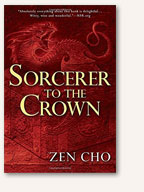
sorcerer-to-the-crownSorcerer to the Crown, the full-length novel, starts slowly and in very high-fantasy fashion, set in a magical version of Regency-era England. It reminded me almost immediately of Jonathan Strange and Mr. Norrell, but luckily it picks up the pace much more quickly. Zacharias Wythe, as a very young boy, proves his extraordinary magical ability in front of a large panel of sorcerers, who promptly all lose their shit. This is not because Zacharias shows such promise so early, but rather because he is a freed African slave. The lead sorcerer adopts him and trains him to be his successor as Sorcerer Royal, the position he holds at the time the book.

A large contingent of white sorcerers actively work against him, even against their own self-interest, solely in order to oust him from his position by spreading outrageous rumors and innuendos. As the story revolves around an extremely thoughtful and conscientious black man trying to navigate the world of magic through difficult times, while surrounded by white men who are actively rooting for his failure, it became much less of an escapist fantasy.

Zacharias then runs across a young woman who shows strong magical abilities, and decides to train her, in the face of all traditional lore saying that magic is beyond women’s understanding. Reading about this black man conquering his enemies and silencing his naysayers, while working with a woman to do the same with hers, just about broke my heart. We didn’t get the ending we deserved, but at least this fictional world did.

the_dressmaker*If I can be excused a diversion for an additional recommendation – a few months ago I saw “The Dressmaker,” and I absolutely loved it! It is an Australian film that didn’t get a lot of showings, even though it stars Kate Winslet and Liam Hemsworth. The preview looked amazing to me – a haute couture dressmaker has to move back to her very rural Australian town in order to take care of her elderly mother – but the reviews were mixed. The negative reviews all tended to revolve around uneven storytelling and shifting mood, and I started to formulate a theory that this movie might be telling a story in a more traditionally female way, one that focuses on relationships and character growth, rather than a single-trajectory action sequence. Seeing the movie absolutely confirmed that for me, and it felt amazing to see a movie that was so clearly by women about women and for women.


Penric & Desdemona by Lois McMaster Bujold


Apparently Lois McMaster Bujold has decided to retire, which is somewhat dismaying as she has long been one of my favorite authors. On the other hand, what she’s decided to do in her semi-retirement is write novellas instead of novels and semi-self-publish them. (Spectrum Literacy Agency is listed as the publisher rather than a regular publishing house.) They are absolutely delightful and I love them and all three of the novellas that have come out so far have come out in 2016. The stories are available for purchase as Kindle books within weeks of them being written so I can track them on facebook.

These novellas: Penric’s Demon, Penric and the Shaman, and Penric’s Mission (so far), are in the series, Penric & Desdemona, about a young man named Penric who acquires a demon he names Desdemona. In this world the acquisition of a demon is what makes an individual a sorcerer, “much like the acquisition of a horse makes an individual a rider.” The Church, which has oversight of the demons in this world, is not best pleased with the situation. Penric is sweet and adorable and Desdemona is a delight.

The stories are set in Bujold’s world of the five gods. The five gods being the Father, the Mother, the Brother, the Sister, and the Bastard (each of whom are interesting characters in their own right although only appearing for the briefest of scenes.)

I whole-heartedly recommend those books as well, each of which has the interesting aspect of being able to stand alone, although I recommend just going ahead and reading them all, and at least the first two in order.

cursechalion

The Curse of Chalion is the first book and a standard (beautifully done) fantasy novel of adventure and court politics.

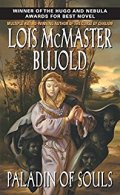
paladinsouls

Paladin of Souls is set some years later and shares some characters with The Curse of Challion but mostly through references, and is interesting in its main character being a middle-aged woman, mother and widow, who has had a rough life and is trying to find her place again… with much adventure and court politics.

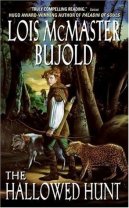
hallowedhunt

The Hallowed Hunt shares no characters with the other books except for the gods, and is actually set in a whole different country and time period. This one has the most intriguing and heart-breaking villain story arch that I think I’ve ever run across and is amazing, especially since I still love the main characters and want them to succeed.

And then the Penric novella’s come in and it’s only in reading them that I can put together the time line, since they’re set some centuries after The Hallowed Hunt and but some time before The Curse of Challion.

Anyway, I love all of these and think you should read them all, but I mostly needed to just gloat with joy about the three Penric & Desdemona novellas that have already been made available with murmurs of at least two more. Yay! They are wonderful!


Prudence and the Dragon

By Zen Cho

You guys, is there any better feeling than when you discover a great new author? A link to Zen Cho’s story “Prudence and the Dragon” showed up sort of randomly on my Tumblr, with a comment saying that it was the best short story they read in a long time. I figured even if it wasn’t the best for me, I’m game for a decent short story about dragons.

Guys, it was the best short story that I’ve read in a very long time! It reminded me very much of Patricia C. Wrede’s dragon series (which were my favorites all through childhood) especially in how Cho provides this wealth of absurdist detail that gives such richness and humor to the story.

So read “Prudence and the Dragon” as soon as you get a chance, and then read the sequel short story about Prudence’s best friend in “The Perseverance of Angela’s Past Life” (both of which are appropriate for readers of all ages – there is light romance, but nothing graphic).

I don’t want to make a big deal out of it since the stories themselves don’t, but they are also just perfect examples of how to weave multiculturalism and different identities into a story without making it the focus of the entire storyline.

I have since also bought a novel, a novella, and a collection of short stories by Cho, since I think she might be my new favorite author, and I’ll review them, too, as I finish them.

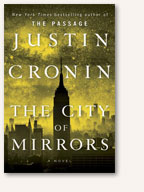
The City of Mirrors

By Justin Cronin

city_of_mirrorsI wasn’t going to review this book because it is the third in a trilogy in which I’ve already discussed the first two. However, the third book pissed me off so much that I had to rant. I am also about to spoil the hell of this book, starting right now, though I’ll throw a page break in before the more specific spoilers.
The City of Mirrors has a problem, and that problem is Timothy Fanning. The character Fanning is also known as “Zero,” as in Patient Zero, the original vampire. He is the main villain of the whole series, having orchestrated the spread of the vampire virus purposefully, though he has stayed mostly behind the scenes in the first two books.

Unfortunately, in the third book we get a much more in-depth look, via a 100-PAGE MONOLOGUE in which he gives his entire history, starting almost from birth, and it is just the most undiluted example of white male entitlement that I think I have ever read. I really wanted to believe that this was on purpose, to make a commentary on how dangerous this kind of unacknowledged privilege can be, but I had increasing suspicions that Cronin intended it to create a more complex villain with a sympathetic backstory. The monologue itself was insufferable, but the recipient of it, a previously strong woman, appears to receive it with sympathy and understanding.

Here’s where I’m about the spoil the hell of this book, by sharing a breakdown of his backstory.  Continue reading

Every Heart a Doorway

I first started following Seanan McGuire on Twitter when someone linked to her hilarious series of tweets about an owl in her yard. It wasn’t until I had already seen about 100 pictures of her cats that I realized that she was an author that we’ve actually reviewed here on the site. Back in 2012 Anna thought that Rosemary and Rue was hit or miss, but I quite liked her latest, Every Heart a Doorway.

I think I was won over just by the concept: it’s a murder mystery set at a boarding school for teenagers who found doors into magical fairy realms as kids, but are now stuck back in the real world. I mean, that’s great, right?

I actually agree with what Anna said in her earlier review of McGuire’s writing:  occasionally things felt a bit forced, almost like I could see the author saying, “And now I will do this.” But this is really a small complaint. The premise is great, there were fabulous details about the various fairy realms one might wander into, and the whole story had a sense of creepiness that was delightful. The reader sees the action through the eyes of the main character, who had spent her time away in a world of the dead, and her desire for quiet and stillness infuses the book in a wonderful way.

This is just a quick little story, really like a novella, so there’s not a whole lot more to say. Except that this is well worth your time. Also, isn’t Every Heart a Doorway just the best book title? It’s like a line of poetry I want to recite over and over.

Kinsey’s Three Word Review: Fairy tale aftermath.

You might also like:
 The Scream movies, or Buffy the Vampire Slayer, or possibly Wicked? That seems like an odd selection of media, but my favorite thing about Every Heart a Doorway was how it used the tropes of fairy tales and made them part of the story, which all of those other things do (in their genres) as well. Although in tone and length, this felt an awful lot like The Ocean at the End of the Lane.

Shadowshaper

By Daniel José Older

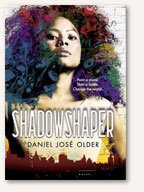
ShadowshaperThis is the third book from the bitchesgottaeat bookclub, where Samantha Irby recommends a book that she’ll be reading, with the idea that we could read it at the same time but never actually discuss it at all. I’d already read and loved the first, Carry On, and was surprised and delighted by the second, Everything, Everything. Even after a 2-for-2 record, I didn’t really want to read her third recommendation, Shadowshaper. There’s just not much that I can relate to with magically talented teen artists living in Brooklyn, quite frankly.

The protagonist, Sierra, is a high-school senior focused on painting a large mural on the side of an abandoned building in her neighborhood. She notices  other murals in the neighborhood fading unnaturally quickly, and then things get stranger from there. The writing seemed a bit uneven to me, which kept me from getting fully involved in the story, but the story itself is really unique and interesting.

A strong theme in Shadowshaper is immigrant culture, and the elements of one’s old country that one brings to one’s new country, in music, dance, food, and spirituality. Sierra’s family and most of her neighborhood is Puerto Rican, most of her friends are either Hispanic or African American, and her love interest is Haitian. There is a subtler theme, too, of misappropriation of cultures that aren’t one’s own. The book additionally asks questions about what kind of role academic study can play in understanding if it is necessarily on the outside, looking in. My favorite element of the story is how these themes are carried through in the supernatural elements, as well, but I can’t really elaborate without extensive spoilers.

Author Daniel José Older writes extremely visually, describing all the colors of the murals and the neighborhoods and the spirits themselves. As a reader, I get a bit bogged down in large descriptive paragraphs, but I kept thinking what a phenomenal movie this would make with animated murals traveling through the New York cityscape!

—Anna

The Girl From Everywhere

girl

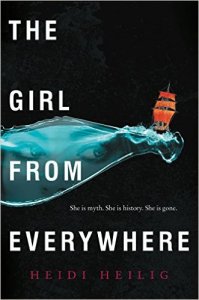
Okay, this one is going to be complicated to describe but hang in there, it’s worth it. The Girl From Everywhere by Heidi Heilig is this crazy mix of time travel and fantasy and a coming of age YA story that constantly spins off into unexpected directions.

Nix is a teenage girl who lives on a time-traveling pirate ship. (I know!) She was born in 19th-century Hawaii, but her father has the power to sail a ship into any original map he has–even maps of fictional places. Nix’s mother died when she was a baby so Nix has grown up on the ship with a crew of sailors collected across times and places. She has developed a knack for raising the money they need for new maps through elaborate time travel import/export schemes, and is happy on the ship that is the only home she’s ever known. But her father is obsessed with finding a map that will get him back to Hawaii before Nix’s mother died, and Nix doesn’t know whether she will even still exist if they make it there. Despite not knowing how the rules of time travel might affect her, Nix still agrees to help her father try to track down one last map of Hawaii, but to get it they’ll need to pull off an elaborate heist and not get caught by the police, local crooks, or the winds of time itself.

How does time travel work? What are we willing to sacrifice for love? What is the difference between history and myth? What do we have to give up to make our own lives apart from our family? What would Ocean’s Eleven look like in 19th-century Hawaii? There are all kinds of things happening here, but the story still feels very grounded. And even through most of the book takes place in colonial Hawaii, Nix’s father was originally from the modern-day U.S. so both Nix and the story have a very modern sensibility.

Also, how pretty is that cover?

Kinsey’s Three Word Review: Fantastical historical caper

You might also like: Time and Again is a classic time travel story, and I’ve already talked about how much I love When You Reach MeKindred by Octavia Butler is a dark take on the subject, and I’ll always recommend Connie Willis for time travel stories. But a lot of this book dealt with Hawaiian history and Unfamiliar Fishes by Sarah Vowell is a comprehensive but snarky look at that sad story.

Bone Gap

I first heard about Bone Gap, written by Laura Ruby, on the Pop Culture Happy Hour podcast as part of their round-up of National Book Award winners and I planned to write a post recommending from just about the minute I started it. So the fact that it just this week won the 2016 Printz Award for excellence in literature for young adults this week  makes this a very timely review (a rarity for me!).

Bone Gap tells the story of Finn, a teenage boy who lives with his older brother in a tiny, Midwestern farm town. Finn has a reputation as being a bit slow or spacey, and things have only gotten worse since the disappearance of Roza, a young woman who was living with them. Finn was the only witness to her kidnapping, but he hasn’t been able to describe the kidnapper and everyone in town (including his brother) has been looking at him askance ever since. Aaaand that’s about all I want to say.

I went in to this book knowing that it included elements of magic realism, and I’m going to tell you that much because I think our readers here more likely to pick this up if it’s got a bit of magic to it (Biblio-therapy readers are a fanciful lot). However, I also read the book summary on the inside of the cover and it gave me some details that I wish I hadn’t known. This story and its magic and its central mystery unfold so slowly and naturally that I think part of the joy of reading this is letting the story take you along at it’s own pace.

So, don’t read any online reviews, just trust me on this. Bone Gap is sweet and mysterious and sometimes dark and scary and sometimes small-town claustrophobic, and just all around interesting. It’s a book that cast a spell on me.

Kinsey’s Three Word Review: Magical small-town mystery

You might also like: I almost hate to make recommendations here, since anything I suggest is going to telegraph the ultimate tone of Bone Gap. But I can’t stop myself from telling people what to read, so, Alice Hoffman and Francesca Lia Block are two authors that do magic realism well. I like them both, although Hoffman’s books tend to tip towards middle-aged women and Block’s really speak to angsty 14-year-olds. Another option is Please Ignore Vera Dietz, by A.S. King, a book with an element of magic that splits the difference and would appeal to a wide range of folks.

The Night Circus

By Erin Morgenstern

Night_CircusThis book should have been everything to me – a spooky circus and a sorcerous battle set in the Victorian Era – but it was just so damn boring. It started strong with the hoary old magicians selecting unaware students to continue their contest of skills, and then building the titular circus to serve as the staging ground. Once the circus is up and running with the young magicians showing off their respective skills in increasingly elaborate exhibits, the novel really bogged down in endless descriptions of amazing and whimsical spectacle.

I really wanted to like this book because it has shown up on so many people’s best book guides, but the vast majority of the book is physical descriptions of settings both in the circus and out, and I find those extremely tiresome. Kinsey, who has read and enjoyed it, recommended approaching it like a poem, but I mostly don’t enjoy poetry either. There was just enough intrigue to keep me from giving up on the book entirely, though I kept interrupting it in order to read other books, and the action finally begins in the final 20% of the book.

I will say that the end is very good, but I just don’t think it was worth quite the level of build-up it got. While I sure would like to actually visit the night circus and see it all for myself, reading about it got old really fast.

—Anna