Sequels

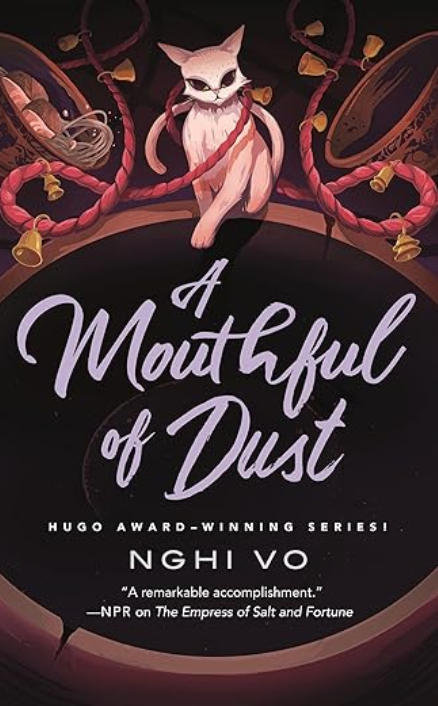
A Mouthful of Dust
The Singing Hills Cycle #6

by Nghi Vo
October 7, 2025

In the acknowledgements after the story, the author describes her editor telling her, in 2020, that maybe the readers weren’t ready for this story. In 2024, the editor was like, okay, yeah, this will be fine. Likely because the world has been rough and we’ve become accustomed to it. I think the editor was right. This is a more difficult story than some of the others, and none of them have been particularly light, but it was still so very good.

Cleric Chi and Almost Brilliant arrive in the town of Baolin to learn stories of the legendary famine that’s long enough in the past that it feels safely distant to the reader and to Cleric Chi, but recent enough to still have an immense and ongoing impact on the residents recounting their stories of what they did when their whole city was starving.

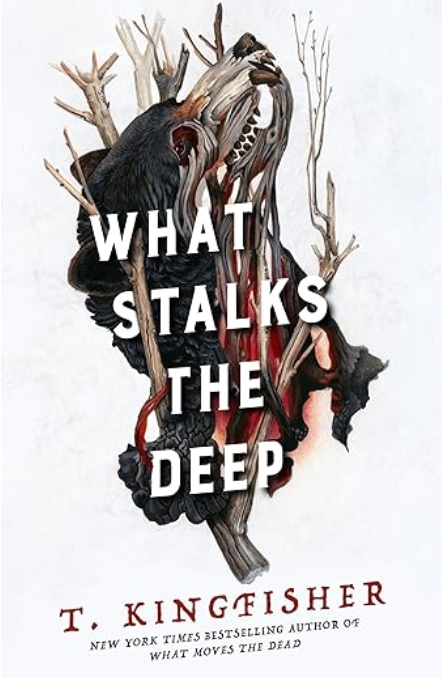
What Stalks the Deep
Sworn Soldier #3

by T. Kingfisher
September 30, 2025

Alex Easton, the sworn soldier from Gallacia, travels to America… specifically to West Virginia, to an old abandoned coal mine where Dr. Denton’s cousin has gone missing while exploring the cave. Denton specifically requests Easton’s help because the preliminary evidence has been deeply creepy to the point of unbelievable, but after their shared experience in the first book in the series, at the House of Usher, Denton is sure that Easton won’t immediately dismiss it. Easton would very much like to dismiss it because it is deeply creepy but instead sees the whole investigation through, all the way to the very creepy end.

What really struck me in reading this is how similar Easton is, as a character, to John Watson: not necessarily the brightest, although not stupid by any means, but definitely dedicated, and more inclined to get into trouble than they’d like to admit. This is an investigation with no brilliant detective, just a group of individuals trying their best.

The other thing that struck me is a spoiler about the monster in question that I really want to share but also don’t want to give away! But this book makes me wonder if there are trends in the way new horror monsters are developed and how much horror writers crib from one another. Or maybe I just don’t read enough horror to recognize the less common but still regular tropes. But there are similarities to a very different book I previously reviewed!

In the meantime, both of these series are delightful with some remarkable similarities to one another, despite their decided differences, based on the narration by laid-back nonbinary main characters who find themselves in situations. I highly recommend both these series.

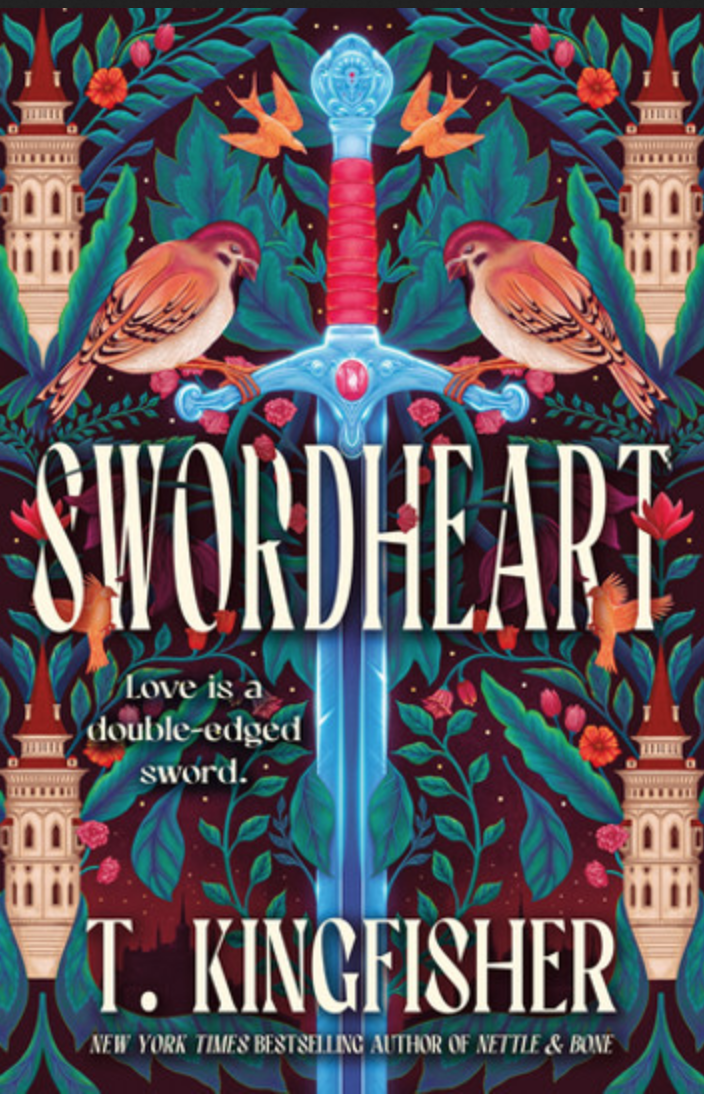
Swordheart by T. Kingfisher

Swordheart
by T. Kingfisher
2018

This is delightful and hilarious and a surprisingly quick read despite being fairly long. The story pulled me along as the plot goes on wild side-quests and the main character goes on wild tangents. I adore the main character, Halla, a housekeeper who had come into an unexpected inheritance that involves some really angry dis-inherited relatives that she has to avoid. She was happily living her life, more or less, and would have continued to do so if not for the need to avoid the awful relatives which has led to acquiring a magically haunted sword, running away from home, meeting bandits on the road and having to escape them, meeting police chasing the bandits on the road and having to escape them, and increasing number of hijinks that domino ever onwards.

The second main character, Sarkis, is the magically haunted sword and also a barbarian from a distant land, who is used to being used as a warrior by other warriors, and is now a companion for an escaping housekeeper and isn’t quite sure what to make of the situation. We slowly get more of his backstory over the course of the book, but (in my opinion) his true delight is to be the outside perspective on Halla and her situation. It’s hilarious!

I was also pleased to see confirmation in the afterward that this was going to be a trilogy. Since it was published in 2018, I assumed the other two would already be available. Alas! Book 2 of the trilogy is due to be published in August 2026. Hmph. I will wait.

I also realized about a quarter of the way in that Swordheart is set in the same universe as the author’s Saint of Steel series, of which I have read the first three of four:

Paladin’s Grace (Saint of Steel, Book 1)
2020

It’s actually only as I was putting together this review that I realize from the publication dates involved that these books were written after Swordheart, and thus these are in the Swordheart universe rather than vice versa. I had read a great essay about the social history of perfume and how closely perfumers were tied to alchemists and to poisoners and someone had recommend this book in the comments and it really is fabulous. Set in a generic historic fantasy setting with gods and demons and paladins, our main character Grace is a perfumer trying to make a living, but having to fight systemic sexism every step of the way. And also accusations of being a poisoner. Meanwhile, the main male character is a paladin’s who’s god has since died and thus his own status is deeply in question. I really enjoyed the deep dive into the perfuming business as well as the interesting theological perspective. After I read it, I immediately put a hold on the remaining books in the series:

Paladin’s Strength (Saint of Steel, Book 2)
2021

Paladin’s Grace had introduced four paladin’s who had survived the death of their god, and there was a book for each of them to figure out how to continue living when the religion they had devoted themselves to was so thoroughly disbanded. This is the second book and continues to do some amazing world-building on what religions there are and how they interact with one another and with their gods and I do love a deep dive into fantasy theology.

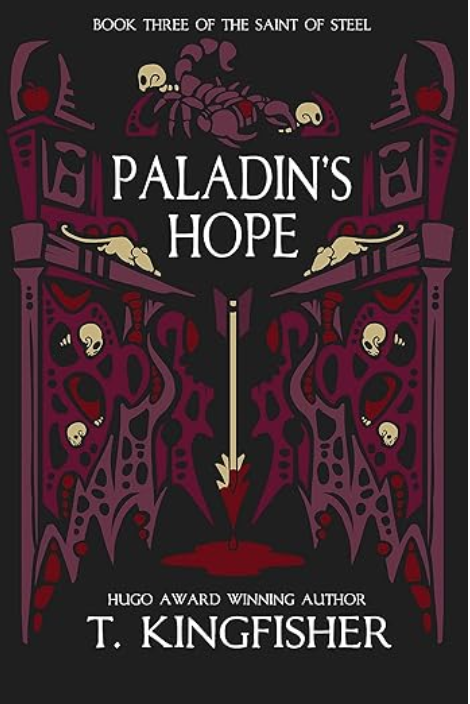
Paladin’s Hope (Saint of Steel, Book 3)
2021

This is the third book in the series and I probably should have taken a break rather than reading one book after another because I remember liking it well enough, but just loosing some steam in reading them back-to-back-to-back. I really love Kingfisher’s characters and world-building, but this book focused more on the overarching series plot of a massive villain in the background who must be routed out before they destroyed all of society or something like that and I just didn’t find it as interesting.

I’m pretty sure the reason I didn’t review these here before was because I’d been planning to review the whole series in one go but then didn’t get around to reading the final book: Paladin’s Faith. However, I’ve gone ahead and put a hold on that at my local library and plan to read it in preparation for Daggerbound being published in August 2026.

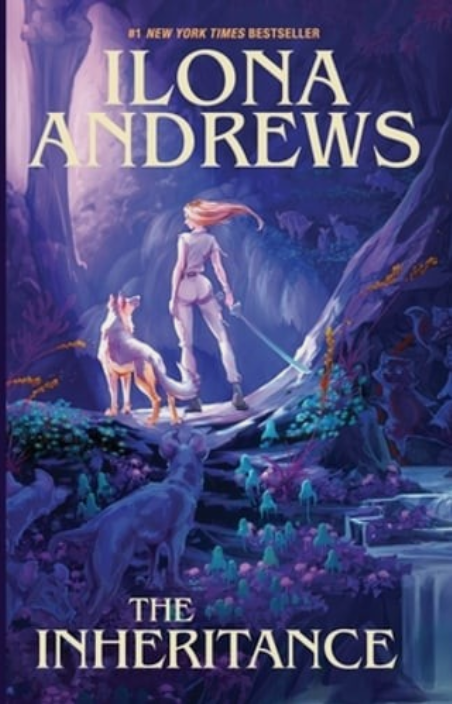
The Inheritance by Ilona Andrews

The Inheritance (Book 1 of The Breach Wars)
by Ilona Andrews
August 2025

This book is fun! It would a guilty pleasure if I were still at a point in my life where I was willing to feel guilty about a simple pleasure. This book is good because it makes me happy. The authors clearly had fun writing it and I had fun reading it, and if I were going to try to compare it to Great LiteratureTM, then there would be some issues, but that’s not the league it’s in, and in the league of fun pleasures, it’s a wild success!

I also get a kick out of knowing that these authors clearly read/watch the same Dungeon Adventure genre of Korean comics/anime that I do. The premise: a decade or so ago, mysterious portals starting appearing that would produce monsters that had to be fought and the portals closed; at the same time some people gained a whole variety of super powers perfectly suited to fighting the monsters; people formed guilds to organize the fighters, and thus plots involve both fighting monsters and political shenanigans with wealthy celebrity fighters and saving people. Probably the most well-known in this sub-genre is Solo Leveling, my favorites are: Traces of the Sun and Mission: Save the Hunter, but I’ve probably tried at least a dozen others. There are a lot of takes on this and now Ilona Andrews are writing their own and I am here for it!

This is also an interesting break from Ilona Andrew’s usual writing in that it is a pure adventure story with no romantic plot line. Not only that, but there is a character in the first chapter who is set up as the obvious love interest who winds up being a minor villain instead. I was delighted by the twist!

There is significant overlap in the world-building for this story with their Innkeeper Series, which I would normally link to a prior review of but am shocked to discover that I haven’t previously reviewed any of those stories. The Innkeeper Series is a great deal of fun, starting with:

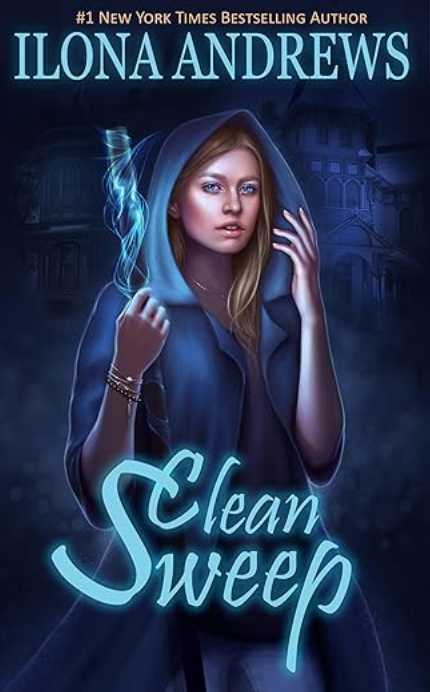
Clean Sweep (Innkeeper Chronicles Book 1)
2013

which introduces Dina Demille who runs a small inn in rural Texas that caters to a very specific clientele: interplanetary visitors who want absolutely safety for the duration of their stay and who, in turn, promise to not make it too obvious to an unaware general human population that Earth is very conveniently located as a waypoint for a lot of very strange travelers. Shenanigans regularly occur.

There’s enough specific overlap between the societies of aliens introduced in the Innkeeper series and some background discussed in The Inheritance that I would expect them to be set in the same universe but there’s also enough different in the standard Earth culture, that I’d expect them to be entirely different. I’m definitely curious about what will be revealed in book 2 of the Breach Wars series or book 7 of the Innkeeper series.

Also, Ilona Andrew’s next book, due in 2026, This Kingdom Will Not Kill Me, is their take on the transmigration sub-genre in which the main character of the story is a regular person in the real world who wakes up inside a story that they’ve been reading with full knowledge of the oncoming plot. Most well-known is probably Scum Villain’s Self-Saving System, my favorite is probably Cleric of Decay, and I have at least started half a dozen other stories on Manta or Webtoons with the same concept. I hope Ilona Andrews are having as much fun with these as I have been!


Testimony of Mute Things by Lois McMaster Bujold

Testimony of Mute Things
by Lois McMaster Bujold
October 2025

A new Penric & Desdemona novella! Yay! This is a delight and while it is the fifteenth story written, it is set chronologically as the fourth in the series. As much as I enjoy Penric as a family man who is famous/infamous and experienced, it is wonderful to see the younger Penric still getting himself established and being underestimated and relying more on older mentors to help him figure out his next steps. And, interestingly, in this we learn more about Ruchia, Desdemona’s prior host, and look at what it means to have friendships with people who are a combination of mortal and immortal. Ruchia is dead, but Desdemona continues on and thus so does Ruchia’s imprint.

Something that I find particularly delightful about this series as a whole is that the publisher listed on Amazon is Spectrum Literary Agency which is not, in fact, a publisher. Lois McMaster Bujold is retired. She was a wildly successful science fiction and fantasy author with 27 novels (at least), many short stories and compilations, and translations, and some years back she declared that she was retiring. And in her retirement, she apparently entertains herself by writing novellas and doing the equivalent of self-publishing but with the full support of a literary agency with full editorial work, and just no marketing at all. She doesn’t need to do any marketing, because fans such as myself are more than willing to just check back every so often to see if there’s anything new and be ecstatic when there is!

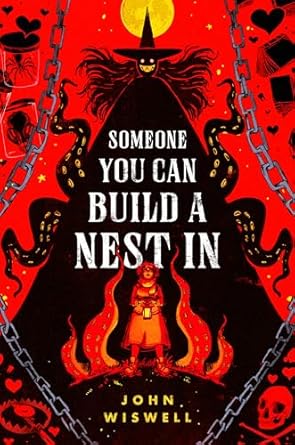
Someone You Can Build A Nest In by John Wiswell

Someone You Can Build A Nest In
by John Wiswell
2024

This book is very cute and very gross. It’s a remarkably sweet romance between a literal man-eating shapeshifting ooze and a member of a monster-hunting human family. The story is set in a hand-wavy historical fantasy setting mostly in and around one town but with knights and nobles and small kingdom politics happening in the background. In the opening scene, the monster Shesheshen wakes up from hibernation when a hunter enters her lair in order to kill her and harvest her heart. Instead, she kills and eats him, not necessarily in that order. Later on, she meets his sister Homily and falls in love. There are, as you can imagine, some problems that must be resolved for any relationship to work out.

The plot is tricksy with a couple of twists and turns that kept my anticipation high. It also side-stepped a lot of issues by having a main character who was so very inhuman that she, and thus to a certain extent the reader, just didn’t care about the ongoing body horror. It’s not horror to the point-of-view character so everything is fine!

I enjoyed the book and thought it was both fun and funny.

However, I do have some caveats:

One of them is oddly how sanitized the story is. Of course there is a lot of death and killing, but I was a bit taken aback by how few people Shesheshen actually winds up killing, despite her stream of conscious thought process that classifies people as highly edible. (Her thought process is hilarious!) Given that the author is upfront about monsters often being a metaphor for disability, it makes sense that he wrote a more misunderstood monster than a truly vicious one, but it also felt like he was trying to write both at the same time and couldn’t quite manage to reconcile the thought process with the actions so it doesn’t quite work out.

While the expectation of death and gore is obvious from the very beginning, there was a scene of extreme animal harm in the middle of the book that surprised me and broke the rhythm of the story for me. Spoiler: the animal does get rescued and does survive, but it’s an unpleasant scene that hit me harder than anything else in the book.

And finally, I think this book could have done better as a duology. The book is broken into eight parts and takes place over the course of a full year. The main plot and primary character arcs and half the year are covered in the first seven parts. The eighth section covers the other half of the year and a whole secondary character arc that gets skimmed through extremely quickly. It could have been a whole sequel, possibly from Homily’s perspective, but it felt very rushed as a too-long epilog to the main story.

But overall, this book was fun and enjoyable and a great build-up to Halloween.

Sworn Soldier series by T. Kingfisher

I have started the spooky season off right with a pair of eerie fantasy horror novellas that I highly recommend (although admittedly not to my 6-year-old cousin for whom I had to do some quick page flipping to find a section I could read aloud without introducing any concerning concepts.)

What Moves the Dead
by T. Kingfisher (aka Ursula Vernon)
2022

This first novella is a retelling of Edgar Allen Poe’s The Fall of the House of Usher, which I actually only read in full afterwards, although I vaguely knew the gist of it through literary osmosis. The original is a bit of a slog with a lot of words about not much happening. In contrast, Kingfisher goes above and beyond in developing some of those details into full plot arcs and monster development, creating a cozy horror story that is deeply unnerving, with a wonderfully unique character to be the narrator.

Also, not to get into spoilers beyond what the cover already shows, but I feel like this book could be part of a triptych with Entangle Life and Little Mushroom to really cover the full expanse of literary discourse on fungi.

The narrator is Alex Easton, a retired soldier from Ruritania, a fictional eastern European country that apparently has a long history of being a fictional setting, and has — in this story at least — a running gag about how miserable the country is in pretty much every way, but it’s still home. An interesting twist that reminds me of the Cleric Chih series is that in the Ruritanian language, soldiers have their own dedicated pronouns, and thus anyone who doesn’t like their born pronouns can swear in as a soldier and get a soldier’s pronouns as part of the deal along with PTSD and various other injuries.

Easton is fascinating enough, that it’s no wonder that the one-off story became a series, and thus the second book is:

What Feasts at Night
by T. Kingfisher (aka Ursula Vernon)
2024

This is another cozy horror novella set in the 1880s, that follows pretty soon after the prior one where Easton is hoping to recover from the events at the House of Usher, although would have preferred to do so in an apartment in Paris rather than in an old hunting lodge in Ruritania, but events conspire to bring Easton to rural Ruritania, an unexpected death, and some deeply superstitious villagers. The characters are a delightful as they try to get along, despite having distinctly different perspectives, and the world-building perfectly creepy in the way it presents the world as dangerously uncertain about what is happening and even more uncertain about what to do about whatever is happening.

Kingfisher does an excellent job of both taking advantage of and subverting some of the standard writing tropes to keep both the reader and the characters uncertain. The supernatural elements are introduced into the world building in a way that feels all too natural and realistic.

The third book in this series, What Stalks the Deep, just got published last week and I’m on the list for it as soon as it hits my library, but wanted to give it a call out here as well. It’s coming soon!

The River Has Roots by Amal El-Mohtar

The River Has Roots
by Amal El-Mohtar
2025

This author has a way of using language to create worlds like lucid dreams. She makes metaphors so strong and pervasive that they’re world-building. It lives in the space between poetry and prose, and reading it feels like a way to slow the frantic pace of my thoughts and set my brain to a reasonable rhythm. I’m in awe of her writing.

This story is a retelling/re-imagining of the classic folk song, The Two Sisters. And of all the versions I’ve read/heard, I like this one best. It’s not a long book, only 100 pages, and includes many beautiful black-and-white illustrations.

El-Mohtar is one of the co-authors of This Is How You Lose the Time War, which was extremely good but also complicated in a way that required more focused concentration than this book did. This story feels closer to Nghi Vo’s The Singing Hills Cycle books, which is also a high complement.

The Hymn to Dionysus

By Natasha Pulley

Ooh, Natasha Pulley just keeps getting better and better at her special talent, which is weaving truly brutal social commentary through a cover of fantasy action. I went into this one with less trepidation after The Mars House, and I’m sort of wondering if The Mars House was a setup. There are enough notably similar themes between the two novels that I began to think of them as a pairing of sorts, though very, very different in setting, character, and plot.

The Hymn To Dionysus has an even more light-hearted tone right off the bat. Our protagonist is a happy child soldier in ancient Thebes, and if it doesn’t exactly sound like a happy existence to a modern reader, well, sometimes that’s just the case with fantasy, especially historical fantasy. I mean, look at the majority of children’s and young adult media, right? The Hunger Games and Naruto, just to name a few right off the bat – full of deeply traumatizing events for young children who just sort of make do, and that’s what our protagonist does, too. His life has some downsides (murdering, enslaving, etc.) but there’s plenty of upsides, too (his military unit is like a family to him, he gets to travel and see all sorts of sights). He and everyone else in Thebes are just going along, until Dionysus, the god of madness, shows up and suddenly they can’t just go along, and the full awareness of it all starts crashing down on them, and it is devastating, for both the characters and the reader.

As if all that wasn’t enough, there are some striking comparisons to our current world. My ancient Greek history isn’t up to much, but I started getting the impression this was set toward the end of the Grecian empire, with a years-long drought devastating all levels of civil society. As field slaves run away, figuring capture and death is better than starvation on the stringent food rations, the military is charged with rounding up ‘criminals’ to work the fields for the necessary food for the city and given a quota to meet, which rang direly true.

It ends as satisfactorily as possible, more so than I’d imagined it being able to after a whole series of gasp-worthy twists, and left some scenes indelibly imprinted in my head, so I’d generally recommend this, though I am looking forward to returning to something a little more gentle next (spoiler: I didn’t do that).

Love, Death + Robots: The Official Anthology : Volume One

Love, Death + Robots: The Official Anthology: Volume One
2021, audiobook 2025

I have not watched the animation series, but I’ve heard good things about it and I saw that this audiobook existed and so I got it and listened to it on my work commute. And I didn’t quit halfway through, though I was extremely tempted. It has some of the worst writing I’ve ever read/heard. Like, at least one story that’s right up there with Eye of Argon, and others that were close runners up. What’s also crazy is that, as I was listening, increasingly appalled with each new story, I realized that they were managing to cover a wide range of ways in which writing can be poorly written.

In retrospect, I realized that there were two entries that are explicitly screenplays and thus can be forgiven (I suppose) for going into details about exact camera angles, and scene changes, and repetitions of the exact time of day even though it didn’t change, but wow was it hard to get through on my commute. The fact that one of those screenplays (“The Witness” by Alberto Mielgo) literally opened with “a beautiful woman is naked in front of a mirror, applying make-up” felt like such a stereotype/cliche that I wondered if it was intended as a spoof. Sadly, if it was intended as satire, it never made any particular point.

A lot of the stories (“Suits” by Steve Lewis, “Sucker of Souls” by Kirsten Cross, “Shape-Shifters” by Marko Kloos, “Blind Spot” by Vitaliy Shushko, “The Secret War” by David W. Amendola) had men with overwrought machismo fighting slavering aliens, with the type of clinical descriptions of violence and gore that I might expect from an audio-description of a visual media, but not from even a book adaptation of a movie. (“Lucky Thirteen” by Marko Kloos, has a woman with machismo fighting human soldiers, but the rest remains the same.) Text and video are different types of media and text is better served trying to describe the impact of violence/gore on the characters rather than just a description of a picture. However, most of them couldn’t even make their violence impactful. Plus, a really eerie pattern I noticed was how in these stories, there was all this extreme violence between the “main characters “good guys” who feared for this lives but stayed strong through it all because they needed to protect their people, versus the “bad guy” alien others who were mindless killing monsters with no thought or culture of their own, only an endless desire to kill humans. But their actions were the same, extreme violence towards one another: just one side was good and one side was bad. It felt like video games for armchair warriors, who wanted to feel powerful and liked gun statistics and weren’t at all interested in the source of any given conflict.

Some of the stories (“Sonnie’s Edge” by Peter F. Hamilton, “The Witness” by Alberto Mielgo, “Beyond the Aquila Rift” by Alastair Reynolds) had an interesting concept and/or twist that I would have enjoyed seeing presented better and with less of a look at the authors’ sexual issues.

“Beyond the Aquila Rift” was actually the first story (ie, the seventh story) that I thought was genuinely well-written. And then it swerved into focusing on a middle-aged dude’s feelings about his extra-marital affair and it mostly stayed there for the rest of the story, pushing aside the interesting science fiction scenario and reminding me of the stereotypical English professor writing a novel about having an affair. The author tried his best to make the affair plot-significant and mostly managed to make the protagonist so self-centered he came across as a sociopath.

There were some decent stories. (“The Dump” by Joe R. Lansdale, “Fish Night” by Joe R. Lansdale, “Ice Age” by Michael Swanwick, “Alternate Histories” by John Scalzi.) It’s too easy to forget them when I think back on the book. But they were there. They were short, but interesting and fun and funny.

There were two genuinely good stories that I enjoyed a great deal and actually recommend. Luckily, I can even provide links to them (the written versions, not the audio):

Good Hunting” by Ken Liu is excellent and heart-breaking and heart-warming and all that about China losing it’s magical culture during the British colonial period and then regaining it in a steampunk fashion.

Zima Blue” by Alistair Reynolds is fascinating and thought-provoking and I have so many thoughts about it but also don’t want to provide any spoilers, because the story itself is so well laid out in the way it presents the situation and slowly makes the reveal, and then leaves the reader to continue to thinking about all the implications for days afterwards. It’s about an artist who went through extreme body modifications in order to have experiences no one else could, and the reporter who interviewed him about his final piece.
Manners and Monsters

By Tilly Wallace

I’d run across a couple different recommendations for this book, and the premise is fascinating! Set in a fantasy England in the early 19th century, a biological weapon created in the Napoleanic wars has turned several hundred members of the English aristocracy, primarily women, into zombies of a sort. Honestly, the worldbuilding is so clever, this is more of what I would have liked to see in Pride and Prejudice and Zombies! The aristocracy, being the elite, have made it a whole song and dance, with a whole new set of ridiculous etiquette around their living-dead members.

When the etiquette is broken quite violently with a zombie-esque murder (missing brains, of course) at a grand ball, chief investigator Viscount Wycliff, on the fringe of haute ton himself, must pry into secrets of the various ‘unfortunates’ in attendance. In order to ruffle as few feathers as possible, he is accompanied by Spunky Heroine™ Hannah, the unassuming daughter of a surgeon specializing in undead ailments. And here’s where the novel lost me a little.

I generally liked Hannah, but both protagonists are fairly flatly written: Wycliff is brusque to the point of insulting, while Hannah pines for love at least half a dozen times throughout the book. The two are very clearly destined for each other, which wouldn’t bother me if they didn’t seem like an exceptionally bad match. I’d be reading along, enjoying the general zombification of the Regency era, and then their personal interactions would be a sour note. Romance really is trickier to write than people realize!

An additional big kudo to author Tilly Wallace, though: she sells all of her books directly through her website, tillywallace.com, where you can pay and promptly download an epub file. As someone trying to cut my very last tie to amazon (those pesky self-published ebooks), I very much appreciated this, and hope that more self-published authors follow suit!