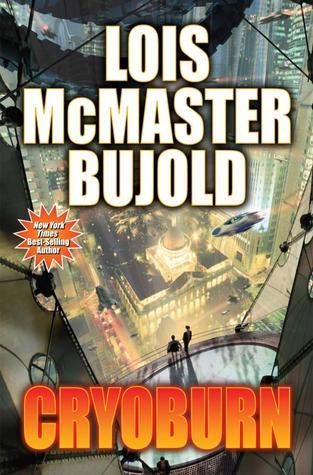
Cryoburn by Lois McMaster Bujold

Cryoburn
By Lois McMaster Bujold
2010

So I finally got around to reading Cryoburn, which is a ludicrous statement for me to have made. I adore Bujold. I discovered her about fifteen years ago and have read her books ever since. She has three different series, set in three wildly different universes, each of which I love. I have read everything she has ever published and loved them all. She was the first author for whom I actually started purchasing new-released hardcover books and even now is one of only four authors for whom I have done that. So why, then, did it take me nearly two years to read this book, checking it out from the library?

When it was first announced, I was super excited. A few months before it was finally due to be published, the publisher posted the first several chapters online as a teaser and I raced over to read them… and found myself kind of, well, bored.

First of all, this is the fifteenth book set in this universe and the eleventh book following the adventures of Miles Vorkosigan. And it is the first book in which there is no major character development.

It makes a certain amount of sense. Miles was introduced in The Warrior’s Apprentice (incidentally, that book (awesome-awesome-awesome) is available for free online, because both Bujold and Baen Publishers are very cool) as a high-born teenager in a military culture who failed to pass the military entrance exam due to physical disability despite all the nepotism in the world. He’s an awesome character: a brilliant, hyperactive dwarf with brittle bones, a lot of high-ranking family connections, and a deep desire to prove himself. It gets him into and then out of So Much Trouble.

But he does, slowly and painfully (and awesomely!), grow up. He grows into himself and faces set backs and failures and grows into himself again and changes who he is and what he wants and if the teenage years were hard, the twenties were driven, and the thirties were vicious, but now he’s settled. He’s happy with who he is and where he is and what he’s doing.

This makes me very happy for him.

But, well, there’s a reason most stories end with the whole “happy ever after” summary of the rest of characters’ lives. Happy settled people aren’t really as interesting as manic, driven people.

Now, character development isn’t the only thing that Bujold does fabulously well.  Her world-building is amazing and rich and deep. Her plot lines and mysteries are complex and tricky and hilarious. And Miles does remain an excellent character and driven in his investigations once they get going.

Cryoburn absolutely demonstrates Bujold’s skills at both science-fiction world-building and tricky plotting. The problem is that since the storyline is a mystery, and the reader only sees Miles’ discoveries as he’s making them, it takes a while for both Miles and the reader to get the momentum going.

Once it gets going, though, the book is excellent. I love the twisty plots and plans and characters and Miles’ manic investigation into them all.

It occurs to me that this book actually might work best as a stand-alone, without having read any of the previous books in the series, and thus coming to it without expectations.

The only thing that needs real background to get the full impact is the epilog, after all the plot ends have been tied up. The epilog, oh, the epilog: it hits like a punch to the sternum and makes my heart skip a beat. (You do need to have read the series to get the full impact, but oh, my heart, oh Miles, oh Bujold, love-love-love!)

So expect to slog a bit through the beginning, but the later two-thirds are really, really good.

Gunmetal Magic by Ilona Andrews

Gunmetal Magic
by Ilona Andrews
2012

This is a pretty mixed review given that it’s for a book that I enjoyed in a series that I loved.

I enjoyed this book a lot. There was fun banter and exciting action and all sorts of fun. On the other hand, it wasn’t exactly the best work of literature I’ve run across, not even the best by this author. The plot depends more on shiny-magic-handwaving than it does on logic and the characterizations are pretty dependent on introductions from previous books. There are also a few scenes that seem to have been included for no particular reason at all.

I assume those scenes are part of the set up for the next book, actually. That actually brings me to skirting around a spoiler that I wrote about in one of my spoiler posts, regarding how this book was written primarily in order to set up some circumstances in preparation for the events in the next book. This book is well-worth reading as the next building block in a really awesome series, but I don’t think it can or should stand alone. I definitely recommend the series, though, but start at the beginning and read them in chronological order. While the main series is planned to have seven books, I would say that this counts as book 5.5. While focusing on a side character, the events of this book are necessary to the development of the series in general.

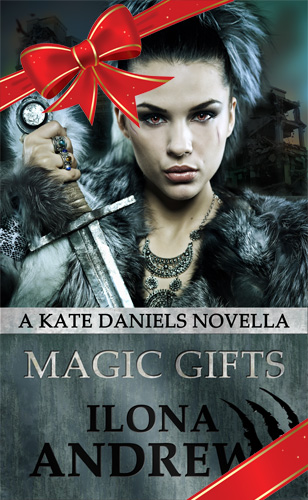
The suggestion to read the books in chronological order includes, incidentally, the suggestion to read the novella, Magic Gifts, which is included at the back of this book, before reading Gunmetal Magic. Which means, that when you get the 448-page book, the first thing to do is to flip to approximately page 330 and start reading. Magic Gifts is the story of what Kate Daniels, the main character of the series, is doing in the background during Gunmetal Magic, which focuses on the adventures of Kate’s best friend Andrea.

Anyway, a couple of things about the book in particular:

On the plus side: One thing that I really appreciated about Gunmetal Magic is how deftly it managed to flirt with but then avoid the classic romance-novel cliché of the love triangle in which one girl must choose between two guys. While the structure is still there, Andrea deals with the situation in a realistic fashion without all the angst and general waffling that I had feared. I was impressed. The characters were fun, the banter was fun, and I was pleased at the romantic resolution.

On the minus side: This could be a plus or a minus, depending on your perspective, I suppose, but the book covers some heavy ground regarding extreme childhood abuse very lightly. Maybe a bit too lightly. It’s not that I want to read a realistic depiction of how extreme childhood abuse affects adult relations (which I assume would be horribly depressing,) but I kind of think that introducing the issue and then not dealing with it might be worse. On the other (third?) hand, I’m willing to handwave away some of that with a vague explanation of magic and societal changes, etc.

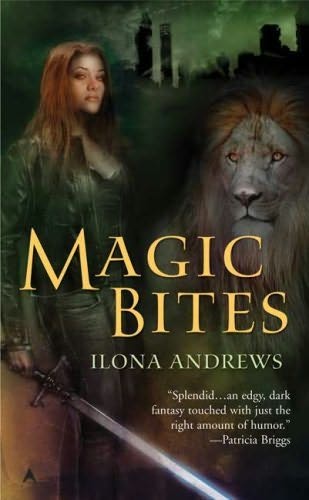
So I will end this review with the suggestion that you go read Magic Bites (Kate Daniels, Book 1)

Ilona Andrews Spoilers, part 2

As I mentioned in the previous post, I attended a book signing by Ilona and Gordon Andrews yesterday evening. In the first part, I described what they said regarding some of their books and stories that were published prior to a week ago. This post describes Gunmetal Magic and future Ilona Andrews publications.

First, there are a few general things about upcoming books, and then more specific spoilers under the cut.

The Kinsman series (currently consists of Silent Blade and Silver Shark) seems to have been primarily written by Ilona (the woman) with less input from Gordon than the other Ilona Andrews (the author) stories. Thus, it was a bit disappointing when she said she didn’t really have any ideas regarding what to write for any future stories set in this universe. Too bad. But she did say that they had plans to write something to post for free on Christmas as a present to their readers, and that story could potentially be set in that universe. I’ll live in hope.

The next book set in the Edge series is planned to be the last of the books. They sold the rights to a TV series, which would be awesome, and is yet still extremely unlikely to actually come to fruition. Depending on reader and publisher interest, Gordon seemed to think there might be another book following a slightly more grown up Jack and George, but there are no real plans for it at the moment.

However, there are solid plans for a Jim and Dali book which should come out after the Kate Book 6 book but before Kate Book 7.

And now, for the real spoilers. If you don’t like spoilers, don’t click the link below.


Continue reading

Ilona Andrews Spoilers, part 1

Ilona and Gordon Andrews, who jointly write under the name Ilona Andrews, were at BookPeople yesterday evening and I went to hear their talk and to get a signed copy of their newest book, Gunmetal Magic. The talk was a lot of fun, and their youngest daughter, who was maybe 14-years-old and constantly interjecting comments, was adorable. (The daughter actually kind of reminded me of Lydia from The Lizzie Bennett Diaries… big smile, rolling eyes, and a propensity for teasing her parents.) However, I told Anna that she was probably just as happy not being able to attend, because there were a lot of spoilers.

Thus, the reason for breaking the description into two posts:

This post, part 1, is going to be Anna-friendly, ie, discussing all the books and stories that were published prior to this week. The next post (part 2), will discuss all the books and stories that might be coming down the pipe.

It was interesting to see that Gordon loved talking about the plot twists coming up while Ilona (the individual) didn’t like any possible mention of spoilers, including mentions of facts that were stated in previous published books. However, since I’m going to recount some stories about the writing of different books, there will be spoilers below.

For those of you who haven’t read and don’t want spoilers for AlphaMenz, Magic Bites, or Magic Mourns, don’t click on the spoiler cut below.

Continue reading

The Lizzie Bennet Diaries

The Lizzie Bennet Diaries
By Hank Green and Bernie Su
2012

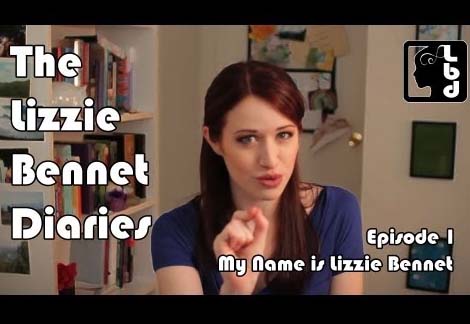
I would not have thought it was really possible to transpose Pride & Prejudice into a modern setting, but then I watched some of the episodes of The Lizzie Bennet Diaries and was amazed. This is the Bennet family in the current time as told through Lizzie Bennet’s online video blog. And it’s delightful!

It’s also still a work in progress, still being updated twice a week with new episodes. So far there are 30+ episodes, each between 2.5 and 5 minutes long, and Lizzie and Jane are staying at Netherfield, visiting Bing Lee, his sister Carolyn, and friend Darcy.

The translation of the story from the 19th century to the 21st century is both really well done and kind of fascinating. What changes and what doesn’t change is pretty awesome.

While the majority of the story is told diary-fashion about off-screen events, some of the events take place while Lizzie is recording the videos and seven characters have directly appeared on camera (so far): Lizzie Bennet, of course, but her also her friend Charlotte who helps with the video editing, her sisters Jane and Lydia, Bing Lee and Caroline have appeared a couple of times, and, in one memorable episode, Mr. Collins.

It’s really well done, and it’s a bit like potato chips: each episode is short and quickly watched and yet you can’t just watch one. There’s more to watch and you want to watch them all!

Thus, you should go start watching! Here’s the first one.

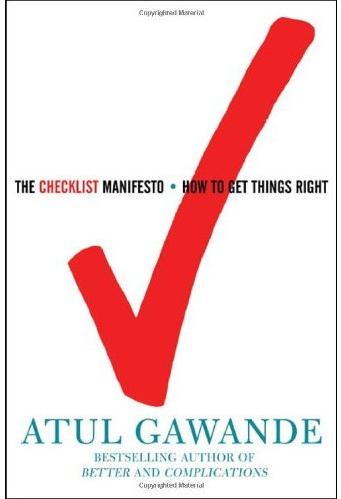
The Checklist Manifesto by Atul Gawande

The Checklist Manifesto: How to get things right
By Atul Gawande
2009

To start off, this is a really excellent book and I recommend it to everyone. I’ve reviewed a few management books in the past, but this one is by far the best one, in part because it’s less about managing people in specific scenarios and more about managing complex situations in general, and in part because it’s focused on a single recommendation and discusses how and why that recommendation is important. As the title says, the book is about the importance of checklists.

As a manifesto, it set out to convince me of its premise: that checklists can be used to great effect. It succeeds. I am thoroughly convinced and now think you should be convinced, too.

A lot of jobs today are incredibly complex and only getting more so as time goes by. Checklists can go a long ways towards helping to compensate for this extreme complexity. The examples Gawande uses are surgery (Gawande himself is a surgeon), aviation, building construction, investment analysis, and cooking.

Historically, these jobs were all performed by individuals relying solely on personal experience and instinct. Now, these jobs are most often performed by teams of experts with access to vast quantities of research in addition to their own personal knowledge. This is an improvement, of course, but it also introduces problems of complexity in having to coordinate with multiple people and incorporate excessive amounts of information.

In performing these jobs, the professionals need to know and be able to instantly recall more detailed information than is really possible and they need to be able to trust that their teammates are performing equally super-human mental tasks as well. Such trust is often a mistake. When dealing with extremely complex tasks, professionals will sometimes focus so much on the difficult or tricky portions of their tasks that they forget to perform the basic preliminary steps. Even the best and most experienced experts in their fields are still just human. Checklists, however, can supplement memory to ensure that everyone remembers the basic steps, while at the same time running through a checklist as a group can ensure that everyone on a team is on the same page.

I would love to go through each of Gawande’s examples and explanations because the examples were all so interesting and the explanations were all so useful. For example, the discussion of how airplane pilots came to use checklists and why they go through some every single time they fly, no matter how experienced they are, is fascinating. Equally fascinating is the interview with Boeing’s master checklist writer regarding what defines a good or bad checklist. The whole book is both interesting and useful and I could burble on about each of the stories or arguments or lessons, but really, it’s probably better if you just go and read the book.

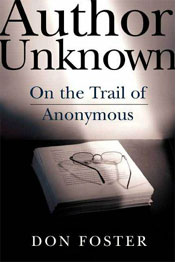
Author Unknown

Author Unknown: On the Trail of Anonymous
Don Foster
2000

I like books and I like reading but, while I am capable enough of literary analysis to have graduated from high school, I admit to a somewhat patronizing attitude regarding the field. My reaction opinion has generally been: well, if you want your life’s work to be looking for “hidden meaning” in texts, go for it, but really, what’s the point?

In Author Unknown, Don Foster answers that (rhetorical) question with six anecdotes about the real-world application of literary analysis.

A couple of the chapters support (in my opinion) my previous stance of: who cares? It was interesting to see how Foster investigated the authorship of a particular poem written centuries ago, but in the end, what does it matter?

However, other chapters demonstrated much more immediate relevance: Tracking down the authors of terrorist manifestos can save lives.  Proving the authorship of witness tampering documents in the White House can threaten administrations.

Each chapter describes the process of literary investigation and analysis, of a piece of writing with the intend to prove or disprove the authorship of the piece, relying on internal evidence. While Foster does look for external evidence as well (could the author have known of events the piece is discussing?), the investigations in this book are all focused on internal evidence (what person would have written these words in this way?) The way Foster comes to his conclusions and the evidence he looks at is pretty fascinating. Each chapter can also be read alone, as an individual story.

Chapter 5, Wanda, the Fort Bragg Bag Lady, is my favorite of the stories. It may not demonstrate a great deal of real-world impact but it does present a real-world black-humor farce, involving multiple anonymous authors, obsessions, murders, suicides, Hells Angels, bad poetry, good poetry, beat poetry, and a complete absence of bag ladies.

Over all, the book is fun and Foster has a lightly humorous way of writing even as he delves into close readings of archaic documents. For anyone who has doubted the importance of literary analysis: read this. I feel a nice combination of convinced that literary analysis is important after all while still vindicated that a lot of the use it’s put to is pretty darn silly.

Fifty Shades of Grey by E. L. James

This is the first of two reviews of this book. The next one will likely be somewhat more positive. So keep an eye out for another forthcoming review.

Fifty Shades of Grey
E. L. James
2012

I enjoy fanfiction, both the fact that it exists as a genre1 as well as the genre itself. Thus, when I heard that someone had written an AU2 Twilight fanfiction and then changed the names in order to publish it professionally, I decided to read it. I hadn’t enjoyed Twilight, but mostly I found it uninteresting and poorly crafted. With a different author and a different setting, this had potential.

Especially since the articles I had read about it, were mostly shocked by the fact that apparently women can like sex. Yes, even mothers! The fact that this is apparently shocking makes me mourn for the women’s movement. Given that this was the primary complaint about the book, I thought the book must be pretty good.

Alas, I was doomed to rather severe disappointment.

To a certain extent, E. L. James did fix one of the major problems I had with Twilight. The characters are well presented. The narrative descriptions match their actions. Thus, Ana is both described as shy and acts shy. Christian is both described as arrogant and acts arrogant.

Another thing the author does really well is build anticipation. What’s going to happen next?, how are these two characters going to get together?, etc. It kept me reading for about half the book.

Then I hit the first sex scene, and wow, the badness.

From there on out, as the book attempts to get more serious, it becomes something of a travesty that I had trouble slogging my way through.

It’s not clear to me that this author (or the editor for that matter) knows what sex involves or any real concept of physicality or how bodies work much less anything at all about the BDSM3 lifestyle. Given the whole plot of the book is based on the sexual awakening of a young woman and the moderate depravity of her love interest, the lack of understanding on the author’s part is a major problem.

The problem with this book is not that it was based off of another author’s work and not that it contains a lot of sex; the problem is that it’s poorly researched, poorly written, and, to an even greater extent than Twilight, it attempts to romanticize a highly dysfunctional relationship.

1 U.S. Copyright law involves a fundamental division between idea and expression. Ideas are not considered under copyright, ever; only the expression of those ideas is protected. In the past, this was taken to literally mean the exact words. Even translations were considered to be a matter of the ideas rather than the expression. More recent legal interpretations of copyright have expanded what exactly is considered an expression to include not only translations but also events, places, and characters. However, no case of fanfiction has ever made it through the court system, and thus whether or not the genre infringes on copyright remains uncertain.

2 AU in this context means “Alternate Universe.” In fanfiction, this means taking well-loved characters, relationships, and plot devices and transposing them into completely different settings and situations. In this case the Twilight characters were used in a modern setting.

3 BDSM stands for Bondage & discipline, Dominance & submission, Sadism and Masochism. (It is not to be confused with DBMS, which stands for DataBase Management Systems, with which I am somewhat more familiar.)

The rest of this review is going to involve spoilers of the R-rated variety, so I’m putting a break here. Proceed at your own risk. Continue reading

What happened to conclusions?

There are some traditional plot arcs out there that various authors use, re-use, re-interpret, or ignore entirely, depending on their choice. But there is one basic plot arc that I consider pretty universal: beginning, middle, end.

First there’s the beginning in which the writer starts the story and introduces the characters and the world and the problem at hand. Then there’s the middle in which stuff happens. Finally there’s the end in which the results are revealed for the stuff that happened in the beginning and the middle.

Is there some post-modern style now that considers endings to be passé? Because I have recently read two young adult books that I enjoyed right up until I realized that the last few pages weren’t actually going to involve any sort of conclusion.

There’s a difference between a book being the first in a series and just hacking a book into multiple pieces. Or so I had thought. But twice in a row, two otherwise well written books suddenly stopping like this. It feels like a conscious choice. It’s not a style that I approve of, but I’m beginning to really think it might be a stylistic thing rather than simply bad writing, especially since, aside from the lack of any conclusion, they were good books, or at least two-thirds of good books.

Hollowland
By Amanda Hocking
2010
(Free kindle edition on Amazon)

Remy King is nineteen, the world has fallen apart in a zombie apocalypse and she is going to go across country to get to her brother if she has to walk to do it, beating off zombies all the way. She is kick-ass and awesome, acquires a few companions and loses a few companions (but luckily not the lion, because I never before realized that a proper kick-ass heroine needs a lion companion, but this book convinced me), and is generally determined. This was pretty much exactly what I was in the mood for during my own finals madness.

Except for the fact that this is book #1 of The Hollows series and the plot transitions smoothly into plot #2 before the book ends, leaving me going: Seriously? That’s where you decided to break off? Seriously?

Cinder
By Marissa Meyer
2012

Cinder is a mechanic with a stall at the local market bringing in the only income her family sees. She’s also a sixteen-year-old cyborg in a world that considers cyborgs to be less than human. Her step-mother was not happy that Cinder’s adopted father had decided to adopt a cyborg and even less happy that he then proceeded to die of the plague just a few months later.

A lot of people are dying of the plague these days. Including the Emperor.

Which leaves the prince and heir to the throne in the rather unhappy position of being pressured to marry the queen of the independent moon colony. The lunar people have mind control powers and their royalty tend to use assassination and mutilation to get what they want.

This is the kind of crazy re-imaging of the Cinderella fairy-tale that I just can’t resist. It was excellent and crazy and fun… right up until the final climactic scene turned out to be less climactic and more of an introduction to a whole new plot arc with no conclusion in sight. Apparently there are four more books in the works.

So, what’s up with this?

Neither ending is really a cliff-hanger, per se. They’re just incomplete stories. For anyone who reads amateur fiction published online, it feels like I just came to the end of the posted portion of a WIP (Work in Progress). I had rather thought that the benefit of reading formally published books is that none of them are WIPs. It’s depressing to discover that’s not the case.

So, I ask again, is this really a style of writing that’s going around now: plot arcs composed of beginnings and middles, but no ends?

The Edible Book Festival

The Edible Book Festival
An Annual International Festival
April 1st

This is a collective review and an introduction to a whole genre of books that you may not be aware of. These books are not necessarily intended to be read, but rather to be eaten.

The annual Edible Book Festival is an international celebration that always falls on April 1st, i.e. April Fools’ Day. Each city holds its own competition for the most impressive, the most creative, the wittiest, or the puniest “edible books.”

These edible books range from simple puns with food names to elaborate craft creations by pastry chefs and book binders. Amateurs and professionals alike show off their creations and compete for various prizes. They range from hilarious to awe-inspiring.

Some entries are books made of edible material. I entered my local competition with a book made of crepes, and perfect bound with melted cinnamon chips.

Other entries are puns based on famous book titles. My second entry was “Grape Expectations,” created by a still life of a cluster of grapes, a bottle of dry sherry, and two wine glasses.

I didn’t win any of the prizes, because there were some pretty excellent other entries. Some of them were:
• Tart of Darkness
• War and a Piece of Cake
• A Separate Pea
• Pride and Pretzles
• The Grill with the Flagon of Pink Goo
• A Wrinkle in Lime

It was lots of fun. I mostly ate War and a Piece of Cake afterwards with a few grapes from Grape Expectations. It could be said that I devour books on a regular basis, but normally this is said metaphorically. Not today though.

When was the last time you ate a book?