The Bible: Leviticus

I had a road trip recently, so I checked out the book-on-tape version of Leviticus and am quite glad I did so, because, wow, would I have bogged down in this if I had tried to read it. It is pretty much a combination how-to manual for sacrifices and a law-book combined.

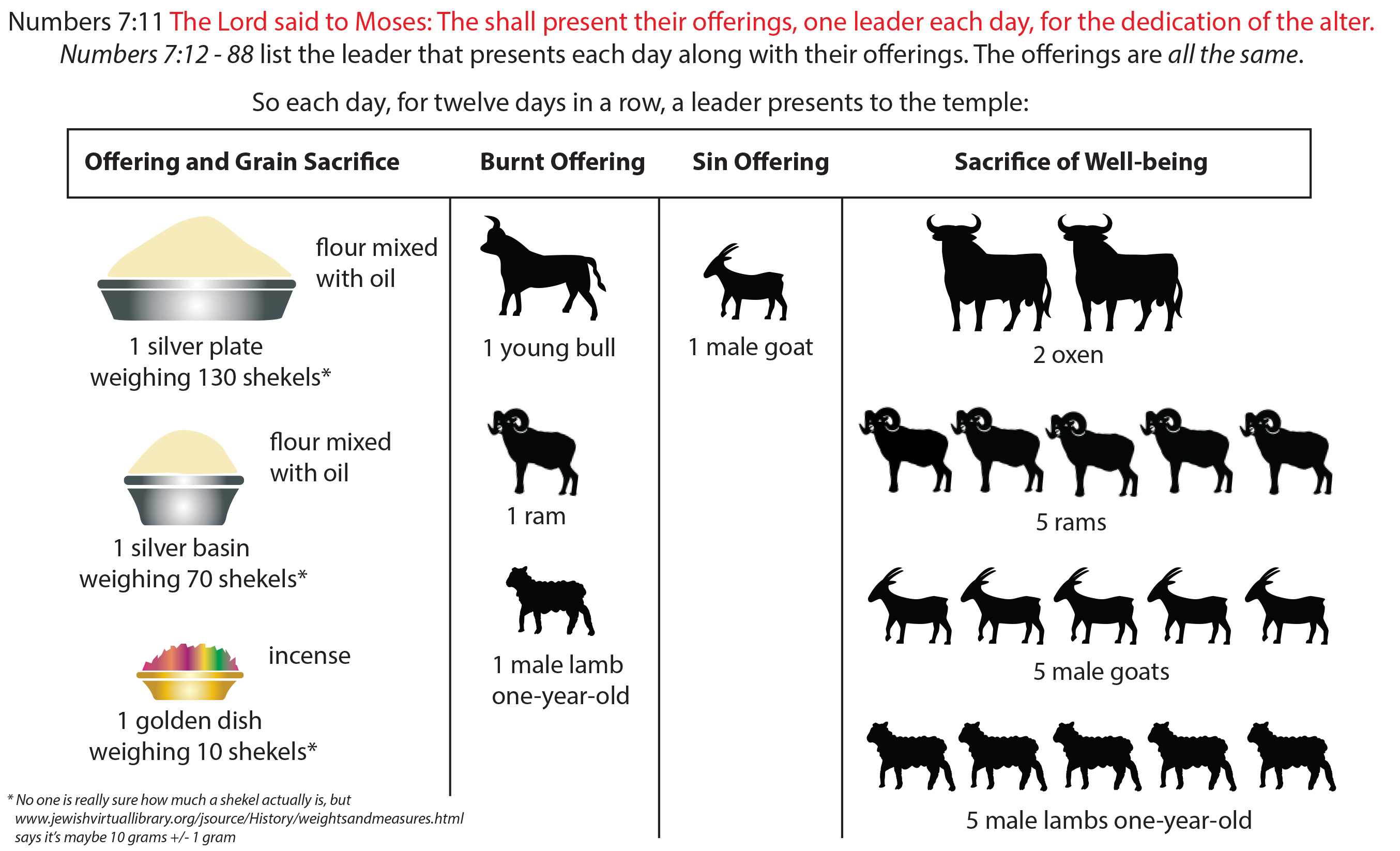
Chapters 1 – 9 cover sacrifices. All the sacrifices. There are burnt offerings and grain offerings and incense. There are sacrifices to remove sin, to please the Me, and to make requests. There are all the different animals that can be used (although only those without blemish!) depending on intent and income. And grains and oils. (No yeast. Yeast is bad for sacrifices. God is quite repetitive and adamant on the topic of yeast.)

And then there are the ways in which the sacrifice is to be performed by the priests, and what is to be burned entirely (to make an aroma pleasing to Me) and what can remain to be eaten, and who can eat it and where they can eat it.

(I’ll address Chapter 10 below.)

Chapters 11 – 17 list the many (many, many) reasons for needing to make a sacrifice. There are the many holy days that require celebrating over many days and many sacrifices. And then there are the many ways in which a person naturally becomes unclean (having a rash, women having their period, men having a wet dream, anyone having sex, eating something unclean, touching a dead body, touching something that has touched something unclean, a leader or priest in power becoming unclean, etc.)

Listening to this in the car with the modern translation by the American Bible Society, I was really struck by how much God comes across as a picky kid listing all the things that disgust him. (Bodies. Bodies disgust him. And all the things they do. Age and blemishes and sex and reproduction.) But there’s also the sense that he wants to keep the sacrifices coming on a regular basis, so you’d better keep getting unclean and needing to make regular sacrifices. But don’t worry if you’re not getting unclean often enough: there are still all the holidays and regular sacrifices!

Chapters 18 – 27 still talk some about sacrifices, but focus more on just rules rather than shilling for sacrifices. The rules are many and varied but there’s a large focus on how selling property and slaves works. (It works, incidentally, differently for Israelites than for foreigners, and differently for Levites than for any of the other Israelites, and is all structured around a seven-year cycle, at the end of which purchases of land and people largely disappear and ownership reverts.)

Anyway, Chapter 10 is the only part of this book that involves plot and characters. God once more demonstrates questionable behavior: The high priest Aaron has four sons who are also priests. Two of them manage to burn incense in a manner displeasing to God, so God kills them. Since they were killed for displeasing God, their bodies got dragged out of camp and their father and brothers told they weren’t allowed to mourn for them. Because those guys burned incense incorrectly.*

And finally, I can’t review Leviticus without at least acknowledging the two infamous Leviticus verses:

18:22 You shall not lie with a male as with a woman; it is an abomination.

20:13 If a man lies with a male as with a woman, both of them have committed an abomination; they shall surely be put to death; their blood is upon them.

These were so embedded in the lists of things that deserve death and/or exile that they lost some of their power, especially as the incorrect usage of incense apparently also deserved death. I think if I were an orthodox Jew who kept strictly kosher, I would need to do some soul searching on these strictures, but I’m not. I agree with the rules against incest** and bestiality, but I come to that agreement from a different motive than just differentiating myself from the Hitites et al (as in chapter 18) or avoiding a stoning (as in chapter 20). I don’t agree with the rule against homosexuality and because I don’t agree with God’s reasons as stated here, I see no reason to not disagree with the rules. It did occur to me for the first time, though, that it’s a very gender-specific law. God has plenty of issues with women and menstruation and childbirth (women must spend about a quarter of their lives “unclean”), but there’s nothing saying they shouldn’t have sex with one another.

Summary: How and why to perform sacrifices. How and for how much, to sell property and people.

Moral: Obedience. Blind obedience or else you will die a horrible death. Wowza.


* Admittedly, I kind of assume that the historical basis is that the two priests somehow managed to set their fancy robes on fire while burning the incense.

** Nearly the entirety of Chapter 18 consists of the different forms of incest that are now unlawful. Many of these forms, I recognize as being applauded in Genesis. Hopefully this means that going forward, there will be less incest. Here’s hoping.

Next up: Numbers

The Bible: Exodus

So…

That happened.

I’m familiar with the story, of course, but reading this felt a bit like reading an original Grimm fairy tale after growing up on Disney.

I had three main reactions:

First:

I’m not sure how to say this without being horribly offensive, so I’m just going to say it:

In my opinion, the god in Exodus reads a whole lot more like a demon than a god.

What really got to me in this book was that not one person wanted God’s attention or intervention. God makes demands of and threatens his chosen people and his enemies alike.

The Israelis were unhappy as slaves, but it had been generations since God had paid them any attention at all so they never asked for anything, and when God did decide to intervene, their situation got so much worse that they begged God and Moses to just let them be.

Moses himself was an unwilling prophet. He had committed murder and had run away before he ever met God. Out in the wilderness, God gets to Moses and demands that Moses be his prophet and doesn’t take “no” for an answer.*

Repeatedly, the Israelis tell Moses and God to stop trying to help them.

Instead, God intentionally makes things worse for them in order to demonstrate His power. Every time Pharaoh decides to give in to Moses demands to let the Israelites go, God hardens Pharaoh’s heart** so that Pharaoh refuses to let the Israelites go and God gets the chance to kill more Egyptians in a display of power. The death-toll is both tremendous and also completely intentional.***

Second:

After the Israelites get out of Egypt, Moses goes up Mount Sinai to speak with God and comes back with the stone tablets with the Ten Commandments. That’s pretty common knowledge. I was also already pretty familiar with the rest of the judiciary-type rules stated in Exodus 20-23.

However, somehow I had never before noticed God’s demands in Exodus 25-31 where Moses is given detailed instructions for how God wants his temple to be constructed and what he wants his priests to wear. God has some extremely specific concepts of what he wants and how he wants it. I can only assume that God gave Moses some illustrations in addition to the verbal descriptions written down for me to read, because the instructions for how to take large expanses of cloth and turn them into a tent by means of 50 loops didn’t make a whole lot of sense to me.

One thing that wasn’t immediately evident from the text but that Anna pointed out when I was talking it through with her later, was that the rules set forth in Exodus 25-31 were revolutionary for the time. They were both revolutionary and extremely liberal, because they defined rule of law. Here is potentially a first step away from a straight-up might-makes-right culture, with God setting down a basic code of laws that everyone must obey, poor and wealthy alike.

But the rules are not actually that long. There’s a lot more time spent describing exactly how the temple was to be constructed and then how it was constructed, along with what the priests were to wear, down to their high quality linen underwear so that they don’t expose themselves in the temple.

And third:

There’s a lot of foreshadowing of future conflict, for all that God promises a land of milk and honey for his Chosen people. He promises this glorious land, but also specifically states that he’s going to run off a whole bunch of other people who were there first.**** I am strongly reminded of Nina Paley’s This Land is Mine animation.


Summary: God is playing a game and using all the people as pawns.

Moral: Maybe blind obedience? When a power as strong as God decides to pay attention to you, your best bet is to be unquestioningly obedient because nothing else will help and obedience just might? I don’t know. I’m certainly not a religious scholar. If anyone else has any ideas, please comment and let me know.


* Moses apparently really does not like confrontations and gets stage fright too awful to be able to demand anything of anyone. God, who apparently can only work miracles through Moses at this point, assigns his mouthpiece a mouthpiece of his own, and Aaron comes along to speak for Moses who speaks for God.

** That level of mind control also makes me deeply uncomfortable. I couldn’t help but sympathize with Pharaoh who must have felt like he was going insane.† Pharaoh wasn’t capable of making logical decisions or react naturally to events because every time he did something to make himself less evil, God made him change his mind.

† Not that he was particularly sane to begin with. Example: Pharaoh refused Moses’ first few demands because the first few miracles Moses performed were things that Pharaoh’s own magicians were capable of replicating, ie, Pharaoh doubled several of the early plagues by having his magicians duplicate them. Why did he think that was a good idea?

*** God is quite bloodthirsty. Even after the Isrealites have left Egypt behind, when they make God angry, the Levites are the clan to follow Moses’ command to slaughter their friends and families. They killed 3,000 of their own in a single night and are much rewarded for that.

**** Exodus 33:2   And I will send an angel before thee; and I will drive out the Canaanites, the Amorites, the Hittites, the Prizzites, the Hivites, and the Jebusites.

Next up: Leviticus

The Bible: Genesis 12 – 50

Okay, this is going to be broken into two sections: Genesis 12 – 36, and 38 which cover a whole lot of time and people, and Genesis 37, 39 – 50, which focuses on Joseph son of Jacob (AKA Israel) son of Isaac, son of Abraham.

Genesis 12 – 36, and 38

So, this is really difficult to summarize because it read a bit like a summary already. And not just any summary, but like the TV guide version of a really fraught soap opera. Or, given the amount of incest, prostitution, making and breaking of alliances, and the one notable wedding massacre, possibly a summary of Game of Thrones. (Although very little violent rape, which is good. Kind of. Trickery and drugged non-consensual sex: sure; Violent rape: only once and definitely shown as being bad.)

It would be difficult to track who the protagonists are, if this were any other book (my impression from getting regular summaries of Game of Thrones, it’s a bit hard to keep track of who the good guys are there, too.) The way this book is written, though, the good guys are the winners and the winners are the good guys, pretty much by fiat. It’s the opposite of the moral from the Book of Job. If you win, then God must have been on your side. And the God of Genesis is not above being the heavy in a protection racket or supporting some pretty shady characters.

While it is tricky to find a moral here, it is not bad as an entertaining soap opera, and covers a lot of different sexual and political scenarios.

I’m increasingly unimpressed with people who try to use the bible to argue for chastity. Maybe that will come later. But in Genesis, people have sex because they want a child, but they also have sex because they feel like it, or because they want to get something from it, or they’ve been given to the person so that someone else can get something from it. And while there is a sense of sanctity in marriage, it is oddly something that foreigners are expected to respect rather than the protagonists. (Abraham and Isaac both pimped out their respective wives Sarah and Rachel, and then blackmailed the men who took them up on it. And in case a reader develops too much sympathy goes to the wives: Sarah and Rachel, in turn, pimped out their servants as surrogate brood mares to their husbands. At one point, Isaac was doing stud service to four women who traded his nights between them: ah, the fraught soap opera of the women’s quarters.)

Just, wowza.

Anyway, the plot does slow down a bit later, stops skipping through generations, and focuses on a single individual: Joseph.

Genesis 37, 39 – 50

This is not to say that Joseph’s life isn’t a soap opera all on it’s own. So Joseph, the youngest but one of twelve brothers*, gets uppity with his brothers about some dreams he’s having, and how he’s going to be the greatest of them all. So, they decide that rather than killing him, they’ll sell him into slavery and tell Jacob (AKA Israel) that he was mauled to death by a wild animal.

But Joseph succeeds in life and rises in the ranks of his new master’s servants until he’s running the whole estate. Then his master’s wife tries to seduce him and when he refuses, she accuses him of rape and he gets sent to prison. From prison, he gets noticed by the Pharaoh , who elevates him to a position where he rules all of Egypt, second in power only to Pharaoh who doesn’t appear to do much at all.

Then there’s a great famine and Joseph’s brothers come to buy food from Egypt, and Joseph provides very mixed messages regarding his thoughts on his brothers. There is much trickery and lying and wailing and weeping, and eventually it all works out because all the brothers plus father Jacob and their household of 70 all move to Egypt to live with Joseph and his wife and two kids.**

You might think this is more than enough plot to keep the writing pretty adventurous, but there is still a whole lot of repetition. There will literally be a conversation that happens between two characters and then one of those characters will recount the whole of that conversation to a third character, so the reader gets to read the exact same words twice. It’s makes it a bit difficult to keep track of my place in the text.

But anyway, there’s a lot of weeping on the neck and kissing on the face in this section.

Summary: This is a soap opera.***

Moral: I’m really not noticing any type of moral in here. If there’s a moral, it’s like that of Scheherazade’s 1001 Nights: people are people and you shouldn’t believe in stereotypes because each person is an individual who may be good or evil, clever or dumb, violent or peaceful.****

* The begats continue to get to me. Not only have there been many generations, but each generation contains many siblings and a lot of them get named. And they’re so tedious that I hadn’t even noticed before that there are repetitions even in the begat sections. Names aren’t re-used for other people, no, the exact same people get listed multiple times! “Person X’s son are A, B, C, D, E, and F. The sons of person X are A, B, C, D, E, and F. The first born son of person X was A, who fathered G, H, I, J, and K. The second born son of person X was B, who fathered L, M, and N. Thus the sons of person X were A, B, C, D, E, and F.” Yes, I know, I get it already!


** Oh the begats for those 70 people.


*** I’m reminded of a Stargate/NCIS fanfiction, Stardust, in which Daniel Jackson gets amnesia (again) and discovers a bible in the hotel room he’s staying in. Without any of the cultural weight behind it, the book is actually a pretty fascinating story, and all the rest of the characters kind of grin about how enthralled he is by the story.


**** Scheherazade spent some three years telling entertaining stories to her husband, in part to convince him that people were people, some good and some evil, some honorable and some dishonorable, and knowing one honorable man and one dishonorable woman does not mean that all men are honorable or all women dishonorable. The other part of the reason was the more immediate goal of: don’t kill me before I finish the story. Who wants a show canceled on a cliff-hanger?


Up Next: Exodus

More fanfiction!

So I recently discovered that Naomi Novik (author of the Temeraire series) presented to congress about the importance of the fair use exemption, to foster creativity. Go her!

Since I was at work when I discovered this, I read the written testimony rather than watched the video, and narrowly avoided bouncing around like a crazy woman.

Anyway… it made me want to post another set of fanfic recommendations.

After my last fanfic post of massively-long stories, I’m back to recommending some short fun fics:


Infinite Use
by Elizabeth Hoot

Fandom: Pride and Prejudice by Jane Austen

Summary: I’ve always wondered what exactly went on when Lady Catherine told Darcy about her meeting with Elizabeth. There are a lot of versions of that scene, but none hit quite right. Mostly, they took a serious approach to a scene I’d always imagined as absolutely hysterical. So, with no further ado…

Why I like it: It cracks me up. Just, she really highlights the ludicrous nature of the situation. In a romance with all the serious emotional development and fraught revelations of Pride & Prejudice, this story looks at one of the off-screen scenes and shows just how hilarious it must have been. Hee.


Beautiful Ideas
by metisket

Fandom: BBC’s Sherlock.

Summary: Mike knew what would happen if he introduced John Watson to Sherlock Holmes. He knew exactly what would happen, and he did it anyway.

Why I like it: First, because it’s wonderful. More specifically, though, it takes a minor character who essentially fulfills a plot point and then never appears again and makes him a full character. That is always a wonderful thing. Even more wonderful, though, is the character, who is shown to be wickedly funny and well aware of what he’s doing.


Because Superman Is Not Evil
by Brown Betty

Fandom: Superman with a bit of Batman

No summary, but the first line is: Clark spent, perhaps, seventeen minutes when he was fourteen thinking super hearing was a cool power.

Why I like it: For those of us who are not big Superman fans, one of the primary reasons is that Superman comes across as just too perfect and good and serious in his virtue and it just not particularly sympathetic. This take on Superman, though, makes me grin. He’s still a good and virtuous person, but he’s still a person. And possibly he has his own issues with his reputation for virtue.


A Good Fight
by togina

Fandom: Marvel movies/comic books. Mostly Captain America and Avengers.

Summary: “You remember that pub in London?” Steve went on, and Tony thought that someone should have made a note in the SSR records on Captain America. Something like, ‘Subject is a brawler. Do not, under any circumstances, take him to a bar unless you’re carrying brass knuckles and possibly an RPG.’

Why I like it: This highlights a side of Captain America that is often ignored. He tends to be shown as straight-laced and obedient to authority, with a side order of naive farmboy thrown in, even though his actual backstory has him growing up poor but scrappy, in very urban Brooklyn, during the Great Depression and Prohibition. His first military action (to save Bucky) was completely rogue action on his part. He was (and is) scrappy as anything. Sure, he has a strong moral compass, but that just meant he got into more fights than he might otherwise. This is a celebration of the good guy, Steve Rogers, who also just likes to brawl sometimes.

Warning: It’s a sad state of affairs that I need to warn about a homosexual relationship, but such it is. While there’s nothing too graphic in this story, Steve Rogers and Bucky Barnes are most definitely in a relationship. (In addition, while being gay was illegal at the time of their youth, it wasn’t exactly uncommon, and they actually grew up in pretty much the center of gay Brooklyn. I would say it’s extremely unlikely that wasn’t intentional by the original creators.)

The Bible: Book of Job

I had actually read the Book of Job before, as a reading assignment in my high school English class.* Reading it again as an adult was a much different experience though. I’m all the more certain that people should not rely on their childhood studies.

I remember being really angry at the story, because God is so incredibly unfair to Job. While the text remains the same, my perspective on both the events and the dialogues gives me a very different interpretation.

The overarching structure of the story is a challenge offered by Satan and accepted by God, to test Job’s faith, but the majority of the text is a series of Plato-esque dialogues between Job and the various people who come to remonstrate with him. While the arguments are long and repetitive, I think the combination of the arguments and Job’s replies offer some seriously important lessons.

First: I’m fairly sure that Job’s wife was suggesting that Job go the Hamlet route, and avoid the slings and arrows of outrageous fortune by killing himself. To which Job replies that good and bad both come from God, and you can’t choose to just get one.

This bit reminded me of Kahlil Gibran’s The Prophet, where he writes:

But if in your fear you would seek only love’s peace and love’s pleasure,
Then it is better for you that you cover your nakedness and pass out of love’s threshing-floor,
Into the seasonless world where you shall laugh, but not all of your laughter, and weep, but not all of your tears.

Second: Job’s three friends come to tell him that since he’s being punished by God, then he must have done some pretty awful things to deserve that punishment, and maybe it’s time for him to repent and beg forgiveness. To which Job replies that, no, he doesn’t understand why he’s being punished, but he knows that he has only ever acted righteously, and has done nothing to deserve the punishment. The friends get progressively more vicious in their anger at Job’s refusal to admit to culpability. I think the moral of these three arguments and three rebuttals is to not blame the victim.

I think this is an incredibly important lesson. It’s also kind of in direct contradiction to what I’d previously recalled from Bible studies, which tend to be heavily weighed towards the lesson of the good being rewarded and the evil punished. But, no, this book acknowledges that sometimes bad things happen to good people, and that doesn’t mean they deserved it.

Third: God comes in a whirlwind to remonstrate with Job directly, but it’s interesting how the remonstration is focused. God essentially lists a long series of challenges to Job’s understanding and abilities regarding the world. Does Job know about the wild horses or the eagles or the ostriches? Did he make them in all their wildness and does he understand them? They’re all clearly rhetorical questions, and at first I thought that it was just God being something of a bully: I’m powerful, you’re not, so don’t question me. But the more I read and the more thought I gave it, I think instead, it’s more a demonstration that the world is complex, and Job is not the center of it.**

The lesson here is that Job’s punishments are not because of him at all, but part of something greater. We don’t know the full story behind Satan’s challenge to God, and all we see is Job’s part of it, and we can only take on faith that there is a purpose.***

Fourth: After Job apologizes to God about questioning his actions, God then turns to remonstrate the friends for victim-blaming. God lets them know that they’re only going to be forgiven for their sins if Job asks for forgiveness on their behalf.

Keeping in mind that this is the Old Testament, it’s still interesting to see that God’s forgiveness is not all-encompassing. In this case, the friends have been castigating a righteous man and their sin is not going to be forgiven with simple repentance. They need the forgiveness of their victim before God will grant them forgiveness.

And final thing of note: In the beginning, Job had ten children, seven sons and three daughters, who were all massacred along with their families as part of the test of Job’s faith. In the end, Job has ten more children, seven sons and three daughters, who live and prosper. Of his twenty children, only three are named, his three surviving daughters: Jemimah, Keziah, and Keren-happuch, to each of whom Job gives an inheritance to match their brothers’.

One of the things I’m increasingly aware of sexism in the modern era is the way it projects into the past. There was certainly plenty of sexism in the past, but it wasn’t nearly as pervasive as it’s generally thought. Women did many of the same things as men did, they just don’t tend to be described in the history books, and when they are described, they aren’t widely studied. Case in point: the book of Job names three of his daughters even though I had always had the impression that, like in the various begat sections, only the males get named.

I am reminded yet again, of how important it is to read this for myself rather than relying on the generalized sense of the book coming from no particular source.

Anyway, instead of concluding with a recommendation****, I’m going to end with a summation of what I think the moral is (if you disagree, feel free to comment.) The overall moral: Don’t victim-blame. Don’t assume that a victim deserves their suffering or did anything to warrant it.


* We also read the Mahabharata and Maya Angelou’s I Know Why the Caged Bird Sings. Mrs. Fort was going to teach great literature and if the school board disagreed, then they could fire her. They didn’t fire her. She was awesome!

** In addition to the long series of challenging questions about the goat and the ox and the donkey, there’s also long descriptions of the powerful might of the Behemoth and the Leviathan, that mostly left me confused. Okay, God, you created some really tough creatures. Is there a point to this description? If yes, I’m missing it.

*** I’m still not happy with the argument that you shouldn’t question the actions of God. I prefer the relationship that Raprasad Sen has with the divine, demonstrated through his poetry in honor of the Hindu goddess Kali. (Grace and Mercy in Her Wild Hair: Selected Poems to the Mother Goddess, by Ramprasad Sen, Translated by Leonard Nathan and Clinton Seely.) In his case, worship doesn’t mean blindness to faults, nor does devotion mean constant happiness. Like any other love, the pious love can include times when you’re not very pleased with the other person.

**** My overall recommendation is: If you’re a member of one of the religions that sees the Bible as holy script, then read it yourself so you know what it says, rather than relying on anyone else to tell you–if these are God’s words, then let them speak to you, rather than play telephone via someone else. If you live in a society that uses the Bible as a guide, then read it so that you know what’s truly in there and what’s not, and allows you to both understand where arguments are coming from and when they’re wrong. If you’re neither, then it’s probably still a good book to be familiar with, although maybe focus on the religious texts of your own religion and region first.


Next up: The remaining three quarters of Genesis.

The Bible (Genesis 1 – 11)

There was a Fox news reporter who was nicely highlighted on The Daily Show with Jon Stewart for saying that the movie Noah was completely untrue to the bible, because the story was so much grittier than she remembered from her illustrated kiddy bible back in Sunday school. So, clearly she’s an idiot, first for thinking a kid version of any piece of literature is going to be the same as the original, and second for admitting to that on national television. However, it was something of a reminder to me that I actually hadn’t read much more than a quote or two from the bible since high school, and have certainly never read the whole thing.

Given how many people base their opinions on what they think is or is not in that book, I figured I had better go ahead and read it. If I can read Atlas Shrugged, then I can certainly read the Bible.

Awesomely, there are multiple standard schedules for people who want to read the whole bible without bogging down too badly in the (gosh darned) “begat” sections.*

Anyway, after mulling over some of my options, I decided that I was going to read the English Standard Version** chronologically by events. And to keep me honest, I’m going to live blog the whole thing. I’m not actually planning on sticking to the schedule though (you shouldn’t have to put up with this for a whole year), but it will keep me going in the correct order and make sure I don’t fall behind the set schedule.

Anyway, I thus start my first post on reading the Bible:

Genesis 1 – 11

This section is both plot intensive and pretty familiar to me (from Sunday school some large number of years ago.)

It also covers a lot of ground extremely quickly. In Genesis 1 – 5, we’ve got creation, the garden of Eden, Adam and Eve, Cain and Abel, and a geneology that goes down to Noah. Then the writing slows down a bit, because Gensis 6 – 10 is Noah’s story.

What was rather stunning however, were the parts that I didn’t remember, and even more so the parts that I hadn’t really given much thought to before.

I’d never really thought about it before, but you know how the creationist theory is that we’re all descended from Adam and Eve? Well, according to this, we are more specifically all descended from Adam’s great-great-great-great-great-great-great grandkid Noah*** and Noah’s unnamed wife.

And each of those nine ancestors of Noah also fathered other sons and daughters, who went off to live their lives and start whole family trees of their own which were all apparently too corrupt to live because they all get wiped out in the flood and aren’t even named in the geneology, beyond the reference to “other sons and daughters.”

Anyway, what I hadn’t remembered at all, however, was Genesis 1:6-8, in which God created an expanse that divided the waters below the expanse from the waters above the expanse, and he called the expanse heaven. The rest of the creation story continues in the waters below the expanse. So, inquiring minds want to know: what happened with the waters above the heaven???


* The (gosh darned) “begat” sections are why I never managed to read the whole thing through before.
** Free on Kindle. And I was kind of stunned to discover, or rather, to fail to discover any free King James translations, which is my preferred version for excellent quotes.
*** Adam fathered Seth, who fathered Enosh, who fathered Kenan, who fathered Mahalalel, who fathered Jared, who fathered Enoch****, who fathered Methuselah, who fathered Lamech, who fathered Noah.
**** I really want to know more about Enoch. There’s really nothing about the rest of the characters beyond their names, but Enoch apparently walked with God and was so loved that rather than have him die, God just took him away directly. Just… what?

Next up:

Job. Apparently the entire book of Job is set chronologically between Genesis 11 and 12. Curious.

The Opposite of Fate

TheOppositeOfFateThe Opposite of Fate
written by Amy Tan
read by Amy Tan
2004

This was a really interesting set of nonfiction essays by the writer Amy Tan, author of The Joy Luck Club and The Kitchen God’s Wife. Since it’s a collection, rather than a single piece, there was a great deal of overlap in the topics being discussed, and that actually made it more interesting for me, rather than less. Because the topics were often the same or similar but the writing time and intended audience varied, it gave very different perspectives on some of the events in her life. And she has had a quite eventful life.

While Tan’s fiction is very much fictional, I can see why so many of her readers think these stories are true. Tan’s real life would fit right in with that of her fictional characters.

I particularly liked her perspective on minority authors, and how they don’t need to be and shouldn’t be required to be minority spokespeople. The best stuff speaks to the human condition, not just the minority condition.

I was reminded of reading The Thousand and One Nights, the set of recursive stories that Scheherazade tells to her husband over the course of three years so as to postpone her execution. Her husband believes that all women and certainly all wives are evil and deceptive and deserve to die before they get the opportunity to betray their husbands. So Scheherazade tells story within story about people being people: men and women and husbands and wives and children and lovers who are variously good or evil or strong or weak or smart or stupid or silly. Because while Scheherazade’s husband believes all women are evil, the lesson Scheherazade is trying to teach him is not that all women are good, but that women are people just like men and each individual must be judged by their own merits.

Anyway, I enjoyed this book, but also think that I will probably not read any of her other books. I like to keep a certain amount of distance when looking at the human condition, and Tan seems to dive right in to look at the difficult and the gritty parts of being human.

Fangirl by Rainbow Rowell

Fangirl-Rainbow-Rowell-Cover-677x1024Fangirl
Rainbow Rowell
2013

Rainbow Rowell is an amazing author and I really enjoyed her two previous books: Attachments is a delight and Eleanor & Park is amazing and also amazingly tense, because dear god, those kids!

Given my own love of fandom, I was particularly delighted to see her publish a book about fanfic writers, or at least a fanfic writer. And I did enjoy this book. The characters are delightful and the plot was interesting.

That said, there was just something off about the book and it took me a while to pin down exactly what. The main tension of the story is whether or not Cath (the main character) can deal with the real world or will focus herself exclusively on fandom. This is a real crisis for many college students. However, I found two main problems with the implementation of this plot, one with the timing of the plot arc and the other with the writing style interacting poorly with the tension of the story.

The writing style is almost fairy-tale like, with a focus on significant events and turning points without getting into much of the day-to-day activities of the characters. This is a writing style I often enjoy, but when the plot tension is about whether or not the main character is doing her regular day-to-day activities, then it becomes pretty important for those activities to be explicitly addressed. There’s a real question of whether or not Cath is attending her classes, and she says she is, but we only ever see her in one of her classes. In addition, there’s a major plot point about one thing that Cath doesn’t do. But since so much of what she does do isn’t described, there’s no way to tell when she doesn’t do something. That plot point comes out of nowhere when it’s finally revealed.

The timing is also problematic. Like most stories, this one is structured with the climax at the end of the book and the end of the time period being described. It certainly makes sense to structure a story like that. But the kind of crisis that Cath is dealing with isn’t one that waits until the end of the year. When I went to college, there were members of my cohort who struggled with online and fandom obsessions. I was only introduced to fandom in college, and started being active in it in my later years, after I had gotten the hang of college itself. From what I saw, though, with others, was that the crisis came early on. They made a choice in their first month of the semester, if they could balance fandom and real world or not. If they couldn’t balance the two, and if they picked fandom, then they flunked out fast. The crisis point doesn’t wait until the end of the year. At most, it might wait until the end of the first semester.

So, the end of the book focuses on this crisis of priorities, but I had actually judged the crisis point to have long passed, and I had to play catch-up a bit when the story referenced a turning point that I didn’t even notice. It was a fun book about wonderful characters, but the timing and the tension of it weren’t very well done. I still enjoyed it, but it’s definitely no Eleanor & Park.

Long Fanfictions

In preparation for writing my review of Rainbow Rowell’s most recent book, Fangirl (expect the review soon), I decided it was time to recommend a few more fanfiction stories. What makes this selection stand out from my prior recommendations is that, in honor of Rowell’s main character’s fanfiction epic, all of these are recommendations are really incredibly long.

Previously I’ve recommended short fics, because they’re intended to lure unwary readers into fandom or maybe point out a hidden jewel to someone already in fandom. The longer stories tend to be well known to those already in fandom and be a bit daunting for those outside of it.

The following stories range from 109K to 757K long. To give you some context for those numbers: A harlequin romance (one of those romance books often sold at the check-out line of grocery stores and titles things like The Billionaire’s Baby or The Tycoon’s Virgin Mistress or some such) is generally 10K words. Anyone who has completed the NaNoWriMo challenge to write a novel in the month of November, has written 50K words.

The following recommendations are a demonstration of not just the skill that some fanfiction writers have in weaving together words and worlds and characters, but also the dedication they have in continuing a story line that has gotten immensely rich and complex, and keeping at it until they can bring the story to its intended conclusion.

These stories have required a serious commitment by some fan to write. They take a reasonably serious commitment from some fan to read, too. But they’re worth it!

So, from shortest to longest:

Into the Rose Garden
by Dryad13
Fandom: Labrynth
109,232 words long
first chapter posted: June 10, 2004
last chapter posted: January 8, 2006

Summary: Sarah has good grades, a circle of friends, and a cute boyfriend. Life’s great…right? So why does she have the strange feeling that something’s missing? Fairy tales show that magic will make you or break you. Which category does she belong in?

Why I like this: This is a gorgeous story that does an incredible amount of world building regarding both magic and society, to how the Underground works and where exactly Jareth’s place is, in it and the consequences to Sarah for having defeated him.


The Least of All Possible Mistakes
by rageprufrock
Fandom: BBC’s Sherlock
118,096 words long
first chapter posted: January 31, 2012
last chapter posted: February 20, 2013

Summary: If ever a people deserved tasering, it’s Holmeses.

Why I like this: Lestrade doesn’t get much attention in the Sherlock Holmes stories and it’s a shame given how awesome she (the author decided to make Lestrade a female for this story) is. She’s not brilliant, but she is smart and, more to the point, she’s also practical and pragmatic and with enough self-confidence to know when to ask for help and when to call that help out for being an ass. And she is not at all the sort to put up with kidnappings by the mysterious older brother of her consultant (see the summary.) 😀


Divided We Stand
by KouriArashi
Fandom: MTV’s Teen Wolf
156,742 words long
first chapter posted: July 10, 2013
last chapter posted: October 4, 2013

Summary: Derek is being pressured by his family to pick a mate, and somehow stumbles into a choice that they didn’t expect and aren’t sure they approve of….

Why I like this: This uses a fairly common trope of fanfiction, but one that I enjoy immensely, and says what if this secret society is actually common knowledge? They’ve been around forever and all sorts of their cultural oddities have just been incorporated into society at large. In this case, everyone knows werewolves exist. And then we get to an immensely fun and satisfying romp of a story in which there is romantic drama and mysterious conspiracies and an eventual happy ending. It’s pretty much a perfect comfort story.


Pet Project
by Caeria
Fandom: Harry Potter
338,788 words long
first chapter posted: March 3, 2005
last chapter posted: June 9, 2013

Summary: Hermione overhears something she shouldn’t concerning Professor Snape and decides that maybe the House-elves aren’t the only ones in need of protection.

Why I like it: This is a brilliant story focused on Hermione Granger as she matures enough to realize that teachers are people, too, and starts to notice some of the complexities and tricks of the adults around her, with a focus on Severus Snape in particular, and his role as a double agent. As she begins to delve into the mystery of Severus Snape, she and the author really delve into the magic and magical culture of the Harry Potter world. (Plus, I am completely in love with the house elves of this story, even though I never much cared for that plot line in the original books. “Ears are flapping!”)


Embers
by Vathara
Fandom: Avatar: The Last Airbender
757,222 words long
first chapter posted: September 24, 2009
last chapter posted: January 18, 2014

Summary: Dragon’s fire is not so easily extinguished; when Zuko rediscovers a lost firebending technique, shifting flames can shift the world…

Why I like this: So many feelings! This is an amazing story delving into Zuko’s character as an exiled prince and abused child and doing amazing world building while also delving into the causes and repercussions of genocides and world wars and cultural clashes and children loaded with responsibilities and adults loaded with secrets.

The Elite by Kiera Cass

the-eliteThe Elite
by Kiera Cass
2013

I had enjoyed The Selection enough that when I returned it to the library, I picked up the sequel, The Elite. And just: urg. I will try to get through this review without swearing at the main character.

So this actually made me kind of mad. While I was expecting light and fluffy again like the first book, I would have been fine if this book had decided to just be darker and more complex than the last one. However, the way in which it did so pisses me off: it’s written the same way but our main character is revealed to be an unreliable narrator due to her immense stupidity. She just doesn’t see what’s happening around her unless she has her nose rubbed in it, and thus, as the reader I have my nose rubbed in it.

Admittedly she’s a 16-year-old with little to no education outside of the performing arts, but as a member of a highly caste-structured society, she should have a basic understanding of how power inequalities work in practice. At the very least, she should be capable of noticing oddities that she thinks nothing of but that allow the reader to get a deeper understanding of the world.

Instead, she complains about how awful the caste structure is but she acts like a teenager from modern U.S. society who has simply been transplanted to this new society rather than growing up in it and yet, at the same time, taking it all for granted and not questioning it. And she takes the reader along with her, seeing and thus showing only the most obvious events.

It’s not a poorly written book, per se, it’s just super frustrating and all the things that I’m supposed to like about the main character mostly make me dislike and disrespect her. She is amazingly naive and completely incapable of subtlety. There are uneducated 16-year-olds and then there is America Singer who has managed to avoid both book learning and street smarts or even the ability to observe without leaping to conclusions.

At the end of this book, I mostly just wanted to re-read Poison Study, which follows a young woman in a similarly rigid society who finds herself physically near the center of power and realizes that there are things happening here that aren’t always obvious.

I do not expect to read the third book in this series whenever it eventually emerges.