Ann Arbor Comic Arts Festival 2025

I almost skipped the Ann Arbor Comic Arts Festival, held in the downtown branch of the Ann Arbor District Library, because I was tried and busy and distracted and when I went to double-check the time and location, the website was definitely geared towards families with young kids.

I’m really glad that I went though! There were probably about 50 artists’ booths and while the content was all family friendly (some of the artists had left some of their creations at home in order to keep the selection family friendly) there was still plenty of things that I found interesting. I forgot to come with a suitable amount of cash, but a number of the vendors did take credit cards, and I acquired a few more fascinating items.

100 Demons Dialogues
by Lucy Bellwood
This is a sweet little book that has some serious emotional impact, as Bellwood personifies her internal critic as a little demon that follows her around, and she refutes its arguments as she continues to work on her art. It’s remarkably inspiring.

to and fro
by kat tuesday
This is a short (24 pages) compilation of three of the author’s works, including Peek and Plover in Another Blasted Cave, and is just generally kind of adorable. In some ways it feels like the kind of sketch/doodle story that you might create when you’re bored in a meeting with only your note pad available, except that it’s both really well done and finished.

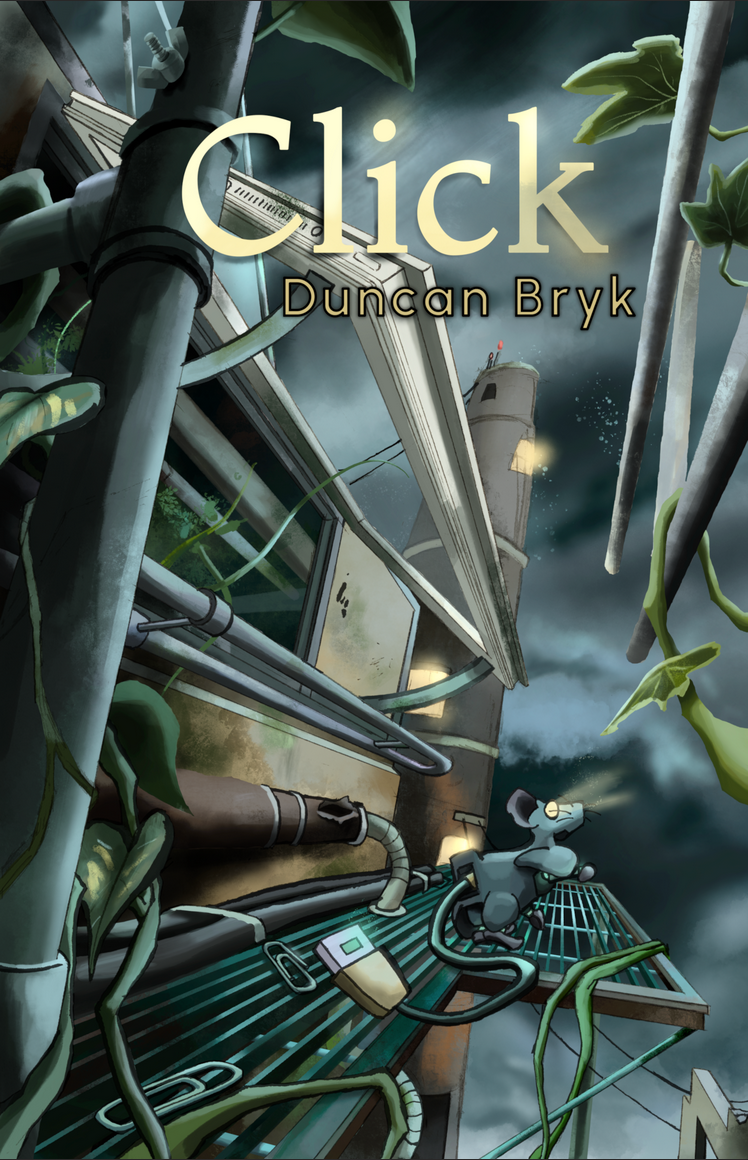
Click
by Duncan Bryk
This has some fascinating background world-building of some sort of magical-realism steampunk post-apocalyptic situation, except that it’s all through the point of view of a mouse that only explores within the one odd mansion and only interacts with the very strange caretaker of that mansion. The caretaker clearly knows more about the situation than the mouse, but the mouse is their only companion as well. The overall sense is a combination of intrigue and melancholy.

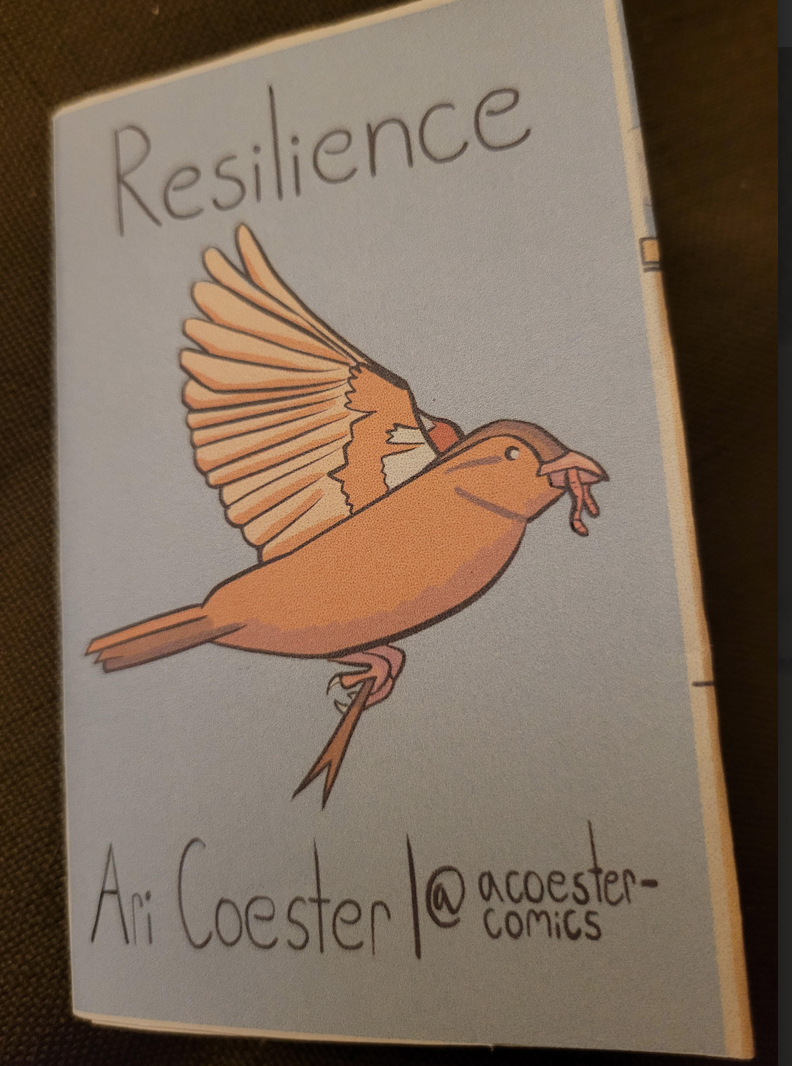
Resilience
by Ari Coester
This is a tiny zine (ie, an 8.5×11 paper folded to create an 8-page booklet) about the anti-bird spikes that corporations install in their signs and how the birds build their nests right on top of those spikes. Adorable!

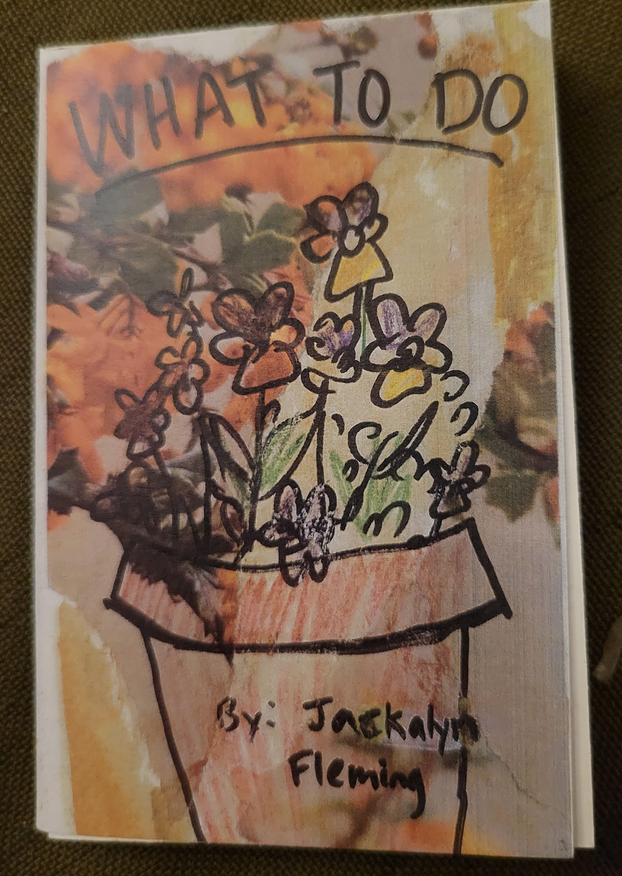
What To Do
by Jackalyn Fleming
This is another tiny zine that consists of a flower wondering what it’s purpose in life is. Having bloomed, it wonders what’s next and asks the people around it. It turns out that the bee has opinions but the bird doesn’t care. It’s both hilarious and feels timely.

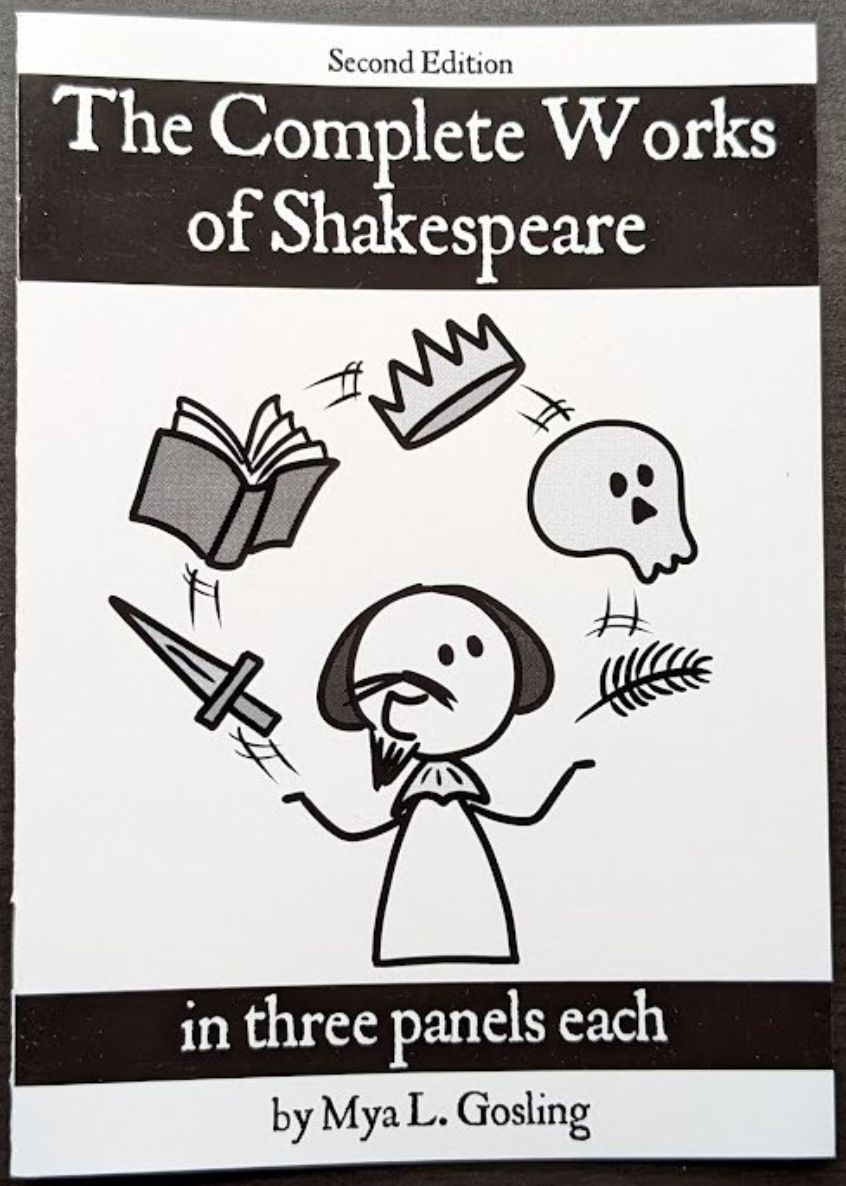
The Complete Works of Shakespeare in three panels each
by Mya L. Gosling
I’ve followed this artist’s work for years and was delighted to get a physical copy of some of her work. It’s hilarious, and also really well done. Just, taking each of Shakespeare’s plays and stripping them down to the bare minimum (and perhaps significantly beyond) of plot points. It feels a bit like poetry and a bit like a series of teasers.

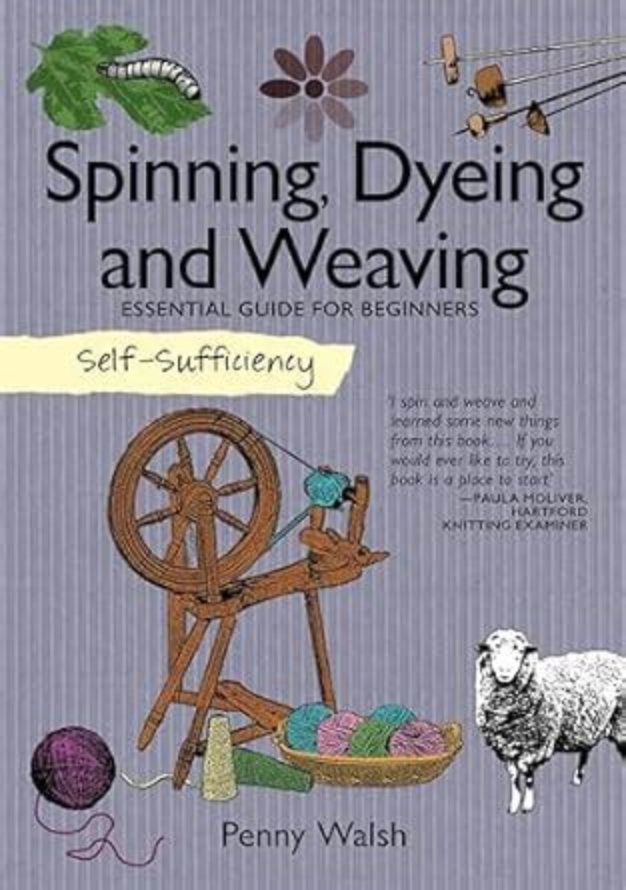
Spinning, Dyeing and Weaving by Penny Walsh

Spinning, Dyeing and Weaving: Essential Guide for Beginners, from the Self-Sufficiency series
by Penny Walsh
2009, 2016

I’ve recently been delving into the basic fibre arts. I’ve taken classes in how to spin wool on a drop spindle, how to dye yarn with natural dyes, and how to “skirt” a fleece that’s been freshly sheered off a sheep. One of these days I’m hoping to learn how to sheer a sheep myself. I already had the basics of weaving, knitting, and crocheting (albeit at the most basic level) and I’m enjoying figuring out the precursory stages. This book seemed like it would be right up my alley.

And it is, sort of. However it’s also absolutely bonkers. It veers wildly between being an extremely basic overview to being an extremely detailed instructional manual, and then back again. Harvesting vegetable fibres such as flax, hemp, or nettle is given a half page summary that mentions the necessity of starting and then interrupting the rotting process; meanwhile, there are 18 pages of recipes for dyes, including ingredients, amounts, temperatures and durations. However, I knew from early on that this book wasn’t going to be particularly reliable when it starts with discussing how easy maintaining a couple of sheep is to have your own steady source of fleeces. That seemed to be the theme of this book: mentioning some elaborate and time-consuming endeavor while narrating that it’s actually very simple.

Overall, I found it inspiring to keep working on the projects I’m working on. In some places, it reinforces some of the things I’ve learned from other sources and while in others it provides alternatives to some of the things I’d previously learned. But I didn’t learned anything new from this book, and not because there wasn’t anything new in it, but because nothing entirely new was explained well enough for me to learn it.

Oddly, the book also tries really hard to be easily readable to both British and American readers, and does so by providing translations between British and American terms as well as between metric and imperial measurements, but every time it does that, it just makes the text that little bit more confusing. For example, writing “2 square metre (21.5 sq ft.)” looks both weird and weirdly specific when talking about a garden plot for raising dye plants. It seemed representative of the variable levels of respect for the reader: we are assumed to be able to understand tapestry weaving from a two page spread including three diagrams and an illustrated loom, but also need clarification about “furniture (slip) covers”.

Overall, I’m not quite sure who the intended audience for this actually is, but it’s really not for a beginner. And while I enjoy learning all of these skills as a fun hobby, it’s not easy, it’s not quick, and it’s not a replacement for store bought: this is not a guide for self-sufficiency. However, reading this did get me off my couch and preparing a fleece for spinning that I’d been procrastinating about. So that’s a win!

The River Has Roots by Amal El-Mohtar

The River Has Roots
by Amal El-Mohtar
2025

This author has a way of using language to create worlds like lucid dreams. She makes metaphors so strong and pervasive that they’re world-building. It lives in the space between poetry and prose, and reading it feels like a way to slow the frantic pace of my thoughts and set my brain to a reasonable rhythm. I’m in awe of her writing.

This story is a retelling/re-imagining of the classic folk song, The Two Sisters. And of all the versions I’ve read/heard, I like this one best. It’s not a long book, only 100 pages, and includes many beautiful black-and-white illustrations.

El-Mohtar is one of the co-authors of This Is How You Lose the Time War, which was extremely good but also complicated in a way that required more focused concentration than this book did. This story feels closer to Nghi Vo’s The Singing Hills Cycle books, which is also a high complement.

The Age of Magical Overthinking by Amanda Montell

The Age of Magical Overthinking: Notes on Modern Irrationality
written by Amanda Montell
read by Amanda Montell
2024

It took me awhile to write up this review for an audiobook I finished a couple of weeks ago, which is helpful because I want to say that it stuck with me. Not constantly, but every day or every other day, I have the thought of: oh this reminds me of that section of The Age of Magical Overthinking! And that is quite impressive.

I can’t recall how I ran across this book but my library had it as a book-on-tape (ie, CDs) and I have a commute that goes faster if I’m listening to something interesting. This was definitely interesting and gave me plenty to think about. Montell has a bubbly upbeat voice and matching word choice, her book is filled with fun metaphors and sitcom-esque anecdotes, and that combination tried valiantly to keep the tone of this book cheerful as she discusses cognitive biases and how they impact people on both an individual and societal level, including some pretty grim scenarios.

Magical thinking is the idea that your thoughts alone can manifest changes in the world. Montell picked the title of this book with intention, because this isn’t a book about magical thinking, it’s a book about magical overthinking. And she does the same thing with each of these biases: acknowledge that they developed for a reason and have a reasonable place in our mental toolkit. They are not inherently wrong, but they can cause immense harm when they’re over-used or used inappropriately.

The table of contents lists the biases she covers and also gives you a sense of her conversational writing style:

  • Make it make sense : an intro to magical overthinking
  • Are you my mother, Taylor Swift? : a note on the halo effect
  • I swear I manifested this : a note on proportionality bias
  • A toxic relationship is just a cult of one : a note on the sunk cost fallacy
  • The shit-talking hypothesis : a note on zero-sum bias
  • What it’s like to die online : a note on survivorship bias
  • Time to spiral : a note on the recency illusion
  • The scammer within : a note on overconfidence bias
  • Haters are my motivators : a note on the illusory truth effect
  • Sorry I’m late, must be Mercury in retrograde : a note on confirmation bias
  • Nostalgia porn : a note on declinism
  • The life changing magic of becoming a mediocre crafter : a note on the IKEA effect.

Most of these I’ve long been aware, and none of them came as a shock, but some of them I hadn’t given much thought to before this book. And they’re all worth thinking about. This book does an excellent job of introducing the biases to the reader for further contemplation.

In cases where I had already spent a lot of time thinking about them, Montell’s discussion was still an introductory overview that didn’t cover some of the more complex aspects, which is fair given the kind of book it is. But for the biases where I hadn’t been thinking about them, this was a good jumping off point, to start the process of thinking about how I’m thinking.

Love, Death + Robots: The Official Anthology : Volume One

Love, Death + Robots: The Official Anthology: Volume One
2021, audiobook 2025

I have not watched the animation series, but I’ve heard good things about it and I saw that this audiobook existed and so I got it and listened to it on my work commute. And I didn’t quit halfway through, though I was extremely tempted. It has some of the worst writing I’ve ever read/heard. Like, at least one story that’s right up there with Eye of Argon, and others that were close runners up. What’s also crazy is that, as I was listening, increasingly appalled with each new story, I realized that they were managing to cover a wide range of ways in which writing can be poorly written.

In retrospect, I realized that there were two entries that are explicitly screenplays and thus can be forgiven (I suppose) for going into details about exact camera angles, and scene changes, and repetitions of the exact time of day even though it didn’t change, but wow was it hard to get through on my commute. The fact that one of those screenplays (“The Witness” by Alberto Mielgo) literally opened with “a beautiful woman is naked in front of a mirror, applying make-up” felt like such a stereotype/cliche that I wondered if it was intended as a spoof. Sadly, if it was intended as satire, it never made any particular point.

A lot of the stories (“Suits” by Steve Lewis, “Sucker of Souls” by Kirsten Cross, “Shape-Shifters” by Marko Kloos, “Blind Spot” by Vitaliy Shushko, “The Secret War” by David W. Amendola) had men with overwrought machismo fighting slavering aliens, with the type of clinical descriptions of violence and gore that I might expect from an audio-description of a visual media, but not from even a book adaptation of a movie. (“Lucky Thirteen” by Marko Kloos, has a woman with machismo fighting human soldiers, but the rest remains the same.) Text and video are different types of media and text is better served trying to describe the impact of violence/gore on the characters rather than just a description of a picture. However, most of them couldn’t even make their violence impactful. Plus, a really eerie pattern I noticed was how in these stories, there was all this extreme violence between the “main characters “good guys” who feared for this lives but stayed strong through it all because they needed to protect their people, versus the “bad guy” alien others who were mindless killing monsters with no thought or culture of their own, only an endless desire to kill humans. But their actions were the same, extreme violence towards one another: just one side was good and one side was bad. It felt like video games for armchair warriors, who wanted to feel powerful and liked gun statistics and weren’t at all interested in the source of any given conflict.

Some of the stories (“Sonnie’s Edge” by Peter F. Hamilton, “The Witness” by Alberto Mielgo, “Beyond the Aquila Rift” by Alastair Reynolds) had an interesting concept and/or twist that I would have enjoyed seeing presented better and with less of a look at the authors’ sexual issues.

“Beyond the Aquila Rift” was actually the first story (ie, the seventh story) that I thought was genuinely well-written. And then it swerved into focusing on a middle-aged dude’s feelings about his extra-marital affair and it mostly stayed there for the rest of the story, pushing aside the interesting science fiction scenario and reminding me of the stereotypical English professor writing a novel about having an affair. The author tried his best to make the affair plot-significant and mostly managed to make the protagonist so self-centered he came across as a sociopath.

There were some decent stories. (“The Dump” by Joe R. Lansdale, “Fish Night” by Joe R. Lansdale, “Ice Age” by Michael Swanwick, “Alternate Histories” by John Scalzi.) It’s too easy to forget them when I think back on the book. But they were there. They were short, but interesting and fun and funny.

There were two genuinely good stories that I enjoyed a great deal and actually recommend. Luckily, I can even provide links to them (the written versions, not the audio):

Good Hunting” by Ken Liu is excellent and heart-breaking and heart-warming and all that about China losing it’s magical culture during the British colonial period and then regaining it in a steampunk fashion.

Zima Blue” by Alistair Reynolds is fascinating and thought-provoking and I have so many thoughts about it but also don’t want to provide any spoilers, because the story itself is so well laid out in the way it presents the situation and slowly makes the reveal, and then leaves the reader to continue to thinking about all the implications for days afterwards. It’s about an artist who went through extreme body modifications in order to have experiences no one else could, and the reporter who interviewed him about his final piece.

The Little Book of Bees by Kearney and Holliday

The Little Book of Bees: An illustrated guide to the extraordinary lives of bees
written by Hilary Kearney
illustrated by Amy Holliday
2019

This is a really nice, easy, nonfiction read about bees, with gorgeous illustrations and fun facts and the text broken into many short sections, which is good for my current level of concentration (which has been shot recently.) It felt like it was structured a bit like an elementary school textbook, with lots of side bars and large illustrations, but written for an audience with an adult reading comprehension.

A bit more than half of the book is a solid overview of what bees are, how many types of bees there are (hint: it’s a lot!), and what the differences are between the different types of bees.* The remaining sections talk about different kinds of honey (which led me down an extra online rabbit hole regarding the most expensive honeys), a brief overview of beekeeping (which I’m already thinking of trying), and how modern environmental issues are causing declines in bee populations (which is really depressing although this section does include some suggestions of things regular people can do to help, many of which I’m already doing, but I can try to do more).

Bees really are very cute and I enjoy seeing them in my garden and this book was lovely and interesting, written by someone who really loves bees. And the illustrations are gorgeous!

* I do have to call out one sub-section that discussed the differences between bees, wasps, and flies, though, because it is hilariously biased and told me a lot more about the author than it did about bees, wasps, or flies. According to this author bees are cute and adorable and elegant and lovely, while wasps and flies are simply not as wonderful. (Examples: A bee has elegantly curved eyes wrapping around its head, while a fly has ugly bulbous eyes protruding from its head. A bee has playfully curious antennae, while a wasp has restlessly jittery antennae.) HAHAHAHA! It was a single section that stood out as being uselessly subjective and that made it all the more hilarious.

Detroit Zine Fest 2025

I hadn’t been quite sure what to expect from the Detroit Zine Fest, but was delighted to discover that it was like a local mini Small Press Expo. Maybe somewhere between 50 and 80 vendors? Thus, it was still slightly overwhelming to browse through all the stalls, but was also delightful and I bought a number of really good zines:

Michigan Cryptids by Shi Briggs
A Michigan Unnature Journal by Shi Briggs
These are two books, 12 pages each, about cryptids natives to Michigan, with absolutely gorgeous illustrations and short descriptions. I don’t actually know much about cryptids, so I’m not sure how much these were researched versus created, but I did recognize the Michigan Dogman as a thing. But the black and white illustrations are so beautiful and creepy and inspiring.

Thank You by Eddie Roberts
2023
This is a gorgeous and pointed poem about the culture of consumerism and the push-pull of gratitude for getting things you desire with the discomfort of always having more pushed upon you. It described many of my own conflicting feelings. The author also experiments with some really interesting typography effects.

Passages by Liana Fu
2019
Is a series of poems and musings on being Chinese diaspora going to visit Hong Kong and trying to learn Cantonese, struggling to figure out where they fit in the world where all their native cultures see them as other, and how this intersects with the ongoing cultural struggle of Hong Kong itself under an increasingly oppressive Chinese government.

Of Course I’d still love you if you were a worm, but like we might have to renegotiate certain aspects of our relationship, y’know? It’s a big adjustment: A guide to safely and responsibly loving your partner post wormification by Seth Karp
This is hilarious and also the best kind of crack-treated-seriously brochure. It’s clearly a take-off of the “Would you still love me if I were a worm?” meme, but reminds me even more of an elaborate version of the Jack Harkness test meme. It’s got advice and perspective on what to do if your significant other spontaneously turns into a worm. (Step one: ask what kind of worm? There are different kinds of it will effect your decision.)

Helianthus by Jone Greaves
There is Something in the Basement by Jone Greaves
Instructional Musings for Encounters & Summoning by Jone Greaves
Intent to Carcinize by Jone Greaves
I spent some time trying to figure out which of Jone Greaves’ zines to get since they were all such fascinating titles and wound up getting four of them, each of which is unique and fascinating and thought-provoking. I’ve been getting into short-story writing competitions recently and I feel like these are all examples of how it’s done: to create a world and a concept and maybe a character in just a few pages.

Gentle Laundry by India Johnson
2023
This is a surprisingly fascinating non-fiction 24-page zine about laundry. As someone who mostly learned to do laundry to the extent of put clothes in a machine with detergent and it will come out Officially Clean regardless of any evidence to the contrary, this zine opens up whole new worlds of understanding about what is actually happening and what detergents, soaps, bleaches, etc actually do. It’s also tonally very approachable, although by about halfway through I was feeling somewhat overwhelmed by the all the options and decision branches. But it’s valuable information to know and I have a few ideas for changes I want to try when doing my own laundry. Once I’ve tried a few things, I’ll need to re-read it to see what else.

Shubeik Lubeik by Deena Mohamed

Shubeik Lubeik
written, illustrated, and translated by Deena Mohamed
2022

This graphic novel is amazing! I highly recommend it. It came to me as a second-hand recommendation with the suggestion to just go into it cold, with no expectations of what it is. Just know that it is brilliantly done and beautifully illustrated, award-winning, and anyone reading this should definitely give it a shot. That said, this is a book review blog, so I’m going to go into more (ie, some) detail, but am respecting the original recommendation enough to put those details under a cut.

Continue reading

A Prayer for the Crown-Shy by Becky Chambers

A Prayer for the Crown-Shy, a Monk and Robot Book
by Becky Chambers
2022

I enjoyed the first book in this series, and I think I like this one even more. It feels particularly relevant to my life right now as it considers what it means to have or not have a purpose, dealing with burnout, and the yearning for something undefined but different from what you have. Each of the six chapters is its own little mini-story on Dex and Mosscap’s journey from the deep woods through the rural and farming communities towards the central city. They’re not quite stand-alone stories but feel like individual stepping stones. It’s an overtly philosophical book, as the philosophy is not in the narration or the plot, but very specifically in what the characters are struggling with.

It’s also very open-ended. I can hope that there will be more books in this series, although I can understand why there might not be: the questions the characters and thus the author is asking are so very hard to answer. But I think even with just two books, this isn’t a duology like I’d thought when I read the first book, because the story doesn’t conclude with this second book. The characters are on a long meandering path that doesn’t have a definite end point, that they don’t want to have a definite end point.

It’s remarkably soothing and meditative. It’s also imaging a world where everyone has enough and no one is struggling just to survive, which is something that seems both entirely possible and also so out of reach. It leaves me yearning for something more, but also with the thought that maybe I can try to reach for that something more even if I don’t quite know what it is or how it will go.

A Psalm for the Wild-Built by Becky Chambers

A Psalm for the Wild-Built
by Beck Chambers
2021

This is a charming book that struck me immediately as a mixture of Nghi Vo’s The Singing Hills Cycle and Peter Brown’s The Wild Robot series with a bit of Mai Mochizuki’s The Full Moon Coffee Shop thrown in for good measure. It is also the first of a two-book series and I definitely need to check out the second book. Our main character is Sibling Dex, a monk who has been a gardener for many years but decides at the beginning of this book that they have received a new calling to be a tea monk: someone who travels around the countryside with a pop-up tea stall to provide the populace with tea and comfort. I do love fictional religious explorations and narrow focus narrations too about the tea and the carriage and the villages.

The setting is a quiet futuristic post-industrial utopia on a moon, several hundred years after the Great Awakening when the robots that manned the factories spontaneously developed awareness and declared that they were going to depart human society to explore nature and they didn’t want to be followed. In response, humanity had a Great Transition where they found a balance with nature and since have lived in essentially bucolic comfort. The exact details are not delved into, but it’s against this backdrop that Sibling Dex finds themselves yearning for something more than they have while being confused about how they can be dissatisfied with what they have. And yet.

And it is Sibling Dex, in the midst of their struggles to identify what they need that’s more than what they already have, who makes the first contact between humans and robots in centuries, with a robot who has come to see how humanity is doing. It is very much a culture clash of individuals who are both trying their best but also thoroughly confusing and confused by the other.

No solutions are found by the end of this book, but conversations are had and explorations of both ideas and locations. But overall it was very sweet and extremely relatable.