WWW: Wake by Robert J. Sawyer

wakeWWW: Wake
by Robert J. Sawyer
2009

This was a really interesting book that gave me lots of thoughts. I was impressed with how well thought out the scenario was as the author presents the hows and whys of this artificial intelligence coming into being and develops from there. That was really cool.

There was also a diverse and interesting cast of characters in this interesting scenario.

All the positive features of this book just made it all the more disappointing that the writing felt really flat. I should have liked this book a lot more than I did.

I was half-way to blaming it on being a YA novel and me aging out of the genre… but it’s not that kind of problem. There are plenty of YA books that manage to be extremely lively and engaging and, frankly, there are also plenty of adult books that suffer from the same flat sort of presentation as this one.  There was just something about the writing that kept me from getting into it. This is particularly disappointing because this is the first book in a series of three: WWW: Wake, WWW: Watch, and WWW: Wonder.

The scenario is interesting enough that I wish I liked the book and I might still get myself to read WWW: Watch and WWW: Wonder just to see what else the author thinks would or could happen with an AI in existence. I am startled to find myself in the extremely rare situation of wishing that those thoughts were written as a nonfiction essay rather embedded in a story.

I don’t think the writing is necessarily bad, it just really doesn’t reach me. Hopefully there are other readers out there who appreciate this book and series more.

Gods’ Man by Lynd Ward

Lynd_Ward_(1929)_Gods'_Man_coverGods’ Man: A Novel in Woodcuts
by Lynd Ward
1929

I ran across a reference recently to the wordless novel as a genre that flourished in the 1920s and 1930s. Somehow, I had never run across this before (although I have a couple of picture books that are completely wordless and are awesome) so I decided I needed to check it out. According to Wikipedia, Gods’ Man is one of the preeminent examples of the genre, and I can absolutely see why.

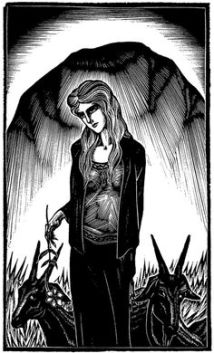
The illustrations really are gorgeous. Some examples are:

Gods_Man_sun_image and Lynd_Ward_(1929)_Gods'_Man_-_surrounded_by_wineglasses

lw_gm025 and lyndwardwife

Just really gorgeous.

The story line is… very 1920s-1930s. A young man, an artist, comes from over the seas to the big city. He’s a kind soul who the fat cats of the city toast and celebrate. He falls in love, but she loves only money! He is distraught and sinks into despair, and is finally chased out of the city, barely making his escape. In the countryside he finds a wonderful woman who nurses him back to health and is all that is wonderful. They are very happy together, except there is no escaping the evil of the big city and all things must end (in a very melodramatic way).

I highly recommend it.

I also think it’s particularly funny that the only words in the entire book (aside from the various title pages), is the name of the inn where our protagonist stays when he first arrives in the city. The sign is legible and reads: “Slink Inn Eat” (Hahahaha!)

I think I like the genre overall. The other wordless books I have are Zoom by Istvan Banyai, which is bright and modern and surreal, and Christmas! and Rain, both by Peter Spier, which are sweet and adorable and heartwarming. I love them all.

The Bible: Esther

I read a YA novel based on this story back in grade school (High school? Middle school?), but let this be a friendly reminder that the Bible is not a book intended for young adults with modern sensibilities, and those YA books are to this as Disney fairytales are to Grimms’ fairytales.

In the story, as I originally learned it, the king’s advisor Hamann slandered the Jewish people to King Ahasuerus, who agreed that they should all be killed. Meanwhile the beautiful Jewish maiden Esther married the king, begged for her people to be spared, and revealed Hamann for a slanderer at the same time. The Jewish people were spared, Hamann was cast from favor, and King Ahasuerus and Queen Esther lived happily ever after.

So, you know, aside from King Ahasuerus’ genocidal tendencies (a rather big aside, in my opinion), a relatively benign YA plot.

Of course, then we get to the source material here, and wow were there some details that were left out.

So, first of all, King Ahasuerus had cast off his original queen, Queen Vashti, because she refused to obey him when he was drunk and wanted her to strip in a public gathering so he could show off how beautiful she was. In response to her refusal, she was cast off and he had all the beautiful young virgin girls* in the land to be brought to him so that he could sleep with one each night and then keep them isolated in his house of wives ever after and never see them again.** There were a lot of girls in the running, though, because it took more than a year for the king to get to Esther.

During that year, Esther courted the favor of the king’s chamberlain who gave her preferential treatment and told her how to seduce the king in turn, such that her night with him pleased him so much that he declared her queen in Vashti’s stead.***

Meanwhile, Hamann is the king’s advisor who’s way too full of himself and decided that Esther’s uncle Mordecai**** hadn’t bowed low enough to him when they passed on the street, and thus Mordecai and all of his people should be killed. The king is apparently too taken with his stream of wives to care about things like statescraft or genocide, so essentially tells Hamann to do whatever he wants. Hamann immediately creates a proclamation that all the Jews are to be killed and their possessions stolen on the thirteenth day of the twelfth month.+

Now, there’s a whole complicated subplot going on between Mordecai and Hamann, but honestly it fits in pretty well in a YA book because it is just that type of juvenile dispute about showing the proper deference and refusing to bow down, etc, except with threats of death and genocide.

But meanwhile, Esther risks being killed for interrupting the king in order to invite the king and Hamann to a fancy dinner. She survives and the king is delighted.++ The first dinner party goes so well, that the king asks Esther what she would like as a boon? She says a second dinner party and the king is once more delighted. The second dinner party is also wonderful and the king again asks what boon he can grant her and this time she’s like, you can save my life and the lives of my people.

The king is horrified that anyone has threatened to kill Esther, his favorite wife, and her people. She directs him to Hamann as the threat.+++ Hamann begs Esther for mercy, but the king sees Hamann near Esther and thinks he’s trying to rape her and has him immediately executed on the gallows Hamann himself had prepared for executing Mordecai. It’s all very dramatic.

However, while all of these events took place in the third month, Hamann’s proclamation about the genocide scheduled for the twelfth month have already gone out. But rather than rescind that proclamation++++, King Ahasuerus was apparently the type who would have enjoyed watching The Purge movies because he makes a second proclamation saying that on the same day that the people were supposed to kill the Jewish people, the Jewish people are granted the right to gather together and kill any of their enemies and take all of their possessions. So, essentially a free-for-all of death and theft on the thirteenth of the twelfth month.

The king asked if Esther wanted anything else and she asked for a second day for the Jews to kill their enemies, plus could all of Hamann’s ten sons also be killed specifically? The king was like, okay.

So the fourteenth of the twelfth month was also a bloodbath, while the fifteenth was feasting and celebration.

And thus the annual celebration of Purim, for surviving Hamann’s plot. And Mordecai goes on to take Hamann’s place as a high counselor and everyone is all very happy.

The End.

Summary: Hamann manipulates the king into ordering the genocide of the Jewish people, but Esther manipulates the king right back into killing Hamann and allowing the Jewish people to kill their enemies.

Moral: Kings can be super easy to manipulate but you’d better be on your guard against someone else manipulating your same king?

* I can only assume that a lot of beautiful young girls heard this proclamation and had an sudden interest in having sex, pronto, with someone in their home villages.
** It’s kind of super similar to Sheherazade’s story, except without the actual death threat to the new brides. Just a single rape-night and then eternal isolation and captivity. So, there’s that.
*** This is a triumph, in case your wondering if it’s actually a good thing or a bad thing.
**** Not that anyone knows that Mordecai is Esther’s uncle, because who would care about keeping track of the relatives of that many wives.
+ I feel like there are practical problems with making a public proclamation that whole communities of people are to be slaughtered on a specific day in the future. Like, I realize it’s important for the death squads to have time to prepare, but I feel like it’s a bit much to expect the intended victims to just accept that their fate is sealed because the king said so.
++ Maybe none of his other wives invite him to spend extra time with them just because he keeps on threatening to kill them? So he’s very flattered that this beautiful woman is interested in him.
+++ Very politically stated, in my opinion, since it was the king himself who gave Hamann the right to threaten them.
++++ I’m actually not sure if it was possible for a proclamation to be rescinded. It might have been that once it was made permanent record, that was it, to avoid confusion with knowing if an official document was valid or not. It might always be valid.

Next up: Psalms

The Bible: Nehemiah

Nehemiah (the character) is introduced (at the beginning of his book even!) as an Israelite serving as the cup bearer for the king of Persia. I’m not sure how one gets to be a cup bearer for a king, but it seems like a pretty sweet position, actually, since you’re essentially part of the king’s entourage without being an advisor with responsibilities other than making sure there’s always wine for the king. Thus, the king tends to really like the cup bearer.

So Nehemiah looks sad for a couple of days, the king (Artaxerxes, aka Ar’tax-erx’-es*) asks him what’s up, and he explains that he worries about how the Israelites are doing in Jerusalem. After some questions about how long a trip there and back would take, Artaxerxes gives Nehemiah funds and permission to go over to Jerusalem and check out the situation. He inspects Jerusalem (a la undercover boss) and then inspires the workers to do more. There was a wall around the city with many gates and many people working on those gates, and they’re all named in chapter 3.

In chapter 4, however, are the neighboring city-states who are a more than a bit suspicious of the Israelite refugees fortifying their town. After some escalation, the Israelites start guarding the half-finished wall, 24-7, until it is complete

Chapter 5 is anger over taxation and whatnot. It sounds all very modern, just with unfamiliar specifics. But why should we have to pay for someone else to eat? What about our children? Is this governor better or worse than the last governor? It’s possible that the reason why I have trouble tracking this chapter is that I’m so tired of the US election arguments.

Chapter 6: The neighbors really don’t like that fortified wall.

Chapter 7: Now that the wall is built, it must now be guarded. Also, time for a census: and you’d better be able to prove your decent, because at least some people were viewed with deep suspicion for claiming to be priests but unable to prove it.***

Chapter 8: Ezra**** lectures the people about the laws, but what’s particularly interesting here is that the chapter itself doesn’t recount the laws. (thank god: Leviticus and Deuteronomy and a whole bunch of other books already took care of that) and instead was like, he read the laws and the people understood them. And then everyone celebrated. Hurrah!

Chapter 9: all the children of Israel attend Sunday school and the highpoints of the entire previous portion of the Bible are recounted in 38 verses or less.*****

So, Nehemiah 9:38 gets us caught up to actual events happening now and is a summary of chapter 10, in which, sure enough “our princes, Levites, and priests seal unto [the covenant]”. I.e, a bunch of named people agree that there are certain rules of this town that everyone has to abide by, mostly involving observing the Sabbath and giving offerings to the church.

In chapters 11 and 12, the people cast lots to see who actually gets to live in the fortified and highly-regulated city. Because all the rules live there, but only one in ten of the regular people do. And we get a list of those one in ten. There’s just no escaping intermittent lists of begats.****** Also, there’s some more celebration in dedication of the city of Jerusalem.

And then in Chapter 13 hits like a load of bricks. It’s back into first person and the narrator (Nehemiah?) is dedicated to his religion and terrible for politics and economics. Keep in mind that most of God’s laws have been previously forgotten because all the Jews were scattered into other lands, and are only now returning to Jerusalem as refugees under the Persian king’s protection. So everyone is attending Sunday school to learn the rules, and the narrator learns that God doesn’t like the Moabites, but apparently the head priest had an alliance with the Moabites and had even prepared them some diplomatic chambers to stay in. So the narrator has those chambers stripped and all of the Moabite’s possessions cast out. And then he discovers that farmers and vintners were working on the Sabbath so he testified against them. And then there were merchants and sellers who sold their goods on the Sabbath so he testified against them too. And then he discovered that some people were still marrying outside of the Jewish religion and so he smote them and plucked off their hair (13:25). And he generally makes everything worse for everyone and expects praise from god for this cleansing.

Summary: These refugees have their new city with their fortified wall but they’re pretty plagued by outsiders being suspicious and insiders forcing them to obey strict religious law.

Moral: If you’re the friend of the King of Persia, you can get support in being an incredible busy-body.


* T
he King James translation uses a lot of hyphens and apostrophes in the names of various people. Artaxerxes is written as Ar’tax-erx’-es, Nehemiah, the titular character of this book, is written as Ne-he-mi’-ah. And there are plenty of other names with similar presentations: San-bal’-lat, Za’-dok, Me-ron’-o-thite, etc. I’m not sure what the apostrophe stands for, but I’m assuming at this point that the dashes are between syllables. So, it’s essentially a little pronunciation guide that also makes the names look just that much more foreign to my poor sheltered eyes. It feels very disconcerting, though, since I’d previously considered it a sci-fi/fantasy trope to make alien names using excess punctuation and random letter mash-ups. It feels very unexpected to see it happen in the Bible. From my perspective a name has a one-punctuation-mark maximum limit before it looks like it’s trying too hard.**

** If there’s any reader out there with a first name with more than one punctuation mark in it, let me know that I might learn something, but I’m going to want to know the story behind your name and its spelling.

*** They were considered “polluted” and didn’t get to eat the holy food of the priesthood unless and until they can prove they’re actually priests. (Nehemiah 7:64-5)

**** Introduced previously as the moral law scholar that the King of Persia was asshole enough to inflict upon the refugees trying to settle. Now the refugees have to try and learn and abide by all the laws of a very specific god.

***** Seriously? Yes, seriously. If you want a children’s book version of the pervious parts of the bible, just read Nehemiha 9:6-38

****** Although, kind of cool is the fact that some of the begats include professions as well as lineages (although I’m fairly sure their hereditary professions, so there’s that). The professions include, but are not limited to: those who had oversite of the outward business of the house of god (11:16), porters and keepers of the gate (11:19), singers (11:22), those given to praise and give thanks (12:24), those with the musical instruments (12:36)

Next up: Esther

The Bible: Ezra

One of my cousins recently graduated from divinity school and he recounted something one of his teachers told him that really stuck with him and now sticks with me: “when giving a sermon, hold the scriptures in one hand and a newspaper in the other.” Given the issues with racism and refugee problems I’ve been seeing in the news recently, this book is particularly on-topic, although not particularly helpful with its conclusions.

This book starts off with Cyrus, King of Persia, having an inspiration. In theory, the idea is god wants a house built for him in Jerusalem; in practice Cyrus bribes Israelite refugees to go over to Jerusalem rather than stay in Persia. And not even with his own funds, just telling the populace, they must give silver, gold, and other goods and livestock to any Israelite from Persia traveling to Jerusalem.

And then we get a massive list of who all the refugees were, where they were from, where they went, and how many they numbered. One thing about reading these books is a reminder of the sheer numbers being dealt with. We’re talking about people in the hundred and thousands and hundreds of thousands.

And then there was a bunch of celebration and prayer and burnt offerings.

Those were chapters 1, 2, and 3. In chapters 4, 5, and 6, however, we discover that bureaucracy is eternal and it turns out various other governing units are not particularly happy with Cyrus’ plan to shift refugees elsewhere, and did anyone actually have a copy of the authorizing letter Cyrus had sent out regarding building the temple? As it turns out, the answer to that last question is “yes,” and if you try to ignore it again King Darius of Persia will have your house torn down and you hung on the scaffold built in its place. So, you know, building that temple continued.

It isn’t until chapter 7 (out of just 10, in the Book of Ezra) that Ezra is introduced as a character. But he’s a scribe in the law of Moses, and under the ongoing patronage of Artaxerxes, kind of Persia.* He’s essentially sent to be a magistrate and enforce god’s law on the people of Jerusalem.

Now chapter 7 is also interesting for being written in the first person, due to most of it being a decree of Artaxerxes, kind of Persia. However, chapter 8 is also in first-person but I’m confused about who exactly it is. Is it safe to assume Ezra? Whoever it is, they gathered a bunch of people – listed in detail – to the river that runneth to Ahava and then contemplated the issue of all of them carrying a bunch of gold through a bandit heavy area. I really enjoyed Ezra 8:22, in which the narrator really doesn’t want to contact the King of Persia to ask for guards for the gold, after having spoken about how great and powerful their god is. Like, that’s just embarrassing. Hahahaha! Anyway, they split up and transport the gold in 12 packages and it all goes well.

In chapter 9, Ezra (I’m assuming) is deeply disturbed about how the Israelites continue to inter-marry and have children with the people who were already living in the lands.

In chapter 10, Ezra (we’re back to the more regular third-person narration) continues to be deeply disturbed by the Israelites having married foreigners, and gathers all the men to discuss the issue. Verses Ezra 10:18-43 list the various males who had taken foreign wives, and even had children by them. But they all promised to “put away their wives” in addition to offering a ram of the flock for their trespass. So… there’s that.

And thus ends the book of Ezra.

Summary: Bureaucracy, racism, and problems with refugees all have long and illustrious histories.

Moral: Yes, money can buy you out of troubles? (Especially other people’s money.) Don’t marry foreigners?

*I’m more than a bit confused by all the Kings of Persia (and/or Babylon – are they the same thing? Is one a subset of the other?), who I assume are ruling sequentially, but the book is a bit coy about the timeline for all of this, which is decidedly unusual, given how specific the books of Kings and the books of Chronicles were. But there are casual and mentions of King Cyrus of Persia and/or Babylon, King Darius of Persia and/or Babylon, and King Artaxerxes of Persia and/or Babylon.

Next up: Nehemiah

Gentleman Jole and the Red Queen

61ku6qro0cl-_sy344_bo1204203200_Gentleman Jole and the Red Queen
by Lois McMaster Bujold
2016

Bujold is one of the few authors who I absolutely trust. I enjoy every single thing she has ever written. Some more than others, of course, but everything is good. One of the amazing things about her is that she clearly refuses to let herself or her writing stagnate. She’s constantly exploring new styles and genres.

This is particularly obvious in her Vorkosigan series, which is currently at sixteen books (of which this is the most recent) plus a number of short stories and novellas. They’re all in the same science fiction universe and to a large extent about the same characters and yet they are often written as wildly different genres: light science fiction, hard core science fiction, murder mystery, psychological exploration, comedy of manners…. Bujold has tried it all and succeeded at it all.

Most of the books follow Miles Naismith Vorkosigan in his various adventures around the universe, getting himself into and then out of a variety of troubles. The first two books that I read, however, are about his mother, Cordelia Naismith, before and immediately after having Miles. This book returns to Cordelia, giving an interesting perspective on what has gone on before that Miles just never noticed, but focusing on where she is going now.

In some ways, it’s reminiscent of Memory, the eleventh book in the series, in which Miles, age 30, must confront a drastic change in his life and decide how to deal with it (while investigating shenanigans in the capital city!). Except that this time, it’s Cordelia at 76 who is looking at changing her life while in the center of small town life. Admiral Jole, who has previously been an extremely minor character, is also brought into focus as he is confronted with a crossroads of his own as he is swept up in the changes she is making.

One of the really amazing things about this book is that it reads more as character-driven non-genre literature than science fiction. While it’s set in this science fiction universe, it’s also set in what is essentially a backwater boomtown. There are a large number of moderately eccentric but utterly relatable characters. Our two main characters are both mature adults with successful careers. This isn’t high adventure, it’s living your life and making choices and dealing with other people.

It’s beautiful and I loved it.

The Bible: Chronicles 2

I am fast approaching the two-year anniversary of when I decided to read the bible within a year. And this is the 15th book (out of 39 in the Old Testament and 27 in the New Testament). So, you know, kudos to all those amazing people who actually manage to make it through the whole thing in a year. In contrast, I (very, very slowly) trek onwards.

You know how sometimes two books will be published as a book and its sequel, but in reading them you realize that they were actually intended to be one book and the publisher just cut that book in half for reasons of their own? So, yeah, Chronicles 2, the second scroll of Chronicles. It’s the same thing as the first one, with an extremely nominal break.

King David is dead, and his son Solomon is now king of Israel. After the funeral and 1,000 burnt sacrifices, God appears to Solomon asking what he wants. Seriously. (Chronicles 2 1:7) Solomon asks for the wisdom and knowledge needed to lead the people of Israel, which is actually a pretty good answer. God says that since Solomon didn’t ask for wealth, honor, death to his enemies, or long life, God will give Solomon not only the wisdom and knowledge he asked for but all the other stuff as well. Sweet!

Now recall how, in Chronicles 1 16-22 and 28-29, there are detailed descriptions of the temple that King David really wanted to build? Well, in Chronicles 2 chapters 2-4 Solomon has the temple built, with more descriptions, and in chapters 5-7, the temple is consecrated and God enters it as fire from heaven and there’s a lot of descriptions of how the temple is to be used, mostly in the form of “If X, then Y” statements.

And then we switch over the wonderful successes of Solomon:
In chapter 8, he builds a lot of towns and was generally so religious that he built a special house for his wife, the daughter of Pharaoh because he didn’t want his own house tainted with her presence.
In the first half of chapter 9, the Queen of Sheba comes to visit and inspect the situation and is so impressed that she gives him all sorts of presents and he is so taken with her that he gives her anything she wants, and then she goes away. (Verses 1-12)
In the second half of chapter 10 (verses 13-31), a bunch of other important people give Solomon a bunch of expensive presents because he is just that amazing. And then he dies.

Chapters 10-12 follow the next king, Rehoboam, son of Solomon, generally being an ass (essentially telling the people: don’t complain to me, or I’ll give you something to complain about)

Chapter 13: King Abijah reigned for three years, and there are battles and rousing speeches, and much calling out to the Lord. Also, he took fourteen wives, and fathered twenty-two sons and sixteen daughters.*

Chapters 14-16: King Asa did what was good and right, mostly by destroying the items of any other religion, including casting out his own mother. However he still ended sinful by relying on political allies at wartime and physicians when he got sick rather than on the Lord.

At this point we’re have caught up with the timeline told in the second book of Kings and there is a lot of repetition. Do you remember the list of the Kings of Judah, as recounted in Kings 2? Well, here they are again in Chronicles 2. Enjoy:

Chapter 17-20: King Jeshoshaphat
Chapter 21: King Jehoram, who died in great agony from a bowel infection and no one mourned him. Ouch.
Chapter 22: King Ahaziah dies, his mother Athaliah tries to kill the rest of the family in order to rule herself
Chapter 23: The downfall of Athaliah: there was a mutiny, she called treason, they decided it wasn’t right to kill her in the king’s house, so had her removed in order to kill her.
Chapter 24: King Joash
Chapter 25: King Amaziah
Chapter 26: King Ussiah
Chapter 27: King Jotham
Chapter 28: King Ahaz
Chapters 29-32: King Hezekiah
Chapter 33: King Manasseh and King Amon**
Chapters 34-35: King Josiah
Chapter 36: King Jehoahaz, King Jehoiakim, King Jehoiachin, King Zedekiah, and generally the downfall of the kings of Judah, with a bit of a teaser at the end for King Cyrus of Persia building the house of Jerusalem again.

Almost all of these chapters start with something along the lines of
“_____ began to reign when he was ____ years old; he reigned _____ years in the city of (Jerusalem/David).”***
and end with something along the lines of
“____ slept with this ancestors and they buried him in the city of _____. His son ____ succeeded him.”

Summary: Oh the repetition: there are a lot of kings who got up to a lot of things, but really, there aren’t any more kings than previously mentioned.

Moral: All things come in cycles, the rise and fall of kings, the good and evil of kings, and there’s no particularly good way to tell the difference between good and evil.

* Let’s pause a minute for the math: 22 sons + 16 daughters = 38 children. 38 children / 14 wives = 2.7 children per wife. And all of this in three years? It’s possible, but the timing is certainly tight. Especially given the number of battles and ambushes, rousing speeches and sacrifices to the Lord. And apparently his other behaviors and deeds were written up in the story of Iddo. So Abijah may not have lived long, but wow did he live intensely.
** Poor King Amon got four versus as a tag at the end of his father’s chapter before his son’s chapter. On the other hand, he was apparently evil and only ruled for two years, so screw him anyway.
*** A surprising number of times, it also includes “His mother’s named was ____ daughter of ______” which is kind of cool.

Next up: Ezra

Fanfiction: Star Wars edition

It has been a while since I’ve posted, mostly because I’ve either been reading books already recommended on this site (wow, was Bone Gap awesome!) or mainlining a whole bunch of fanfiction. Thus, it’s time for another fanfiction post, this time all in the Star Wars fandom.

One of the things I really enjoy about fanfiction is that there are a lot of common plot ideas that different authors will try their hand at writing. So you wind up with these sets of stories that are variations on a theme.

One recent theme that came out of Star Wars: The Force Awakens is to look at how Finn’s escape from the First Order effected those Stormtroopers left behind. These are all amazing and in many ways deal with variations on stories themselves, since the Stormtroopers hear about Finn through rumor and word-of-mouth.

Cautionary tale by Aviss:
summary:
After the Starkiller, Finn becomes a cautionary tale among the troopers.
This doesn’t always work in the First Order’s favour.

Tomorrow (there’ll be more of us) by dimircharmer:
summary:
“FN-2187 was real, right?” She sounds very young again. “Please tell me he was real.”
“I’m real,” said Finn, who was on his first patrol since his back healed. “And my name’s Finn now.”
Her eyes widened. “You have a name?
*
Or: The resistance is starting to get stormtrooper defectors. Finn helps them out.

The Story of Finn by LullabyKnell
summary:
The story they hear is that of FN-2187.
He’s a defector – a traitor to the First Order. He’s not the first, nor will he be the last, and the First Order expects to retrieve him and end him quickly.
But that’s not what happens.
The only thing Stormtroopers own are stories.

have you heard by peradi
summary:
“I heard FN-2187 was a Stormtrooper.”
Finn Sparks a revolution


Explorations of how Stormtroopers react to the events of the movie is both awesome and very closely tied to canon. There’s no reason to believe that those stories couldn’t happen. And I really want have you heard to be the plot for the next movie because it is just that perfect.

In contrast, sometimes the themes that gain multiple writers trying it out are a lot more random: such as the idea that maybe Obi-Wan Kenobi could travel back in time and ensure the tragic events of the past-now-future don’t happen. It’s such a wonderful idea that really speaks to the foundation of fanfiction: let us fix this thing so the world is a better place.

Negotiator by Esama
summary: Obi-Wan dies, wakes up and decides to live a whole different life

Waking Dream by flamethrower
summary: A simple injury during what should have been a routine mission brings shocking changes to the lives of Qui-Gon Jinn and Obi-Wan Kenobi, and may alter the future of the Jedi Order.
note: this is awesome, but also nearly 50K words long and the first in a series that runs 550K words long. Still worth reading!

this is unexpected by marbleglove
summary: a self-indulgent response to the many, wonderful time-travel Star Wars stories that send a more experienced and more knowledgeable Obi-Wan Kenobi back in time to change the many tragedies to come
note: this is quite short (little more than 1K words) and more playful than plot-ful.

As much as I love the variations on a theme that sometimes happen (and I really, really do love them!), I am also incredibly impressed with the authors who find a perspective or concept I haven’t seen before. Thus I am incredibly impressed with Fialleril who wrote a series of gorgeous short fic delving into the slave culture of Tatooine, into which Anakin was born and near which Luke was raised.

The Tatooine Cycle by Fialleril

Chosen: When Shmi Skywalker was thirty seven years old, she went out into the desert.
Seductio: He learns that he must be free of attachment.
Patriarchy: Fathers always desire the destruction of their children
Children of the Desert: They were the children of the desert, born for squalor and mystery
Amakurra: Tatooine wasn’t home for her in the way it was for Luke. But for Leia, who would never go home again, Tatooine – at least, this part of Tatooine – was strangely comforting.

The Shamer’s Daughter

shamersdaughterThe Shamer’s Daughter
By Lene Kaaberbol
2006

This was a good little book although it was a bit on the young side of YA for me. In an unrelated note, it’s actually really interesting how young the main character was. The main character, Dina, is old enough to be well into the age of reason but nowhere near pubescent so there’s absolutely no romantic plotline. I appreciated that.

I also hadn’t realized this book was the first part in a series so I thought the ending was particularly interesting as it resolved the immediate problem while leaving a much larger problem still there. While I now know that it was setting up for a sequel, at the first read, I assumed it was an aspect of Dina being young and focused on the immediate situation.

Over all, the book reminded me a lot of Sharon Shinn’s series with The Safe-Keeper’s Secret, The Truth-Teller’s Tale, and The Dream-Maker’s Magic. Like those books, The Shamer’s Daughter is set in a world in which some people are born with semi-magical talents that give them careers even as it sets them apart from society at large.

Dina, the titular Shamer’s daughter, has inherited her mother’s skill of being able to see (and force others to see) everything that they are ashamed of by looking into their eyes. No one really wants a Shamer as a neighbor, but they have a social role in identifying criminals.

As one might expect, when a crime involves the death of the ruling family of a kingdom and competing heirs to the throne, being a Shamer who can actually see the truth is a bit fraught. Especially since the ability is built on shame and thus doesn’t work on people who don’t feel shame.

While this book simplifies the world and the complexities of people’s emotions in general, it still does a really good job of presenting some very clear answers to traditionally complex questions about guilt and responsibility and the strength to do what’s right.

Also, apparently there’s a movie, but it doesn’t look good.

The Gods of Tango

carolina-de-robertis-book-the-gods-of-tangoThe Gods of Tango
By Carolina de Robertis
2015

This is a switch from my usual reading in that it’s general literature rather than genre, but I ran across some recommendation for it that I can no longer recall and decided to give it a shot. I’m glad I did because it’s really very good.

The writing is very lush. Very poetic. And generally a style that I enjoy a lot and Anna dislikes to the point of finding it unreadable. But it’s an appropriate style, too, for a story set in Beunos Aries in the early 1900s, as the immigrant communities ballooned and the tango developed as a music style, a dance, and a culture in the cross cultural whore houses that catered to that population.

The story line follows Leda, who at seventeen marries by proxy her cousin Dante and sets out on her own from Italy to join him in Argentina. The marriage and trip is entirely by her own decision as she longs to escape the small, traditional Italian town where everything is proper and no one acknowledges the horrors that happen behind closed doors. Upon reaching the massive immigrant city of Buenos Ares, Leda discovers that her husband died at a union strike just days before she arrived. She is now a widow in a city overrun by male immigrants from around the world, where women are divided into two groups: pure women supported by husbands or fathers and whores.

In her new city, refusing to return to her family in Italy, Leda considered her options along with her growing passion for tango music (and the thought of playing on the violin her father gave to her husband) and makes the dangerous decision to avoid both paths available to women, and to dress herself as a man instead.

I particularly liked how, while Leda is the main character and the story line follows her experiences, periodically there’s sections that show the events from another character’s perspective – and that perspective includes whole histories of who that person is and what they have experienced to bring them to this point. Even as the characters may have shallow views of one another, we the reader see how much the actions and interactions of the characters are driven by their pasts.

It is all very literary. Which is not something I generally say as a compliment. Normally I find “literature” just tries too hard to be “real” and misses both realism and story line, but this was actually really well done.

One warning though, is that the book is extremely graphic in its discussion and presentation of sexuality. The Buenos Aires culture is full of machismo, the demographics have many more male immigrants than female immigrants, and prostitution is the only job priced without the assumption that a woman is merely supplementing her husband or father’s income. Sex is discussed and had in a variety of permutations on a regular basis and described with physical, mental, and emotional detail. In addition to this, one of the driving themes throughout the book is Leda’s struggle to come to terms with what happened to her girl cousin but never acknowledged when she was twelve and her cousin thirteen.

But that said, it is a really good book that I almost skipped reading, but instead stayed up way too late finishing three days after I started.