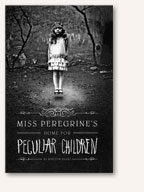
Miss Peregrine’s Home for Peculiar Children

By Ransom Riggs

Miss Peregrine's Home for Peculiar ChildrenI’d seen this book a couple of times in bookstores and been hooked in by the eye-catching cover and title, but hadn’t gotten around to even looking it up at the library. But, last week a coworker and friend brought it in to work, having just finished it, and she happily leant it to me, saying it was a quick read.

It was a quick read, and one that I enjoyed very much, but I’m also finding it kind of difficult to describe here. If you pick up the book at a store or library, you’ll first notice the cover, and then, flipping through, see that there are odd, vintage photographs reproduced throughout the book.

At first I thought the photos were simultaneously something unique but also a bit of a gimmick, and they continued to cause a bit of a dilemma for me as a reader. On the one hand, they were extremely interesting illustrations to the story; at the same time, pondering these real-world artifacts took me out of the narrative a bit each time. So, I’m torn over whether I think they added or subtracted from the overall book.

So, photos aside, the plot felt like it took themes that I love from a variety of young adult and fantasy books – special abilities, time travel, WWII child evacuees (a favorite theme of my childhood since seeing “Bedknobs and Broomsticks”)– and combined them into something pretty original and very entertaining.

The strongest element of the book for me was the characters. Just about every single character is multi-dimensional, mostly sympathetic but with realistic flaws. Even side characters that only got a couple of pages caught my attention, and I wanted to read more about them, as well.

It doesn’t hurt, also, that the beginning of the story takes place in Florida, which is always portrayed in books as being full of fun craziness, but then the majority of the book takes place in Wales, which is the most beautiful place I have ever been, bar none.

Though the book wraps up the immediate storyline, it seems fairly clear that the author is intending to write more with these characters and this world, and I am very much looking forward to reading them. (Author confirms that he has started work on the sequel.)

—Anna

Death Comes to Pemberly

By P.D. James

I read a very brief mention of this book a couple of days before Christmas, and thought to myself, “I better put a hold on that at the library.” I promptly forgot, of course, but on Christmas Day my wonderful father had bought it for me! I finished Comfort & Joy while on vacation, so was able to crack open Death Comes to Pemberly on the plane ride home.

Basically, Death Comes to Pemberly is an old-fashioned British murder mystery, picking up about 5 years after the end of Pride & Prejudice, centered around the married life of Elizabeth and Darcy. I’m normally a little ambivalent about novels that pick up where other famous novels ended, but a couple of things overcame that for me here: 1) I’m not actually a die-hard fan of Jane Austen, so her writing isn’t as sacrosanct for me as it is for many readers, and 2) P.D. James herself has her own excellent reputation as an author.

I have a vague memory of trying to read some of P.D. James’ other novels before, though I can’t remember which ones, and finding them a bit too…technical is the best word I can come up with, though it isn’t quite right. Anyway, her trying to pick up the style of Jane Austen corrects that for me, softening the prose and the characters, and while she can’t write exactly as Jane Austen does, I think she does a fairly good job of capturing the spirit of the characters. Darcy in particular is a surprisingly sympathetic character, and it is actually really interesting to get his perspective on events.

A not-too-long divergence: I feel like male characters in regency novels, even those written contemporarily, are often inaccessible. I think it is probably an accurate portrayal—that men at that time even more than now were expected to be stoic—but as I’ve gotten older, I’ve realized how very young some of these characters are, and how unsure of themselves they must have been in spite of themselves.

P.D. James actually plays on that a bit, making more overt for modern audiences what Jane Austen might have expected her audience to already know, the responsibilities laid on older sons to carry on family duties at a very young age.

I enjoyed the book so much that I hate to even write a criticism (and I’m not convinced that it is a fault of the book), but an odd occurrence happened enough that I can’t quite overlook it. Several times while reading the book, I would turn the page to continue reading, and have to go back and check that I hadn’t accidentally turned two pages together, that there seemed to be the occasional jump in plot. Now, I should qualify this with mentioning that the entire time I was reading this book, I was recovering from a cold and was pretty well dosed with cold medicine, so I can’t say that I was firing on all cylinders, either.

—Anna

Comfort & Joy

By India Knight

I checked this book out from the library after Kinsey discussed it in her post about recommended holiday readings, and it was a very good holiday book indeed.

Here’s the thing about Comfort & Joy: the narrator, Clara, feels just like a very good friend. I wish I could just sit down and chat with her, hearing her opinions about life and sharing my opinions and just comparing our viewpoints. Just like with any friend, most of the time I think she’s very smart and interesting, and sometimes I think she’s being silly and melodramatic, and sometimes I imagine that she would think that I was being the same.

The book is broken up into three years’ worth of Christmases (or Christmi, to use an inside joke from the book). Five pages in, I had my first laugh-out-loud moment; seven pages in, I felt Knight had already perfectly captured an aspect of Christmas with this quote:

“That’s the thing about presents, isn’t it? Especially Christmas ones. The judiciously chosen present, the perfect gift, is offered up in the spirit of atonement and regeneration. It says, ‘Look, I know I don’t call as often as I should, and I know you think I’m grumpy and short-tempered’—insert your own personal failings here; I’m merely précising mine—‘but the thing is, I know you so well and I love you so much that I have bought you the perfect thing. And so now everything’s okay, at least for today.’ Which is all very lovely but a great deal easier said than done, and which is why I can feel the hair at the back of my neck curling with heat and stress.”

Honestly, it actually felt a little odd reading it at my own family Christmas. It is so realistic and engrossing (with some similarities but mostly very different from my own life) that I felt like I was almost experiencing two realities layered on top of each other.

—Anna

some readings about readers

I’ve run across a couple of readings this past month, celebrating readers (sort of).

The first was an article in Scientific American Mind magazine, titled “In the Mind of Others,” and subtitled “Reading fiction can strengthen your social ties and even change your personality.”

The article initially left a bit of a bad taste in my mouth, seeming to say, “You know that weirdo that is always reading alone? They might not be as dumb as we all thought!” The intro to the article spends a bit of time describing insulting assumptions about readers that I hadn’t totally realized were common (“people who read a lot of fiction are socially withdrawn bookworms who use novels as an escape from reality”), and then debunking them.

After I got over my initial bristling, though there were some interesting accounts of the experiments themselves. One tests viewers’ abilities to recognize emotions from just photos of eyes, with the premise that fiction-readers are more empathetic to other people’s emotions and will thus get better results.

Over the holidays, my whole family took it (being a very quiz-happy group), including one nonfiction reader and one non-reader, and all six of us fell comfortably in the average zone, so our very small pool did not demonstrate significant results, but did make for an interesting hour as we all compared our results. (There was some extensive joking that men seemed to read almost all female expressions as “desiring” or “flirtatious.”)

The main conclusion I took from reading this article was that I am not partial to reading scientific articles. (The four-and-a-half page article took me three days to actually get through.)

The second reading, forwarded to me by a friend who had also sent it on to her son, was a blog entry. Called “A Girl You Should Date,” it cuts through all the scientific pedantry that I’d previously been struggling through in Scientific American Mind, to create a very poetic epistle celebrating female readers. I don’t agree with every single thing it says (I do not like to be asked what I’m reading while I’m currently engrossed in a book), but it makes me feel good about myself and I’m glad that it got put out there.

—Anna

Crooked Letter, Crooked Letter

By Tom Franklin

So, it has been a bit of a rough couple of weeks—holidays are looming and my company has some restructuring coming up—but I will say that Crooked Letter, Crooked Letter is a good book to help you get some perspective on life.

I am stressed about getting all my work and Christmas shopping down, but I am not a poor black boy or a painfully shy white nerd trying to get by as an outsider in the deep South…Oh, wait. I was a painfully shy white nerd in Texas only about 10 years after this book takes place. (Although Austin, though less liberal then than it is now, was still a damn sight more liberal than rural Mississippi, and the mid-90s were just  generally more liberal than the mid-80s, so it’s a bit of a cheap comparison.)

Still, there were several details that did actually remind me of my own adolescence. Very minor spoilers follow:

Continue reading

Oscar Wilde and the Vampire Murders

By Gyles Brandreth

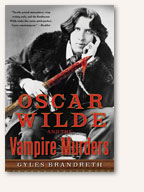
I picked this book up from the library on a whim (despite the truly hideous cover*), without any foreknowledge, figuring I like historical mysteries and I like Oscar Wilde. After starting it, it occurred to me that I’m not entirely sure I like historical novels that fictionalize real-life characters however, and this proved no exception.

Actually, much like with The Hangman’s Daughter, I found it frustrating that I didn’t know the actual historical events better in order to judge what was true to the real-life characters and what the author was inventing for the story.

The basic premise of the story is that Oscar Wilde meets up with Arthur Conan Doyle in order to solve a high-society murder mystery with some assistance from Bram Stoker. It sounds kind of cool, right? Oscar Wilde is a really interesting historical figure, very witty and extensively quoted.

Here’s the thing, though: fictionalizing him by shoehorning his various well-known quotes into fictional conversations comes across as lazy writing and makes his character almost completely insufferable.

Oscar Wilde is the protagonist and central detective of this book, which is the fourth book of an on-going Oscar Wilde historical mysteries series. All the other characters describe him as irresistibly charming, but through the scenes of the book, he comes across as melodramatic, egotistical, and often inconsiderate of those around him.

Honestly, it wouldn’t surprise me if he was all of those things in real life, as well, but I found him almost unbearable in this novel, always spouting off some witticism, regardless of whether it is actually pertinent to the discussion. He seemed to be showing off his cleverness at all times and that gets to be a bore really quickly in real life.

Poor Conan Doyle is described as sort of doddering and hide-bound (apparently Oscar Wilde’s brilliant detection is the inspiration for Sherlock Holmes), and my sympathies were entirely with him throughout the entire book. Toward the middle of the book, when I had to really slog through it (it picked up a bit toward the end when the mystery itself stepped up), Conan Doyle writes to his wife, “And Oscar, I confess, I am beginning to find rather ‘too much.’” Amen, Conan Doyle. Amen.

— Anna

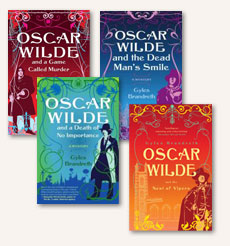
*Excuse my going off on a graphic-design tangent, but when pulling the image of the cover of this book, I saw the covers of the previous books in the series, and they are just really attractive and create a really nice set that I can’t figure out what happened with the design of this cover. [Ah! With a very little of research (reading the reviews on amazon), I found that this book was previously released under a different title (Oscar Wilde and the Nest of Vipers) and with a cover matching the others. I would say that the new cover design seems like a mistaken attempt to capitalize on the vampire craze right now, but I did pick it up myself, didn’t I?]


The Miraculous Journey of Edward Tulane

By Kate DiCamillo

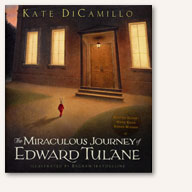
Oh, Lord, this book! I knew I shouldn’t read it. When Kinsey mentioned it previously, comparing it to The Velveteen Rabbit, I even commented that considering how affected I was by The Velveteen Rabbit, I was going to steer clear of Edward Tulane.

Then, I was browsing in a used bookstore, saw a copy, and figured I’d just read the first few pages to see what all of the fuss was about. 20 minutes later, I was almost halfway through (it is a young readers book with large, well-spaced type) and realized that I had better put it down if I wanted to avoid embarrassing myself by crying in the middle of the bookstore.

The next day I checked it out from the library, waited until I had an evening to myself, and sobbed my way through the second half. And I mean really sobbed, not just tearing up or anything. Now, honestly, I think it is probably more hard-hitting for adults than children, since most children won’t completely resonate with the theme of losing people you love and learning to love again.

But if I were a parent, I don’t know that I could get through reading it to my child without completely embarrassing myself all over again. So, there’s that. Read it, but carve out a time and place to curl up by yourself and think about life and love afterwards (and get some eye drops in order to disguise red, puffy eyes).

[When googling for a photo of the cover, I ran across this review, which I think has a very good analysis, but with spoilers.]

—Anna

Devil-May-Care

By Elizabeth Peters

Elizabeth Peters’ novels were some of my first adult novels, and I couldn’t have had a better author for transition. Her books are almost all mysteries, though when I think back on them, I can’t think of a single one that features a murder—they usually deal with theft of artifacts. They are all funny, with likable characters and light romance, which makes them perfect for a young teen graduating out of young adult books.

Devil-May-Care is my favorite of all of her books. It was published in 1977 and features a young woman caretaking her aunt’s mansion, which turns out to be haunted. Sound familiar?

Well, the heroine is smart, capable and mostly unafraid, and the other characters are all engaging and humorous. The plot moves along quickly and interestingly, and with great humor. One warning: each scene leads seamlessly into the next action, so it can be quite difficult to find a stopping point for breaks, leading to too many late nights this week.

A line toward the end of The Shining brought this book to mind for me and inspired me to pick it up again (very mild spoiler):

Continue reading

The Hangman’s Daughter

By Oliver Pötzsch

Before I got distracted by Isaac Marion’s zombies, I read The Hangman’s Daughter and was struggling with writing a review. It is difficult because the book has two very different themes. On the one hand it is a fairly run-of-the mill murder mystery, with somewhat slow plotting. On the other hand, it is a meticulously researched account of Bavaria in 1659 which is not a time or a place I am terribly familiar with. (The author actually is, though; he is writing about his own ancestors and used a lot of personal family papers in his research.)

I enjoyed it all-in-all, but it wasn’t an easy read. The mystery, for me, took second place to the historical aspects, which were fascinating but also disturbing. It turns out Bavaria in 1659 is not a terribly pleasant place to be, especially as a woman.

The accusation of witchcraft was still a prevalent and valid police matter and was dealt with quickly and brutally. Most shocking for me was how many of the characters didn’t actually believe in the charges of witchcraft, but still went along with it out of fear or convenience. The author makes a point of showing how accusations of witchcraft were used very deliberately to keep women in a subservient place, particularly those like midwives who had knowledge and careers of their own.

It was too historically realistic to be the fun murder mystery I was hoping for after The Shining, but it was undeniably interesting. Just know what you are getting into; the protagonist is the hangman (his daughter is disappointingly peripheral for being the title character, but I guess that fits in with the time period) and he does his job as both hangman and interrogator. Not exactly for the weak of stomach.

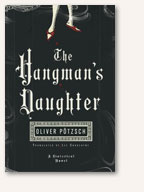
Addendum: as I was looking for a photo of the book cover, I ran across other reviews of The Hangman’s Daughter, which were all a lot more critical than mine but with which I generally agree. It makes me think that I’m just not a very critical person, which is a little unfortunate when writing for a book-reviewing blog.

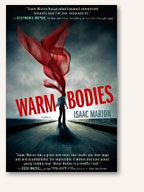
Warm Bodies

by Isaac Marion

I heard this theory that vampires are popular when the Democrats are in power because the fear is that Democrats are moral degenerates, and zombies are popular when Republicans are in power because the fear is that Republicans are mindless hordes. It’s entertaining, but doesn’t really seem to hold true. The current vampire fad (these things do seem to see-saw) seemed to have started back with Bush in office, and right now I think we are seeing a decline in vampires and an upswing in zombies while Obama is in office.

Anyway, all of this is to say that I think Warm Bodies is very much talking about our current culture (at least in the U.S.), where people feel isolated and disenfranchised (i.e. dead). The zombie protagonist fights against his very nature to attempt to have memories and feelings, and it is poetic, sweet and depressing, all at once.

I like to imagine that the Isaac Marion was out with friends and they were talking about the current romanticism of creatures like werewolves and vampires that used to be fearsome and grotesque. And maybe a friend dared him to write a book romanticizing the truly morbid, zombies, and, by God, Marion won that bet!

It is, however, much more than a love story. Warm Bodies explores life, and what it means to be alive versus dead, regardless of biological conditions of life. Zombies is what lets Marion explore that. Walking dead characters want something more out of their existence, while living characters yearn for non-rising death in the post-apocolyptic land.

I think the author was able to really explore an idea that I’ve been rattling around in my brain for a while (but have been unable to really pin down), which is that our culture seems increasingly fascinated with the idea of an Apocalypse. Now, I have a tendency to assume my thoughts and feelings reflect the thoughts and feelings of our society as a whole, so definitely take that into consideration. It feels like in 1999, when Y2K was imminent, everyone was all abuzz with it, but with real concern and fear for the changes it could inflict.

The current 2012 talk feels a bit more wistful than nervous, like we know not to expect anything, but that we are actually hoping that something will happen. That there is a pervasive and growing idea that there is something wrong with our society, that we are on the wrong track, but that it will take a big upheaval to make a change and we need something badly to trigger this change. That is what Warm Bodies is all about to me.

I will say that the ending doesn’t quite stand up to the rest of the book, though it is still very good. Like a lot of authors who are trying to relate pretty complicated themes in a narrative structure, Marion somewhat wrote himself into a bit of a corner. Even so, I’m still going to go ahead and say it: come-what-may in December, I’m declaring this as my favorite book of 2011.

Oh, one last thing: the book begins with a scenario very similar to the short story that I previously posted about, but veers off into a new direction that was initially disconcerting to me, but of course paid off in the end. It does, however, undo some of the more simple sweetness of the original short story, which made me a little sad.