Game Change: Obama and the Clintons, McCain and Palin, and the Race of a Lifetime

By John Heilemann and Mark Halperin
I know I haven’t posted in a while, and it is because I’ve been hauling my way through a large and very unusual book for me—political nonfiction—so I’m writing a very long post to compensate.

I checked this book out from the library the day after seeing the HBO movie of the same name, which was just a narrow slice of the full scope of the book*. I enjoyed the movie; I knew all the public politics already, but it was fascinating seeing all the behind-the-scenes shuffling, like peering backstage at a show. I wanted to know more about it, so I checked out the book.

And very quickly realized that I did not want to know more about it. Politics isn’t a Broadway show, it’s a sausage factory**, and if I wanted to still enjoy sausage, I damn sure didn’t want to see how it is made. Now, I’m a democrat and the book reads somewhat democrat-leaning, though the authors are political correspondents and journalists who I am sure pride themselves on their unbiased stance. However, every single person comes across as single-mindedly, self-centeredly ambitious in a microcosm of politics that not only doesn’t seem to have much relevance to the rest of the nation, but seems to disdain the rest of the nation a bit. So, I guess that, at least, is something bipartisan.

I will give Game Change this: it is so minutely, exhaustively researched that it sort of boggles the mind. It is written in a narrative structure, following the various candidates like protagonists in a story. When tracking Obama in 2006, well before he was in the national consciousness, they extrapolate his frame of mind from a note he passed to another senator in a committee meeting and a hand gesture (not the one you are thinking of right now) he made in the hallway of the Capitol. I imagine the two authors scouring every building he ever set foot in and asking everybody and anybody there, “Did you ever see President Obama? What was he doing? Did he say anything—anything at all?!”

The best part is reading about the events that I actually remember from the race, but reading them in context with everything else that came between. The oddest part, though, is reading about pivotal, influential events about which I had no idea here in the midlands of America. (ex. Apparently, Maureen Dowd wrote an article in which she interviewed David Geffen about his disillusionment with the Clintons? It was a big moment where democrats felt free to criticize the Clintons and support Obama instead? I mean, I know who Maureen Dowd is, though I’ve never read anything by her. I initially thought David Geffen might be Liza Minnelli’s most recent husband, until it quickly became clear that wasn’t right.)

I guess I can kind of see where politicians get their contempt for all the rest of us, but I think that contempt comes from a very ignorant place—they have no idea how we think and how we make decisions. And because they don’t understand it, they disdain it. I imagine that it is stories like my own that drive politicians crazy: I saw the campaign ads, read articles, and still couldn’t make up my mind between Clinton and Obama. Then, I read a post on a small blog that I regularly check out where the author commented that if Clinton gets elected, two families would have been running the White House for 24 years and that is some disconcerting dynasty-building right there. And that’s what did it for me—that one post made my decision.

Later, it occurred to me that this phenomena kind of highlights how insular the political world is, at least for the active players. For myself, only the largest of political events break into my brain space that is otherwise occupied with my daily office work, what I’m making for dinner, how to balance this month’s budget, etc. For the people in this book, though, this is their entire life.

When the HBO movie came out, Palin understandable objected to it, and HBO tried to argue that it wasn’t necessarily an unflattering portrait, which of course it is. The book is not truly flattering either, but it is a lot more balanced in assigning blame equally on McCain’s people.

The vast majority of the book is spent on the democratic primaries, to the point where it gets a little bogged down, but then it rushes through the general race at breakneck speed, making me feel like I was missing things that they simply weren’t discussing.

This is perhaps the best compliment: Game Change already has me looking at the 2012 race in a different light.

A couple of random concluding thoughts:

  • The book does a great job of humanizing the politicians. It is a little embarrassing to admit, but it had not occurred to me that politicians could actually be sad or get their feelings hurt while on the campaign. I guess I just thought that so much of the discourse was overblown wind-bagging, that it all was. I was kind of shocked how many of them break down into tears at one point or another.
  • Hillary Clinton’s political career so far could almost be a Greek play (I’m not sure yet whether a tragedy or comedy): her husband is the one that initially gives her the political clout and name-recognition to run for president, but he was also her biggest obstacle in the campaign and probably the strongest reason she lost.
—Anna
__________________________________________

*A VERY narrow slice – the book breaks down as follows:

  • Pages 1-267: the race for the Democratic nomination, focusing on the Obama and Clinton campaigns, with some discussion of Edwards (which has been very informative in light of the current trial)
  • Pages 268-319: the race for the Republican nomination, focusing almost entirely on McCain with a few pages about Giuliani
  • Pages 320-436: the general election (the events of the HBO movie are all contained within pages 353-416)

**The 12-year-old in me says, “YEAH, it is!” (sorry)

Wait Wait…Don’t Tell Me!

Every Saturday morning, I go grocery shopping, and on the drive I listen to either Car Talk or Wait Wait…Don’t Tell Me!, depending on how early I’ve gotten up (yes, I know, my life is full of glamor and excitement). This morning, I turned on the radio part way through Wait Wait…Don’t Tell Me! where they were chatting with a guy they introduced as the most prominent children’s book author who is also a felon. I’d missed the part where they actually said his name, which may have made it even more engrossing.

He starts by telling his story and it’s like when you are at a party and everyone is chatting, but as one person keeps adding anecdotes that get stranger and stranger, everyone else gradually stops talking and are just hanging on this one guy’s words. I don’t want to give any of it away because it is really worth it to hear it in his own words here.

(Looking up the link, the author is Newbery Honor recipient Jack Gantos, who I’m not actually familiar with, and the interview is a recast from January, but if you haven’t heard it before, it is well-worth a listen and is only 11:22 minutes.)

—Anna

Baltimore; Or, The Steadfast Tin Soldier and the Vampire

by Christopher Golden and Mike Mignola

Book Cover: Baltimore; Or, The Steadfast Tin Soldier and the VampireI heard about this “illustrated novel” when I read Baltimore: The Plague Ships during my comic book glut a few weeks ago. I wasn’t quite sure what an illustrated novel was, but figured that since I liked illustrations and novels, it was probably for me. Also, while I enjoy comic books, I actually like novels better, so I figured that if I really liked Baltimore the comic book, I was going to love Baltimore the novel. You’ve probably already figured out from this lead-up that I did not.

There were a couple of issues, and I think the main one is that there is a reason that comic books/graphic novels and novels are two distinct mediums. They have significantly different narrative structures, and it is the rare author who can work in both (even more kudos to Neil Gaiman, then). In graphic novel Baltimore, the art and text worked together seamlessly and each provided content that the other lacked.

In illustrated novel Baltimore, the illustrations were small, simple black-and-white woodcut-style illustrations that kind of floated in the text on every few pages. I had imagined that they would be full color, full page reproductions of paintings, something even more impressive than the art in the graphic novel, something to distinguish it from the graphic novel and justify having a medium called an illustrated novel. (Thinking it over, Miss Peregrine’s Home for Peculiar Children better matches my idea of the definition.)

I can’t be entirely impartial on the written content because it was in a style that I find particularly difficult to read: characters telling stories. The majority of the novel consisted of three friends of Lord Baltimore sitting in a pub, telling stories about themselves and their relationship to Baltimore, while waiting for him to meet them. Sometimes, while telling stories about their past, their past self would then tell a story! It all got very convoluted, and that kind of flashback narrative lacks a sense of action and urgency to me.

It read like almost the opposite of a graphic novel, which has to be mostly action-oriented in order to support engaging illustrations. This came as a bit of a shock to me, but in retrospect, it kind of makes sense. For a dedicating author of comic books and graphic novels to try his hand at writing a full-length novel, the author must want to try something different, to write something that couldn’t be supported in a comic book structure.

Christopher Golden and Mike Mignola’s effort feels like what it probably is: an amateur attempt at an unaccustomed medium. They didn’t know a whole lot about writing novels, but they knew that novels were different than comic books, so they wrote something as different as possible.

—Anna

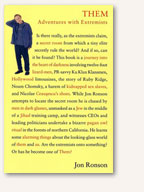
Them: Adventures with Extremists

By Jon Ronson

I am very much a believer of Occam’s Razor—that the simplest answer is usually the correct one—which makes me pretty much anti-conspiracies. I have to admit, though, that Jon Ronson’s Them gave me pause.

The front cover has this description:

Is there really, as the extremists claim, a secret room from which a tiny elite secretly rule the world? This book is a journey into the heart of darkness involving twelve-foot lizard-men, PR-savvy Ku Klux Klansmen, Hollywood limousines, the story of Ruby Ridge, Noam Chomsky, a harem of kidnapped sex slaves, and Nicolae Ceausescu’s shoes. While Jon Ronson attempts to locate the secret room he is chased by men in dark glasses, unmasked as a Jew in the middle of a Jihad training camp, and witnesses CEOs and leading politicians undertake a bizarre pagan owl ritual in the forests of northern California. He learns some alarming things about the looking-glass world of them and us. Are the extremists onto something? Or has he become one of Them?

Book Cover: ThemI had previously discovered Jon Ronson when he was on a hilarious episode of NPR’s This American Life, talking about his most recent book, The Psychopath Test. (If you haven’t heard the episode, you definitely should—they bring in a psychologist to administer the “psychopath test” to the NPR staff.)

I promptly picked up the book at the library and realized that I had experienced Jon Ronson before—he wrote the book Men Who Stare At Goats, which was made into a movie a few years ago with Ewan McGregor and George Clooney. Several things became clear all at once: Ronson has a writing style unlike anything I’ve read before. He describes himself as a humorous journalist, but he writes in a kind of nonfiction stream-of consciousness. I enjoyed the movie “Men Who Stare At Goats,” but the characters just seemed to sort of float along and kind of accidentally run into important people or pivotal events. It didn’t seem very realistic in the movie, but it now seems very much how Ronson operates, and once you get used to it, it is pretty awesome being along for the ride.

Ronson just seems like the most pleasant, unassuming, agreeable person, and he must be because he gets interviews I wouldn’t have believed possible. In “The Psychopath Test,” he meets with CEOs, even after telling them he wants to see if they are psychopaths! It is unbelievable—they are just sort of amused. I think he must have some superpower of not giving offence. Them starts off with him spending a year off and on with Britain’s self-proclaimed right-hand man of Bin Laden, even though Ronson himself is Jewish.

Ronson has a very active voice in his books, unlike most journalists, and that is very much part of the charm. The reader gets a much clearer sense of the full interactions, and I started to notice that Ronson asks lots of questions but only very rarely disagrees or confronts people. Even his questions are very inviting, sort of “I’m sure I’m being very stupid about this, but what about….” People seem usually pretty delighted to speak with him. (Although if I recall, The Psychopath Test begins with one of his subjects from Them being very unhappy with his treatment in the book and threatening him.)

In the book’s preface, he explains how he came up with the title Them. While in the middle of researching the book, he describes his research to a friend, and the friend replies, “You are sounding like one of THEM.” And I have to warn that after reading this book, not all the extremists will seem so extreme to you, either.

It reminded me of watching a tv program on the Society of Masons with Tom. They had lots of conspiracists describing various farfetched theories about the Masons, and Tom and I had a good time laughing at how ridiculous it all was. Then, the program interviewed a representative from the Masons, and he was so slick with complete non-answers (“why, we are just a normal fraternal order, how could you possibly think otherwise?”) that for the first time I had some momentary doubt.

—Anna

Wuthering Heights

By Emily Brontë

Book Cover: Wuthering HeightsLast night I was watching the new Fright Night movie (it’s okay—a fun, distracting movie; nothing mind-blowing or anything), and there is a scene where the female love interest is sitting on the hero’s bed, reading Wuthering Heights, when he comes in. She starts the conversation by saying, “You know, this book is actually really sexy, in a frustrated, unconsummated kind of way.” And it made me laugh and laugh.

It also reminded me of the stories from several years ago, when publishing companies were trying to sell Wuthering Heights to Twilight fans. (Apparently, Wuthering Heights is mentioned in Twilight as Bella’s favorite book? I read Twilight, but I don’t actually remember that.) And, I was so curious as to what those poor, bamboozled teenage girls thought of it.

Now, I haven’t actually read Wuthering Heights since high school, but I absolutely hated it then. I get that they are selling it now as a tragic romance for the new goth teen, but I think of tragic romances as people who are kept apart due to circumstances beyond their control á la Romeo and Juliet, not situations where the people are so hateful that they bring upon themselves every terrible thing that happens to them (no spoilers, though!).

So, what do you guys think of Wuthering Heights?

—Anna

Comic Book Glut

In a ridiculously extended simile/metaphor, books are like food—good literature is a hearty meat-and-potatoes kind of meal; fluff novels are something delicious and comforting like baked mac-n-cheese; nonfiction is a nice big salad, healthy and perhaps a little goes a long way.

All of this is to describe how I feel about comic books—they are the candy of my book meal. I love them, but once I start reading them, I always crave more, and finally after hours of reading them, I feel a little off, in a kind of empty and stale way. So, I try to indulge in comic books in moderation.

However, this afternoon, it was a beautiful day, and my work let me out early. I went to the library to check out a nice, healthy salad of a nonfiction book, but for some peculiar reason, my local library organizes the graphic novels in the nonfiction section, so I also walked out with five graphic novels, and then proceeded to glut myself on literary candy.

1) The League of Extraordinary Gentlemen, Century: 1910

Cover: The League of Extraordinary Gentlemen, Century: 1910I loved The League of Extraordinary Gentlemen, Volume 1 (I even enjoy the movie in a very guilty-pleasure kind of way). The premise of having characters from famous literature join a crime-fighting group, lead primarily by a strong female character, sold me within the first few pages. That it was a period piece, set in the 1800s was an additional bonus. The character dynamics were engaging and the plotting was clever.

Then, Volume 2 got a little more outlandish in plot, made the female lead weaker and more traditionally “feminine,” and added some jarring sex scenes. I not only began to feel like I wasn’t the target audience, but that perhaps they were actively discouraging female readers. The League of Extraordinary Gentlemen, Century: 1910 goes even further. It is maybe a third of the length of the previous two volumes, and feels more like an introduction of new characters than a complete story, but it still manages to squeeze in seven illustrations of topless women, three illustrations of full frontal female nudity, and two rapes. There’s shock value, and then there’s just being disagreeable.

2) American Vampire, Volumes 1 and 2

Cover: American VampireI really wanted to like these, and I did enjoy parts of them. The premise is interesting and had some good possibilities: a group of traditional European vampires come to America during the expansion of the railroads in the Wild West. One of them unintentionally “converts” a train robber, and the American vampire is a new breed—he draws strength from the sun. The two volumes follow him to the 1920s, where he “converts” a young starlet, and then the story follows them both (in separate plotlines) through the 30s as they battle both the clan of original European vampires and a secret society of vampire hunters.

I love both vampires and historical fiction, and like I said, it had great potential. It’s hard to pinpoint exactly what was missing because it wasn’t terrible, it just wasn’t as good as I had hoped or thought it could be. The writing was a bit clichéd, the characters were two-dimensional and not very sympathetic, and the plot eventually devolved into little but violence. The art itself had a rough, sketchy quality that I liked on first view, but began to just look increasingly muddy and almost blurred to me. It is clearly an ongoing series, but not one I’ll be continuing with.

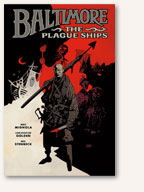
3) Baltimore: The Plague Ships

Cover: Baltimore: The Plague ShipsAnother historical vampire comic, but this one was everything and more I was hoping for with American Vampire. The author is the same as for Hellboy, but this one has a darker atmosphere that I really appreciate. The book jumps right into the action with our hero, Lord Baltimore, hunting down vampires in a small village off the coast of France in 1916. His background and the history of this world unfold throughout the story, along with some nicely paced plotting.

The art is a really nice screen-printing style, with minimalist, flat color fields, with a muted palette that gives the illustrations a really nice atmosphere. It is fairly clearly the beginning of a series, though Volume 2 doesn’t come out until June. In the meantime, the introduction mentions that this comic book is a companion piece to the illustrated novel, Baltimore or, The Steadfast Tin Soldier and the Vampire. I’m not entirely sure what an illustrated novel is, but I definitely plan on finding out.

4) Blacksad

Cover: BlacksadThis was the one I was the most excited about (I may have even done a little jump in the library aisle), so I saved it for last. I already knew that I was going to love it because I own it, sort of. First, a quick story: my dad travels a lot for work and he would bring all of us kids souvenirs from everywhere he travelled. He brought us each anime comics from Japan when I was a young teen, and that hooked me (even though after very careful perusal of the illustrations, I finally discovered that my dad had accidentally bought me a schoolboy romance story). Subsequently, I asked for a comic book from every country he went to, so I now have comics from Germany, Sweden, Holland, China, Ireland, Croatia (from my wonderful friend, Hannah), and France.

One of my two French comic books is Blacksad, and it is brilliant! From what I could piece together from the illustrations, it is a gritty noir mystery, which you already know I love, with anthropomorphized animal characters, drawn more beautifully than any other comic I have seen. Blacksad is John Blacksad, a black-and-white cat and private detective. I was so, so excited to actually be able to read it, instead of poring over the pictures and trying to read a word or two of the French with my high school Spanish learning. It turns out the writing is almost as lovely as the pictures, and I can’t recommend the whole package enough.

A Reliable Wife

By Robert Goolrick

Book Cover: A Reliable WifeA Reliable Wife is apparently a quintessential workplace “water cooler” book. It was among the books literally stacked on top of the water cooler at my old job, and is one of the books in my new job’s kitchen (though on a table diagonal from the actual water cooler). I had admired the cover (I like the maroon and gray color scheme) and read the back blurb* several times while filling my water bottle, but had been reluctant to read it. It sounded like it could go two different ways, either a high-brow character portrait or a low-brow romance, and I like to at least claim that I don’t enjoy either, though I’ve been known to indulge in both.

I had asked a coworker whether this was an inspirational, love-conquers-all kind of story, and she said no, but I wasn’t entirely sure I believed her. Then, my previous book, the fifth in the Lady Julia Gray series, made me so irritated with romantic leads that I decided I wanted a book with at least the possibility of two people in a relationship scheming against each other until one kills the other (I wasn’t even that particular about who killed who, though I’m usually pretty biased toward the wife).

Anyway, without spoilers, it is not really a love-conquers-all story, though it could perhaps stretch to be interpreted that way. It is a bit of both high-brow and low-brow, and I really enjoyed it! There is lots of character portraiture of the two main protagonists, background to demonstrate how they each got to be at this current point in their lives, interspersed with some fairly unexpected intrigue and deceit. It was not exactly the book I was looking for when I started to read it, but I was quickly engaged and then satisfied with it in the end.

In addition, this book is all about sex. The characters all have sex, talk about sex, imagine having sex, imagine other people having sex, etc. Sex drives most of the characters and their motives most of the time. I’m always kind of on the fence about reading about sex; it often makes me feel uncomfortably voyeuristic. At the same time, it is a fragile story of two very damaged people coming together and trying to do right by each other and themselves, which resonated a bit more for me than all the sex.

P.S. – This book is also ALL about the small tragedies of everyday life, so clearly not for you, Kinsey.

*Here’s the back blurb: “He placed a notice in a Chicago paper, an advertisement for a ‘reliable wife.’ She responded, saying that she was ‘a simple, honest woman.’ She was, of course, anything but honest, and the only simple thing about her was her single-minded determination to marry this man and then kill him slowly and carefully, leaving herself a wealthy widow. What Catherine Land did not realize was that the enigmatic and lonely Ralph Truitt had a plan of his own.”

—Anna

The Fabulous Clipjoint

By Fredric Brown

Let’s talk a little bit about Pulp Mysteries. I LOVE them, even though they are deeply offensive by most of today’s standards, and the mindset of a hardboiled detective is about as far from my own as it is possible to be.

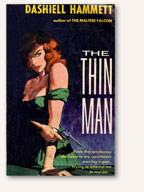
Book Cover: The Thin ManI was first introduced to them in high school, when my family went through a phase of watching movies from the 40s, including The Maltese Falcon, The Big Sleep, and The Thin Man. I went from there to reading Dashiell Hammett, who I absolutely love, and a little Raymond Chandler, who threw around the n-word enough to make me too uncomfortable to read most of his books.*

For a while, I looked for contemporary authors who also used the hardboiled style, and found Robert B. Parker (entertaining fluff that my mom accurately criticized for never allowing his characters to grow), Bill Pronzini (who has a nice gimmick of having a narrating detective who is never given a name), and my then favorite Joseph Hansen (featuring a gay insurance investigator who is as tough and stoic as any Sam Spade or Philip Marlowe).

Book Cover: Detective DuosSeveral years ago I picked up a collection of short stories titled Detective Duos, and was introduced to Fredric Brown’s Ed and Am Hunter, who immediately supplanted all other pulp mysteries in my heart forever. He wrote seven novels and one short story about the detective pair, all of which were published between 1947 and 1963 and are currently out of print, as far as I know. Tracking down each precious copy might have added just a little bit to my love of the series. (Much thanks to my wonderful sister for finding the seventh and rarest novel for me as a Christmas present a few years ago!)

In my opinion, Fredric Brown has not gotten the recognition he deserves as an author in any genre, though he is more known in the science fiction genre. I haven’t actually read any of those, but my impression is that they fit in fairly well with other contemporary science fiction novels, while his pulp mysteries really stand out from the rest.

The first book of the series, The Fabulous Clipjoint, introduces us to Ed Hunter, who is just 18 and teams up with his uncle, Ambrose “Am” Hunter, to solve the murder of his father. They live in gritty noir-ish Chicago, and feel the bitterness and cynicism of every other pulp detective, but Brown writes them with honesty and vulnerability that makes them more relatable and likeable than any other pulp mystery characters I’d read. I knew this book was something special when Ed makes a speech about wanting to have a drink of whiskey in honor of his dad, downs a hefty shot of whiskey, and promptly throws up.

Funny story, though: My first copy of The Fabulous Clipjoint ended with a plot dead-end with the detectives stumped, and I was a little taken aback but impressed at Brown’s moxie at showing that real-life mysteries don’t always end in tidy packages. Then, I ran across another copy in a used book store, and realized that my first copy was missing the last third of the book. The actual ending isn’t as bravely unusual, but is a lot more satisfying as a reader.

*Rereading The Fabulous Clipjoint, there are more casual racial slurs than I’d remembered, which is very unfortunate. They never actually describe a specific character, which is something of a poor salve for my conscience, but one I have to hang on to or else quit pulp mysteries forever.

—Anna

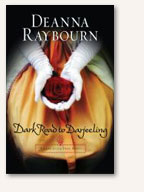
Dark Road to Darjeeling

By Deanna Raybourne

I wasn’t really intending to review this book because it is the fourth in a series that I’d already talked about, but I haven’t posted in a while and I had a serious issue with the conclusion, which I’m going to spoil the hell out of below the break.

But first, some non-spoilers. One thing I really appreciated is that the Dark Road to Darjeeling takes place at least several months after the third book, which is kind of refreshing. So often each mystery novel in a series happens within a week of the last one that it becomes kind of ridiculous how often the main characters run across murders.

Again, like the first few books, the relationship between the hero and heroine kind of wavered for me. Pretty much scene-by-scene I would go between appreciation and irritation. The relationship is very progressive for the Victorian setting (perhaps anachronistically so), but also very repressive by today’s standards, so when I recalled the Victorian setting, I would be impressed with the relationship, but when I compared it to my own relationship, I would get my feminist self all riled up.

Anyway, this book is set in a remote area of India, and I found the descriptions of the setting and various peripheral characters the most interesting of any of the books in the series so far. And, after the mystery was solved, there was an additional twist that didn’t bother me nearly so much as the mystery solution and which bodes for some interesting characterization in the fifth book.

Alright, so now that the pleasantries are taken care of, I’m going to spoil the entire murder mystery of the book after the break. I actually feel a little hesitant to do this, like I’m breaking a reader’s cardinal rule, but here goes:

Continue reading

Cool, Calm & Contentious

By Merrill Markoe

Book Cover: Cool, Calm & ContentiousI did not know who Merrill Markoe was when I first saw her touting this book on The Daily Show with Jon Stewart, but she was so funny on the show and the excerpts from the book were so funny that I immediately put my name on the waiting list at the library. Apparently along with everyone else in Boulder, too, because it took several months for the book to come to me.

Then, I mentioned the book to my office-mate, and she caught me up that Markoe was a comedy writer for David Letterman and dated him for several years, which was good information to have for several of the essays which discuss her love life in satirically veiled terms.

I expected the book to be really funny; what I didn’t expect was for it to be so insightful. At least three different points she makes were directly applicable to my life, and at least one has already made an improvement in my life. How many books can you say that about? Especially ones that are already sidesplitting.

I have to warn that one of the essays, about two-thirds of the way through the book, starts funny like all the others, but then veers into pretty dark territory. After that, it is all comedy again, but it threw me for a bit of a loop.

—Anna