A City of Ghosts

By Betsy Phillips

Since it is very possible that all three authors of this blog will lose power due to Sandy for the next week, I’m posting my Halloween post a few days early.
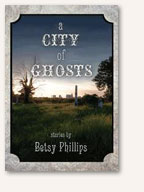
Book Cover: A City of GhostsKinsey and I were discussing the blog, sort of roughing out upcoming posts, and I mentioned how I like to read something spooky in honor of Halloween, but that I couldn’t actually remember ever reading a book that truly scared me, like so scared I don’t want to turn out the lights. (After more thought, the story of “The Monkey’s Paw” made me very unhappy at the time of reading it, though didn’t interfere with my sleep at all, and Steinbeck’s The Pearl has given me a lifetime phobia of scorpions, so those seem to be as close as I get to scared.)

Anyway, Kinsey lent me A City of Ghosts, which is a collection of ghost stories set in Nashville, self-published by the author in 2010. I was somewhat dubious about this book for a couple of reasons: 1) I am a huge snob about self-published books; and 2) I am a huge skeptic; not only do I not believe in ghosts, I can’t even imagine any evidence that would make me believe in them, up to and including seeing one for myself.

However, it was really, really good! Not spooky, but just super interesting. It was a comfort to me that the author notes in several places at the beginning of the book that this is a work of fiction, since then I could just enjoy the stories without picking apart the possible truth behind them. Although, Phillips writes in such an easy, first-person, conversational style that I had to reconfirm for myself several times that she did indeed state upfront it is fiction.

I read it more like a book of poetry, especially since the stories were very short, mostly ranging between one to three pages long. Phillips uses the small vignettes to flesh out (so to speak) aspects of Southern society, like the shadow of slavery and the ongoing racism and classism, that are hard to encapsulate in concrete terms on their own. I interpreted the ghost stories as metaphors for how events can become permanently embedded in our social consciousness and dictate how our lives are led even decades later.

The book is dividing into two sections, the first titled “April,” and the second titled “October.” The stories in “April” are a bit lighter in tone, reading a bit more like traditional ghost stories and addressing more individual cases; “October” has several stories that include flood waters, very clearly dealing with post-Katrina recovery. Even while typing this, I can see how ghost stories about the victims of Katrina sounds like it could be incredibly insensitive, but the stories instead describe the hurricane as a specter itself that hangs over the survivors with nightmares of the flood waters and grief over the victims.

I just found it very poignant, and in that way, much more lastingly enjoyable that I would more traditional ghost stories.

— Anna

Slaughterhouse-Five

By Kurt Vonnegut

Banned Books Week 2012Book cover: Slaughterhouse-FiveWhen I decided to read Slaughterhouse-Five for this year’s Banned Books Week (and the couple weeks following, as well, apparently), I was a little baffled that I hadn’t already read any of Vonnegut’s books because I like science fiction and I’ve had Vonnegut recommended to me multiple times. I even vaguely recalled meaning to read some books but never getting around to it.

Then, I got a couple of chapters in, and remembered that I hadn’t just meant to read his books before, I’ve actually started several of his books in the past, and put them down again. I just cannot get started into Vonnegut’s books, which is so frustrating because I really enjoy both sci-fi and social satire, and he is a king of both. So, I bring you this review in three Acts: Dismissiveness, Grudging Respect, Zealous Appreciation.

Act I: Dismissiveness

I spent roughly the first half of the book trying to put my finger on the problem. It isn’t as though I especially disliked it or thought it was a bad book; I just felt that I didn’t totally get what he was trying to say and that his writing style wasn’t one that speaks to me. When Tom asked if I was enjoying it, I had to admit that I wasn’t, and when he looked a bit disappointed, I followed up by saying that I thought it was a little too philosophical for me, like Vonnegut is communicating a theory about life, instead of sharing a concrete facet of life, and I get impatient with that. Tom nodded, because he has despaired of my disinterest in philosophy before, but I continued to mull over my answer.

And I think it was something even further, that his people weren’t interesting to me as characters. That they seem more like placeholders in his philosophical argument; their actions only serve to augment the message of the book. So, I didn’t have any vested interest in the future of the characters, which is especially true in this non-chronologically-linear novel where the future is all spelled out early on, and even the characters in the book don’t have much interest in it, either.

Acts II and III with spoilers and excerpt after the break…

Continue reading

Things I Learned at the National Book Festival

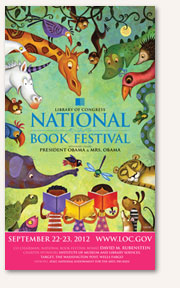
National Book Festival 2012This weekend, I went with Kinsey to the National Book Festival on the National Mall, and it was an awesome conglomerate of book lovers! We went to hear John Green, Patricia Cornwell, and Lois Lowry speak, and it was fascinating listening to them discuss their various approaches to writing and relationships with their books, because they really were widely different (and I’d like to encourage Kinsey to comment or post with her reasons for wanting to hear Patricia Cornwell speak, because they are very amusing).

Five things I learned at the National Book Festival:

  • If I listen to an author talk about a book for long enough, I will want to read that book.
  • Authors really appreciate libraries and librarians, which I had sort of wondered about since it conceivably cuts into revenues.
  • Having an author talk about a fictional character as a separate, independent entity makes me a little uneasy.
  • There are lots of ways to ask the infamous question, “where do you get your ideas?” (but the answer is always a variation of “beats me”).
  • All spouses of authors deserve our respect and sympathy.

I also was embarrassed to realize that the one-year birthday (September 17) of this blog had blown right past without me realizing it, so happy belated birthday, Biblio-therapy!

This was brought to my attention at the booth for Banned Book Week, which is also coming up (September 30-October 6, 2012), and which was our first collection of themed blog posts. For many years, I have been fielding many, many recommendations for Kurt Vonnegut, and have been slightly ashamed that I haven’t actually read any of his books, so I may pick up the frequently banned Slaughterhouse-Five in honor of Banned Book Week. It appears to have been most recently banned in 2010 because it “glorifies drinking, cursing, and premarital sex,” all of which I am very much in favor of, so it might be a good pick for me. However, I have a couple of other books on my list, as well, so I guess I’ll see how I feel next week and surprise you!

—Anna

Rosemary and Rue

By Seanan McGuire

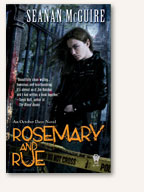
Cover Image: Rosemary and RueRosemary and Rue…isn’t terrible. It is one of those books that is perfectly serviceable, but also demonstrates how difficult writing really is. I joke about my fantasy ‘trash’ books, but the truth is that my favorite authors manage to create empathetic characters in a relatable world, even when that world is so crawling with vampires, werewolves and fairies that it bears very little resemblance to the real world. They make it seem so effortless and natural that I can laugh off the books as ‘trash,’ until a book like Rosemary and Rue reminds me how much skill really goes into writing fantasy by showing me the pitfalls that other authors have avoided.

In case I haven’t damned it enough with the faintest of praise, Seanan McGuire writes like I would, constantly having to remind the reader (and possibly herself) of the perimeters of the supernatural elements of her world, that amateur error of telling (over and over) instead of showing. Unfortunately, even the telling often contradicted itself, to the point where I seldom fully understood what was going on in the plot. Some examples after the spoiler cut:

Continue reading

Live With A Man and Love It

By Anne Fisher

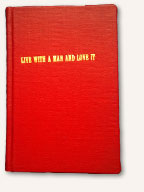
Book Cover: Live With a Man and Love ItLive With A Man and Love It, published in 1937, is a small red book that Thomas and I ran across several years ago at the Boulder library sale. We bought it for a dollar to have a laugh, and then promptly forgot about it.* I was additionally a little charmed by the author’s acknowledgement that one wouldn’t naturally and automatically love living with a man.

Book Inside Page: Live With a Man and Love ItWhen I finally cracked open my copy, I found several pages have some disconcerting rust-colored stains, hinting at the possibility that at least one reader decided not to learn to love living with a man, and chose a more violent solution.

Anyway, Live With A Man and Love It unfortunately falls in sort of a murky area between being hilariously out-of-touch and being an actually useful relationship guide. I was surprised how modern some of the advice seemed to be:

“During the first year have a monthly check-up in which you both agree to be perfectly honest and frank, and tell the other fellow about the things he does that are irritating. Promise not to get sore, but endeavor if possible to change the faults.”

Seriously, that’s not bad advice at all (though probably easier said than done). But before I could get too impressed she would bust out some shockingly dated language:

“Urge him to see other people once in a while. He won’t get that love-strangled feeling and he’ll come into the noose without knowing it’s tightening!”

My favorite part of the book is getting a peek into life and marriage in the 1930s, like spending evenings visiting friends and neighbors, playing bridge and handing out calling cards. That is so different from my own life that it blows my mind! It sounds like it could be kind of nice, actually.

The book also brings up a personal rant of mine, so I’m going to take the opportunity to share it here: Rule 11 in the book is “Never Go to Sleep With a Quarrel.” I think that rule is just the worst and was probably invented by a divorce lawyer. Just keep staying up later and later, while you both get increasingly tired and cranky, until you both dissolve into crying and screaming barely coherent insults? Seriously, just go to bed! You’ll be amazed at how much less you care about whatever you were fighting about once you get a good night’s sleep. So, there’s my relationship advice for you: always go to sleep (actually that’s sort of my general advice for most things in life).

*I had a little daydream that perhaps this overlooked little book would be a rare antique, but no luck.

—Anna

Whispers Under Ground

By Ben Aaronovitch

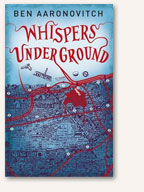
Book cover: Whispers Under GroundI have been eagerly awaiting this third book in the series for several months now, and I should have been using that time to reread the first two books. Whispers Under Ground does not stand alone very well, and unfortunately I’d forgotten a lot more of the previous books than I’d realized. No doubt due to my poor memory, the plot seemed a bit muddled, but the characters were just as charming as ever (seriously, PC Peter Grant is one of the most likable characters I’ve ever read).

Addressing the characters, however, leads me to a bit of a rant about the book publishing industry: why don’t the people writing the blurb on the back of the book actually read the book?! Here’s the last few sentences of the back cover description for Whispers Under Ground:

“…It’s up to Peter to plumb the haunted depths of the oldest, largest, and —as of now—deadliest subway system in the world. At least he won’t be alone. No, the FBI has sent over a crack agent to help. She’s young, ambitious, beautiful…and a born-again Christian apt to view any magic as the work of the devil. Oh yeah—that’s going to go well.”

I first read that and was actually kind of dreading this new character, which seemed like such a fantasy and mystery trope: the mismatched partners, with the protagonist having to scramble to cover all evidence of anything magical. I don’t think it is a spoiler to say that this character doesn’t exist in this book. There is an FBI agent; she is female, smart and ambitious; the book never mentions her religion or level of attractiveness. I liked her, and I was impressed by Aaronovitch writing her. I’m not impressed with the author of the back blurb trying to fit an unusually professional relationship into a trite drama.

Okay, rant over and back to normal programming: Aaronovitch, who previously wrote episodes for Dr. Who, is clearly, and endearingly, a huge fan of the entire fantasy genre. Affectionate references to the Lord of the Rings, Avatar: The Last Airbender (cartoon, not movie), Dungeons & Dragons, and The X-Files are sprinkled throughout the text. It became kind of a game for me to try to track down all allusions.

—Anna

Thirteenth Child and Across the Great Barrier

Patricia C. Wrede

Book Cover: Thirteenth ChildPreface and warning: I have been a HUGE Patricia C. Wrede fan ever since my best friend gave me Talking to Dragons for my birthday when I was twelve. At the time, I’d never read anything like it: adventure, fantasy, humor, and light romance all together in a book with a narrating hero that a preteen girl can empathize with and a heroine that she can admire. Wrede is particularly clever with creating characters and narratives that subvert traditional fantasy tropes: clumsy knights, ditsy princesses, wizards that melt with soapy water, and dragons that demand complicated etiquette, I believe to date that I have read all of Wrede’s books, even though they tend to be quite young, “young readers” rather than “young adult.” (Upon a quick consultation with amazon, there is actually one of her books I have not read – a ‘junior novelization’ of The Phantom Menace, and I think I can be excused for not only not reading it, but pretending it simply doesn’t exist.)

She also manages to blend the fantasy genre and period-piece genre better than almost any author I’ve read. I won’t totally divert this review, but Sorcery & Cecilia is just such a wonderful fantasy story set in the Regency period, and is just such a perfect blend of historical romance and fantasy that it seems so easily done, but it clearly isn’t*.

Book Cover: Across The Great BarrierAnyway, the Frontier Magic series is set in an alternative universe that is obviously similar to our pioneer days in the United States, but with a world that developed with magic. The main character and narrator is a young girl who is born the thirteenth child in her family, which is considered extremely unlucky, to the point where relatives insinuate she probably should have been “taken care of” at birth. Within the first book, Thirteenth Child, she grows from about 5 years old to 18, growing up, going to school, and learning magic, and then the second book continues for the next couple of years, where she takes on her first magical job as a young adult. The third book, The Far West, sounds like it starts off where the second book ends.

Both books are a bit more atmosphere-driven, and less crisis-driven, so it has a leisurely pace that can take a little adjustment as a reader of rip-roaring adventure stories. However, it is such a charming book in every way, from the magical elements to just the frontier elements—it reads a bit like a fantasy version of Little House on the Prairie. And, seriously, what could be better than that?

—Anna

*Aside rant: how is this so difficult? Seriously, one would think the two would go hand in hand—vampires and all sorts of other magical creatures are immortal, after all. The audience that reads fantasy books has a pretty big overlap with the audience that reads historical novels and romances, I believe. How is almost every period-piece fantasy book I’ve read just terrible?

Rest in Peace, David Rakoff

I have been seeing and reading a lot of eulogies for David Rakoff today, and wanted to add my two cents. I knew who he was, of course, but hadn’t realized how ubiquitous he was. Author, commentator, artist, dancer, comedian: truly a Renaissance man in the modern world. I only realized now how much he contributed to so many of the mediums I love. I’m sad that I didn’t know his works better, and am going to try to remedy that as soon as I can.

—Anna

Restaurant Reviews From a Privileged Nine-Year-Old

By Jesse Eisenberg

A couple of nights ago, I was just feeling kind of off, you know? Like, nothing was wrong, but nothing seemed quite right, either. Probably because my days are no longer spent mostly on the beach, napping, and snacking. I couldn’t find anything interesting to me, and I was sort of half-heartedly browsing my regular blogs and one of them linked to a series of fictional essays that actor Jesse Eisenberg (The Social Network or Zombieland, depending on how high or low your brow is; I think you can probably guess which movie I know him from [go see Zombieland—it is awesome!]) has been writing for McSweeney’s.*

Anyway, Eisenberg is enviably as good an author as he is an actor, and the stories, called Restaurant Reviews From a Privileged Nine-Year-Old, both made me laugh and kind of broke my heart, and were just the perfect reading for an hour before bedtime.

*I don’t know what it is about McSweeney’s, but I find it really daunting, so I never just go on and browse. Maybe because it is so beautifully designed or so chock full of very clever writing? Whatever it is, it is clearly too nice a site for me. However, whenever anyone sends me a link to an essay on McSweeney’s, I can pretty much guarantee that I’ll love it.

—Anna

Is Everyone Hanging Out Without Me? (And Other Concerns)

By Mindy Kaling

Having finished The Checklist Manifesto on my beach vacation (taking a lot of grief from my friends for bringing such antithetic beach reading), I picked up Mindy Kaling’s memoire, Is Everyone Hanging Out Without Me?, at my friends’ house while waiting for my airplane back home, and it really would have been a much more suitable book for the beach. I really enjoy Mindy Kaling as Kelly Kapoor in “The Office,” and I’m a little embarrassed that while I realize logically that as a successful writer, director and producer, she must be much smarter and more insightful than Kelly, she does such a good job of inhabiting that character that I keep sort of forgetting that she’s not Kelly. At least I’m not alone at this, because Kaling includes a whole list of ways she is similar and ways she is dissimilar to Kelly as a service to her readers. In all of our defense, she does actually have quite a few similarities, including the tone of the book.

My friends had warned me that it isn’t quite on the level of Tina Fey’s Bossypants, and it isn’t, but I think I enjoyed it just as much, quite frankly. Bossypants is a much more traditional memoire, while Is Everyone Hanging Out Without Me? is more of a collection of comedic bits strung in chronological order of her life. I perhaps would have liked a little bit more about her actual life stories, like her childhood in what sounds like a very well-to-do and predominantly white neighborhood in Massachusetts, the lasting friendships she made in college, and her breakthrough in New York and then LA. But, I wouldn’t have wanted to sacrifice the stand-up-comedy tone of the book, either. I do also love “listicles,” which are getting a bit of a backlash on the Internet nowadays, and there are several chapters that are structured as lists.

So, basically, this would have been a great book to read on the beach but was also a good book to read during the Olympics’ endless volleyball games, being then easy to put down for the gymnastics or diving.

Graphic design addendum: I think this book just has the prettiest cover ever. Like, lots of covers are elegant, striking, distinguished, mysterious, or garish, but I can’t think of another one that is just so straight-up pretty.

—Anna