Dark Triumph

By Robin LaFevers

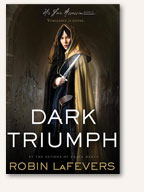
Book Cover: Dark TriumphKinsey recommended the first in the His Fair Assassin series, Grave Mercy, just a couple of weeks ago as a fun historical romance about deadly nuns. I was at the library when I read her post, and figured, why not? I checked it out, despite the size of the book (large), the cover of the book (beautiful girl posing melodramatically), and the inside blurb description (“For how can she deliver Death’s vengeance upon a target who, against her will, has stolen her heart?”), and I gobbled it up within the next week. It is just nonstop fun with the historical intrigue, which I liked better than Kinsey, and lots of romantic hijinx. I had a great time reading it, but wasn’t sure I was going to continue to read the series until I read the little teaser for the sequel in the back, at which point I immediately went back to the library to get the sequel.

Dark Triumph follows a peripheral character introduced in Grave Mercy, another, more troubled novice of the nunnery for the God of Death. The book focuses more on the character and her past than the surrounding politics, and is thus able to make her more nuanced and interesting to follow. The two books remind me a bit of Ilona Andrew’s Edge series, where the first one is lots of fun action with somewhat generic heroine and hero, and the second one takes the more interesting side character and continues his story. While I liked Grave Mercy, I loved Dark Triumph, and literally struggled to put in down at times within the three to four days that I devoured it. So Grave Mercy is worth reading if only to then read Dark Triumph (which does not stand alone, so needs to be read sequentially).

I would be reading the third book in what I believe will be a trilogy if it was out already, but unfortunately I have to wait until Spring 2014. I’m not terribly intrigued by the heroine, already introduced in the background of both books, but I’m hooked on the series now. In the meantime, I will leave you with a phrase from a critic’s praise for Grave Mercy that I found amusing (from the back cover panel of Dark Triumph): “a plot that nods to history while defying accuracy.” (Yep, that seems about right.)

P.S. – While looking for the book cover image, I ran across the author’s website, where she has posted the first chapter of Dark Triumph, which gives an excellent preview to the book, and also does spoil Grave Mercy a bit, so use caution.

—Anna

Among Others

By Jo Walton

Book Cover: Among OthersKinsey introduced me to Jo Walton through her Small Change series, which is actually pretty brilliantly titled, now that I think about it. The three books, titled Farthing, Ha’penny, and Half a Crown, are solidly written English murder mysteries with the added brilliance of being set in an alternate history in the 1930s and 40s in which England supported the German Nazi Party (which is not all that improbable: if not for Wallis Simpson, Edward, a known nazi sympathizer, might have stayed on the throne). Anyway, the mysteries themselves are intriguing, but it is the setting and characters that really make those books shine.

When I ran across several (very favorable) reviews for her new book, Among Others, I added it to my to-read list immediately. It was described in the reviews as a coming-of-age story set in a world of magic and fairies, and I was so there! It…isn’t exactly that. I still really, really liked it, but the magic is very much in the background, an alternate setting like in the Small Change series. It follows a teenage girl from Wales recovering from personal tragedy while attending a very British preparatory school, and on occasion she confers with local fairies for advice. The magic of the world is utilized very effectively as a way to look at the world around you and make decisions for the direction of your life. I quickly got over any disappointment in the marginalized fantasy because once again, the characters and settings were completely engaging.

I’ve insisted that Rebecca read it next because I think she’ll appreciate the one aspect of the book that I found a bit alienating. Very minor spoiler: Mori, the heroine, finds comfort and friendship in a SF book club held at her local library. Much of Among Others is a love letter to the genre of science fiction and all the great authors that founded the genre. I’m not much of a SF reader, though; I had only read a few books by the authors mentioned, and I had liked even less. (The book is set in 1979, so I kept having to bite my tongue against criticism over the omission of more recent authors.) The heroine and the club are very sniffy about people who don’t like science fiction, and the book does such a good job of carrying that feeling through in the writing that I felt the alienation a bit as a reader.

—Anna

Dark Places

By Gillian Flynn

Book Cover: Dark PlacesDark Places made me feel terrible, but at the same time I read it straight through in just three days, staying up far too late into the nights.

Kinsey has previously reviewed two of Gillian Flynn’s novels, Gone Girl and Sharp Objects, and had recommended Dark Places to our friend Cara. (Kinsey in fact said that when Cara asked for summer reading recommendations, Kinsey, knowing her tastes, combed through all of her recent favorites for the most grim and depressing.) When I went to visit Cara a couple of weeks ago, I picked up her copy to just check out the first few pages. One of the first things I did when I got home was put a reserve on it at my library and then waited with literary withdrawal symptoms (lack of focus, irritability…) for my request to come in.

The book follows Libby Day, the sole survivor at the age of seven of her family’s massacre, supposedly by her older brother in a Satanist sacrifice. At the beginning of the book, she is a severely emotionally stunted adult who simply lives off of the charity donations that accumulated during the news frenzy of her family tragedy. She is nearing the end of her funds when she is contacted by a club of true crime fans who want to pay her to help them prove her brother’s innocence. She agrees solely out of financial desperation but becomes caught up in the investigation herself.

The book seesaws between Libby’s current search for the truth and first-person perspectives from both her mother and brother on the day before the massacre. I mean this as a total compliment, but as I read through it, the sense of doom and accumulating circumstances felt very real, like gathering storm clouds. (This is not a good book for Rebecca.) Like Kinsey described in Gone Girl, as a reader you have no idea how it is going to pan out, and keep wavering in each chapter: did the brother do it? Surely not, but wait, did he, though?

One night, after finally tearing myself away from the book, I was thinking about how insane all of this Satanist stuff sounds, like just completely bonkers, and all of a sudden I remembered it! For those of you who didn’t live through the 80’s, it sounds completely absurd, and it absolutely is, but it was also truly there: this very real fear that there were Satanist cults lurking in every town, just waiting to grab young children off the street and sacrifice them in a violent ritual. It is so ridiculous (and eventually discovered to be totally unfounded) in retrospect that I had completely forgotten about it until this book, and suddenly I remembered as a child, peering into graffitied tunnels (where I’m sure the local teens just went to smoke) and thinking, “that could be a lair for the Satanists.”

It really kind of boggles the mind when this kind of national hysteria occurs, and one of the most powerful aspects of this book is that it really brings home how unlucky individuals can be destroyed before we all recover our senses.

—Anna

The Outlaws of Sherwood

By Robin McKinley

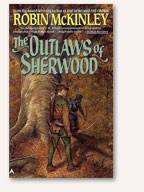
Book Cover: Outlaws of SherwoodI mentioned The Outlaws of Sherwood in my previous review as a possible non-homophobic treatment of a heroine-in-disguise romantic plot. I decided that since it had been years since I’d actually read it, though, I was a bit fuzzy on the actual treatment, so figured I’d better reread it.

Robin McKinley is a favorite author of mine, so even though this isn’t one of my favorite books of hers, it is still better than most books out there. It is also the most realistic and least romanticized version of the Robin Hood story that I’ve ever read/seen/heard. This can make it a bit slow at times—Robin is often unsure of himself and uncomfortable with his increasing renown—but the characters really shine. The outlaws of Sherwood Forest are desperate people who are simply trying to stay alive in a time of political and economic upheaval while keeping as much a moral compass as possible in their circumstances.

Unfortunately, per my previous review, the Little John storyline was not quite as extensive as I’d remembered, with the woman-in-disguise element dealt with summarily enough that it does not really address the issue of potential homophobia. On the flip side, the female characters themselves are, I believe, the most interesting and nuanced characters, so at least there is a strong feminist theme.

—Anna

Seven Daughters and Seven Sons

By Barbara Cohen and Bahija Lovejoy

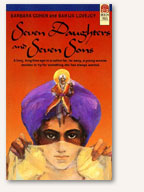
Book Cover: Seven Daughters and Seven SonsRebecca and I were discussing the other day whether it is possible to have a romantic storyline with the old trope wherein the heroine dresses as a boy without including even a hint of homophobia. You know: girl is disguised as boy, girl meets and falls in love with boy, and boy discovers the disguise when he also falls in love with girl since he just knew he could never have those kinds of feelings for another boy. The Fourth Vine writes up an excellent analysis of the inherent homophobic issues in Georgette Heyer’s The Masqueraders here.

I had suggested Robin McKinley’s Outlaws of Sherwood as a possibility, in which Little John says that after he began to have feelings for an apparent boy, he studied her more closely to see what was attracting him since he had never before felt that way for a boy, and then saw through the disguise. It is a fine point, but an important one that he didn’t automatically know that she was a woman because of his feelings, so he wasn’t immediately repudiating homosexual attraction. Confusion instead of repulsion.

Rebecca suggested Seven Sons and Seven Daughters, in which the middle daughter in a family of seven daughters dresses as a man in order to go out and make her fortune in trade like her male cousins do. I’d never read it, but was at loose ends, book-wise, so figured I’d give it a shot. It is also quite short, since it is more Young Readers than Young Adult (I would estimate late elementary/early middle school). It does still have some of the inherent anti-gay sentiment, though more by omission in that it never occurs to the love interest that he could be romantically attracted to a boy. Either he has a strong brother-like friendship with a young man or a great romance with a young woman, and the gender of his person of interest will determine that. Considering that this book is the retelling of an eleventh-century Iraqi folktale, that is pretty good.

More interesting than the treatment of the romance-in-disguise, though, was the description of the evolution of Sharia law in the Middle East. The heroine Buran’s family is very poor and pitied by the locals because having seven daughters and no sons at all is clearly a curse from Allah. Sons are how one gains wealth and prestige, and Buran’s wealthy uncle is considered additionally blessed with his seven sons. When coming up with her idea to set out as a man, Buran thinks back over the previous centuries, when women were free to be “musicians, scholars, warriors, poets, and merchants,” and describes how the caliphs had given their power away to the conquering Persians, who brought with them the hajib, and then the Turks, who brought even stricter restrictions for women.

Even though the book itself is very clearly pro-women, the pervading anti-women sentiment in the general society can be a bit shocking to modern ears. One reason Buran is able to stay disguised as male for several years is that no one believes that women have the minds for business strategy, so if someone is successful in business, that person is unquestionably male, all appearances aside.

As evidenced by this quite long review, this 220-page, large print book for young readers gave me quite a bit of food for thought, especially in our current political discourse on the Middle East, Islam, terrorism, gender roles, definitions of traditional families, and sexual equality. Not so bad for a couple day’s reading of a folk tale and love story.

—Anna

The Tightrope Walker

By Dorothy Gilman

Book Cover: The Tightrope WalkerDorothy Gilman is most well known for her Mrs. Pollifax mystery series, but I like her stand-alone books better, and I like The Tightrope Walker best of all. Actually, Mr. Penumbra’s 24 Hour Bookstore reminded me a bit of it, and I meant to mention that in the comments of Kinsey’s review, but I forgot, so I figured I might as well reread The Tightrope Walker and review it on its own. Both books feature a central character who is sort of lost and floating through life without a purpose until they get work in an eccentric shop, and both are drawn into a mystery through an artifact within the shop. How’s that for a very specific genre of books?

Both also have a sort of sincerity in the characters and the message that is not that common in modern books. I am very definitely a Gen-Xer and sincerity mostly makes me super uncomfortable (I am way more at ease with satire and irony), but in both of these books, I find it fresh, original, and charming. The Tightrope Walker is especially impressive, I think, with how it positively addresses the newish movements in feminism, psychotherapy, and new age philosophy in the 1970s. The heroine has childhood trauma that she works through with a variety of processes, but she is so optimistic about every movement and philosophy that as a reader you see the attractions of them all, even the ones that are more scorned today (the love interest is introduced early in the book doing meditation in a portable pyramid). It still reads so modern that every time I read it, I am a bit surprised when the heroine buys some bellbottom slacks.

—Anna

New Development in Publishing

I just finished Rainbow Rowell’s Attachments, which Kinsey has already reviewed, so I’m just adding on that I LOVED it, and everyone should go read that, too (right after Good Omens). It was seriously one of those books where I was disappointed that it actually ended because I would have been happy to keep reading it for months.

Anyway, this is not a post about Attachments, much as I loved it. In order to get some more Rainbow Rowell after finishing the book, I immediately went on twitter and followed her, and she is currently talking about a very interesting new event in the literary world: Amazon is buying the rights to tv shows in order to try to monetize the corresponding fanfic.

It is all very new and embryonic, so no one is quite sure how it is going to work, but just that it is certainly going to change things up and it will be quite interesting to see how. Rowell and her followers bring up some very interesting points about what it means to monetize a previously free art form and to normalize a fringe culture (particularly a female-dominated creative outlet into a male-dominated media field).

Rebecca has previously given a basic overview into the world of fanfic here, and wants to think over this new development before commenting (she concurs with Rowell’s tweet, that she has many thoughts but few opinions yet on this news).

Discussing it with Rebecca, though, it occurred to me that this isn’t quite as much a sudden new development as it is being reported. Rowell brings up that every author after Stan Lee that used the character Spiderman was in essence writing fan fiction. Sherlock Holmes works continue to be published long after Conan Doyle’s death. Publishing houses have already started searching out popular fanfic authors for original works, and have even published fanfic pieces, just with changed names. So we keep moving forward at a fairly steady pace, I guess?

—Anna

Good Omens

By Neil Gaiman and Terry Pratchett

Book Cover: Good OmensThis is less of a book review, since I’ve read Good Omens at least half a dozen times, and more of a PSA:

GO READ THIS BOOK!

Seriously, it is awesome! The basic premise is inspired by Antichrist-genre movies, such as “The Omen” (which I also love, but you don’t need to in order to love this book), but with a twist: what if the Satanic nuns, who were supposed to switch the infant Antichrist with the newborn of the American consulate, accidentally misplaced him instead, and he ended up being raised by perfectly normal and very British middle-class parents in a small English country town?

After introducing the premise, settings, and characters within the first 60 pages, the majority of the book takes place over the four very busy days before The End Of The World. High-jinx ensue, of course, and there is a surprisingly wide array of players, including angels, demons, nuns, witches and fortune-tellers, witch hunters, nosy neighbors, and, of course, the Four Horsemen of the Apocalypse.

Both Neil Gaiman and Terry Pratchett excel at creating literary screwball comedies with dozens of characters all running around at cross-purposes. To my mind, though, the two authors are so perfectly matched because each balances the other’s weaknesses as well. Gaiman can get a bit melodramatic, while Pratchett is often too silly for me, so the two of them together create a fast-paced story with a light touch that doesn’t get bogged down in either symbolism or puns.

—Anna

Red Glove and Black Heart

By Holly Black

I previously reviewed the first in this trilogy, White Cat, which I absolutely loved. I can’t really review these subsequent books, though, because it is the kind of series where even reading the back blurb of each book gives away brilliant twist endings from the previous book. I can’t just not review them, though, because they are awesome! I wanted another chance to tell everyone to go out and read the whole series. I swear you’ll just devour all three in one lost weekend of literary debauchery!

Book Cover: Red GloveAnyway, without any spoilers for any of the books, Red Glove really brought home to me what I love so much about these books: they are noir mysteries, full of old school gangsters and con men and corrupt cops, but also noir-lite, set in high school, or rather an up-scale preparatory school. Our protagonist is classic teen boy, often angry and with poor decision-making skills, but is also a very amusing and often clever smart-ass.

Red Glove spends more time in the school itself than White Cat, which I appreciated. I really love world-building and just the mundane details of the school life were fascinating to me (I especially loved the school scenes in Harry Potter, too).

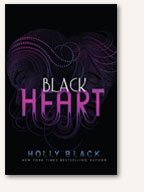
Book Cover: Black HeartEach book, too, gets a little wider in scope. White Cat deals with the protagonist’s direct family, while Red Glove extends more into the criminal world surrounding the family (I swear, these are all elements introduced right off the bat, and not spoilers). Black Heart goes even further and deals with the politics and government of the world. Unfortunately, I believe that this series has been planned as a trilogy with no subsequent books anticipated, though I would be a happy reader if Holly Black decided to revisit it.

—Anna

Free Comic Book Day

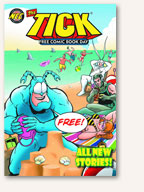
Free Comic Book Day Comic: The TickIt’s that most wonderful time of the year (tomorrow)! On the first Saturday of May each year, comic book stores around the country host Free Comic Book Day, where they offer free special edition comics from the various publishers, as well as store-wide sales and raffles. The free editions aren’t the best stories, of course, but they can be good introductions to new series, and if you are a comic book fan, it is just a fun community event. The official website has a store finder, and I definitely recommend just stopping by your local store if you have any interest in comic books.

—Anna