All Seated on the Ground

By Connie Willis

Years ago, author Connie Willis released a collection of delightful Christmas-themed scifi stories called Miracle. The two best stores are considered annual reading in my family: one is about a woman who gets “haunted” by a Christmas spirit that insists on granting her heart’s desire; the other is about an invasion of puppet-master type aliens during Christmastime. My extremely brief summaries here do not at all capture how funny these two stories are, which is what makes them so wonderful (not all the stories in the book are funny, and be warned, when Connie Willis goes serious, she goes very serious indeed.).

Then, in 2011, Willis released the novella “All Seated on Ground,” which I put off reading due to my dislike of novellas (they always seem both too short and too long), even though it sounded like it recaptures the tone from her earlier Christmas stories. Unfortunately, I felt that it recaptured her earlier writing a little too much, becoming a bit of a retread. Once again, aliens have come to earth, but in this scenario, they have landed and then proceeded to stand around, saying nothing but glaring disapprovingly, while an array of academics and politicians attempt to communicate with them. This has been going o for nine months until just before Christmas, when they react to something for the first time by promptly sitting down upon hearing the line “all seated on the ground” in a Christmas carol.

The novella then follows the rush to determine what they are reacting to and what their reaction is trying to communicate. I love the idea of having to deal with disapproving aliens on top of all the other holiday stresses, but the implementation was just so similar to some of Willis’ other stories that while it was still quite funny, it was just not as surprisingly funny as some of her earlier work.

—Anna

P.S. – In case you are looking for a quick holiday-themed distraction at work, may I recommend Cracked’s “6 Things People Get Wrong About the Bible’s Christmas Story”? This line made me snort on the metro: “It wasn’t until the Middle Ages that the magi began to be described as kings, largely to make the New Testament story better match the Old Testament messiah prophecies, and probably because ‘kings’ sounded better than ‘magical spice perverts’.”

Lean In: Women, Work, and the Will to Lead

By Sheryl Sandberg

Book Cover: Lean InSo, clearly, there has been a ton of buzz about this book, which tends to turn me off a bit, but when it came up at Rebecca’s work, we decided to bite the bullet and read it (I just beat her to it here on the blog). I entered with super low expectations—I had imagined some sort of 80’s powersuit, dog-eat-dog type of guide—but I have to admit that I very quickly changed my mind.

After reading the introduction, where Sandberg directly addresses how complicated and potentially problematic it can be to try to give blanket professional advice to women across all lifestyle choices and financial situations, I thought, okay, this might not be so bad. After the first couple chapters, I started to find points relevant to my own work behavior, and by a third of the way through, I was completely sold on Sandberg.

Now, I did have to tailor the advice to my own situation, of course. I am not a particularly aggressive or ambitious person, pretty much directly opposite to Sandberg herself, but one of the most important take-aways for me was guidance on how to work with aggressive and ambitious people (especially being vigilant about not letting cultural indoctrination lead me to react poorly to women in particular being this way).

So, I guess I’m just jumping on the very crowded bandwagon to say that this book is both a worthwhile read and actually a pretty entertaining one, as well. (In the acknowledgments page, she thanks her editor “who never heard an anecdote that couldn’t be expanded on” and I’d like to extend my thanks to her, too, since I love a good anecdote!) So even if you don’t think it is your type of book, you may very well enjoy it.

—Anna

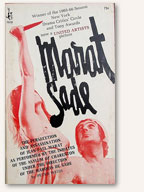
Marat/Sade

The Persecution and Assassination of Jean-Paul Marat as Performed by the Inmates of the Asylum of Charenton Under the Direction of the Marquis de Sade

A Play by Peter Weiss

Book Cover: Marat/SadeI’d heard of this play years ago, and not to put too fine a point on it, it sounds like a complete clusterfuck, and I have been curious about it ever since.

The premise is based on the historical facts that Marat was assassinated during the French Revolution in 1793, that Sade participated in the revolution and even made the memorial address at Marat’s funeral, and that Sade later put on plays with the other inmates during his internment in Charenton Asylum from 1801-1814.

In this fictionalization, Sade is producing a play about the assassination of Marat, casting the various other asylum inmates. It is quite short, just two acts that together are just 102 pages, and it starts off surprisingly funny, with sort of slapstick humor around the extremely amateur production. I was pleasantly surprised, and thus lured quite capably into the subsequent ugliness surrounding the French Revolution and Sade’s personal philosophies.

Both the revolution and Sade committed horrific atrocities, though they came from opposite justifications: the French Revolution declaring that some violence must be committed for the improvement of society (so, basically, a regrettable side effect in the search for good), and Sade declaring that the only way to understand the human condition is to explore the very worst of it (the search for evil as humanity’s defining feature). This basic disagreement is explored through debates between Marat and Sade that appear to happen outside the play-within-the-play, and possibly only occur in Sade’s head.

The back blurb advertises that “It is total theatre: philosophically problematic, visually terrifying…. The play is basically concerned with the problem of revolution. Are the same things true for the masses and for their leaders? And where, in modern times, lie the borderlines of sanity?” My main take-away, however, was to wonder how much of the political and philosophical grandstanding by Marat and Sade was purely self-serving to justify their own personal indulgences. Sade likes to rape and torture, but he wants to see himself as something greater than just a violent sociopath, so he claims that all of humanity has these same urges, but only he has the courage to explore them honestly. And, though I am more sympathetic to Marat’s ambitions, he clings to his ideal of how the revolution will be played out, with himself as the people’s savior, and any deviation from that is treason and must be eradicated violently and completely.

I would pay quite a bit to see this live, actually – the descriptions of the sets, with a rudimentary stage and props within an asylum, the inclusion of a four-person chorus to punctuate points throughout the play, and the wide variety of players, often wandering on their own would make it quite the spectacle. (I would also like to see the movie from 1967, but the library doesn’t have it, and I don’t want to swing $38 for it, which is amazon’s very cheapest offer.)

—Anna

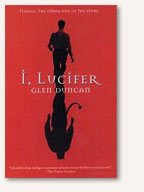
I, Lucifer

By Glen Duncan

Book CoverI actually first ran across the album of the same name by The Real Tuesday Weld several years ago, which quickly became one of my favorites, but even after I found out the album was inspired by this novel, I hesitated to read it because what if I hated it and then couldn’t enjoy the album as much?

However, it was then recommended by a commenter on io9, where I’ve gotten quite a few good book recommendations recently, so I decided to take the plunge. I figured it might be similar to Good Omens.

It isn’t really. It is darker and nastier, which, I mean, makes sense, given we are talking about Lucifer here, but most modern personifications of the Devil as protagonist aim for something a little more sympathetic.

The very basic premise is that God is willing to welcome Lucifer back into Heaven on condition that he lives out a human lifespan in a human body, without committing any mortal sins. Lucifer narrates this ordeal, and is deeply unlikable—his narration is a manic flow interrupted often by praises of sex, violence, abuse and torture. I mean, it is a good job of personifying the Devil, but it was a pain to read at times.

What really surprised me, though, was the more nuanced discussion of the somewhat problematic aspects of religion, like the balance between freewill and predetermination, an omniscient being having an adversary, and Good begetting Evil. It was disconcerting to end a paragraph about bestiality and rape jokes, and start the next one on the deeper meaning of life.

So, this is a little embarrassing to admit, but in the end, I, Lucifer, a memoir of sorts by Satan himself, talked about religion, faith, and devotion in a way that really resonated with me. I realize that this does not speak highly of me.

There is a particular line in which Lucifer scoffs at his previous life as an angel in Heaven: “He turned a side of Himself to us and from it poured an ocean of love in which we sported and splashed like orgasmic kippers, singing our response in flawless a cappella.” And I thought, if Heaven is like being a fish in an ocean of love, surrounded on all sides with love, even breathing love into your body and circulating it throughout so that there is nothing but love and warmth and light in your entire existence, well, that would be pretty nice, I think.

And if you were created in this environment and had experienced only that, ripping yourself free would leave you so wholly cold and empty and hungry, that it would be little surprise that your existence outside of God would be pure torture and the crazed search for something, anything, to fill that void.

So, in the end, I’ve been happily listening to The Real Tuesday Weld’s album all week, so no harm done, and I will say that the odd, vaudeville-style song in the beginning called “Bathtime in Clerkenwell” makes a lot more sense now.

—Anna

P.S. This book actually complements Rebecca’s Biblical reviews quite well. Lucifer has a lot of the same complaints that Rebecca has brought up, particularly about God “not playing fair” when He hardens various people’s hearts so that He can smote them all the harder later.

Mermaid in Chelsea Creek

By Michelle Tea

Book CoverWhew, this is a good book. This is how good it is – I actually started reading slower at the end to stretch it out longer.

Mermaid in Chelsea Creek is basically my favorite kind of book: metaphorical fairytale. And it is a fairy tale, but kind of a grimy one, if that makes sense. Thirteen-year-old Sophie starts getting visions of a mermaid who tells her that she is destined to save the world. Sophie, however, is your average young teenager, cranky, stubborn, and self-centered, trying to figure out her place in the world and her relationship with the people around her. She lives with her overwhelmed single mother in the economically struggling city of Chelsea, MA, where everyone seems to be hanging on by a thread.

It truly is this real-ness where the book really shines. The titular mermaid just puts a mystical filter over the growth every teenager must go through, and how difficult it can be even if you don’t have a grand prophesy to fulfill. Even the various magical creatures are trying to find their places in a decreasingly magical world. The themes of how full of pain and anger and sadness the world is, and how easy it can be to give up in the face of it all, but also how important it is to fight it with kindness and understanding, in whatever small ways are available to you — well, those struck a cord with me right now.

The mermaid is the most fantastical character, for sure, but the pigeons are the best, which is why they are on the cover. I hate to even mention anything that might make someone hesitate to read this, but I do feel that I have to extend a couple of warnings: there is some animal harm, which is pretty devastating, of course, and the book ends on an utter and complete cliff hanger.

The one problem with metaphorical fairy tales, if it can even be considered a problem, is that with things like cliff hangers, you never know whether it means there will be a sequel or if it just serves to show that there are no true endings where everything gets wrapped up. I’m okay with that, actually, but I’m rooting for a sequel because I would love to read it. (Edited to add: there is a sequel – Girl at the Bottom of the Sea comes out next year!)

Incidentally, the hardcover edition is published by McSweeney’s, and is a gorgeous volume, with an embossed cover, thick paper, and lovely line illustrations.

— Anna

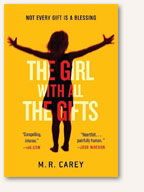
The Girl With All The Gifts

By M. R. Carey

Book CoverI’ve only paused in working my way through the Flavia de Luce series, which I’m continuing to love, because a reserve that I’d placed a while ago at the library finally came in. I hadn’t intended to find an appropriately spooky book for Halloween, either, but I guess things just aligned that way.

io9 gave The Girl With All The Gifts a raving but very coy review. Having read Carey’s other novels, I was willing to take the plunge on this one without more detail about the book itself. This novel has a similar setting as his others, of a dystopian London, but ratchets up the suspense significantly. This is due in large part to the truly excellent characters. I found some of Carey’s previous characters a little cartoony, but his characters here are very real. The novel shifts viewpoints between the various characters, so the reader gets wildly different perspectives on the same situation. Because there is no objective voice, I found my judgments of characters and situations constantly evolving.

The Girl With All The Gifts opens with a strange 10-year-old girl, locked in a small cell in an underground bunker, along with dozens of other children, who are delivered to and from a classroom each day under armed guard. This is all she (and the reader) knows, and while she doesn’t care for the guards, she loves her teacher and is not unhappy.

The book slowly expands from there, with the multiple perspectives helping the reader put the pieces together, which is half the fun, so I certainly don’t want to spoil it here.

In lieu of a longer book description, here’s another Halloween recommendation. I decided that I couldn’t stomach another season of American Horror Story, so to fill the void, I decided to watch HBO’s Carnivale, which I’ve been meaning to watch for years. And it is exactly what I wanted: suspenseful and creepy without being gross. Also, I was congratulating myself on being so smart to recognize all the religious symbolism in the first episode, before I saw how heavy they were hitting in the second episode, so there’s that.

—Anna

Halloween ComicFest

ComicFest 2014I did not know this was a thing until yesterday evening, but now I’m all pumped to go tomorrow: apparently, in addition to Free Comic Book Day in May, comic stores have Halloween ComicFest, where they offer free Halloween-themed comics! I don’t actually have anything to add to that: Halloween! Free comic books! (Okay, I’ll add two things: one of the free comics is done by Terry Moore, who did (does?) Strangers in Paradise, and one is done by Loeb and Sale, the team that created Batman: The Long Halloween, both series I’ve very much enjoyed.)

The Flavia de Luce Series

By Alan Bradley

I read a recommendation for Alan Bradley’s Flavia de Luce mystery series online and was intrigued by the idea of an 11-year-old girl detective in a small British town in the 1950s (seriously, who wouldn’t be?). Reading some background on the series before diving in, I also learned that the author wrote his first book, the first in this series, at the age of 70, which is just very encouraging to people who haven’t quite found the time to pursue their passion yet. Of course, he’s had to spend years now answering why a 70-year-old man chose an 11-year-old girl as his protagonist, which has got to get a little tiresome, but I thought his answer was a good one: he wanted his protagonist to be someone who is almost invisible in society, so is able to go unnoticed in pretty much every situation.

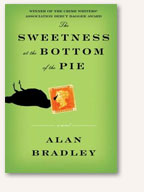
Book Cover: The Sweetness at the Bottom of the PieAnyway, I started with the first book, The Sweetness at the Bottom of the Pie (I love his titles), and it was an utter delight! The mystery is a little obvious, but I was much more willing to forgive Flavia for not putting the pieces together much sooner, especially since a great deal of her time is spent trying to disrupt her family whenever possible. Her family consists of her emotionally distant widowed father and two older sisters banging around in their centuries-old ancestral home, and it is just classic British flakiness.

The author is maybe a little heavy with the similes at times, but though it sometimes distracted me, it was inoffensive overall. A sign of my advancing age may be that I often sympathized with the poor inspector who was just trying to solve a somewhat unpleasant murder and everywhere he turns, there’s a small girl underfoot, certainly quite bright, but still a very young child nonetheless. I struggle a bit to describe how well I think the author describes Flavia’s brilliance while also keeping her clearly quite young.

The second book, The Weed That Strings the Hangman’s Bag (seriously, such fun titles!), however, has a passage in it that I think really showcases the balance and which I particularly loved. I’m including it after a page cut, not because it has spoilers (though it does spoil Madame Bovary, so take that caution I guess), but so that it doesn’t fill up the entire home page: Continue reading

Suddenly Last Summer

By Tennessee Williams

So, I watched “Suddenly Last Summer” the other night – I’d been meaning to watch it for a while because what a cast! Katherine Hepburn! Liz Taylor! Montgomery Clift! Also, what a plot – psychosis, lobotomies, and cannibals! I had no idea how all of this could fit into one two-hour movie, and I’m still not entirely sure, actually.

My first impression (spoiling the big reveal, but you’ve had over half a century to check this one out) was that this was one of the most homophobic movies I’ve ever seen, but then I was confused because the original play was written by Tennessee Williams, who was openly gay himself, and though he clearly had a wide variety of issues, I never thought his sexuality to be one of them. (It turns out I may have been wrong about this, actually.)

There was another, subtler theme of gods and sacrifices running through the play, though, and I wondered if that was more prominent in the original version, and a homophobic Hollywood played up the homosexual angle instead. All of this to say that I checked out the one-act play to see for myself.

So, I remain a bit confused. It is not wildly different from the movie. The first part is pretty much a monologue by the mother (Katherine Hepburn’s character), and it showcases Williams’ trademark Southern mother – overbearing, out of touch, and clinging to old-fashioned social mannerisms. There are some hints that Williams is also criticizing some artifice in the gay lifestyles of the time, though I haven’t gotten to the worst part yet (the end). The lobotomy aspect was rolled out a bit more subtly than in the movie (which wouldn’t have been difficult, since the movie opens on a lobotomy procedure), and is more conflicted about the process than the movie projected (the adulation of the lobotomizing doctor in the movie made me a little uncomfortable, as well).

The second part is mostly a long monologue by the cousin (played by Elizabeth Taylor), and this is where the most problematic parts of the movie come in, with her exposing her cousin’s homosexual and promiscuous lifestyle and how it ultimately lead to his downfall. In the end, I guess I would say that the movie switches the priority of themes from the book; the theme of a sacrifice-demanding god is somewhat more prominent than homosexuality in the written play. Though because the play is really just two monologues strung together by a bare minimum of structure, I would say that this is more of philosophical and/or psychological study than anything else, really. I’m still somewhat baffled by it all, but after doing some brief online research, it looks like I’m in good company; this play is still quite the cinematic controversy. (Also, the contemporary review of the file is a hilarious panning!)


Mike Mignola Graphic Novels

Mike Mignola is most well known as the creator of the Hellboy series, which I find a little too silly for me. However, I really admire the artist that partners with him on the inside pages (Mignola himself illustrates most of the covers and I like his style, too). So, I was interested in checking out some of his non-Hellboy work. I previously read, hugely enjoyed, and reviewed Baltimore Volume 1: The Plague Ships here, and just recently remembered to track down the now-released sequels.

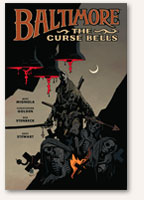
Book CoverBaltimore Volume 2: The Curse Bells

This volume goes a bit darker than the previous one, exploring how men can become monsters themselves through their obsessions. I found it gripping, but not exactly pleasant to read. What I did enjoy, though, was that the story expands more on the alternate history of this world, confirming that it is set just barely post-WWI, with foreshadowing of WWII. It also has vampire nuns.

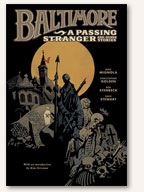
Book CoverBaltimore Volume 3: A Passing Stranger and Other Stories

I was a little hesitant over this one because short stories can go either way, but I really liked it. Mignola uses the shorts to really focus on the characters themselves. We get backstory on two main villains from both previous volumes, and quite a nice look at Baltimore’s struggle to stay moral in his own obsessive quest. It made some of the ickiness from volume 2 more palatable.

Book CoverThe Amazing Screw-on Head and Other Curious Objects

This book is very odd. I believe it is really just Mignola playing around with stories and drawings that he knows won’t hold up to a full graphic novel treatment, but he is so successful that the publisher figured fans would probably be entertained. I would agree, too, that this is probably just for the true fans that want a comprehensive collection of Mignola’s works. The titular Amazing Screw-On Head is literally a sentient head that can be screwed onto a variety of mechanical bodies and does sort of vague battle in service of President Lincoln. Even the backpage blurb didn’t seem quite what to make of it: “If you read only one comic about severed robot heads fighting…I dunno, some damn thing or the other at Abraham Lincoln’s behest, that comic should be The Amazing Screw-On Head.” —Comic Book Resources.

I will say that my favorite vignette in the collection was The Magician and the Snake, written by Mignola’s seven-year-old daughter. It was no less cohesive a story than the rest, and had a very charming description of love and friendship that continues even after death. So, I guess what I am saying is I can take or leave Mike Mignola on this book, but I quite recommend Katie Mignola.

Book CoverWitchFinder: In the Service of Angels

Mignola is back to what I like best: supernatural period pieces. WitchFinder features Sir Edward Grey, recently knighted by Queen Victoria for hush-hush deeds done in service of the crown. In this volume, though, he is tracking a demon brought out of the excavation of an ancient Egyptian tomb and made corporeal in London.

It has a similar feel to Baltimore, though a different historical period and Grey is different enough in character (not quite as hardened and still able to be smitten by a comely medium) that it is not simply a retread. The illustrations are lovely, as usual, and the story interesting, but the pacing was a bit slow. It ends a bit abruptly with only partial resolution, and though there is a second volume out, I’m not sure I’m going to follow up with it. (Except, that upon further research, i.e. amazon description, the second volume takes place in the American West and I love a wild west story.)

—Anna