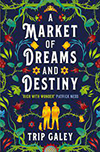
This novel is set in a fantasy version of Victorian England, where one of our protagonists is an indentured servant in a mundane workhouse and the other is indentured in the underground fae market. The two meet by coincidence (or grand design?) and in addition to an instant attraction, seem to also possess skills and access to help the other toward freedom.
Author Galey does an incredibly good job of weaving together the dual goals that sometimes align and sometimes not, as well an immersive world balancing realistic and fantasy elements. He uses the same mirroring to reflect on the many different ways that the poor and working class are exploited by the wealthy, and how whole systems of society are built on exploitation.
The strong plot element and theme of workers’ rights and community mutual aid felt both contemporaneously Dickensian and very timely for 2023 (and hopefully 2024). It also created high stakes for the various plots and schemes that kept me on the edge of my seat for most of the book. At times I clung to the fact that I’d seen it recommended on a romance forum in hopes for a happy ending. (Minor spoiler: though serious sacrifices are made, the final resolution falls into place immensely satisfyingly.)
As I get older, I find I have to work a little harder to generate a holiday spirit among all the daily life stressors and nonsense, so I like to gear up with some seasonal reads:
The Haunting Season: Eight Ghostly Tales for Long Winter Nights
I bought this because it includes a Natasha Pulley story about Keita and Thaniel from her Watchmaker of Filigree Street series, which I adore. The general reader reviews are mixed, with many readers saying that Pulley’s story was the weakest since it doesn’t stand alone if you aren’t familiar with the characters. Being well familiar with the characters, though, my experience was the opposite: I very much enjoyed Pulley’s story, always happy to get more of Keita and Thaniel, but was disappointed in the other stories.
Perhaps it was because I was already familiar with Pulley’s characters, but they were the only ones that I actually liked. Most of the other stories featured either selfish or delusional characters, I suppose to ‘justify’ the hauntings one way or another? The plots also seemed overly complicated and obtuse, so each story ended just as I felt like I was starting to get a feel for it.
Sentenced to Christmas
By Marshall Thornton
Marshall Thornton writes the most ridiculous rom-com and cozy mystery plots featuring a cast of hilarious dirtbag characters, and I get a real kick out of his books. As befits the title, the plot of this book is absolutely ridiculous: arrested for burning down the patriotic Christmas tree in front of a conservative talk radio station, our protagonist Gage is sentenced by a crackpot judge to spend Christmas with the prosecuting assistant district attorney (his own defense attorney being Jewish) in order to “learn the true meaning of Christmas.”
The thing about Thornton, though, is that his dirtbag characters then often react with more realistic cranky befuddlement, and it is consistently laugh-out-loud funny. Only one thing stops me from wholeheartedly recommending this: Gage’s friend and assistant is introduced as non-binary, and that being a point of contention with their family, especially around the holidays. Unfortunately, Thornton presumably forgot, and uses she/her pronouns for them for a chunk of the middle of the book. I am confident that it is an unintentional writing error, and amazon reviews mention that some editorial errors have been fixed, so hopefully this is no longer a caveat.
It’s Okay That It’s Not Okay by Christina Tran 2022
I got this book from the Small Press Expo and it’s really good and also really emotional, about the process of dealing with grief after too long trying to push past it. Trans’ mother died in 2003, but the story is set in 2011, as she deals with the results of never fully allowing herself to grieve before, and not feeling able to grieve anymore. It’s really beautiful and well done, using the graphics to show both how busy she kept herself for years and also how hard the depression hit when she was no longer able to push the emotions away. There were definitely parts I recognized in myself and others. I highly recommend it.
Cat Burglar Black by Richard Sala 2009
This is an adorable classic gothic mystery with gangs of orphaned street thieves, mysterious secret organizations, orphans, previously unknown aunts, mysterious illnesses that require full face bandages, hidden treasures, and a lot of just-off-screen gruesome deaths. There was also a lot of info dumping about the various backstories, but the action was really well done. The deaths had a certain Edward Gorey quality to them. I expect kids and teens would love this, but I might be too old to properly appreciate the many macabre deaths.
Thistil Mistil Kistil by Sarah Schanze 2015
This is gorgeous. It’s another Small Press Expo acquisition that I bought entirely for the illustrations which are amazing, and only then did I pay attention to the story which is also really good. The plot is about a viking kid who has died honorably in battle, but due to circumstances has been blocked from Valhalla and given the mission to find three pieces of famous weapons that Loki has stolen and return them to Odin before he will be allowed to enter. So he goes to Loki to try to figure out what he did with them. Loki is more or less curious about how is all going to play out and probably has motives of his own to go along with this quest to find whatever happened to those pieces. Stuff happens. After reading this, I discovered that it is only the first five chapters, and while the story is not yet completed, the first twenty-two chapters are available online: https://www.tmkcomic.com/archive/ Yay! So I am now all caught up and wow, did things get complicated and I really hope the rest comes soon! But also, just wow, the illustrations are so beautiful and so significant to the story telling.
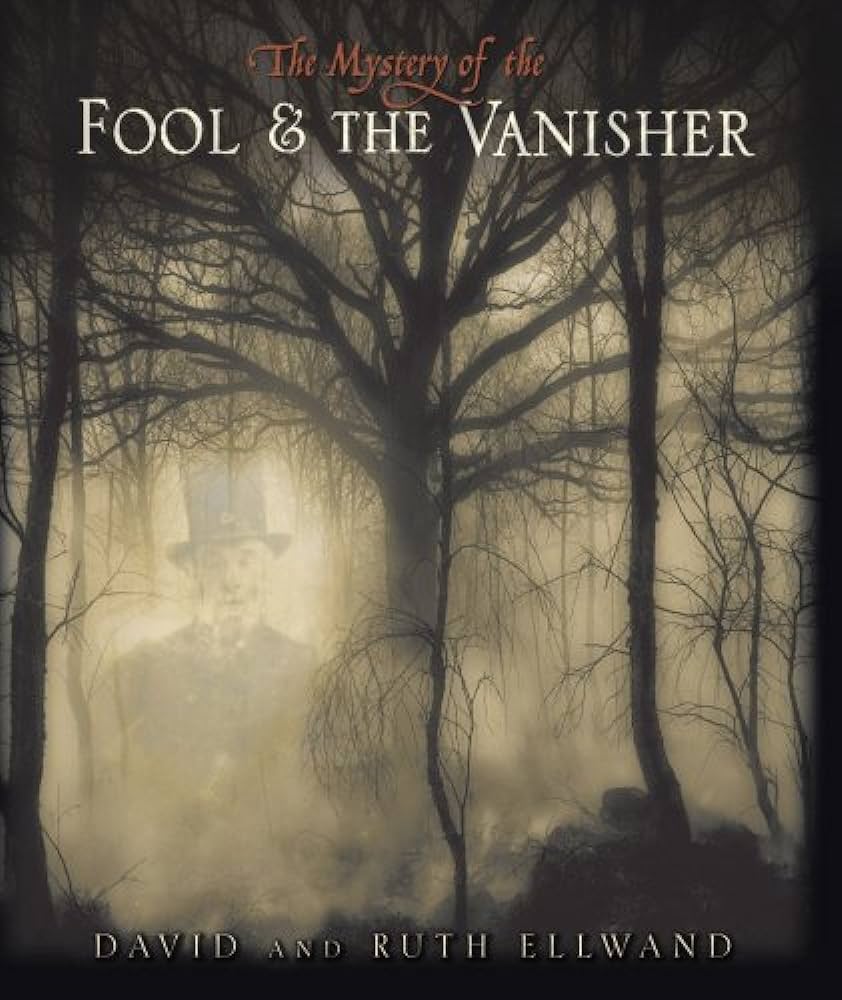
The Mystery of the Fool & the Vanisher by David and Ruth Ellwand 2008
This book is less of a graphic novel and more an extensively illustrated short story. (“Picture book for adults” was how I first phrased this but then thought that sounded pornographic, which this is decidedly not.) The plot is a Victorian gothic mystery about a photographer, an archaeologist, and the pixies who do not appreciate archaeological digs in their territory. The illustrations are all photographs, including photographs of photographs, as the framing story is about a photographer who finds an abandoned locked trunk that contains documentation of a much earlier photographer who tried the prove the existence of the fae folk. (I was much reminded of Arthur Conan Doyle’s attempts to prove such.) It is extremely atmospheric.
I only realized after starting this novel that heist stories usually dovetail into two very disparate directions, either clever and glossy (à la Ocean’s Eleven or Leverage) or gritty and desperate (Six of Crows, for one). I enjoy both in general, but currently have more of the emotional capacity for the first, and The Housekeepers decidedly falls into the second.
The recently dismissed housekeeper from a wealthy household gathers together a team to strip the house of all its valuables. The team is all women, most of whom have served in domestic positions, with all the poverty and humiliation that entails. Each woman has her own private motivations and ambitions, and the cooperation of the team always feels like a very fragile agreement that could break at any time.
None of them are particularly likeable, though I sympathized with all of their positions and the actions they felt forced into. It reminded me a little of Parasite, where the extreme inequality is a prison for everyone involved, whether on the luxurious side or not. I could see a solution where all the characters find true purpose and satisfaction, but given the world they lived in, it was impossible, and instead I read in dread of who would get hurt the worst.
And that world, the society they live in, created a more finely pointed, subtle dread than just the suspense of the heist itself. These women who had once been domestic servants are now in much more precarious financial positions, but also have more personal freedom on their own. When they go back into service to set up the operation, the grind of the drudgery becomes its own obstacle, as manual labor and exhaustion take their toll.
The whole thing became a bit much for me at times, honestly—at times I couldn’t put the book down, but other times I had to take a break after a few pages—and the book carries it right to the end. There was no satisfying wheeling out of the perfect plan, just nail biting, and I was hanging onto the blurb raving about “a sensational triumph and the ultimate takedown of those in power” to ensure a happy ending.
I thought this looked like an intriguing gift for any of my cooking-minded friends, so checked it out of the library to preview it (after a number of astonishing failures, I’m trying to do better about reading books before giving them as gifts). I figured I could flip through it at the very least, but I was shocked how quickly I was thoroughly immersed!
First, it is a beautiful book, with full-page photos to illustrate each story/recipe, and would make an excellent gift I think. This also makes it go by fast: I had casually opened the book just to flip through it, and two hours later, I was halfway through and already eager for the next story. Secondly, it covers so many different foods and so many different situations, including some very timely ones of isolation and illness during the pandemic.
It opens with Samantha Irby’s recipe for Rejection Chicken, a perfect author of brilliant, very human (i.e. often humiliating) stories to set the tone for an anthology about comfort foods in tough times. All the stories were so interesting and varied, with only one dud in my opinion. The final story, too, closed the book with such a humorous disaster that I gasped.
First, let me apologize for the spam post(s?) that have appeared on this blog (I was honestly mortified). I’m not sure how it happened; I’ve been working with WordPress to bolster the security, but I’m not fully confident it won’t happen again. I guess the only assurance I can offer is that it was probably fairly obvious that we are not trying to advertise Romanian casinos to you?
But also, I’ve been in a bad case of reader’s block lately. I’ve started three different books, and stopped less than halfway through each one, losing interest just to doomscroll twitter, tumblr, and reddit instead. I wasn’t sleeping all that well either, and it felt like part of the same thing: just a little too nervy to really relax.
In desperation to actually finish anything, I picked up the copy of bell hook’s Appalachian Elegy that a friend had given me for Christmas, hopefully last year though I can’t swear to it. I don’t really understand the vast majority of poetry but figured it might work as a palette cleanser of sorts for my brain. It is a very short volume: only 66 one-page poems total, but I took my time with it.
She covers the natural beauty of the Appalachians, and ties it into the people there, both past and present, and the opportunities and oppressions that those people have faced. It is a lot to cover, and yet the poems feel airy and lyrical at the same time. I only read 5 or 6 poems each night, stopping when I felt myself either zoning out or trying to rush through the words, and slowly felt like I was starting to unwind. I still struggled with feeling like I was missing the deeper meaning, and I very likely am, but just the words and rhythms became enough for me. I am still struggling to concentrate on anything longer, but this has certainly helped and I hope to remember to turn to poetry in the future as well.
The Body Factory: from the first prosthetics to the augmented human by Héloïse Chochois translated by Kendra Boileau 2021
This is another book I bought from Graphic Mundi at the Small Press Expo and it feels a bit like a Mary Roach book, in that it looks at the history and development of a fascinating but somewhat disturbing topic, in this case amputation and prosthetics. This being a graphic novel* came with some pros and cons in that the illustrations were extremely helpful in following the topic, but also kind of disturbing as the topic started with dismemberment. But it covers a lot of ground very quickly, using a framing story of a young man who loses his arm in a motorcycle accident and is getting through the recovery process.
The book is divided into four main chapters:
Amputation
Phantom Limb
Prostheses
Transhumanism
This book is very much a basic introduction to the topic and concepts that can give you a foundation from which to look into more details, and I found this fascinating and sufficient for the first three chapters discussing history and anatomy but less so for the final chapter which seems a more niche philosophical perspective than a mainstream overview. The mention of how “Eugenics is a matter of great debate among transhumanists who recognize that there are negatives but also positive aspects to eugenics” was a major red flag for me.
So this book is fiction (framing story), nonfiction (first three chapters), and philosophy (fourth chapter.) In some ways this reminds me of Sophie’s World by Jostein Gaarder (a book I only read once, decades ago, so take with a grain of salt) in the way it’s framed, but I didn’t care for that book and I did enjoy this one. Although upon reflection, Sophie’s World was all about philosophy and the one section I didn’t care for in this book was the philosophy chapter.
I did enjoy this book, and I do recommend it, but with some caveats: be prepared for some casual medical gore and expect the fourth chapter to be the author’s take on philosophy rather than the nonfiction of the previous chapters.
* I’ll reiterate a pet peeve of mine that this type of book gets called either a “graphic novel” or a “comic book” and both of those are misleading terms when it comes to books like this one. But I don’t have a better term for it. Sigh.
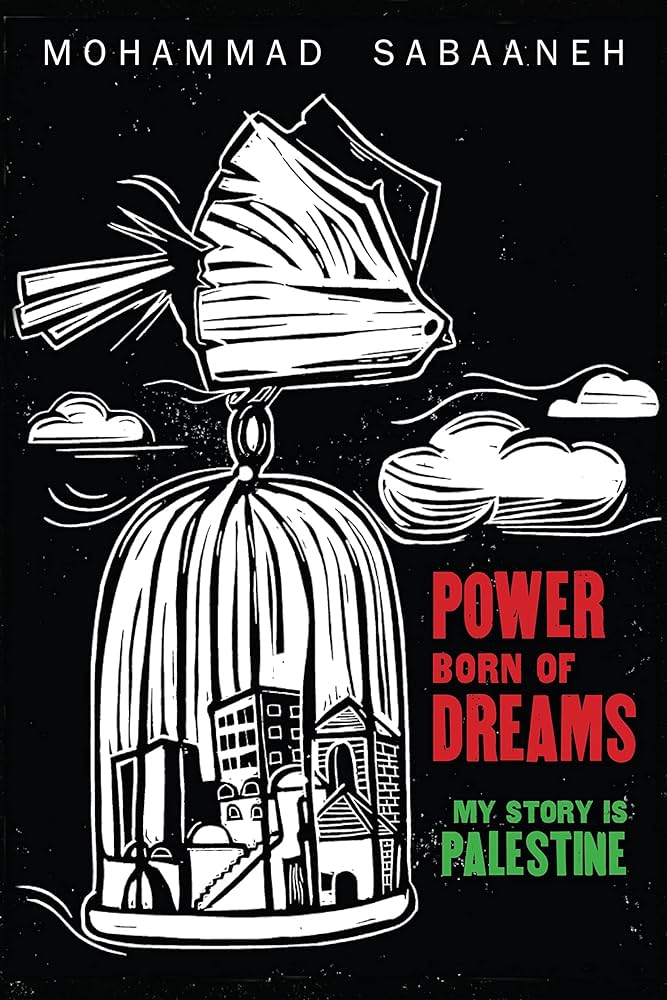
Power Born of Dreams: My story is Palestine written and illustrated by Mohammad Sabaaneh 2021
This reads more like prose poetry than a standard graphic novel, and it’s gorgeous and also devastating. Sabaaneh is an artist, journalist, and political cartoonist who lives in the West Bank but wrote this book while getting his masters degree in London and reflecting back on his time as a political prisoner in Israel and his life in general as a Palestinian. It’s about his life and the life of his community in tiny snippets and stories about oppression and holding onto hope because there’s no other recourse than to hope and dream for better.
I bought this book from the Street Noise Books publisher stall at the Small Press Expo before the most recent series of attacks from Hamas on Israel and from Israel on all of Palestine, but only read it after that was already in the news. The two sets of stories, from reading this book and hearing the news, gave each other context and break my heart. This book is not fictional, for all that it’s structured around a man hearing news from a bird who’s flying through his prison window, and the headlines in the news are not just statistics but real people living and dying and struggling to be free.
The main book is about Sabaaneh’s experience in prison and the small amount of news he was able to hear about what was happening with everyone else, but the afterwards are six single pages with basic introductions to significant historical events, locations, and laws effecting Palestine from 1967 to 2020.
The illustrations are all linocuts (images carved in linoleum and then printed), which are both beautiful and increasingly rare because they’re so time consuming to make. I’m pretty sure the only other book I have that’s similar are the wood cuts in Gods’ Man which was written in 1929.
This book is beautiful and heart-breaking but important, about a current political topic (which is rare for me) and I highly recommend it. Just be prepared to take the emotional hit.
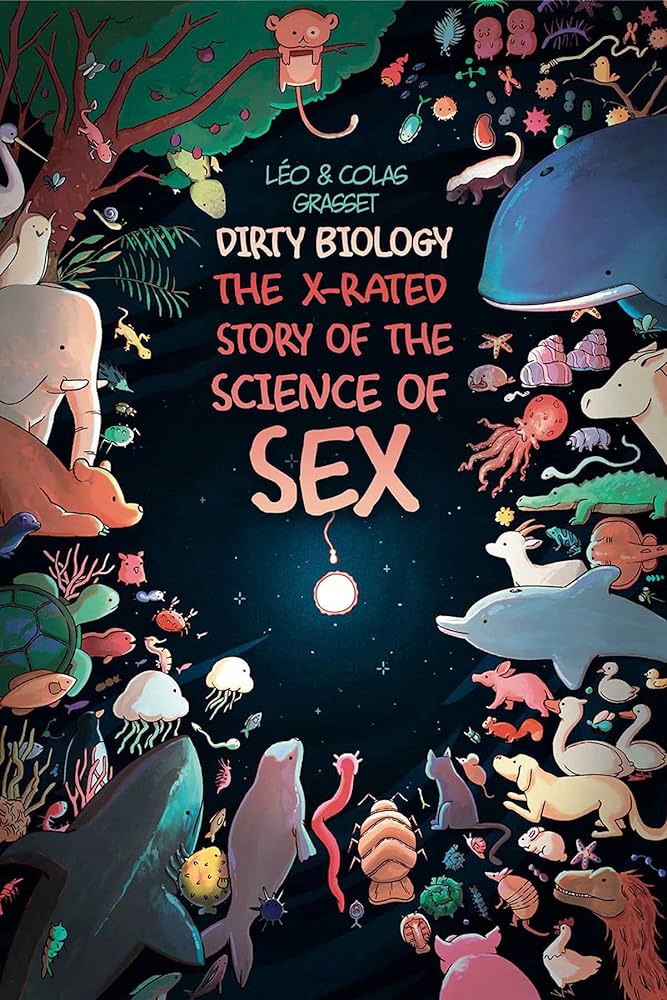
Dirty Biology: The X-Rated Story of the Science of Sex written by Léo Grasset illustrated by Colas Grasset 2021
This is a fabulous and hilarious non-fiction graphic novel* about the biology of procreation through time and across species, on both theoretical and practical levels, and gives a really good basic introduction to the topics and peculiarities, with lots of great examples. The book is narrated by a small cast of cartoon figures that keep the discussion very conversational, and the cartoon nature of the illustrations keep the discussion amusingly raunchy without being unpleasantly graphic (in my humble opinion.)
I bought it at the Graphic Mundi stall at the Small Press Expo and the woman there said that it was frequently used in biology classes, and I believe it. This made biology really accessible. At the same time as reading this, I was also reading Evolution’s Rainbow by Joan Roughgarden (I haven’t finished that yet) but reading Dirty Biology was helpful in giving me some context to understand Roughgarden. And in a time when trans issues and gender identity are controversial political topics, I find it useful to have an understanding of what “sex” means in biology jargon, which, as it turns out, is completely unrelated to any political talking point I’ve heard.
For the most part, I find graphic novels much quicker reads than the equivalent books, and this was no different, but it still took some time to get through, to properly follow the discussion even with extremely helpful illustrations. I was even slower in the occasional sections delving into topics that weren’t easily illustrated, such as the pros and cons of sexual reproduction versus cloning and the effects of genetic recombination.
Anyway, I highly recommend this as a fun introduction to a complex topic.
*I really wish that there was a term for this kind of book that wasn’t “graphic novel” or “comic book” because those terms just seem really misleading when it comes to nonfiction.
Ooh, this book is so good, I started recommending it when I was only halfway through — and I was already halfway through after staying up far too late on the first day of reading. Told entirely through emails, texts, and memos, I never thought I would audibly gasp (and giggle) so many times at the contents of an email!
The communication is primarily among a small community theater group, who become increasingly unhinged under the stress of trying to raise money for an experimental cancer cure for the director’s grandchild. Nothing is quite as it seems, and my speculations and allegiances shifted with each new message. There’s not much more to say without getting into spoilers, and so much of the fun of the book is watching it all unfold, so I’ll keep this short.
One reassurance: though the tagline says “One Murder. Fifteen Suspects. Can You Uncover the Truth?” it does not in fact make you, the reader, solve the mystery, which had been a slight concern of mine — the book ties up all loose ends very nicely (that said, Kinsey and I had slightly different interpretations of the final ending).