Death Comes to Pemberly

By P.D. James

I read a very brief mention of this book a couple of days before Christmas, and thought to myself, “I better put a hold on that at the library.” I promptly forgot, of course, but on Christmas Day my wonderful father had bought it for me! I finished Comfort & Joy while on vacation, so was able to crack open Death Comes to Pemberly on the plane ride home.

Basically, Death Comes to Pemberly is an old-fashioned British murder mystery, picking up about 5 years after the end of Pride & Prejudice, centered around the married life of Elizabeth and Darcy. I’m normally a little ambivalent about novels that pick up where other famous novels ended, but a couple of things overcame that for me here: 1) I’m not actually a die-hard fan of Jane Austen, so her writing isn’t as sacrosanct for me as it is for many readers, and 2) P.D. James herself has her own excellent reputation as an author.

I have a vague memory of trying to read some of P.D. James’ other novels before, though I can’t remember which ones, and finding them a bit too…technical is the best word I can come up with, though it isn’t quite right. Anyway, her trying to pick up the style of Jane Austen corrects that for me, softening the prose and the characters, and while she can’t write exactly as Jane Austen does, I think she does a fairly good job of capturing the spirit of the characters. Darcy in particular is a surprisingly sympathetic character, and it is actually really interesting to get his perspective on events.

A not-too-long divergence: I feel like male characters in regency novels, even those written contemporarily, are often inaccessible. I think it is probably an accurate portrayal—that men at that time even more than now were expected to be stoic—but as I’ve gotten older, I’ve realized how very young some of these characters are, and how unsure of themselves they must have been in spite of themselves.

P.D. James actually plays on that a bit, making more overt for modern audiences what Jane Austen might have expected her audience to already know, the responsibilities laid on older sons to carry on family duties at a very young age.

I enjoyed the book so much that I hate to even write a criticism (and I’m not convinced that it is a fault of the book), but an odd occurrence happened enough that I can’t quite overlook it. Several times while reading the book, I would turn the page to continue reading, and have to go back and check that I hadn’t accidentally turned two pages together, that there seemed to be the occasional jump in plot. Now, I should qualify this with mentioning that the entire time I was reading this book, I was recovering from a cold and was pretty well dosed with cold medicine, so I can’t say that I was firing on all cylinders, either.

—Anna

The Great Night, by Chris Adrian

Chris Adrian’s The Great Night has been getting fabulous reviews everywhere, including on NPR’s Pop Culture Happy Hour, my favorite podcast ever and the thing that makes my commute bearable. The book is billed as a retelling of A Midsummer Night’s Dream set in modern-day San Francisco. I liked the book and would recommend it, but I think anyone interested in reading it should keep two things in mind:

1) It’s more “inspired by” than a retelling. This is not Clueless, where you can find an exact parallel to almost every character and plot point. Yes, there are fairies and it is Midsummer Eve, but from there the plot’s relation to Shakespeare’s play gets hazier. In this version, Titania and Oberon rule the fairy world under a San Francisco park, but their marriage is breaking under the weight of their grief over the death of a human changeling boy they had adopted. Puck is not, well, puck-ish but is (to quote NPR’s PCHH) a Big Bad who is freed from service to the King and Queen and is now out for revenge. Humans are involved, but it’s not two pairs of lovers, it’s three single city residents all on their way to the same party, who get trapped in the park when Puck is freed. And remember the “rude mechanicals,” like Bottom with the donkey’s head? In this story those are the homeless people also trapped in the park during Puck’s rampage.

2) The tone is . . . dark. I know that the play deals with themes that are not all sunshine and roses, including the fickleness of love, our lack of free will, etc. But I’ve always thought of the play as one of Shakepeare’s works that is is easy to watch–everyone lives, it’s funny and pretty and there is usually music and people dressed up in fairy wings. But this is not a happy book, or a playful book, or a light-hearted book. It’s overall theme is one of loss, and how people chose to deal with their losses. Titania and Oberon were suffering from the death of (what they considered) their child, while the human characters are all struggling to figure out how to carry on with their lives after their own tragedies.

But while it wasn’t quite what I was expecting, it is a beautiful book. I don’t particularly like San Francisco (in fairness, I’ve only been there once and it was in June, which is apparently the February of San Francisco), but Adrian’s descriptions make it seem like the city that would have fairies, if any one did. The passages where Titania’s changeling son is dying are both spell-binding and heartbreaking. She’s not a likeable character, but her grief is so real it is painful to read. She and Oberon are forced to take the boy to a human hospital for treatment, and the absurdity of the fairies trying to interact with and understand the human world is striking. I’ve obviously never been in this situation, but I wonder if a hospital–specifically the children’s cancer ward–would seem just as surreal and otherworldly to any parent with critically ill child. When the author is not writing critical beloved books, he’s a pediatric oncologist (don’t we all feel unaccomplished now?) and the parts of the book that talk about medical treatments and hospitals and doctors’ lives have a feeling of authenticity. I also enjoyed how the storylines of the various characters, human and fairy, overlapped in unexpected ways. I don’t want to give anything way, but I found the connections very satisfying.

This is a book that requires some faith–you have to read along and trust that the story and relatonships between the characters will become clear, but it’s one that has stayed with me days after I finished it.

Comfort & Joy

By India Knight

I checked this book out from the library after Kinsey discussed it in her post about recommended holiday readings, and it was a very good holiday book indeed.

Here’s the thing about Comfort & Joy: the narrator, Clara, feels just like a very good friend. I wish I could just sit down and chat with her, hearing her opinions about life and sharing my opinions and just comparing our viewpoints. Just like with any friend, most of the time I think she’s very smart and interesting, and sometimes I think she’s being silly and melodramatic, and sometimes I imagine that she would think that I was being the same.

The book is broken up into three years’ worth of Christmases (or Christmi, to use an inside joke from the book). Five pages in, I had my first laugh-out-loud moment; seven pages in, I felt Knight had already perfectly captured an aspect of Christmas with this quote:

“That’s the thing about presents, isn’t it? Especially Christmas ones. The judiciously chosen present, the perfect gift, is offered up in the spirit of atonement and regeneration. It says, ‘Look, I know I don’t call as often as I should, and I know you think I’m grumpy and short-tempered’—insert your own personal failings here; I’m merely précising mine—‘but the thing is, I know you so well and I love you so much that I have bought you the perfect thing. And so now everything’s okay, at least for today.’ Which is all very lovely but a great deal easier said than done, and which is why I can feel the hair at the back of my neck curling with heat and stress.”

Honestly, it actually felt a little odd reading it at my own family Christmas. It is so realistic and engrossing (with some similarities but mostly very different from my own life) that I felt like I was almost experiencing two realities layered on top of each other.

—Anna

The Girl of Fire and Thorns by Rae Carson

Happy 2012, everyone! My year started off with someone backing into my car on New Year’s Eve and a wave of bitter, bitter cold sweeping over my city, as if even the weather was buckling down and getting back to work. Nonetheless, I had a wonderful holiday and am really excited about what 2012, especially what new books I will read. I plan to do a fair amount of traveling the first part of this year and am actually looking forward to the time in airports and on buses to get some reading done. Nothing like winter travel to ensure that you will have hours and hours to nothing but read and watch your flights get delayed.

To finish up my 2011 books, the best thing I read over the holidays was The Magician King by Lev Grossman, which is the sequel to The Magicians. I raved about how much I loved The Magicians and I liked the follow-up just as much. I don’t want to say anything about the plot of characters, because it could spoil things for people who haven’t read the first one, so let me just say that I thought they were both great, everyone should go read them both, and I am very much looking forward to the planned third book.

The book I can talk about is also great, although in a different way. The Girl of Fire and Thornsis the latest in my winter string of YA books featuring kick-ass female protagonists, and it’s my favorite so far. Elisa is the younger princess of a small country and as the book starts she is being married off to the king of a neighboring land, as part of a treaty that will unite the two nations against an aggressive enemy that is threatening them both. Elisa is smart and understands the political necessity of the marriage, but she is also insecure, overweight, in the shadow of her capable older sister, and overwhelmed at the idea of being queen of a foreign nation. And when she gets to her new home she learns that her husband hasn’t told anyone they’re married, leaving her stuck in the middle of a political mess. To top it all off, Elisa is the one child chosen by God every 100 years to bear the Godstone, a sign that she has been selected to perform a great service, but she has so little faith in herself that she is scared she won’t even recognize the service when she sees it.

From this starting point, the book follows a military and political storyline as the country prepares for war, but the real focus is Elisa’s development as a person and a leader. There is a terrible trope in fiction (both YA and adult) in which the fat girl loses weight and finds herself, and I had a moment of panic early in this book when I thought that was where things might be going. However, Carson does a great job of showing how Elisa doesn’t become an entirely new (thin) person, but uses the skills and intelligence she always had to rise to the occasion and do what needs to be done. Yes, she loses weight along the way (why can’t a character just be fat and awesome for once?) but it’s made clear that this is not the most important change. Elisa’s voice is so clear throughout the story that her progression from scared teenager to capable adult feels like real, believable growth.

I will also say this: The Girl of Fire and Thorns surprised me constantly. As much as I love YA books, they can sometimes be predictable, and there were a few plots twists in this one that I did not expect at all. And while there could be a sequel that continues the story, and I would happily spend more time with Elisa, this is a complete and satisfying book all on it’s own. I’ve still got a pile of YA fantasy waiting for me, but I suspect this one will stay very high on my list.

some readings about readers

I’ve run across a couple of readings this past month, celebrating readers (sort of).

The first was an article in Scientific American Mind magazine, titled “In the Mind of Others,” and subtitled “Reading fiction can strengthen your social ties and even change your personality.”

The article initially left a bit of a bad taste in my mouth, seeming to say, “You know that weirdo that is always reading alone? They might not be as dumb as we all thought!” The intro to the article spends a bit of time describing insulting assumptions about readers that I hadn’t totally realized were common (“people who read a lot of fiction are socially withdrawn bookworms who use novels as an escape from reality”), and then debunking them.

After I got over my initial bristling, though there were some interesting accounts of the experiments themselves. One tests viewers’ abilities to recognize emotions from just photos of eyes, with the premise that fiction-readers are more empathetic to other people’s emotions and will thus get better results.

Over the holidays, my whole family took it (being a very quiz-happy group), including one nonfiction reader and one non-reader, and all six of us fell comfortably in the average zone, so our very small pool did not demonstrate significant results, but did make for an interesting hour as we all compared our results. (There was some extensive joking that men seemed to read almost all female expressions as “desiring” or “flirtatious.”)

The main conclusion I took from reading this article was that I am not partial to reading scientific articles. (The four-and-a-half page article took me three days to actually get through.)

The second reading, forwarded to me by a friend who had also sent it on to her son, was a blog entry. Called “A Girl You Should Date,” it cuts through all the scientific pedantry that I’d previously been struggling through in Scientific American Mind, to create a very poetic epistle celebrating female readers. I don’t agree with every single thing it says (I do not like to be asked what I’m reading while I’m currently engrossed in a book), but it makes me feel good about myself and I’m glad that it got put out there.

—Anna

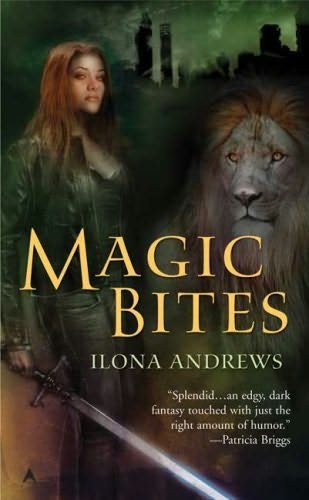
“Magic Bites” by Ilona Andrews

Magic Bites
by Ilona Andrews
2007

Since I reviewed Magic Gifts yesterday, I decided I needed to go back and introduce the universe. Magic Bites is the first in a seven-book series, five of which have been published at this point and two of which I am avidly waiting for. While each book has it’s own stand-alone plot, the characters develop across books. There are also four short stories and an upcoming book that are tangential to the main series.

But first, some background:

There have been a huge number of books published recently with:
1. Spunky female protagonist
2. Vampires
3. Werewolves

Off the top of my head, authors who have written these books are:
Patricia Briggs
Stephanie Meyer
Laurel K. Hamilton
Charlaine Harris
Robin McKinely
Ilona Andrews

And whole lot more.

These are, frankly, just the ones that I’ve personally read, and read recently. (Some of these I liked, some of these I didn’t, and I’ll tell you all about it if you ask nicely… or if you refrain from yelling “No!” loudly enough.) There were a lot more whose covers I’ve seen in bookstores and simply couldn’t bear to read because I was positively glutted with spunky female protagonists dealing with vampires and werewolves (SFPDwV&W).

However, I am still going to write a review of Magic Bites recommending this book to all of you other readers out there who are similarly glutted on SFPDwV&W.

It’s fabulous and you should read it.

Ilona Andrews the author, incidentally, is actually made up of a married couple: Ilona Andrews the person and Gordon Andrews her husband. I went to a convention they were at recently and got my copy of Magic Bites signed by Gordon Andrews. He wrote:

This book is terrible. Start with Magic Strikes. It’s the best.
To Rebecca
Gordon and Ilona Andrews
Don’t read this book!

I, on the other hand, am perfectly willing to tell you that despite being half of the author, he doesn’t know what he’s talking about and you should definitely read Magic Bites, and you should read it before reading Magic Strikes (which is the third book in the seven book series.)

Magic Bites is their first published novel and shows some of the uncertainty of a first book, but were it shines is in world building. This book is an introduction to the characters and to the world. The characters are fun and idiosyncratic and the world is magnificent.

It’s urban fantasy, set in Atlanta, Georgia, with magic, but the book explains how and why the magic is there, from an educated layperson’s perspective.

The werewolves aren’t just werewolves, they have an extremely contagious magic-based virus that has both physical and mental symptoms. They have a culture and a reason for that culture.

Vampires, on the other hand, are dead. They are dead and they are bloodthirsty and they will kill you unless piloted by a “Master of the Dead.” The Masters of the Dead have a massive corporate/cult structure of their own.

And our main character, spunky female protagonist that she is, has motivation and history and reason for all of her character strengths and weaknesses.

This book introduces the reader to a world that has vampires and werewolves and a spunky female protagonist and also, unlike pretty much all other others, makes sense.

(In fact, it makes enough sense that I can quibble about little mistakes in the logical structure of the world because there’s enough logic there for there to be mistakes! If you’re at all interested, I would absolutely love to nitpick in the comments section, because this is a book, and the beginning of a series, well worth reading and thinking about and nitpicking.)

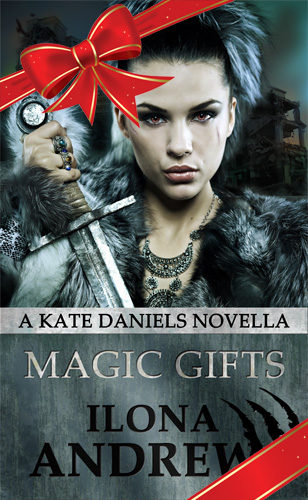
“Magic Gifts” by Ilona Andrews

“Magic Gifts”
by Ilona Andrews
2011

I like Vampire-Werewolf type books. And I have strong opinions regarding which ones are good and which ones… aren’t, but for now, I want to talk about something that one of my favorite authors did for Christmas:

She (actually “they” since Ilona Andrews is a husband-wife duo, but I’m going to go on and refer to her as her) gave her fans a novella. It’s free for download from her website, in pdf, kindle, or epub from her blog.*

The story has Kate Daniels (mercenary fighter and only recently acknowledged consort to Curran) and Curran (Beast Lord) dealing with vampires, attorneys, neo-vikings, and fae. All they wanted was to go on a nice date, but stuff keeps on happening. It’s awesome!

The events happen after the events of the fifth book in the Kate Daniels series and in the background of the sixth book (Gunmetal Magic, which focuses on Andrea Nash, Kate’s best friend and coworker).

As a heads-up, because this is a Christmas present, free to the fans, it was not given a professional lay out or a final professional proof reading, so expect a few typos and layout problems, but the story itself hangs together and the world building is where this author really shines and she shines here, too.

So thank you, Ilona Andrews, for a wonderful Christmas present, and I hope readers here enjoy it, too.

* This was posted late on Christmas Eve 2011, and will be available for two weeks. After that, it will be cleaned up and made available as a short story included at the end of Gunmetal Magic.

All These Things I’ve Done

I think I’ve mentioned here how much I love young adult books, but just to reiterate: I love them a lot. There are loads of YA books out there and, as with any genre, it’s key to have a trusted source to help you sort out the pearls from the muck. My favorite YA source is Kidliterate, which reviews picture books for little kids but is also a fabulous place to learn about new and upcoming books for teens (and grownups). The site’s creator works for an independent bookstore, so she reviews things from a bookseller’s perspective, meaning you sometimes get interesting inside information on the expected audience or potential controversies. But she never spoils the books, so there’s no need to worry about getting too much information. I was thrilled to see that the Kidliterate folks have posted a whole flurry of holiday recommendations, including a list of YA books with “awesome teen girls” as the main character. I’ve immediately put every one of those on my library list, but until they start coming in I can talk about Gabrielle Zevin’s All These Things I’ve Done.

Zevin has written a number of other YA books, including 2005’s Elsewhere. That one is about a girl who dies and ends up in the afterlife, where you age backwards until you’re a baby and you are born again back into the world. Which sounds dumb, frankly–when I heard the description of this books I remember thinking clearly that it was Not a Book for Me. But a friend with a solid YA track record recommended it, and I found it charming. It was a bit like reading a fairy tale or a fable, but at the same time had a very matter-of-fact attitude towards death and the afterlife that never made me, as an extremely nonreligious reader, uncomfortable.

All These Things I’ve Done is about Anya Balanachine, a teenager living in New York City in 2083. In this particular dystopian future there are shortages of everything, the city is rife with crimes–the standard. More specifically to this universe, coffee and chocolate have been outlawed and Anya’s father made their family fortune as a crime boss in the chocolate underground. Both her parents are now dead, so underage Anya is responsible for keeping her family together and trying to keep them out of trouble and out of the family business. It’s YA, so there’s also a cute boy and a school dance.

I enjoyed the book and it had some lovely touches. Although it’s set in the future, Anya’s world feels very accessible, close enough to our world to be easy to imagine and different in believable ways. For example, producing new materials is so difficult that the teenagers wear vintage clothes when they go out–this is both logical and let me imagine that Anya and her friends were wearing clothes from my closet. And the New York the characters live in is certainly different, but still recognizable. I also really like the matter-of-fact way the book handles how Anya feels about her father’s organized crime involvement and how it affects the way other characters treat her. It’s clearly something she struggles with, especially as the book goes on, but not something she can afford to get overly dramatic about. Anya’s relationships with her sister and brother also feel very real–loving, but occasionally irritated.

I had one major issue with the book, however: I didn’t realize until I was nearly halfway through that this is first book in a series (the Birthright series) and it reads that way. As much as I enjoyed All These Things I’ve Done, it felt like a really long introduction to a story. Just when I started thinking to myself, “All right, NOW we can get going!” the book ended. Which bodes well the book two, whenever it comes out, but leaves book one as an unfinished story in my mind. I know this is probably my own fault for not researching enough before I started reading, but am I going to have to start assuming that every YA book is part of series unless I am specifically told otherwise? Look, I love being able to read two or three or more books about characters that I love, but I do need for those books to stand alone. The Hunger Games may have always been planned as the first in a trilogy, but it is a complete, satisfying story with a sense of conclusion and ending. Or, you know what, it doesn’t necessarily even have to stand alone. The second two Hunger Games books can’t stand by themselves, and I adore the Mortal Instrument books by Cassandra Clare, which are not  independent stories and are full of cliffhangers. Maybe the real issue is that I need to feel like I got my money’s worth, so to speak, out of the book. I want to feel like it was a piece of writing worth my time. And this one felt like a very long introduction to characters who are going to get to the real action later.  I think my suggestion here is to go read Elsewhere now, and then come back and read the Birthright series in a few years when more books are out and the story feels more like a meal and less like an appetizer.

And now I am off to wrap a million presents and celebrate with my family. Happy holidays to all of our tens of readers and here’s to a 2012 full of good books!

Crooked Letter, Crooked Letter

By Tom Franklin

So, it has been a bit of a rough couple of weeks—holidays are looming and my company has some restructuring coming up—but I will say that Crooked Letter, Crooked Letter is a good book to help you get some perspective on life.

I am stressed about getting all my work and Christmas shopping down, but I am not a poor black boy or a painfully shy white nerd trying to get by as an outsider in the deep South…Oh, wait. I was a painfully shy white nerd in Texas only about 10 years after this book takes place. (Although Austin, though less liberal then than it is now, was still a damn sight more liberal than rural Mississippi, and the mid-90s were just  generally more liberal than the mid-80s, so it’s a bit of a cheap comparison.)

Still, there were several details that did actually remind me of my own adolescence. Very minor spoilers follow:

Continue reading

In the Garden of Beasts and A Thousand Lives

I do most of my reading at night, right before I fall asleep. Which can be problematic when I’m reading something creepy, since I end up either laying in bed listening for suspicious noises or having nightmares where I’m chased by evil book characters. So it probably wasn’t very wise of me to read In the Garden of Beasts: Love, Terror, and an American Family in Hitler’s Berlin by Erik Larson and then follow it up with A Thousand Lives: The Untold Story of Hope, Deception, and Survival at Jonestown by Julia Scheeres. This late-night unsettling reading, combined with the Nyquil I’m taking for a cold I picked up traveling last week, has led to some very bizarre dreams. But I would recommend both books to people reading during daylight hours, and they work surprisingly well together. They each examine why people choose to follow madmen who lead them to do terrible things, both to themselves and others–the difference is in the scale.

In the Garden of Beasts is about the American ambassador to Germany in the 1930s, and describes his family’s life in Berlin as Hitler rose to power. It focuses on 1933, the turning point when Hitler consolidated his power, and it’s basically an entire book of foreshadowing. Larson is describing elegant Berlin parties and the love interests of the ambassador’s daughter, but we all know how this story ends. I occasionally got a overwhelmed by the level of detail, and I wished I had an org chart to help keep all the minor diplomats and German politicians straight. However, Larson does a wonderful job of creating a sense of oppression and fear. I could feel myself getting more and more tense as I read, wishing I could jump into the pages and tell all these people to get out of Berlin before things got any worse.

A Thousand Lives tells a much smaller story. Scheeres uses FBI documents to describe the rise of Jim Jones, from his very early days as a minister in Indiana to his horrible end in Guyana. (I can’t bear to type out any details, if you don’t know the story you can check out the Wikipedia page.) She follows a number of individuals, detailing why the church originally appealed to them, how their views of the church evolved, and how they ended up in Guyana. I hadn’t realized how initially progressive Jones’s teaching on race and class issues was and that was fascinating, but it’s an ominous, disturbing book. Not all of the individuals profiled in the book died in Jonestown, but there aren’t any happy endings here.

I liked both books, but I think Larson did a better job of explaining how good, rationale people could get caught up in such a situation. I was struck by the number of people who thought from the very beginning that Hitler and his cronies were lunatics, but chose to stay in Germany because they assumed that at any minute sense would prevail and the Nazis would be thrown out of power. By the time they realized that madness was going to win the day, it was too late for them to get out and Hitler had too much power to defeat. Sheeres also describes how people had serious doubts about Jones and his church, and how many tried to escape or stand up to Jones. However, for me she doesn’t get to the heart of why people followed Jones when he was so obviously mad. Hitler had the power of the German state behind him to enforce his choices, but it seems like Jones’s followers could have walked away once he he started abusing children and talking about conspiracies. (At least, they could have while they were in the U.S.–Scheeres makes it clear that once Jones got his followers to Guyana, they were trapped and had virtually no way to escape.) Maybe it is personality trait: I can imagine myself deciding not to emigrate away from my home country, choosing instead to stick it out and hope things improved, but I find it very hard to imagine giving up my life and following a religious leader to a foreign country. As thoughtful as A Thousand Lives was, it still didn’t explain the attraction of Jim Jones, while Larson created a disturbing picture of a society that is too easy to imagine myself in.

I have got to find myself some more cheerful things to read, but if you’re interested in some 20th century history and ready to start building a time machine so you can go back and rescue people, I would recommend In the Garden of Beasts and A Thousand Lives.