Wait Wait…Don’t Tell Me!

Every Saturday morning, I go grocery shopping, and on the drive I listen to either Car Talk or Wait Wait…Don’t Tell Me!, depending on how early I’ve gotten up (yes, I know, my life is full of glamor and excitement). This morning, I turned on the radio part way through Wait Wait…Don’t Tell Me! where they were chatting with a guy they introduced as the most prominent children’s book author who is also a felon. I’d missed the part where they actually said his name, which may have made it even more engrossing.

He starts by telling his story and it’s like when you are at a party and everyone is chatting, but as one person keeps adding anecdotes that get stranger and stranger, everyone else gradually stops talking and are just hanging on this one guy’s words. I don’t want to give any of it away because it is really worth it to hear it in his own words here.

(Looking up the link, the author is Newbery Honor recipient Jack Gantos, who I’m not actually familiar with, and the interview is a recast from January, but if you haven’t heard it before, it is well-worth a listen and is only 11:22 minutes.)

—Anna

Angelology by Danielle Trussoni

In my last post I mentioned how much I liked my book-a-day calendar, but I didn’t say that one of my favorite parts of the calendar is its tiny book reviews. The pages on those calendars are small so they only get a couple of lines to describe each recommendation, but they do a great job capturing the essence of the book. For example, the calendar said that Angelology was like a cross between Dan Brown and Umberto Eco, and that is a great description.

The premise of Angelology is that the angels of biblical times took human wives, resulting a race of divine beings called Nephilim who live amongst humans. But these are not happy guardian-type angels–the Nephilim have no souls and have been manipulating and oppressing humanity for centuries. Angelologists (a word I’m glad I could just read and didn’t have to say out loud) are the scholars and adventurers who dedicate their lives to fighting the Nephilim’s efforts to exterminate humanity. Oddly, their efforts seem to involve a lot of research in Latin. Two stories run in parallel throughout the book–a modern-day tale of a young nun and a historian trying to unravel a mystery, and a series of flashbacks to a story of angelologists working in Nazi-occupied France. Angelology is far better written than a Dan Brown book, but it does have that element of trying to solve a mystery through the use of medieval relics.

Things I particularly liked about the book:

1) Trussoni creates a very complete world where the existence of angels has been smoothly worked into historical reality.

2) The WWII characters were compelling and the descriptions of Vichy France were fascinating.

3) Most of the modern-day story takes place in New York City, which I really like reading about.

4) Depending on how you read it, the ending was open-ended in a way I found satisfying and true to a complex story.

Things I did not like:

1) The book was long. It felt long. I suspect a good editor could have cut 100 pages out without losing a thing.

2) The modern-day characters seemed flat to me–the young nun, in particular, felt really implausible.

3) There were a number of things about the Nephilim world that didn’t really make since to me. Like, they have servants from lesser angelic classes that are never really explained? And I guess that the Nephilim’s ultimate goal is to completely exterminate humanity, but they don’t seem to be working towards that end with much enthusiasm (despite a relationship with the Nazis). I said that the world felt complete, and it does, but the more I think about it the more cracks appeared around the edges.

4) Depending on how you read it, the ending set things up for a sequel and I feel like I’ve read enough about these people and don’t need another book.

This wasn’t a perfect book, but it was interesting and ambitious. And I’d far rather read a flawed, ambitious book than a technically-adept dull book.

Siren of the Waters

One of my Christmas presents from my father this year was one of those page-a-day calendars. But instead of cartoons or a new German phrase each day (last year’s gift, which was awesome because instead of normal, touristy phrases, it included things like, “The sword was sharp and dangerous.”) this one recommends a book each day. If you’re wondering how this calendar could possibly appeal to everyone, the answer is that is throws in a little of everything. So far, it has recommended that I read Howard’s End, that Andre Agassi autobiography, and a non-fiction book about maps. I suspect that if you read all its books you would have an impressively wide array of knowledge and would be a killer Jeopardy player. I have no intention of reading all of these random books because I am super-picky about what I read (see also: why I am not in any book clubs), but each week there’s usually one thing interesting enough that I pin that day to my bulletin board, which is becoming a sort of messy to-read list. The first of the page-a-day books I have finished so far is Siren of the Waters by Michael Genelin.

Siren of the Waters is the first book in the Jana Matinova detective series. Jana is a detective in Slovakia, but she started her career in the police force in communist Czechoslovakia. While there is a traditional murder mystery driving the plot, the real heart of the book is in the descriptions of life under communist rule. The story is set in the modern day but features extensive flashbacks that show how the communist state dictated Jana’s professional life and crushed her family, and how only the well-timed fall of the Czechoslovakian government allowed her to continue in her career. The book is not touchy-feely in any way, so it doesn’t get into Jana’s emotions about all of this, but it does show the incredible level of change that ordinary people had to deal with as Iron Curtain fell. Part of the book also takes place in France, so there’s also some discussion of the tensions in the European Union as the poorer, more corrupt former communist states try to integrate themselves into the European community. I’m afraid that I’ve made this sound like an especially dull issue of The Economist, and it’s not at all. There is plenty of murder and intrigue to keep things moving along, but the book also shows how people’s everyday lives continue to be affected by the country’s political history

I found Siren of the Waters a little too bleak for me. Mystery is a genre that is so finely divided into sub-genres that you can pinpoint exactly what level of gore and darkeness you’d like to read about, and while I am not quite at the level of reading about mysteries solved by knitting circles (totally a thing), I prefer something a little less soul-crushing than this. But sometimes mystery series pick up the pace once all the scene-setting of the first book is done, so I might check out the second Jana Matinova book. It’s definitely an interesting way to learn some Eastern European history.

Baltimore; Or, The Steadfast Tin Soldier and the Vampire

by Christopher Golden and Mike Mignola

Book Cover: Baltimore; Or, The Steadfast Tin Soldier and the VampireI heard about this “illustrated novel” when I read Baltimore: The Plague Ships during my comic book glut a few weeks ago. I wasn’t quite sure what an illustrated novel was, but figured that since I liked illustrations and novels, it was probably for me. Also, while I enjoy comic books, I actually like novels better, so I figured that if I really liked Baltimore the comic book, I was going to love Baltimore the novel. You’ve probably already figured out from this lead-up that I did not.

There were a couple of issues, and I think the main one is that there is a reason that comic books/graphic novels and novels are two distinct mediums. They have significantly different narrative structures, and it is the rare author who can work in both (even more kudos to Neil Gaiman, then). In graphic novel Baltimore, the art and text worked together seamlessly and each provided content that the other lacked.

In illustrated novel Baltimore, the illustrations were small, simple black-and-white woodcut-style illustrations that kind of floated in the text on every few pages. I had imagined that they would be full color, full page reproductions of paintings, something even more impressive than the art in the graphic novel, something to distinguish it from the graphic novel and justify having a medium called an illustrated novel. (Thinking it over, Miss Peregrine’s Home for Peculiar Children better matches my idea of the definition.)

I can’t be entirely impartial on the written content because it was in a style that I find particularly difficult to read: characters telling stories. The majority of the novel consisted of three friends of Lord Baltimore sitting in a pub, telling stories about themselves and their relationship to Baltimore, while waiting for him to meet them. Sometimes, while telling stories about their past, their past self would then tell a story! It all got very convoluted, and that kind of flashback narrative lacks a sense of action and urgency to me.

It read like almost the opposite of a graphic novel, which has to be mostly action-oriented in order to support engaging illustrations. This came as a bit of a shock to me, but in retrospect, it kind of makes sense. For a dedicating author of comic books and graphic novels to try his hand at writing a full-length novel, the author must want to try something different, to write something that couldn’t be supported in a comic book structure.

Christopher Golden and Mike Mignola’s effort feels like what it probably is: an amateur attempt at an unaccustomed medium. They didn’t know a whole lot about writing novels, but they knew that novels were different than comic books, so they wrote something as different as possible.

—Anna

Stories I Only Tell My Friends

by Rob Lowe

Book Cover: Stories I Only Tell My FriendsI’ve got Rob Lowe’s back.

Before I read his autobiography, Stories I Only Tell My Friends, I had already felt like I grew up with him through his classic roles like Sodapop Curtis in The Outsiders and Billy Hicks in St. Elmo’s Fire. Later, he surfaced as Young Number 2 in Austin Powers: The Spy Who Shagged Me, seemingly coming back from nowhere (though the book proved me wrong on that). Then he established a place in my heart as Sam Seaborn, the deputy White House communications director in The West Wing.

So when his book came out, I was intrigued, particularly by the title. I bought it in hardcover as a birthday present for myself because I was too impatient to wait for a copy to be returned to the library. It turns out that the title is right on target. The more you read, the more you feel like you’re part of his inner circle. His stories are often deeply personal while they bring you behind the scenes in everything from his movies to his family life to his love life to his struggle with alcohol and time in rehab to his political adventures.

While he had a powerful drive for success and was continually looking for the next big thing. I gladly found Rob to be humble and well intentioned, even through his greatest moments of insecurity and turmoil. Through the unraveling of his life story, he’s sort of carried through his late teenage years into adulthood by a wave he couldn’t control. His hunger to act grew with each major role he played. With it came a lot more than anyone in their late teens and even 20s would be ready for. Visit his profile on IMDB (Internet Movie Database) and you’ll see a reference to him telling USA Today that he went gray at age 24.

What becomes an ongoing element of the book is his insight into other actors, many of whom also got their start in their teenage years, through Rob’s friendships and interactions. From living down the street from the Sheen and Penn families to having lunch with Sara Jessica Parker to running around with the “Brat Pack” to getting reacquainted with Patrick Swayze in Young Blood (years after playing his younger brother in The Outsiders), he continually shares his perspective into Hollywood personalities. It could come off as a bit much (really, you’re going to tout your relationships with everyone?), but his humble voice holds it together.  As he gets older and enters into a more of a soul-searching time, his perceptions grow deeper. Through his depiction of his friendship with Mike Myers you see Rob in a different light—one that shows off his humor, intelligence and lightheartedness—and ultimately encourages him to write the book.

What I enjoyed most about his book is that it actually comes from Rob’s voice. It’s written in a style that feels so conversational that it’s like being in a room with him while he’s telling the story. The genuine tone lets you in as a trusted friend and confidante.

Autobiography is a new genre for me, and I had no idea what to expect. Ideally, I think the story should feel like it’s coming from the true persona of the author and make you like that person more or as much as you already did, or at least see that person in a light that derives respect for his/her journey. (It’s got to be a vulnerable experience to put yourself out there like that.) For me, Stories I Only Tell My Friends did all of the above. Each time I watch Rob act as Chris Traeger in his most current role on the TV show Parks and Recreation, I am glad I got to know him better and feel like I am still growing up with him.

—Christine, contributing author

The Edible Book Festival

The Edible Book Festival
An Annual International Festival
April 1st

This is a collective review and an introduction to a whole genre of books that you may not be aware of. These books are not necessarily intended to be read, but rather to be eaten.

The annual Edible Book Festival is an international celebration that always falls on April 1st, i.e. April Fools’ Day. Each city holds its own competition for the most impressive, the most creative, the wittiest, or the puniest “edible books.”

These edible books range from simple puns with food names to elaborate craft creations by pastry chefs and book binders. Amateurs and professionals alike show off their creations and compete for various prizes. They range from hilarious to awe-inspiring.

Some entries are books made of edible material. I entered my local competition with a book made of crepes, and perfect bound with melted cinnamon chips.

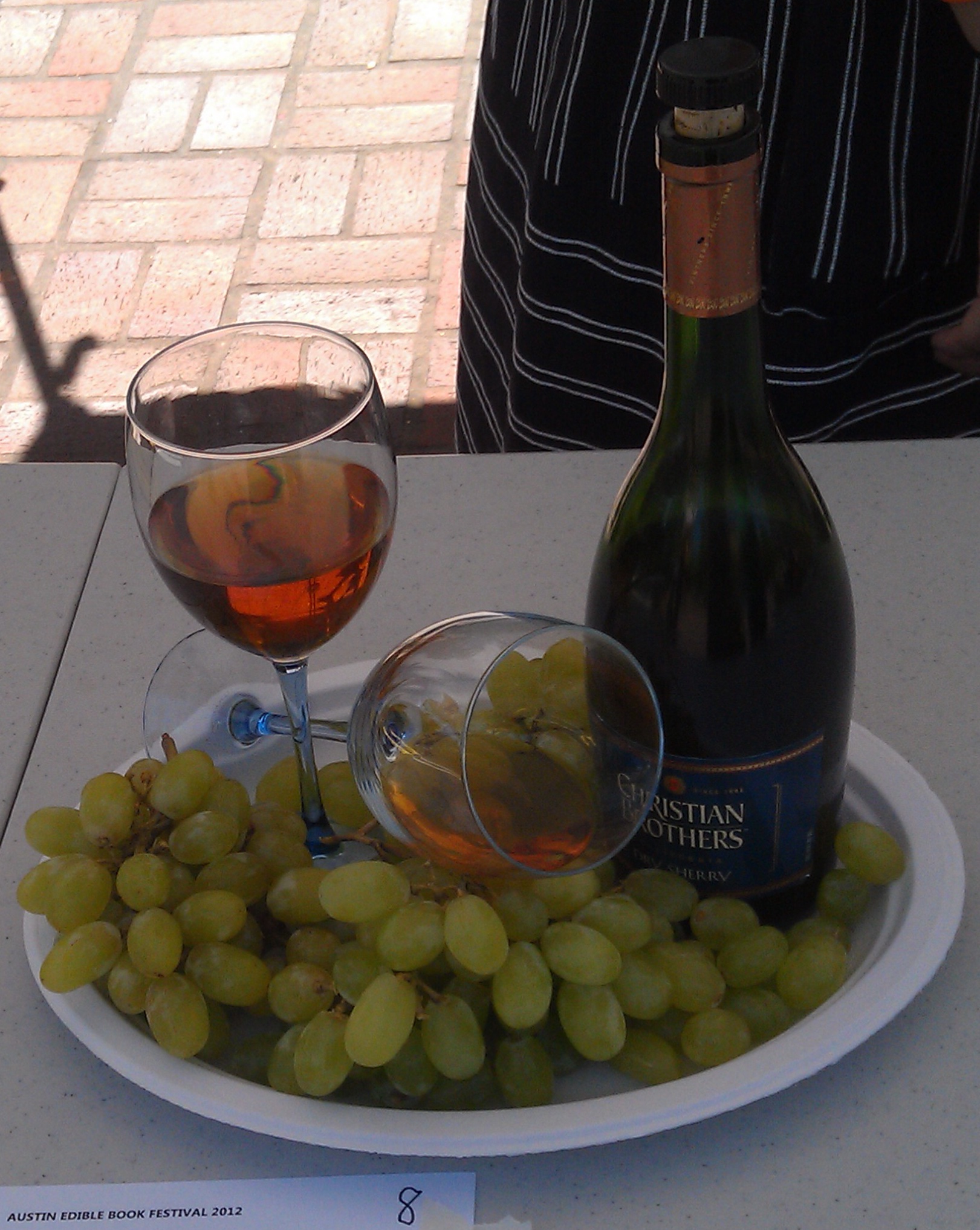
Other entries are puns based on famous book titles. My second entry was “Grape Expectations,” created by a still life of a cluster of grapes, a bottle of dry sherry, and two wine glasses.

I didn’t win any of the prizes, because there were some pretty excellent other entries. Some of them were:
• Tart of Darkness
• War and a Piece of Cake
• A Separate Pea
• Pride and Pretzles
• The Grill with the Flagon of Pink Goo
• A Wrinkle in Lime

It was lots of fun. I mostly ate War and a Piece of Cake afterwards with a few grapes from Grape Expectations. It could be said that I devour books on a regular basis, but normally this is said metaphorically. Not today though.

When was the last time you ate a book?

Them: Adventures with Extremists

By Jon Ronson

I am very much a believer of Occam’s Razor—that the simplest answer is usually the correct one—which makes me pretty much anti-conspiracies. I have to admit, though, that Jon Ronson’s Them gave me pause.

The front cover has this description:

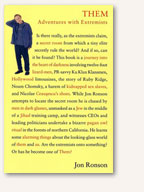
Is there really, as the extremists claim, a secret room from which a tiny elite secretly rule the world? This book is a journey into the heart of darkness involving twelve-foot lizard-men, PR-savvy Ku Klux Klansmen, Hollywood limousines, the story of Ruby Ridge, Noam Chomsky, a harem of kidnapped sex slaves, and Nicolae Ceausescu’s shoes. While Jon Ronson attempts to locate the secret room he is chased by men in dark glasses, unmasked as a Jew in the middle of a Jihad training camp, and witnesses CEOs and leading politicians undertake a bizarre pagan owl ritual in the forests of northern California. He learns some alarming things about the looking-glass world of them and us. Are the extremists onto something? Or has he become one of Them?

Book Cover: ThemI had previously discovered Jon Ronson when he was on a hilarious episode of NPR’s This American Life, talking about his most recent book, The Psychopath Test. (If you haven’t heard the episode, you definitely should—they bring in a psychologist to administer the “psychopath test” to the NPR staff.)

I promptly picked up the book at the library and realized that I had experienced Jon Ronson before—he wrote the book Men Who Stare At Goats, which was made into a movie a few years ago with Ewan McGregor and George Clooney. Several things became clear all at once: Ronson has a writing style unlike anything I’ve read before. He describes himself as a humorous journalist, but he writes in a kind of nonfiction stream-of consciousness. I enjoyed the movie “Men Who Stare At Goats,” but the characters just seemed to sort of float along and kind of accidentally run into important people or pivotal events. It didn’t seem very realistic in the movie, but it now seems very much how Ronson operates, and once you get used to it, it is pretty awesome being along for the ride.

Ronson just seems like the most pleasant, unassuming, agreeable person, and he must be because he gets interviews I wouldn’t have believed possible. In “The Psychopath Test,” he meets with CEOs, even after telling them he wants to see if they are psychopaths! It is unbelievable—they are just sort of amused. I think he must have some superpower of not giving offence. Them starts off with him spending a year off and on with Britain’s self-proclaimed right-hand man of Bin Laden, even though Ronson himself is Jewish.

Ronson has a very active voice in his books, unlike most journalists, and that is very much part of the charm. The reader gets a much clearer sense of the full interactions, and I started to notice that Ronson asks lots of questions but only very rarely disagrees or confronts people. Even his questions are very inviting, sort of “I’m sure I’m being very stupid about this, but what about….” People seem usually pretty delighted to speak with him. (Although if I recall, The Psychopath Test begins with one of his subjects from Them being very unhappy with his treatment in the book and threatening him.)

In the book’s preface, he explains how he came up with the title Them. While in the middle of researching the book, he describes his research to a friend, and the friend replies, “You are sounding like one of THEM.” And I have to warn that after reading this book, not all the extremists will seem so extreme to you, either.

It reminded me of watching a tv program on the Society of Masons with Tom. They had lots of conspiracists describing various farfetched theories about the Masons, and Tom and I had a good time laughing at how ridiculous it all was. Then, the program interviewed a representative from the Masons, and he was so slick with complete non-answers (“why, we are just a normal fraternal order, how could you possibly think otherwise?”) that for the first time I had some momentary doubt.

—Anna

Wuthering Heights

By Emily Brontë

Book Cover: Wuthering HeightsLast night I was watching the new Fright Night movie (it’s okay—a fun, distracting movie; nothing mind-blowing or anything), and there is a scene where the female love interest is sitting on the hero’s bed, reading Wuthering Heights, when he comes in. She starts the conversation by saying, “You know, this book is actually really sexy, in a frustrated, unconsummated kind of way.” And it made me laugh and laugh.

It also reminded me of the stories from several years ago, when publishing companies were trying to sell Wuthering Heights to Twilight fans. (Apparently, Wuthering Heights is mentioned in Twilight as Bella’s favorite book? I read Twilight, but I don’t actually remember that.) And, I was so curious as to what those poor, bamboozled teenage girls thought of it.

Now, I haven’t actually read Wuthering Heights since high school, but I absolutely hated it then. I get that they are selling it now as a tragic romance for the new goth teen, but I think of tragic romances as people who are kept apart due to circumstances beyond their control á la Romeo and Juliet, not situations where the people are so hateful that they bring upon themselves every terrible thing that happens to them (no spoilers, though!).

So, what do you guys think of Wuthering Heights?

—Anna

Jennifer Weiner

I mentioned in a comment on Anna’s post on A Reliable Wife that I should talk about how much I love Jennifer Weiner on Twitter, so let me do that now: I love Jennifer Weiner on Twitter. Weiner is a best-selling author who has been publishing up a storm for the last 10 years or so, and I really enjoyed her first two books, Good in Bed and In Her Shoes. Her later books haven’t done much for me–although I am 99% sure I’ve read all of them I cannot remember the title, plot, or anything else about anything past those first two. Regardless, I think that Weiner is one of the smartest writers out there and I hang on her every tweet. I have the sense that writers today are expected to be on social media and interact with people online as part of their marketing strategy, whether they enjoy it or not. Weiner does social media better than any other writer I’ve seen and she always seems to be having a good time, whether she’s talking about going to the gym or gender discrimination in book reviews.

Weiner certainly spends time on Twitter talking about her kids and live-tweeting The Bachelor (her Bachelor tweets are way more entertaining than the show itself), but she also manages to talk about some very complicated issues in the publishing industry in 140-character chunks. For example, the easiest way to classify Weiner would be to call her a “chick lit” writer, but that’s a loaded word. Saying that something is chick lit immediately conjures up the image of a pink book with shoes on the cover, and a silly story about a silly young woman falling in love in a cute way. The word also has the whiff of bad writing about it. Weiner has addressed this issue head on and has been one of the strongest female voices pointing out the women who write about relationships are disparaged as “chick lit” while men who write about relationships are commenting on modern life. (Example: why wasn’t One Day considered chick lit? If that had been written by a woman, I promise you it would have had a pink cover.) She also argues that books can be well-written but fun at the same time, and points out when authors speak down to their readers by implying that anyone not interested in serious, weighty, depressing modern literary novels written by men is just an uncultured dolt. (She is the one who coined the Twitter phrase “franzenfreuede,” in honor of a much-celebrated writer who seems to have a fair amount of disdain for the reading public.) I always get the sense that Weiner respects her readers, and that she is willing to fight for respect for her work and for the people who enjoy it.

Following Weiner on Twitter is also a good way to keep up on publishing world gossip. She came up in the first place because she’s had an on-going discussion on Twitter about Fifty Shades of Grey, which started as Twilight fanfic. She’s raised a lot of interesting questions about who owns characters and how much authors are (both legally and morally) required to acknowledge when they are inspired by someone else. Weiner also points out the blatant sexism in the New York Times (and other) book reviews, showing how male authors get multiple reviews and glowing profiles while female authors get ignored. She gets a surprising amount of crap for some of these stands, but seems to handle all the flack with a good deal of grace.

Plus, I saw her do a reading once and she was adorable and her husband and baby were there, and they were adorable, and I generally just sort of wanted to be her friend. And while that may not mean I am going to love all her books (although both the book and the movie versions of In Her Shoes are both quite good), I can wholeheartedly recommend keeping up with her on Twitter. She’s fun and smart, and following her makes me feel more fun and smarter.

Comic Book Glut

In a ridiculously extended simile/metaphor, books are like food—good literature is a hearty meat-and-potatoes kind of meal; fluff novels are something delicious and comforting like baked mac-n-cheese; nonfiction is a nice big salad, healthy and perhaps a little goes a long way.

All of this is to describe how I feel about comic books—they are the candy of my book meal. I love them, but once I start reading them, I always crave more, and finally after hours of reading them, I feel a little off, in a kind of empty and stale way. So, I try to indulge in comic books in moderation.

However, this afternoon, it was a beautiful day, and my work let me out early. I went to the library to check out a nice, healthy salad of a nonfiction book, but for some peculiar reason, my local library organizes the graphic novels in the nonfiction section, so I also walked out with five graphic novels, and then proceeded to glut myself on literary candy.

1) The League of Extraordinary Gentlemen, Century: 1910

Cover: The League of Extraordinary Gentlemen, Century: 1910I loved The League of Extraordinary Gentlemen, Volume 1 (I even enjoy the movie in a very guilty-pleasure kind of way). The premise of having characters from famous literature join a crime-fighting group, lead primarily by a strong female character, sold me within the first few pages. That it was a period piece, set in the 1800s was an additional bonus. The character dynamics were engaging and the plotting was clever.

Then, Volume 2 got a little more outlandish in plot, made the female lead weaker and more traditionally “feminine,” and added some jarring sex scenes. I not only began to feel like I wasn’t the target audience, but that perhaps they were actively discouraging female readers. The League of Extraordinary Gentlemen, Century: 1910 goes even further. It is maybe a third of the length of the previous two volumes, and feels more like an introduction of new characters than a complete story, but it still manages to squeeze in seven illustrations of topless women, three illustrations of full frontal female nudity, and two rapes. There’s shock value, and then there’s just being disagreeable.

2) American Vampire, Volumes 1 and 2
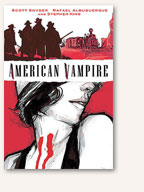
Cover: American VampireI really wanted to like these, and I did enjoy parts of them. The premise is interesting and had some good possibilities: a group of traditional European vampires come to America during the expansion of the railroads in the Wild West. One of them unintentionally “converts” a train robber, and the American vampire is a new breed—he draws strength from the sun. The two volumes follow him to the 1920s, where he “converts” a young starlet, and then the story follows them both (in separate plotlines) through the 30s as they battle both the clan of original European vampires and a secret society of vampire hunters.

I love both vampires and historical fiction, and like I said, it had great potential. It’s hard to pinpoint exactly what was missing because it wasn’t terrible, it just wasn’t as good as I had hoped or thought it could be. The writing was a bit clichéd, the characters were two-dimensional and not very sympathetic, and the plot eventually devolved into little but violence. The art itself had a rough, sketchy quality that I liked on first view, but began to just look increasingly muddy and almost blurred to me. It is clearly an ongoing series, but not one I’ll be continuing with.

3) Baltimore: The Plague Ships
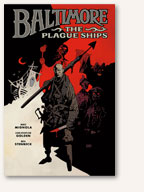
Cover: Baltimore: The Plague ShipsAnother historical vampire comic, but this one was everything and more I was hoping for with American Vampire. The author is the same as for Hellboy, but this one has a darker atmosphere that I really appreciate. The book jumps right into the action with our hero, Lord Baltimore, hunting down vampires in a small village off the coast of France in 1916. His background and the history of this world unfold throughout the story, along with some nicely paced plotting.

The art is a really nice screen-printing style, with minimalist, flat color fields, with a muted palette that gives the illustrations a really nice atmosphere. It is fairly clearly the beginning of a series, though Volume 2 doesn’t come out until June. In the meantime, the introduction mentions that this comic book is a companion piece to the illustrated novel, Baltimore or, The Steadfast Tin Soldier and the Vampire. I’m not entirely sure what an illustrated novel is, but I definitely plan on finding out.

4) Blacksad
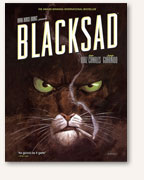
Cover: BlacksadThis was the one I was the most excited about (I may have even done a little jump in the library aisle), so I saved it for last. I already knew that I was going to love it because I own it, sort of. First, a quick story: my dad travels a lot for work and he would bring all of us kids souvenirs from everywhere he travelled. He brought us each anime comics from Japan when I was a young teen, and that hooked me (even though after very careful perusal of the illustrations, I finally discovered that my dad had accidentally bought me a schoolboy romance story). Subsequently, I asked for a comic book from every country he went to, so I now have comics from Germany, Sweden, Holland, China, Ireland, Croatia (from my wonderful friend, Hannah), and France.

One of my two French comic books is Blacksad, and it is brilliant! From what I could piece together from the illustrations, it is a gritty noir mystery, which you already know I love, with anthropomorphized animal characters, drawn more beautifully than any other comic I have seen. Blacksad is John Blacksad, a black-and-white cat and private detective. I was so, so excited to actually be able to read it, instead of poring over the pictures and trying to read a word or two of the French with my high school Spanish learning. It turns out the writing is almost as lovely as the pictures, and I can’t recommend the whole package enough.