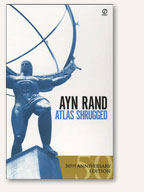
Atlas Shrugged by Ayn Rand

AtlasShruggedAtlas Shrugged
By Ayn Rand
1957

This is a difficult book to sum up. I have 89 pages of single-spaced, typed notes, made over the course of nine-weeks of reading. The one real strength to this book is that it makes me think. It presents a lot of ideas and a lot of arguments and it was the rare conversation in the last two months that did not involve the phrase, “that makes me think of how, in Atlas Shrugged, …”

In live-blogging our process through this book, Anna and I had a lot of thoughts.

Part I: Non-Contradiction
I.      The Theme
II.     The Chain
III.    The Top and the Bottom
IV.    The Immovable Movers
V.     The Climax of the D’Anconias
(extra bit: first impressions)
VI.    The Non-Commercial
VII.  The Exploiters and the Exploited
(extra bit: VII. The Exploiters and the Exploited)
VIII. The John Galt Line
(extra bit: Atlas Shrugged theme)
IX.    The Sacred and the Profane
X.      Wyatt’s Torch
(extra bit: Kurt Vonnegut short stories)

Part II: Either-Or
I.       The Man Who Belonged on Earth
II.     The Aristocracy of Pull
III.    White Blackmail
(extra bit: Atlas Shrugged in the news)
IV.    The Sanction of the Victim
(extra bit from President Obama)
(extra bit on John Galt)
(extra bit on Greek Mythology)
V.      Account Overdrawn
VI.    Miracle Metal
VII.  The Moratorium on Brains
VIII. By Our Love
IX.    The Face Without Pain or Fear or Guilt
(extra musings)
X.     The Sign of the Dollar

Part III: A is A
I.      Atlantis
II.    The Utopia of Greed
III.   Anti-Greed
IV.   Anti-Life
V.    Their Brothers’ Keepers
VI.   The Concerto of Deliverance
VII.  “This is John Galt Speaking”
VIII. The Egoist
IX.    The Generator
X.      In the Name of the Best Within Us

It would make a really fabulous book club book or the subject of a college seminar.

That said, it is also a book in desperate need of an editor to smooth out some of the rough patches and it showcases a conflict between two sets of irrational idiots: spoiled children on one side and vengeful true-believers on the other side. For the most part, I didn’t like or respect any of the characters. Both sides would come out with statements, some of which I agreed with, most of which I disagreed with, but would then back them up with the wrong arguments. Continue reading

Atlas Shrugged (Part 3, Chapters 8-10)

By Ayn Rand

Cover: Atlas ShruggedChapter 7 broke me, people. I only got through it with a generous bribe of Starbucks. I would go into the Starbucks, get my mocha, and force myself to sit there and read Chapter 7 until I’d finished at least 15 pages. You are lucky that Rebecca recapped that section because my idea was to just post:

Atlas Shrugged (Part 3, Chapter 7): tl;dr

Anyway, I’ve gathered the shards of my broken psyche together enough to just get through the final three chapters for you, dear readers. They were actually pretty fast-paced and action-filled, and I would have enjoyed them a lot more before my aforementioned breakdown. Continue reading

Atlas Shrugged, part 3, chapter 7

AtlasShruggedSection 3, Chapter 7: “This is John Galt Speaking”

Writing up this chapter gave me a sharp reminder that this blog is a book-review blog rather than a philosophy forum. Anna has had to hold me back from writing a 500-page response rebutting this chapter, line by line. Reading this chapter was an exercise in patience, allowing a mixture of irrationality, hypocrisy, and lies to just pass on by me.

Continue reading

Atlas Shrugged, part 3, chapter 6

AtlasShruggedSection 3, Chapter 6: The Concerto of Deliverance

This chapter is a lot more palatable than the last one. The bad guys are just as irrationally hypocritical as the good guys, but they are acknowledged as bad guys, and someone finally addresses their logical flaws directly, verbally, and to their faces. Thank you! Reading this book and being inundated by irrational philosophy from all sides has really increased my argumentativeness (rarely in short supply to begin with.) This chapter, though, successfully refutes a lot of the proposed idiocy by itself without needing me to do so. For the first time in the whole book, there is a serious demonstration of someone promoting rationality and logic. I approve.

I think the first two-thirds of this chapter go up there with the scenes of the first train ride on the John Galt line and of Dagny’s aerial chase as being parts of this book that I actively enjoyed.

So, without further ado:

A summary of the events of the chapter, and then some brief discussion of a few specific points.

Continue reading

Mr. Penumbra’s 24-Hour Bookstore

Oh, you guys, this is the best book. If all the Atlas Shrugged has been crushing your faith in books and humanity, I recommend that you read Mr. Penumbra’s 24-Hour Bookstore by Robin Sloan as a palate cleanser.

The main character, Clay, is  San Francisco Web designer who gets downsized out of his job after the economy tanks and ends up working at a bookstore. As if the idea of a store selling actual paper books isn’t weird enough these days, this store is open 24 hours a day and seems to have a very odd clientele. Clay starts investigating and, with the help of his friends, figures out that there is quite a bit more going on in this bookstore. I don’t want to give much more away, but the story involves Google, and hipsters, and medieval mysteries, and is just completely charming.

I’ve raved on this site about The Magicians by Lev Grossman, and in a lot of ways this book feels similar–it’s very much of the present-day, with lots of pop culture references and discussions of Gen X issues about the meaning of life and career and purpose and such. But The Magicians, and a lot of books like it, are so dark. I loved The Magicians, but reading it was a wrenching experience. This book manages to address of a lot of the same issues without being heavy or depressing. It’s a quick read that will leave you feeling good about people and books and the world in general. Who doesn’t need that occasionally?

Kinsey’s Three Word Review: Fun, modern mystery.

You might also like: PopCo, or Neverwhere, or even So You Want to Be a Wizard, although Mr. Penumbra is lighter than any of those.

Atlas Shrugged, part 3, chapter 5

AtlasShruggedPart 3, Chapter 5: Their Brother’s Keepers

The sheer hypocrisy of this book is wearing me down. The reader is given in-depth looks at the thought-processes of our protagonists. The protagonists have full-life backstories and motivations and ambitions. The lack of similar detail for the antagonists and secondary/tertiary characters is not only reasonable but necessary given the limits of a book. But to then denigrate and scorn the antagonists/secondary/tertiary characters FOR THE EXACT SAME ACTIONS as the protagonists BECAUSE THEY LACK ANY STATED MOTIVE infuriates me.

Arg! This chapter is an illustration of the phrase: “We judge others by their actions but judge ourselves by our intentions.”

Anyway, first there is a description of the events of this chapter, and then a series of five brief rants, mostly centered around hypocrisy.

Continue reading

Fanfiction

productimage-picture-discover-fanfiction-today-9528Fanfiction

I have not been reading just Ayn Rand this whole time. That would have driven me completely crazy. I’ve also been reading a fair amount of fanfiction as some light-hearted, palate cleansers. I won’t be reviewing a lot of fanfiction on this site, but I do feel like I should introduce it as a genre, at least.

Fanfiction is a term that describes when fans of a particular story line decide to expand upon that story line by creating their own additions. While the practice has been going on for as long as anyone has been telling stories, the term “fanfiction” is more recent, first gaining wide usage by fans of the original StarTrek series. Now, there is fanfiction for pretty much any book, movie, tv-show, or other type of media that you can think of.

The genre lives in a bit of a legal gray zone since, if the original source is recent enough to be under copyright, then such stories and pieces of artwork are potentially infringing on that copyright. However, fanfiction is generally not produced for commercial gain, reading it comes with the expectation of prior consumption of the original source, and no case of fanfiction has ever been judged in a U.S. court. Published authors vary between actively promoting fanfiction based on their works and actively discouraging it.

As a genre like any other, it also ranges wildly in quality, from extremely shoddy works to amazingly spectacular masterpieces. The amateur nature of the genre allows writers to push at boundaries and experiment with ideas and characters in a way that publishing houses discourage. The online community is well aware of the way they are pushing boundaries, and compensates for it by generally beginning any story with a summary and a series of warnings. These warnings will let you know what source materials (AKA “canon”) you are expected to already know, what characters the author will be using, what romantic relationships will be included, what levels of violence and or sexual content will be included, and any events that readers might have problems with. Fanfiction writers write for fun and readers are expected to approach it for fun, too: use the warnings to read what you expect to enjoy and avoid what you expect to dislike.

The genre as a whole is a living demonstration of the multi-worlds theory: anything that could potentially happen in any universe or with any character, can be written and read with fanfiction. I love it.

Rather than just find fanfiction at random, your best bet is to follow recommendations and browse friends’ bookmark lists. The two biggest online fanfiction compendiums are Fanfiction.net and Archive of Our Own, both of which include reviewing and bookmarking functions.

Here are some good introductory fanfiction stories (ie, fun, short, not too different from their original source material, and no necessary warnings):

Flying Monkeys
by Thimblerig
It can be read on Archive of Our Own.
To understand what’s going on in this story, you should have watched the Marvel movie The Avengers.

The summary is:
The inevitable, horrifying debrief.
“Is this some kind of hobby for you? Planning our imminent destruction?”

The reason I like it is:
First, it’s hilarious. Second, it creates a series of scenes for after the events of the movie, about Clint Barton being debriefed from his time as a mind controlled slave of Loki. The author uses a rich universe and makes it just that much richer by showing some details that just couldn’t have fit into the movie.

Prediction, Protection
By Icarus_chained
It can be read on Archive of Our Own.
To understand what’s going on in this story, you should have watched both the current TV show Person of Interest and the 1990s TV show The Pretender.

The summary is:
Harold was a failed Pretender experiment. Years later, Jarod tracks him down. What follows is a somewhat tense negotiation.

The reason I like it is:
This story uses some background from The Pretender to explain a mystery in Person of Interest. This story makes a connection between these two unrelated universes and asks what if they are the same universe.

Food for Thought
By Ruth Stewart
This can be read on Fanfiction.net (as plain text) or on Livejournal.com (as an entire fake livejournal account, completely with many illustrations.)
To understand what’s going on in this story, you should have read C.S. Lewis’ Narnia series.

The summary is:
A modern teenage girl goes into the Wardrobe, meets Aslan, and learns an important lesson that does not include falling in love with a King.

The reason I like it is:
This is an outsider’s perspective on Susan Pevensie’s life. Susan has died and her grandson and great-granddaughter have come to sort through her belongings. This story is written as a series of blog posts by her great granddaughter, learning about Susan’s life from the records she left behind. This author does an amazing job of researching and then showing recent British history.

Day One
By Zee Viate
This can be read on Fanfiction.net.
To understand this story, you should have watched the TV show NCIS.

The summary is:
The night DiNozzo and Gibbs first met.

The reason I like it:
I stopped watching NCIS around season 7, because the characters were going in directions that I didn’t care for, but this is a look back at young Tony DiNozzo and Gibbs before he knew him, and it reminded me why I loved this show so much for so long.

Followers of the Carpenter
By PaBurke
This can be read on Fanfiction.net.
To understand this story, you should have read book eight of The Dresden Files by Jim Butcher and watched the TV show Criminal Minds.

The summary is:
A serial killer moved to Chicago and followed his normal MO, but this time, he bit off more than he could chew.

The reason I like it:
There’s something wonderful about an outsider’s perspective on some of the characters and events of urban fantasy novels.

Five Scenes Over a Goban
By Opalish
This can be read on Fanfiction.net.
To understand this story, you should have read the manga or watched the anime Hikaru no Go.

The summary is:
Ichikawa laughs until she chokes, and Akira suddenly understands why Shindo spends so much of his time yelling at people to stop hitting him already.

The reason I like it is:
I just love these little looks at how these characters view and interact with each other. This is a peak at everything that made me love these characters in the first place. There isn’t any plot arc, but just some fun character studies.

Evening Encounter
By Maeniel
This can be read on Fanfiction.net.
To understand this story, you should have read the manga or watched the anime Rurouni Kenshin.

The summary is:
Okita’s heading home at the end of the war and encounters a certain redhead. What do they say to each other?

The reason I like it:
In the series, we don’t get much of a look at this time period in Kenshin’s life, but it’s a major turning point for him, and seeing him in this time really shows off his thoughts. Plus, it also develops Okita, who is given very little attention at all in the series, and creates a connection between the fictional series and the real history of the time period.
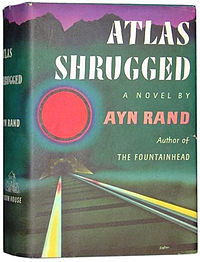
Atlas Shrugged (Section 3, Chapters 3 and 4)

By Ayn Rand

Cover: Atlas ShruggedMuch appreciation for Rebecca, who took over for me for Chapter 2 this week since I fell so far behind in my reading because of my head cold. Also, I found Section 3’s first two chapters, set in Galt’s Gulch (yeah, that’s what they call it – try it out loud) almost unbearable. You know how hearing someone describe a dream is pretty much the most tedious thing ever? It was that for over a hundred pages.

This weekend, however, I was on a strict schedule of reading in order to catch up, and I’ve plowed through Chapters 3 and 4, which were thankfully back in the quickly decaying outside world and much more to my liking. Continue reading

The Round House

Well, Anna and Rebecca deserve awards for continue to slog away at Atlas Shrugged–I mean, my God, will that thing ever end? I, meanwhile, continue to read fantasy stories and romance novels and light, fluffy fun things that make no attempt to develop a new political philosophy. But I did just finish a lovely, quality book that I wanted to mention: The Round House by Louise Erdrich.

Erdrich is known for writing very literary novels about the American Indian experience (I’m using Indian, not Native American, since that’s what Erdrich most often does), often with a hint of magical realism. I’ve tried to read some of her work in the past and never really connected with it, but her latest novel won the National Book Award and was described as a mystery–I was intrigued. And I really enjoyed it!

The story, narrated by a teenage Indian boy, centers around a crime that happens on a Chippewa reservation, and how the main character and his family deal with the aftermath and try to figure out who did it. However, the mystery is secondary, in a lot of ways, to the descriptions of life as an Indian teenager. The details–from what the characters are eating to how they speak–are striking and Erdich does an amazing job of getting inside the head of a teenaged boy, who usually feel to me like they are members of an entirely different species. While this book didn’t have the driving, page-turning quality of Gone Girl, I enjoyed the mystery and the characters, and I would recommend this a starting point for Erdich’s work.

Kinsey’s Three Word Review: Haunting, lyrical mystery.

You might also like: Any of Tana French’s mysteries or, if you’d like to read more about life on a reservation, Sherman Alexie.

Atlas Shrugged, part 3, chapter 2

AtlasShruggedPart 3, chapter 2: The Utopia of Greed

There’s a weird dichotomy in this whole book between what the characters are actually doing and what they (and Rand) describe them as doing.

The level of hypocrisy is pretty much on par between the good guys and the bad guys, it’s just that Ayn Rand castigates the bad guys for their hypocrisy while joining the good guys in theirs. The good guys are also happier with their hypocrisy, which makes me happy. While I sure would appreciate a few sincere people, I definitely prefer happy hypocrites to unhappy hypocrites.

Plus, I also prefer people who act in a way I can support, even if they mouth words I disagree with, to people who mouth words I agree with while acting in a way I dislike. Thus, even though Ayn Rand is saying “Greed is Good,” what she’s actually showing is closer to Marianne Williamson’s quote:

“Our deepest fear is not that we are inadequate. Our deepest fear is that we are powerful beyond measure. It is our light, not our darkness that most frightens us. We ask ourselves, Who am I to be brilliant, gorgeous, talented, fabulous? Actually, who are you not to be? You are a child of God. Your playing small does not serve the world. There is nothing enlightened about shrinking so that other people won’t feel insecure around you. We are all meant to shine, as children do. We were born to make manifest the glory of God that is within us. It’s not just in some of us; it’s in everyone. And as we let our own light shine, we unconsciously give other people permission to do the same. As we are liberated from our own fear, our presence automatically liberates others.”

— Marianne Williamson, A Return to Love: Reflections on the Principles of a Course in Miracles

This, I can agree with whole-heartedly.

Be successful, not by dragging other people down but by building yourself up. Yes!

Anyway, the summary is going to be vague because it’s less a series of events and more a lot of description and philosophy. After that, I’ll have a few comments and a small rant.

Continue reading