Stalking Authors, the Ilona Andrews edition

Magic_RisesPeriodically I like to drop by the websites of my favorite authors to see when their next books are coming out and if they have anything new and interesting up.

Lois McMaster Bujold doesn’t tend to update her website very much, alas. But she does actively support fanfiction, which I appreciate.

Patricia Briggs is pretty good with her website, although she’s gotten somewhat less active on it as her career has taken off.

Ilona Andrews is still very active on social media, including their own website, AND posts regular free stuff.

Robin McKinely has a decent website, although I’m generally somewhat disappointed in her. I love her early work (The Blue Sword, The Hero and the Crown, and Beauty) and feel like Sunshine was her absolute Best Book Ever! Ever since, it’s been just kind of down hill. But I still like to check up on her, periodically, to see if maybe there will be a sequel to Sunshine at some point, or if any of her more recent books look good.

Megan Whalen Turner has possibly the least active author’s website I’ve seen, and yet I still check back because, by god, if there’s going to be another book in series, I will start stalking bookstores and possibly publisher’s warehouses in the hopes of getting to it just that much sooner. (So far, no luck. I will just have to re-read the four that already exist.)

Anyway, this is all a long wind up to letting you guys know that Ilona Andrews has the first chapter of her next book up! This is book 6 is the Kate Daniels series, Magic Rises, due out on July 30, 2013. Yay! You can read the excerpt: HERE!!!

I love this series.

However… the chapter raises some concerns for me.

Thus: Here Be Spoilers (for both Book 5 and for Book 6).

Continue reading

Vampires in the Lemon Grove

By Karen Russell

Book cover: Vampires in the Lemon GroveMy wonderful friend Lori sent me this just because she thought I’d like it and it arrived in the mail in the middle of my Atlas Shrugged doldrums, and it was such a mood lifter, just having it on my to-read shelf. The cover is just so bright and graphic!

I had heard of the author, Karen Russell, through a brief review of her previous book Swamplandia!, which I had assumed was a comic narrative of Florida craziness á la Elmore Leonard. If it is anything like this book, though, (and I believe it is, according to the blurbs on the back cover) my assumptions are way off. Vampires in the Lemon Grove is the strangest book! It is a collection of short stories, and when I described the premise of each story to Rebecca, they just sounded kind of absurd:

“All silkworms in the Western hemisphere have died, so China is now the sole proprietor of silk, and in order to meet the now increased demand, they have discovered a way to turn women into more efficient silk worms.”

Rebecca said, “hmm.”

But, this story and the others are just beautifully written and poetic, even. Russell emphasizes the senses in her writing, describing not just the sights, but also the sounds, smells, tastes and touch of the worlds she builds. In the titular lemon groves, she describes the sun on the fluttering leaves, the feel of the wind that blows through the grove, the smell of lemon that pervades, and the sweet tartness of the lemons and lemonade.

The silkworm story took a bizarre and, quite frankly, almost silly premise and created layers upon layers of symbolism. The disenfranchised, used for production and others’ profit, find hope in self-identity and transformation. Each story was like this; reading them felt like scuba diving or spelunking, moving deeper and deeper through layers of alien landscapes. The stories themselves, too, seemed to each move a little deeper into the human psyche, getting darker and darker, until the last two broke my heart. So, take that as a caution: don’t avoid reading the book, by any means, but just be emotionally prepared.

It wasn’t a quick read because I wanted to savor each story for several days after reading it and before reading the next one. The only criticism I have is that each story ended too soon, almost abruptly, and each time I was left sort of blinking my way out of the story’s world and wanting to know far, far more about the characters.

Three word review: “otherworldly, emotionally devastating”*

*I’m not promising to always follow Kinsey’s lead with the three word reviews (though I love her addition), but I found these in the NPR review, and they just seem spot-on.

—Anna

E. L. Konigsburg

This past Friday, E.L. Konigsburg died. In case you don’t recognize the name, she wrote From the Mixed Up Files of Mrs. Basil E. Frankweiler and was one of the most influential children’s book authors of the 20th century.

If you haven’t read From the Mixed Up Files of Mrs. Basil E. Frankweiler, you should really go track it down immediately because it is delightful. It is about two suburban children–Claudia and her little brother Jamie–who run away from home to New York City and set up house in the Metropolitan Museum of Art. They eat from automats and sleep in the museum’s Tudor bed and end up solving a mystery before returning safely home. When I first read it, I lived in a tiny town in Texas and Claudia’s New York City seemed like another world. But I desperately wanted to see her world, and I put at least some of the responsibility for my love of big cities and current city residence on this book. Plus, the first time I went to New York, I went to the Met and tried to find the fountain where Claudia and her brother took their baths and collected coins. (I never did find it–I think if it ever was a real fountain, it’s not there anymore. Also, I’m sad I can’t eat at an automat.)

When I saw the news about Konigsburg (via Twitter, of course, because how else do I learn things these days), the first thing I thought of was From The Mixed-Up Files. But when I looked up her full catalog, I was reminded that she wrote a whole pile of books that I loved as a child–a partial list includes:

A Proud Taste for Scarlet and Miniver
Up from Jericho Tel
Father’s Arcane Daughter

Jennifer, Hecate, Macbeth, William McKinley, and Me, Elizabeth

Both as a kid and now as an adult, I loved that her stories always seemed to have a twist. A Proud Taste for Scarlet and Miniver is about Eleanor of Aquitaine, but rather than a simple historical fiction biography for kids, it is about Eleanor looking back on her life from Heaven, while waiting to see whether Henry II will get in. And Up From Jericho Tel is your basic friendship-between-two-outcasts except that in this case the two kids end up also befriending the ghost of Tallulah Bankhead. Yes, really. I also loved the way all these books give a lot of power to the opinions and needs of kids, without turning into “message” books. For example, in From The Mixed-Up Files, Claudia decides to run away from home not due to any dark secret, but because she is ready for adventure and feels like there is more to life than her elementary school routine. Sure, Claudia comes off as a little overdramatic, but the message I always took from the book was that it was imminently reasonable to wish for more. And while Claudia ultimately decides that she misses her family and the comforts of home, she also doesn’t give up on her adventure until she feels like she can return with something new and special that will change her everyday life. (I’m trying not to spoil this 40-year-old book, just in case someone decides to track it down for the first time based on my review.)

Konigsburg gave kids a lot of credit, both by creating child characters with agency and ideas, and by trusting that her readers could handle some ambiguity and the occasional ghost of an actress or queen. I was sorry to hear of her death, but so glad that she wrote as many wonderful books as she did.

Kinsey’s Three Word Review of E.L. Konigsburg: Go read everything!

You might also like: The Westing Game always reminded me of her booksa story with a heart where nothing is too obvious.

Frost Burned by Patricia Briggs

Frost_burnedFrost Burned
by Patricia Briggs
2013

There are a lot of girl-vampire-werewolf series out there, with a wide range regarding quality. Frost Burned is the most recent book in one of those series, that started out excellent, backslide into generic, but has managed to recover.

This is the tenth* book set in this particular universe, the seventh that follows the character Mercy Thompson, and I was impressed. The first few books in this series (Moon Called, Blood Bound, and Iron Kissed) are the best ones, while some of the most recent ones (Bone Crossed and River Marked) have felt rather bland, like Briggs was forced to write them in order to fulfill a contract, without having any particular plan or goal with them. In Frost Burned, Briggs is back with energy and interest.

I’m guessing it’s due to the major happening that concluded her most recent book set in this universe, but following a different set of characters. The Alpha and Omega series only has three books so far (Cry Wolf, Hunting Ground, and Fair Game) and these keep on getting better. The end of Fair Game was so spectacular, in fact, it drew me back into reading the Mercy Thompson series, just so that I could see what happens next in this universe.

And, without giving any spoilers: there is definitely a lot of fall-out.

I’m very excited about Briggs revamping (hee: re-VAMPing!) this universe, and think it was probably pretty important that she started alternating which series she was writing, so she could approach the characters with excitement rather than getting bored with them. However, I’m not entirely sure how readable any of her books are, at this point, without going back and reading the earlier ones.

Frost Burned did a pretty good job of filling in the blanks for what happened before, but it was enough that I think I need to go back and read the earlier Mercy Thompson book that I skipped entirely (Silver Borne).

Although, if you want to jump into this universe without having read any of the previous books, I would start out with Fair Game, just because it was a good book, delightful characters, the climax/epilog is really spectacular, and it sets up a whole new situation that is going to continue percolating through any future books in this universe.

* Or eleventh, if you count a novella in an anthology. Or fourteen, if you count short stories in anthologies.

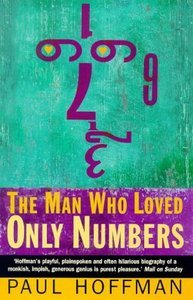
The Man Who Loved Only Numbers

the_man_who_loved_only_numbersThe Man Who Loved Only Numbers
by Paul Hoffman
1998

This is a wonderful book, but it also took me four tries over nearly a decade to get all the way through. It presents itself as a biography of the mathematician Paul Erdös (1913-1996). In reality, the book goes off on a lot of tangents, and there are a lot of natural breaks where it’s easy to set down. It talks about world history and about mathematics and is pretty obviously based on an oral history project. However many tangents it goes on, though, it does always return to Erdös.

Erdös, for those who don’t immediately recognize the name, is the zero point of Erdös numbers—where actors have degrees of Kevin Bacon, mathematicians have Erdös numbers, showing how close they are to having collaborated with Erdös.

Erdös is also one of the few mathematicians who made serious contributions to the field of mathematics after the age of 30, Mathematics generally being a young person’s field. Erdös remained a productive and innovative thinker until his death in his 80s. He was also a very peculiar man, thus a great focus for a biography.

He also seems like a good example of how there are people who are delightful to hear about and make the world a more wonderful place but I’m still glad I don’t have to deal with them personally. (Having read Surely You’re Joking, Mr. Feynman! several times and enjoyed it immensely, the physicist Richard Feynman is likely another of these individuals.) Among other things, Erdös spent most of his life couch surfing at his colleagues’ houses, demanding that they talk mathematics 18 hours a day. He made it work, though, and there was always someplace for him to stay.

Anyway, the problem with the book is that while it is excellent text about a fascinating character, it is also really dense, and not particularly well organized. In addition to Erdös himself, the book describes some of the more accessible and yet unusual mathematical proofs, the lives of various other mathematicians, and a good amount of political history–both that Erdös dealt with and that other mathematicians, both contemporary and historical, dealt with. The history and the mathematics are all related to Erdös’ life and experience, but it’s still a bit like reading multiple books, each of which requires a fair bit of concentration to properly appreciate. The book clearly shows its basis in oral history, and Hoffman doesn’t manage to give it any strong, overarching structure.

It is still well worth reading, but it does take effort.

Anna Dressed in Blood

By Kendare Blake

Book Cover: Anna Dressed in BloodThis book title jumped out at me in the library months ago (for obvious reasons), but then we started the marathon of reading Atlas Shrugged, so I back-burned it for a while, knowing it was going to be my palette cleanser after Rand. At the worst parts of Atlas Shrugged, I just pictured Anna Dressed in Blood waiting for me. And I couldn’t have asked for a better palette cleanser!

It is cheesy and spooky and just awesome! It reminds me a bit of Twilight, actually, if a better writer had written the characters and situations in a way that makes more sense in a rational world. Also with some gender turnaround: Cas moves to a small town in Ontario with his single mother, starting a new school in his senior year and is immediately popular. Sound familiar? He’s also brooding and rude and immediately drawn to the titular female character. He’s kind of both Bella and Edward, but everything he says and does actually makes sense.

Cas is a ghost hunter, a talent and career that he inherited from his now-deceased father. He and his mother travel to new towns that have killer ghosts, settle there long enough for Cas to draw out and dispatch the ghost, and then move on to the next town. He is immediately popular at his new school because he makes an effort to be; he needs access to the gossip mill as quickly as possible in order to do his job. He knows that by being brooding and a little rude, he’ll be considered even more attractive, so he does that on purpose as well. I just love rational characters who have a goal and then follow logical steps toward it!

I felt like the plot got a bit scattered toward the end; I can’t quite put my finger on it, but the pacing just felt kind of odd to me. Even with that, though, this was a very satisfying book with which to recover from Atlas Shrugged. I would be somewhat cautious about recommending it for young readers: there was a fair amount of violence, and I can’t attest to fear factor because I have already described how I completely unfrightening I find ghosts.

—Anna

As You Wish and Sisters Red

I’ve been reading a stack of non-fiction lately–books that are interesting, but not necessarily things I want to blog about. That is, unless folks are interested in a giant autobiography/oral history about the Mob hitman who killed Jimmy Hoffa? But I broke up all the history with a couple of lovely young adult fairytale retellings that seem like they might fit well into the YA vibe we generally have going here. Jackson Pearce clearly has the knack for reframing classic stories into modern young adult stories–she’s got a whole catalog of them. The two I read were As You Wish and Sisters Red and both were totally charming, easy reads.

As You Wish is the story of a depressed teenage girl who accidentally conjures a jinn (or genie) who has to stick around until she makes three wishes. But she doesn’t really want to fix her life with wishes, and he ends up getting interested enough to want to stay. The book is pretty short–almost spare–but it does a wonderful job creating a back story for the jinn with a minimum of information. In fact, the whole book gets across a lot of information and plot while staying very simple and not getting overly flowery. Sisters Red is a more complex story, wrapping together werewolves and the Little Red Riding Hood story, but adding in a relationship between sisters that really touches on the kind of layers that love and obligation create.

This might be making a fine distinction, but I found both these to be more like YA books plus a little fantasy, rather than fantasy books aimed at younger readers. There are no elaborate maps of fantasy kingdoms or complicated world building, but both books present a nuanced picture of teenagers and the serious issues they face, magic and mundane.

Kinsey’s Three Word Review: ABCFamily-esque modern fables

You might also like: Before I Fall by Lauren Oliver or Robin McKinley’s Beauty and the Beast retellings.

Codex Seraphinianus

codexCodex Seraphinianus
By Franco Maria Ricci
1981

In honor of April Fool’s Day, I am reviewing the Codex Seraphinianus. No, this is not a prank or a lie, at least not on my part. The book exists. Just, well… it’s more like it’s a prank or a lie on the author’s part.

The Codex is an incredibly beautiful and extremely peculiar biology/sociology text in a foreign language. Yeah. Think on that for a bit.

Also, I recommend it.

Regardless of what languages you may be fluent in, this book is in a language foreign to you. It’s actually an alien language constructed as either a code or simply a very detailed doodle by the author, such that the written text is just as much an illustration as any of the actual color illustrations.

The color illustrations, of which there are many, are beautifully done, likely with oil pastels or some such.

codex03  codex7  codex_09

The subject of the book is the biology and sociology of an alien world… an extremely peculiar alien world, with a very complex biology. In some ways it reminds me of a steam-punk universe with cyborgs/implants/etc., except that such mechanical additions are intrinsic to the biology of the plants and animals rather than intentional additions later. (Sort of like WTF-Evolution’s even crazier, acid-tripping brother.)

In other ways it reminds me of the biology from Vernor Vinge’s A Fire Upon the Deep or Orson Scott Card’s Speaker for the Dead. Except more so than either Vinge or Card went.

It also reminds me a great deal of the Voynich Manuscript, a document that I have yet to actually see a good copy of, but which is another biology text written in an unknown language. But the Voynich Manuscript has had professional and amateur codebreakers trying to break it for nearly a century at this point and variously manage to “prove” is (a) a complex code that we just don’t have the key to yet, (b) a brand new language that would need to be translated rather than uncoded, or (c) complete gibberish that contains no meaning and can thus be neither uncoded nor translated. Its provenance is also deeply questionable. It has the potential to be (a) a secret alchemical manuscript from the 1200s, (b) a forgery created in the late 1500s and sold to Emperor Rudolf II as a secret alchemical manuscript from the 1200s, or (c) a forgery created in the early 1900s perpetrated either by or on the book dealer Wilfrid Voynich.

But back to the Codex Seraphinianus, it is vibrant and gorgeous and inspiring and confusing.

If you can get your hands on a copy, it’s a lot of fun.

Or, for a more easily accessible book, check out Chris Van Allsburg’s The Mysteries of Harris Burdick, and try to figure out what the plots are of those stories.

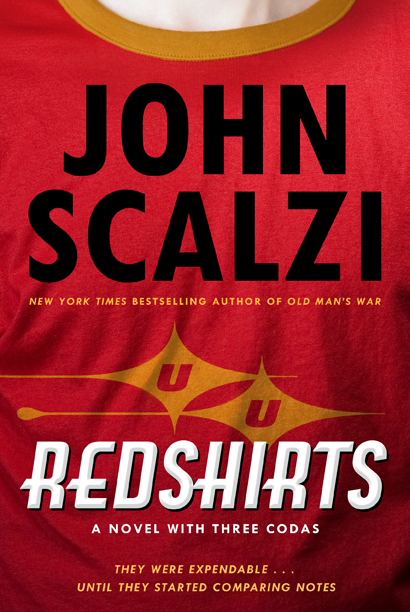
Redshirts by John Scalzi

Redshirts_John_Scalzi1Redshirts
by John Scalzi
2012

First off, this is an extremely meta novel. It doesn’t so much break the fourth wall as it goes right up to fourth wall, run tests on its density and permeability, and then proceed to report the results to the reader.

The story is set in a quasi-Star Trek universe, from the point of view of one of the ubiquitous “Red Shirts,” wondering why there’s such a high fatality rate among his compatriots and such a low fatality rate, given the exact same circumstances, among the command staff. Anyone who watched the original Star Trek series will understand why this premise made me giggle. Plus, I’d read The Android’s Dream by John Scalzi before, and it was awesomely, ludicrously hilarious.

I intended to read this as a bit of a palate cleanser to my Atlas Shrugged marathon as well as a less controversial book to take with me and read in waiting rooms. It worked beautifully for the second intent, but turned out not to be nearly as light-heartedly fluffy as I had been expecting for the first intent.

It does start out fluffy and funny. The first half was straight up silly. Then it begins to really break the fourth wall and the plot is resolved by three-fourths of the way through the book. Then the final quarter deals with the fall out. Most books have, at most, a short epilog summarizing the foreseeable future. This book, on the other hand, spends a significant amount of time confronting issues of self-agency and choice and worth.

While it’s nowhere near a perfect match, in some ways it makes an interesting compliment to the movie Inception.

It was a good book and I do recommend it, but go in realizing that it’s going to wind up more serious than it starts.

Hounded

Well, I think it’s time to get Atlas Shrugged off the top of the blog once and for all! I hope that Anna and Rebecca are both off somewhere reading fluffy things and not thinking about political philosophy. And if they want a fun new fantasy series to read now that they’re free to read fun things, I’ve got a good one for them.

Hounded is the first book in Kevin Hearne’s Iron Druid series. I think there are five books out right now, and after reading this one I am going to hunt down all the rest. The story centers on Atticus, a 2000-year-old Druid who is peacefully running an occult bookstore in Arizona when a Celtic god from his past shows up to settle an old grudge. There are also witches, and vampires, and werewolves–Hearne does a great job of introducing a fully-populated universe of mystical characters who I suspect will play roles in future books, while still keeping this story moving right along. Thor doesn’t actually show up in this book, but all the characters who’ve met him think he’s a dick, so I’m really hoping he shows up eventually. Oh, and Atticus has maybe the best talking dog in the history of talking dogs.

The thing that really charmed me about this book is that it’s funny. Fantasy books can b so dark sometime, and certainly there is some death and destruction here, but there’s limited angst and lots of humor. I really enjoyed the whole thing and am looking forward to downloading the next few to keep me happily distracted on some long plane flights I have coming up.

Also, I don’t do audiobooks because I don’t have the attention span to follow fiction read out loud, but the friend who recommended this one to me said that voices in the audio version were absolutely awesome. So if you are a books-on-iPod person, you might want to check it out.

Kinsey’s Three Word Review: Snarky, modern-day fairytale.

You might also like: Good Omens by Neil Gaiman and Terry Pratchett, or any of Christopher Moore’s books.