The Girls at the Kingfisher Club

By Genevieve Valentine

Book CoverI’ve mentioned before that I’m a big fan of Genevieve Valentine. I love both her blog and her fictional writing, but am continually surprised by how different they are. She is so funny on her blog; her recaps of the television show “Penny Dreadful” were as much a delight as the show itself. Her books and short stories, however, are almost unrelenting melancholy. Her novels are not hugely long or densely worded, but she somehow gives everything a sort of portentous double-meaning which gives the narratives a heavy tone. It is such a vague feeling in the text that I’m struggling to describe it.

Anyway, The Girls at the Kingfisher Club is a retelling of the folktale of the twelve dancing princesses, set in New York City during Prohibition. (The titular Kingfisher Club is the dancing girls’ speakeasy of choice.) The Twelve Dancing Princesses was not a favorite story of mine as a kid, so I only vaguely recalled it. What is just sort of casual misogyny in the original story (of course the king locks up the twelve princesses in a tower – that’s just what you do with princesses in fairy tales), gets fleshed out here into true cruelty in the utmost neglect in a real-world setting. This builds up a strong sense of suspense throughout the novel, as the consequences are suddenly more real.

It made me cry several times in the privacy of my home, but it also, embarrassingly, made me laugh out loud on the metro.

—Anna

Love, Nina

Some of my favorite people on Twitter are a group of British authors that includes Bim Adewunmi (@bimadew), India Knight (@indiaknight), Jojo Moyes (@jojomoyes), and Emma Beddington (@Belgianwaffling). In addition to being generally hilarious, they often have conversations amongst themselves about what they’ve been reading, and paying attention to those back-and-forths is a fabulous way of staying on top of what the cool (but non-pretentious) kids in publishing are reading and enjoying. The problem is that not everything they talk about is available in the U.S. I spent months watching them rave over a memoir that I couldn’t get, but just when I was about to cave and pay the insane shipping on amazon.co.uk, Love, Nina: A Nanny Writes Home by Nina Stibbe came out in the U.S. And it is just as great as they said it was.

Now, if I had just read a description of the book, I’m not sure if it would have caught my eye: in the 1980s, a young woman takes a job working as a nanny for two boys whose parents run in London’s fancy literary/artsy circles, and this is a collection of the letters she wrote home to her sister. I don’t know, it sounds very, innocent-country-girl-in-the-city? Or like a pre-Internet mommyblog? I’m just not sure I would expect much. But it is so much more sharp and thoughtful and, friendly than it sounds.

First of all, Nina and the family she works for are all hilarious. It’s clear that MK (the mom) was far more interested in a nanny who was clever and could keep up with the jokes and get along with the kids than in someone who could cook, clean, or successfully park a car. So there’s no employee-employer feel here, but rather it seems like you’re reading about the daily lives of a snarky bunch of friends. In the letters themselves, Nina often entertains her sister with retellings of conversations she has with the kids or MK, which are awesome. And presumably because these were going to a sister she was close to, Nina doesn’t try to make herself look good in the letters (there is kind of an on-going joke about Nina lying when she gets stuck in unpleasant situations). But that just make her seem even more relatable, and like someone you’d very much like to hang out with. In fact, the whole books feels like you’re getting to be in on all the jokes and secrets of some very cool people—there is one bit when Nina is evaluating a number of people on whether she is going to try to make friends with them, and I found myself thinking, “I really hope she’d have thought I looked worth the effort.” There’s no huge dramatic arc here, or any big tragedy, it’s just a lot of smart people who like each other chatting and having tea and reading things. It’s the perfect life, really.

I should say that this is an incredibly English book. There is a lot of discussion of English foods and dish soap and lots of slang, and lots of references to people that I suspect are more household names in the U.K. than they are here. The book opens with a list of main characters, and I did have to refer back to it and to Google occasionally to make sure I understood all the references. But you wouldn’t have to do this—the point here is not the celebrity gossip, and I think you could skim over every odd English reference and still enjoy this immensely.

Kinsey’s Three Word Review: Cool, charming, and funny.

You might also like: This is not at all original, because a number of other reviewers have mentioned this, but Love, Nina feels a lot like 84 Charing Cross Road, another sweet English book of letters. And Nancy Mitford’s books are from a different generation, but I think they also have a similar chatty, inside-joke sensibility (with just a tiny little bit of added Nazis).

Rose Under Fire

By Elizabeth Wein

Book CoverShortly after Kinsey notified us all about the sequel to Code Name Verity, I checked out Rose Under Fire, with some trepidation, I have to admit. Code Name Verity was excellent, but also completely devastating in parts, and Rose Under Fire had the potential to be even worse. The majority of the book is set in a Nazi concentration camp for women, with extra focus given to the victims of the ‘medical’ experiments. I just wasn’t sure I could take it.

However, Elizabeth Wein is a genius and knows exactly how to tread the line. Most of the book is mercifully told in flashback, so readers can continually reassure themselves that at least these few characters have necessarily survived. This doesn’t mean it isn’t heartbreaking, of course; just not unbearably so. I would even say, all things considered, that overall it was more upbeat (not the right word at all) than Code Name Verity. (It also is not a direct sequel, per se; it has some shared characters, but features a newly introduced main character.)

Several weeks later, I followed this up with watching “Judgment at Nuremberg,” a 1961 film recounting one of the trials at Nuremberg, this one against four judges for crimes against humanity. Spenser Tracy stars as the retired American judge who agrees to oversee the tribunal for this trial, and wrestles with his own conscience in trying to reconcile the crimes that were committed in the past with the current devastation of the country.

The movie explores to what degree individuals are responsible for the actions of a government. Outside of the courtroom testimony, some of the more painful scenes are of regular citizens looking dazed and insisting they had no knowledge at all of the actions of the Nazi party. It inspires an unsettling mixture of pity and anger in both the judge and the viewer, and raises tough questions without easy answers. It was a good companion to “Rose Under Fire,” and now I’m ready to turn to some lighter books and movies.

—Anna

Queen Victoria’s Book of Spells

Edited by Ellen Datlow and Terri Windling

Book CoverThis anthology is collected by the same editors and many of the same authors as Teeth, which I read and reviewed previously. It is described on the cover as “an anthology of gaslamp fantasy,” and having the setting be the common factor instead of the characters allowed for a greater range in the stories, which I appreciated.

The Victorian Era, too, is an excellent setting to pick, since so much was going on! There was the very first world’s fair, an explosion of technology, science, and manufacturing, and a return to romance in the arts. It was an era of lots of contradictions, as well: most well-known for extreme wealth, it also had predominant extreme poverty; the British Empire was both strongly xenophobic and driven to colonize; and Queen Victoria herself was both a pretty and lively young girl, and a solemn and joyless widow.

Though, once again, I checked out the book for the short story by Genevieve Valentine, I was pleased that the anthology also included Elizabeth Wein and Caroline Stevermer. My favorite stories ended up being “The Governess” by Elizabeth Bear, in which a governess takes a position in a very troubled household, and “Phosphorus” by Veronica Schanoes, about the strike of the women who worked in the match factories. Don’t those two alone reveal the wide scope of the book?

Can I also describe how ridiculous I can be? I had always had a vague feeling that I didn’t care for Elizabeth Bear, because I believed that she had written Clan of the Cave Bear (because “Bear”) and/or Women Who Run with Wolves, or some amalgamum of both books that only exists in my head. In addition to the fact that Elizabeth Bear did not write either of those books, I have not actually read either of those books, or any books that Elizabeth Bear has actually written. No reality will keep me from my pointless prejudices!

— Anna

Longbourn

Pride and Prejudice is my very favorite book. It says so right in my bio for this site. I’ve read it dozens of times and love every bit. But I’m not overly precious about adaptations or modern takes–I really like seeing how someone takes such classic material and uses it to say something new, or just puts their own spin on a good story. Now, some re-purposings of the Bennet family have worked better than others. Bridget Jones’s Diary is another of my favorite books and I think it is absolute genius, and the Bollywood movie version Bride and Prejudice is completely delightful. And of course we are all big fans of the Lizzie Bennet Diaries here on Biblio-therapy. But I deeply, deeply disliked Austenland and I don’t even want to talk about Pride and Prejudice and Zombies. I tell you all this so you understand that I am a discerning consumer when it comes to the Jane Austen industry, as it were, and I am heartily recommending Longbourn by Jo Baker.

The one sentence summary sounds very Upstairs, Downstairs or Downton AbbeyLongbourn is about what the Bennet family servants were doing during the action in Pride and Prejudice–but Baker has taken what could have been just a cute idea and turned it into a really thoughtful story about complex, layered people.

Now the hook for the reader, of course, is how the story in this book will line up with the action we’re all familiar with, and how Baker writes about well-established and -loved characters like Jane and Lizzy. And don’t worry, the Pride and Prejudice fan will find plenty of things that mirror the classic. For example, when Mr. Collins comes to visit, the servants are all very concerned that they make the best impression possible, since when he takes over Longbourn he could chose to fire them all. And a few of the Bennets who don’t get the most sympathetic treatment in the book (including Mrs. Bennet and Mary) have an opportunity to show the reader a softer side. But what I found most impressive is that the heart of this story is the entirely new characters Baker creates from the ghostly background characters that Austen mentioned in only in passing and generally not even by name.

While the Bennet girls are sorting out their marital futures, the Longbourn servants are dealing with their own dreams and struggles. Sarah, the maid, dreams of life beyond the structured, never-changing Bennet house. Hill, the cook, has built her whole life at Longbourn, but struggles with what she has given up to create a peaceful space for thew family she’s assembled and how fragile a life spent serving others can be. And James, the mysterious new footman, wants to escape his past and fit into his new household. The beginning of the book describes a life so peaceful and prescribed that it cast a spell over me, lulling me into the quiet rhythms of an English country house. But as Lizzie’s story picks up speed, so does the action below stairs, and the fates of these characters ended up feeling as dramatic and important as anyone’s should be. While the plot of the book hangs on the structure of Pride and Prejudice, Baker’s story takes on its own life. I enjoyed her take on the behind-the-scenes in the Bennet household, but her characters stuck with me after the book was done and Longbourn is worth reading for their sake.

Kinsey’s Three Word Review: Contemplative modern take.

You might also like: Well, Pride and Prejudice obviously, if you haven’t read it. It really is lovely. But there was also something about Baker’s writing–the deliberate calmness, maybe–the reminded me of Ann Patchett, so you might want to try Bel Canto or State of Wonder.

The Bible: Ruth

This is an extremely short book, only four chapters long. In some ways it reminded me of the Book of Job, since it’s a single story with more developed individual characters. For the first time, this is really a more focused story about family love and loyalty; goodness on the scale of individuals.

It was a much appreciated palate cleanser from the previous few books.

In this story, Naomi was a married woman with two adult sons who had each married. Over time, though, both her husband and her two sons died. While she directs both of her daughters-in-law to return to their families as being better able to care for the widowed women, one of them, Ruth, insisted on staying with Naomi.

Where you go, I will go: where you lodge; I will lodge; your people shall be my people; and your God my God — Ruth 1:16

I had known this quote, of course, but it had always seemed the epitome of romantic and I’d assumed it was spoken by a woman to her husband or lover. I’m actually rather pleased to discover that it is spoken by the widowed Ruth to her mother-in-law. This isn’t about marriage, it’s about found family.

Naomi returns to her homeland accompanied by Ruth but are poor beggers. They work together to identify and then seduce for Ruth a new husband, so that Naomi can have an heir and Ruth can have a household. And they succeed in finding a nice older man who is both wealthy and kind (and flattered at being approached by a younger woman.)

And they all live happily after.

It was nice.

Summary: Widowed Ruth follows her mother-in-law Naomi home to a strange land and, with Naomi’s assistance, finds a kind and wealthy second husband to take care of them both.

Moral: Loyalty and kindness can pay off in a happy ending.

Next up: Samuel 1

The Bible: Judges

So in Deuteronomy I complained about how Moses gave this lecture about how the people of Israel would betray the Lord and be punished for their sins, etc, and it really irritated me. Well, here’s the start of all the crap that’s going to happen to them, and sure enough it’s pretty thoroughly their own fault. Once more, I am reminded of Game of Thrones (a show that I actually don’t watch, but keep up-to-date on via summaries) in the way a bunch of unpleasant people wander around doing awful things to one another.

Plus, this should probably have an NC-17 rating, and more likely just be banned, because it is gruesome. And while previous books have been all pro-genocide, this one is pretty pro-rape.

Four nations* were left alive in order to provide a lesson in warfare to the generations of Israelites, and thus we have a timeline made up of conquerings and rebellions, covering the various “Judges” of Israel. There is no particular explanation of how a Judge is chosen or found, and very little information on some of them. (Footnotes mark the six who actually got stories.)

Bad guy: King Cushanrishathaim of Aram-naharaim conquered for 8 years
Judge: Othniel son of Kenaz judged for 40 years
Bad guy: Eglon of Moab conquered for 18 years
Judge: Ehud son of Gera, the Benjamite judged for 80 years**
Judge: Shamgar son of Anath judged (killed 600 Philistines)
Bad guy: King Jabin of Canaan conquered for 20 years
Judge: Deborah wife of Lappidoth judged for 40 years***
Bad guy (nation): Midian conquered for 7 years
Judge: Gideon, called Jerubbaal, son of Joash judged for 40 years****
(Judge? Bad guy?): Abimelech son of Jerubbaal, conquered? judged? for 3 years+
Judge: Tola son of Puah son of Dodo judged for 23 years
Judge: Jair the Gileadite judged for 22 years
Bad guy (nation): Philistines and Ammonites conquered for 18 years
Judge: Jephthah the Gileadite, bastard son of Gilead judged for 6 years ++
Judge: Ibzan of Bethlehem judged for 7 years
Judge: Elon the Zebulunite judged for 10 years
Judge: Abdon son of Hillel judged for 8 years
Bad guy: Philistines conquered for 40 years
Judge: Samson judged for 20 years +++

After Samson we trail off away from judges and get a random story about Micah who gets wealthy in chapter 17 and then gets it stolen away from him by a bunch of other Israelites in chapter 18.

Then comes the really rape-tastic story of the Benjamites (chapters 19-21), which starts out reminiscent of Lot’s situation in Genesis 19, where he offers his daughters to a mob in Sodom in place of his angelic visitors. Except that in Genesis, Lot’s daughters were not accepted as suitable replacement, while in Judges a mob of Benjamites do wind up accepting a Levite’s concubine in his stead. So they gang rape the concubine to death. In the morning, the Levite cuts his dead concubine into 12 parts and sends the parts to the different tribes of Israel to call up an army. The Benjamites refuse to give up to justice the actual participants in the gang rape and thus a series of remarkably even battles takes place, with the Benjamites eventually losing to the extent that their entire tribe was killed with the exception of 600 soldiers who fled into a particularly inhospitable area. Victory was declared but then they had the problem of 600 males left in the tribe of Benjamin and no women and all the other tribes of Israel had sworn not to give any wives to Benjamin but were also unwilling to just let them die out.

The army that had just slaughtered all the women and children of the Benjamites figured out that they could fix this by invading a Canaanite town, killing all the males and the adult females and delivering the young females to the remaining Benjamites to be their wives. This plan provided 400 young girls to “marry” but wasn’t enough to give each Benjamite soldier a wife of his own. So the army told the remaining Benjamites to just kidnap sufficient girls from the religious celebration happening Shiloh, north of Bethel, and then explain to their unhappy fathers and brothers that at least the oath not to give wives to the Benjamites hadn’t been broken, because the Benjamites had taken the wives by force.

So everything worked out?

Blech.


Summary: There were a bunch of people who weren’t as great as Moses or Joshua, but still somehow acquired the title of “Judge.” Occasionally they did stuff (ie, killed people.) Some other people did a lot of raping and sometimes it was bad and other times it was good.

Moral: Hahahahahahaha! “Moral,” you say. Hahahaha! The very last verse in the book is:

In those days there was no king in Israel; all the people did what was right in their own eyes. — Judges 21:25


* Philistines, Cananites, Sidonians, Hivites (Judges 3:1-4)


** The Moabite king he killed was so fat that Ehud left the sword in his body, hidden by the layers on fat, as he wandered out past the servants after his assassination of their king.


*** Deborah gets a song in addition to a rather convoluted story of manipulations.


**** Gideon makes God prove himself and then raises an army of some 20,000 people, but God decides that it’s too even a battle to really show God’s might, so has Gideon send 19,700 of them away, keeping only the soldiers who lap up water from the river like dogs.


+ It didn’t even seem clear to the narrator whether this guy was a good guy or a bad guy. He’s the son of Gideon, a previous judge, but he also killed his 70 brothers in order to inherit and winds up getting cursed and dying.


++ First occasion of human sacrifice: Jephthah sacrificed his daughter as a burnt offering.


+++ Samson gets four whole chapters (13-16) and is an idiot and an ass. Among other things, he makes a bet that he can’t afford, and when he loses, he goes out and kills some local townspeople to take their stuff so he can pay off his bet. And, of course, there’s the famous story of him and his hair and his wife Delilah who cuts it off to weaken him. Four times (4 times!) Delilah asks Samson what will weaken him, and then does it, and calls his enemies in. The first three times, Samson lies to her, breaks his bindings and kills his enemies. The fourth time he decided to tell the truth???


Next up: Ruth

More Fun Stories…

Rebecca and I exchanged a couple of short stories with twist endings that I thought I’d share with you to finish up this week:

I ran across this through io9, which I think I’ve recommended before, and they recommended it as not-your-normal-discontent-in-your-body story:

http://imgur.com/a/CgCaR

And, this one has a double twist ending in just a few paragraphs, the second of which is brilliantly provided in comments:

http://jaytothesun.tumblr.com/post/95881851021/hotmesswithouthehot-lemonmintcoughdrops

—Anna

The Bible: Joshua

I had not expected reading the bible to be such a strong argument for atheism. I can certainly understand why there was such a long time when priests prevented their congregations from reading it themselves and insisted that a priest had to interpret it for them. Because this is just sort of miserable.

Current events are not helping, given:

Generally speaking my faith in humanity is at a definite low point right now, and Joshua did not help at all.

The Book of Joshua

Joshua is a warlord. This book starts off with the details of the battles Joshua led as the Israelite army crosses the Jordan and starts to take over the land.

After the first few battles, though, the descriptions change to just lists. Here are all the cities who were invaded and the people who were killed, because there were too many to describe.

The third and largest part of this book gives detailed descriptions of how exactly the conquered land is divided among the people of Israel.

There’s also a call-out to the magician Balaam, mentioned in Numbers. In Numbers, he was hired to curse the Israel people but blessed them instead, and then gave a speech about the greatness and virtue of God. (It made me laugh.) Well, in Joshua, the army of Israel killed him. “Along with the rest of those put to death, the Israelites also put to the sword Balaam son of Beor, who practiced divination.” (Joshua 13:22)

Since the rest of my description is rather long, I’m going to put the rest under a cut: Continue reading

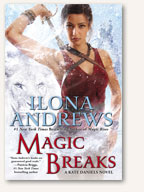
Magic Breaks

By Ilona Andrews

Book CoverEach of the first three books of Ilona Andrews’ Kate Daniels series was better than the last, but once they passed that trilogy mark, each subsequent book got a little more joyless and plodding. Magic Breaks is the seventh book (of what was initially planned to be a seven-book run, but has now been extended to ten planned books) and the first to be released in hard cover,* so it was the first that I decided not to buy and instead checked out from the library. By halfway through the book, I was starting to think this might be the last book of the series I read at all.

I had initially been attracted to the series because it has such an unusual approach to the vampire/werewolf genre and it was laugh-out-loud funny. The last several books have lost pretty much all humor, just sort of slogging through long gory descriptions of violence. The first half of this book felt like a bit of a chore.

However, much like Patricia Brigg’s vampire/werewolf series, this one ends with such a game-changer that I am once again hopeful for the series. The violence continues to escalate, until things (temporarily) resolve in a very interesting way that should clear out some of the distracting clutter of previous story lines in a very interesting and potentially very funny way.

—Anna

*Unfortunately, as much as the authors and publisher try to market this hard cover edition as a possible introduction for new readers, it really isn’t a stand-alone book, and has to be read in the order of the series.