 All Rights Reserved
by Gregory Scott Katsoulis
2017
This book is terrifying. It’s good and I recommend it, but like many such YA novels, it’s set in a dystopian future and it’s a particular dystopian future that I am deeply concerned with.
For some background:
US copyright law was first established in 1790, allowing authors to register their books for a seven-year monopoly on publication, to allow the authors that long to make as much profit as they could before they had to shift their focus to a new creation.
Ever since then, the copyright protections have been creeping to allow creators longer monopolies and pushing back any content going into the public domain to help and assist other creators or just be available to the public for free.
The Copyright Term Extension Act (colloquially known as the “Mickey Mouse protection act” because Disney was so scared of Mickey Mouse entering the public domain) was made law in 1998, and that degrees that all content is automatically copyrighted (no registration or even intent required) and content remains under copyright for 70 years after the original author has died. Great grandchildren can now hold monopolies of their ancestors’ creations… no need to make new content at all.
Meanwhile, what exactly copyright covers has also been expanding: originally it literally just covered the text itself. Translations were not infringing copyright because they were literally changing the language. Characters and settings were free to use. Now sequels and spinoffs are all infringements. Organization for Transformative Works is currently battling just to allow people to freely write fanfiction for purely recreational purposes.
The “fair use” exception was added to copyright law allowing some leeway for people to use excerpts except that one of the ramifications is that it shifts the burden of proof. Historically, a copyright holder had to show that someone had been infringing on their copyright, or they couldn’t sue: innocent until proven guilty. Now, the copyright holder can sue based on any use at all, and the person using it has to prove that their use fits the exception: guilty until proven innocent.
I know less about Patent and Trademark law (the other two main branches of law concerning intellectual property) than I do about Copyright law, but I expect they’ve gone through similar slow transformations.
And I’ve certainly become increasingly aware of how often my purchases aren’t actual purchases, but are legally “lease agreements”. You don’t buy Kindle books or iTunes songs or Microsoft software anymore: you lease the use of them, with restrictions in place. There are definitely rights reserved on those things.
Back to the book:
So in this novel, we’re presented by an America™ that has continued to change intellectual property laws to such a point that words and phrases and gestures are each individually copyrighted and royalties are due for any use of them.
Everyone is tracked and their words and actions monitored to ensure they are paid for. Going into debt means being taken away to work short lives as field labor or indentured indefinitely to anyone interested in buying that debt. Everyone makes some money by being sponsored by various companies to advertise for them. (Rich and/or pretty people get better sponsors.)
Our main character Speth Jime (her first name is a discount name that doesn’t cost too much to say, her last name was probably originally Jimenez except it was too expensive and shortened generations back) turns 15 at the beginning of the book, the last day on which she can speak freely. After that, when a friend commits suicide, she can’t even afford to scream. Rather than make her first speech as an adult (full of product advertisements) she goes completely silent.
The narration shows Speth’s thoughts, but she has no way to communicate with those around her, even as they talk to and at her.
Plot-wise, it feels a bit like The Hunger Games, really, as people try to either ally with her or take her down and giver her suggestions that she has to figure out whether or not to follow. There’s a happy ending (with more than enough loose ends to warrant a sequel), but it’s a nerve-wracking and heart-breaking trip. The cast of characters are interesting and well-developed and diverse in a variety of ways, and Speth is amazingly relatable in the way she’s just become this icon of rebellion that she never intended as anything other than a reaction to personal trauma. The book wouldn’t have held together without the characters being so relatable, but where the book truly shines is the world building. The dystopian world is terrifying as it shows how difficult systematic oppression is to fight, and how easily rights can be worn away and the lack of those rights then normalized.
So very good, and packs a serious punch.
It will definitely make you think the next time you mindlessly click “agree” on a terms of service contract.
 If my previous review,
  The back cover of the book had blurbs comparing it to both Jane Austen and Georgette Heyer, which makes sense because it features very similar characters and setting. Lucy, is the oldest daughter of a rural rector, who comes from a respectable family (her uncle is an Earl!), but without much money. She is responsible for most of the village duties of her late mother, including visiting the sick in the neighborhood.
 fail, fail again, fail better
 I picked up this graphic novel almost immediately upon entering the floor, and it turned out to be my favorite purchase. The author and artist are both Asian Americans, who had discovered a very short run of what was likely the first Asian American superhero, the Green Turtle. They elaborate more on the source material in the back of the book, but the short version is that it was written by a Chinese American author during World War II, showing allied China defending American against Japanese agents. The Green Turtle himself is kept very mysterious in the original books, and is never given any sort of backstory, which Yang and Liew decide to correct in their update.
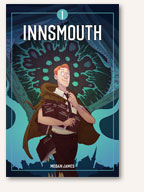 Innsmouth was a close second, though only the first three issues were available (the fourth one has come out in the time it took me to actually post this review), of what will hopefully be a long-running series. (The only drawback to the independent publishing is, who knows how long there will be funding for any given project. If only I were a millionaire!)
 Humans Wanted
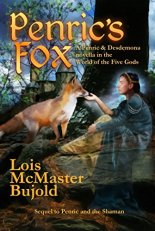 Penric’s Fox (story #5) is essentially a sequel to Penric and the Shaman (story #3). Although it’s set some years later, it’s the same cast of characters and is set decidedly before the events of story #4. One of the things I really enjoy about Bujold is that she plays around with her genres even in the same series and thus this is a detective story, with a discovered corpse and police investigation and all. It was also kind of heart-wrenching and made me tear up a bit but just so very good.
 Prisoner of Limnos (story #6) is a direct sequel to Mira’s Last Dance (story #4) with barely a few weeks having passed for the characters between the two books and dealing directly with some of the uncertainty left at the end of #4. I was also all geared up for some raciness to it, too, but Anna can be reassured that events stay relatively chaste (even as my mind is in the gutter giving me occasional wink-wink nudge-nudges.) This is something of a heist storyline and also introduces a whole swathe of new secondary characters that seem very interesting and open up all sorts of possibilities for future story lines. While this one doesn’t end in quite the almost-cliff-hanger (emotionally at least) of #4, it does leave me just craving more. I just really need to know more about those new characters and their stories and what they do next. I’m keeping my fingers crossed that Bujold continues to write these stories at the amazing pace she’s had so far.
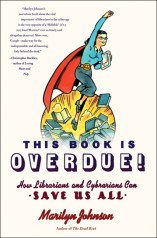 This Book is Overdue: How Librarians and Cybrarians Can Save Us All
