By Mary Roach
 Rebecca has read a fair amount of Mary Roach, but this is my first book of hers, and I have to say, I really enjoyed it! I don’t often like nonfiction, but she has such a juvenile sense of humor about it all that I really appreciated! Basically if anything has even a distant relationship to genitals or farts or such, she’ll be sure to delve into it.
In the introduction, Roach writes, “Simply put, this is a book for people who would like very much to believe in a soul and in an afterlife for it to hang around in, but who have trouble accepting these things on faith.” And I’d say that describes me to a T! She covers reincarnation, séances, ghosts, and near-death experiences, among others, and it is all fascinating. I’m not sure that I can sell this book any better than including the opening to one of my favorite passages:
Is it possible to dress up like a ghost and fool people into thinking they’ve seen the real deal? Happily, there is published research to answer this question, research carried out at no lesser institution than Cambridge University. For six nights in the summer of 1959, members of the Cambridge University Society for Research in Parapsychology took turns dressing up in a white muslin sheet and walking around in a well-traversed field behind the King’s College campus. Occasionally they would raise their arms, as ghosts will do. Other members of the team hid in bushes to observe the reactions of passerby. Although some eighty people were judged to have been in a position to see the figure, not one reacted or even gave it a second glance. The researchers found this surprising, especially given that the small herd of cows that grazed the field did, unlike the pedestrians, show considerable interest, such that two or three at a time would follow along behind the “ghost.” To my acute disappointment, “An Experiment in Apparitional Observation and Findings,” published in the September 1959 Journal of the Society for Psychical Research, includes no photographs.
Roach goes through an enormous amount of archives, in order to bring us the juiciest bits. In fact, I think that’s why I like it so much – reading this felt like gossiping with a good friend. If I have one little quibble, sometimes Roach’s research takes her into realms that are a bit much for me. Rebecca warned against the vivisection chapter in Gulp, and I’m here to warn against the ectoplasm chapter in Spook. I did not know what rumination was before I read this, and I’m not super happy that I know now.
 This book was described as Jane Austen meets magic, which sounded pretty good. And it is pretty good! It just isn’t…that. Lately any book set in a regency-type society is compared to Jane Austen, completely disregarding that it is the characters, not the setting, that makes her so popular. Austen imbues her characters with such wit and charm that it is a delight to read about them even in the most mundane setting or plot. Between Two Thorns doesn’t have any of that charm, really, but instead it has some very good world building.
 I’ve been having a bit of a reading crisis lately. I’ve started three different books and can’t seem to get past around the midway point. It’s not the books’ fault – I mean they aren’t stellar or anything, but there wasn’t any clear reason for my lack of interest. My best explanation is just that the news has been so inundating and depressing lately, and I can’t seem to stay off twitter, and I’m just all worn out.
 The Flowers of Vashnoi
 This was a tough read honestly. It is a moderately well-written YA fantasy novel with a great title and an interesting premise. Demons are real and will grant wishes for people in exchange for a body part. Small requests cost a finger or toe, and they go up to a hand or foot, to an arm or leg. The body parts appear to get taken in a supernaturally clean amputation, and there doesn’t seem to be much lasting physical pain to the process.
 Waaaay back in 2012, I wrote a review about the first book in a new YA fantasy/mystery trilogy by Maureen Johnson. I really liked
  Way back in early 2016 Anna wrote a review of a book called
  I loved
 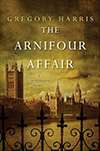 Sometimes I worry that I’m getting too cranky in my old age – that books I would have enjoyed when I was younger, I now pick apart as trite since I’ve read so many other, better books by this point. I really wanted to like The Arnifour Affair: it is a Victorian-era murder mystery featuring a renowned detective, and his partner, both in work and life. Unfortunately, it reads like someone’s Sherlock/Watson fanfic with the names changed. Which, honestly, I would be all over, if only it was well written!
