Slumdog Millionaire by Vikas Swarup

Slumdog Millionaire
by Vikas Swarup
2005

This is a difficult review to write because I did enjoy the book a lot, but also have so many warnings to give before actually recommending it. For example: there is a lot of sexual violence. And also a distinct current of poverty porn (sort of on the level of Oliver Twist). And the dog dies. Also a lot of people die. There’s racism, sexism, classism, homophobia, and general normalized corruption. But it’s also really fun?

The book reminds me of the movies Being There and Forest Gump. Our main character, Ram Mohammad Thomas, is not simple-minded like Gardner or Gump, but he is uneducated, and the premise of all three stories is that the main characters live these wild lives that fit together perfectly by pure providence.

The premise of this book is that Ram has just won a game show by correctly answering thirteen increasingly difficult trivia questions in a row. The game show accuses him of cheating because there’s no way for him to have the level of education to know the answers. The over-all structure of the book is divided into a chapter per question, with Ram telling his lawyer about the portion of his life that led to him knowing the answer to the specific question even if he didn’t know the subject in general. He’s only eighteen, but his life is just this wild ride of being an orphan raised by a priest, sent to an orphanage, acquired by a beggar gang, working as a servant, working as a waiter, running from the police, and meeting all these different people with their own wild stories. 

There’s this huge cast of idiosyncratic characters and while many of the experiences are either traumatic or end in tragedy or both, Ram rolls with it all in a “this might as well happen” way. There’s also a strong thread of situational humor to go along with the horror that makes for a delightful if somewhat boggling experience.

Plus, there are some amazing plot twists, both in the individual chapters and in the overall book plot arc.

I really enjoyed this book, and it covered rough ground extremely lightly, but any potential reader should decide for themselves if they’re up for trying it.

I did wonder if I needed to watch the movie, if only to see how they dealt with all the trauma and also how they would cover so many stories without being at least ten hours long. Since I’d just read the book, I went ahead and read a summary of the movie and the movie solved both problems by sharing only the premise and structure of the book while changing the character and life history completely to something a lot more generic. Which, in my opinion, really misses the point.

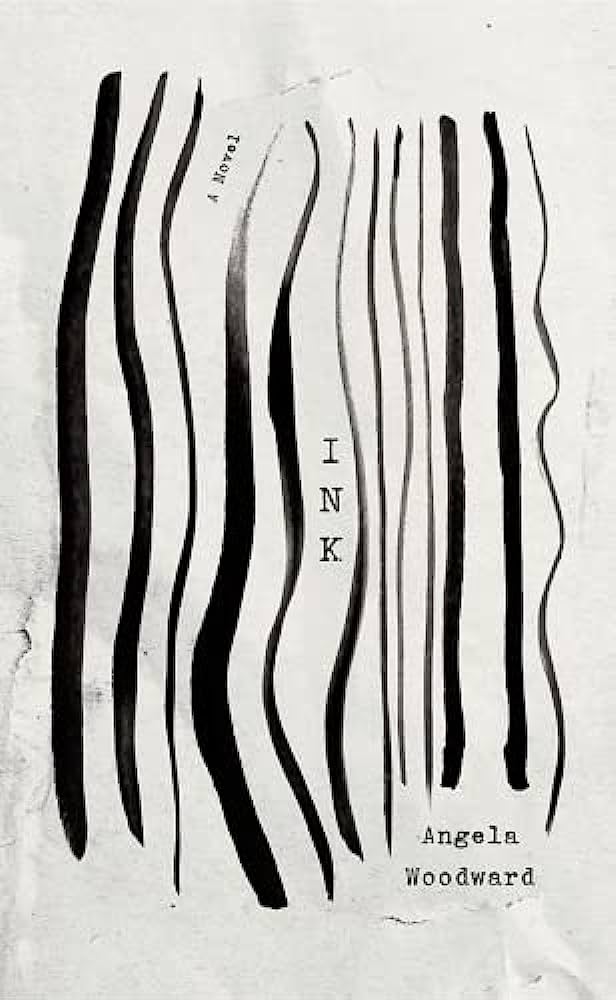
Ink by Angela Woodward

Ink: a novel
by Angela Woodward
2023

Every so often I try reading a literary work and relearn why I don’t read that genre. Woodward is a skilled wordsmith and her writing is lyrical, but her worldview is distasteful and her world-building is poor. Both the characters and the narration are unpleasant in an undeserving way.

I was reminded of a time when I went on a walk with a work friend: we were having a good time mostly window-shopping and chatting in a walking district, when I tripped: stumbled over my own feet, fell to my hands and knees. A few passersby paused but I was fine, I got back up and we continued to walk. The only reason I remember the instance at all is that my work friend said that if that had happened to him, it would have ruined his whole day. He lived in a world where tiny meaningless mistakes could overwrite hours of enjoyment, and the attention of strangers meant critical judgment and inspired shame.

That was his lived experience and I imagine something similar is also Woodward’s experience, and it is certainly her characters’ experience, and it’s such a miserable world to live in: constant judgment both internal and external and no freedom to just enjoy what you can. As Anna pointed out when I complained to her about it: there’s also the meta aspect of Woodward and her characters expecting to be criticized for everything and here I was criticizing them. So it’s not necessarily wrong, but just overly weighted in that direction.

This book is trying to do something interesting, with three different threads: the expected thread of the novel with it’s characters and events, a series of digressions into the history of ink as a substance, and a first-person account of the author discussing her life and writing process for this book.

I found the history of ink fascinating, but untrustworthy. I wish I had read it in a nonfiction book. The first-person accounts I found mostly confusing as to it’s purpose. Perhaps to differentiate Woodward from her even more unhappy characters?

The novel section is what had inspired me to read the book (and not just because that’s the only part that’s in the blurb): it’s about two women who are transcribing the Abu Ghraib detainee statements in the early 2000s. That was around the same time I was doing freelance transcription for various studies in academia: nothing as terrible as first-person torture accounts but enough difficult subjects that I understand some of the impact it can have.

Unfortunately, the book treats the subject as a simple conceit and doesn’t otherwise address it. There are a few short recurring excerpts from those interviews interspersed for shock value, but that was it. At the beginning I thought it was an interesting demonstration of how the mind can shy away from horror by considering more minor aspects: Here’s a single sentence about torture, let us now read several pages on the history of ink. But by the end of the book, as the few repeated excerpts came up, they were treated more like intrusive thoughts to be entirely disregarded, rather than parts of stories that the women were spending days, weeks, months, listening to.

The experience of listening to stories of trauma for hours on end, or even the experience of straining your ears to hear exactly what is said, the click-whirr of the machine, the delight in slow speakers and the difficulty of quick speakers, or the shear physicality of typing all day… None of it was addressed. The characters’ experience was so completely different from mine that it seemed unlikely that Woodward had ever tried transcribing. Or maybe her body, ears and hands all work as differently from mine as her worldview does. 

Woodward explicitly states that she was imaging what these people who must have existed would be like, but increasingly it frustrated me that this isn’t at all what they would be like, starting with being English-speaking only. Woodward wrote a novel about two women in an office environment who both have various levels of unpleasantness in their home lives, but the details of their job appeared to have no impact on them whatsoever.

This book had so much potential: a fascinating premise by a talented wordsmith, and it’s really irritating how poor the results were.
Allow Me to Retort: A Black Guy’s Guide to the Constitution

By Elie Mystal

Elie Mystal remains so funny and smart on the slowly dying Twitter platform, and his book is funny and smart, of course, too, but also infuriating. He uses his very comprehensive knowledge of law to walk the reader through how the constitution has been twisted to protect only some citizens while continually persecuting others.

After giving a fair amount of background in a much needed (for me) setting of the legal stage, Mystal gets down to his two central theses: 1) that originalists (like our current sitting conservative judges) are simply wrong for trying to solely recreate the intention of rich white slave-holding men who did not accept women or any nonwhite people as equals; and 2) all or at least most of our current constitutional crises could be fixed if everyone followed just the 1st and 14th amendment to the fullest extent (that all the other amendments are just closing loopholes that conservatives should never have been allowed to make in the first place).

Every point is bristling with examples from real life cases, which was both immensely helpful to put in context and a struggle, either intellectually because of the legalese or emotionally because of the hypocrisy of the judgments. I truly think Mystal does a masterful job of simplifying each case down to its basics, but I still had to take a deep break and brace myself before each v.

Mystal divides the book into short chapters addressing discrete arguments and provides not only legal, but also philosophical, and anecdotal examples. This makes the book much more readable than it otherwise could have been, but it still hovered around the top edge of my understanding. Which isn’t a bad thing at all! It’s good to stretch with books that are a little advanced, but I definitely had to take my time. (Bless him, though, for mixing in Star Wars and Marvel movie metaphors with Socratic and Hobbesian arguments.)

He closes the book with some quite straight-forward suggestions for fixing our current predicament, mainly eliminating the electoral college and expanding the supreme court, and makes solid arguments for the logic and legality of both. It left me with a lot to think about, and a mixture of hope and pessimism about our government and society as a whole.

Everyone in My Family Has Killed Someone

By Benjamin Stevenson

I was very amused that Kinsey had recommended this in her review of Hench, since I was reading it at that very moment! I enjoyed it enough that I should check out Hench and the others she listed as well. And, I don’t think I really should have enjoyed this book! It is chock full of literary elements that I normally find frustrating or off-putting, like heavy foreshadowing or winky meta narration. I often find that meta concepts in books take away from the emotional impact, that as a reader one is then too focused on the conceit of the writing structure to get really immersed in the narrative. Benjamin Stevenson manages to capture both, though.

There’s a couple layers of conceits, too. The title is the most obvious: everyone in the narrator’s family has killed someone, or at least will have by the end of the book. When a body is found at the remote retreat hosting the family reunion, suspects are everywhere. Ernest, the narrator, is also an author of, not mysteries, but guides on how to write mysteries. As more bodies appear, he investigates his family, slowly uncovering a slew of past mysteries and secrets.

As narrator he’s a strict adherent of the rules established by the authors of the Golden Age of Detective Fiction, and extremely dismissive of the modern trend of unreliable narrators. Though he repeatedly swears to be upfront and truthful about everything, he still manages to insinuate one thing before the story twists to something else. It is very clever, and I actually enjoyed more and more each time it happened.

There are also moments of surprisingly philosophical introspection, on all the different ways people can die and other people can take the blame or be blamed for those deaths. The ultimate end is quite a spectacle (that I imagine will translate well to television, if the proposed adaption goes through), and bends the classic rules in a letter-of-the-law-not-the-spirit kind of way.

Into the Riverlands by Nghi Vo

Into the Riverlands
by Nghi Vo
2022

I had somehow failed to notice the publication of this third part of The Singing Hills Cycle, sequel to The Empress of Salt and Fortune and When the Tiger Came Down the Mountain, but am delighted to have found it now. Each novella stands alone, but they show the experiences of Cleric Chih and Almost Brilliant in their exploration of the world in search of stories and histories to bring back to their abbey.

While this world has always had a certain magical element, this book is more traditionally wuxia than the previous two. Chih is not a martial artist, and they are present as a witness rather than a direct actor of events, but there are current events of bandits and martial arts masters as well as legends of heroes and villains, and there’s a real question of how much or little overlap there is between the tales and the truth, with each of the characters having their own opinions too.

I’d already commented in my review of Zen Cho’s The Order of the Pure Moon Reflected in Water that it fits in well with this series, but I was reminded of it even more when reading this newest novella. I also felt both ridiculous for not noticing immediately and a bit proud of myself for realizing eventually that the jianghu, where most wuxia stories are set, translates directly to “riverlands”.

This book is only 100 pages long, but it packs a lot of rich details into those pages without ever feeling rushed. When I finished the book, I also had to go back an re-read the beginning again to see these characters in the context of the completed story. It’s a really beautifully written story with multiple interesting perspectives on how history is told.

Witch King by Martha Wells

Witch King
by Martha Wells
May 30, 2023

I’ve been having trouble focusing on books recently, but this wonderful book managed to break through that malaise. Possibly in part because at the beginning it fit right in with The Untamed fanfic that I’ve been reading.

In many ways it felt like Wells might have seen that show and/or read that book and decided to write her own take on it: The titular Witch King is awoken from the dead, has a new body, and has to figure out what happened and why. The story also alternates between current events and prior events when he was an adolescent fighting what seemed like an impossible battle against powerful villains, with uneasy allies.

It is very much Wells’ own story, though, with fascinating, complex characters and even more fascinating, complex societal world-building, and turning so many stereotypes just ninety degrees, so that they’re not inverted so much as just going off in unexpected new directions. I love this author’s writing so much, but her Murderbot series has been so fabulous recently that I just hadn’t thought about how much I love her fantasy books as well. Wells’ fantasy worlds are all multicultural, in a wonderful way, such that it’s not the plot, but it’s important background the characters and how they interact with each other and the plot.

This book has a lot of action and adventure and fights and rescues and escapes in both the current events and the past events plot lines, but it also has a remarkably calm and focused perspective that reminds me a bit of The Empress of Salt and Fortune. The past plot line is many decades in the past and time has had a chance to heal some of those wounds, or at least scar them over. And in the present plot line, Kai (the Witch King) is an experienced adult with those scars giving him perspective and distance even from the current events.

Wells also does an amazing job of running both plot lines in parallel such that they interact with and give important context to each other. Although it did take several chapters for me to get over being dismayed each time it switched because I’d gotten so invested in one plot line that I couldn’t remember how invested I was in the other until I was back in and dismayed to swap back.

The whole book was fascinating and fun and kept me focused to the point where even as I set it down nearly as often as I had any other book I’ve tried to read recently, I consistently picked it up again, and read it over the course of four days. I highly recommend it.

Hench

Ages and ages ago, Rebecca reviewed a funny romance novel called Love for the Cold-Blooded, which peeked behind the scenes of life as a super-villain’s sidekick. That story felt so fresh because it subverted the ubiquitous hero/villain tension by making the heroes seem kind of dumb and the villains seem reasonable, if perhaps a little dramatic. It also featured a surprisingly sweet romance. If you’re interested in a book that flips the traditional script on superheroes but with a very different feeling, Hench by Natalie Zina Walschots avoids all the sweet predictability of a romance.

In Hench, Anna Tromedlov (even she knows this name is a little silly) is a data analyst scraping by doing temp jobs for small-time villains. She’s not overly ambitious or too concerned with the morality of her work, until she becomes collateral damage when a hero sweeps in to save the day. As she recovers from a serious injury that no one will admit was caused by a “good guy,” she becomes obsessed with the damage that heroes can do. She starts applying her intellect and skills to the problem, and she gets drawn right into the heart of the hero/villain conflict. What seemed like just an ethically-dubious desk job is suddenly a much more dangerous proposition.

I appreciated that Anna was never overly concerned with whether she was fighting on the right side or not–her alliances are clear from the beginning. Rather, she has to figure out just how much she’s willing to put into her job, what allegiance we owe to the people we follow and what we expect from them in exchange, and how all her villain-izing will impact the rest of her life.

There is a lot of overlap between this story and The Boys on Amazon, which is a good, interesting show addressing some of these same issues. I do like The Boys, but I also find it grosser than I can handle at times, and awfully overloaded with a bunch of loud white guys. I think the fact that Hench is a book (so I can skim over some of the grosser stuff) and is the internal story of a smart, take-no-shit woman (who also has no patience for overbearing dudes), made it more compelling and enjoyable for me.

Kinsey’s Three-ish Word Review: Darkly-funny villain adventure

You might also like: This is a tough one, because Hench has such a specific voice. But a few other books that put a twist on some traditional situations/tropes include Sign Here by Claudia Lux, Vampire Weekend by Mike Chen, and Everyone in My Family Has Killed Someone by Benjamin Stevenson.

Woman, Eating

By Claire Kohda

Uh, this novel is very strange. It’s a dark, often melancholy, coming of age story, as Lydia, a sheltered 23-year-old, is on her own for the first time after placing her mother in a care home. She’s awkward and shy, trying to find herself in her internship at an art gallery and her studio at a young artists’ collective. She’s also a vampire.

But still a very, very young vampire, who is struggling with her identity, as well as to ethically source blood in London. For the majority of the book she is starving (thus the title), and obsessed with human food she can’t digest. This wouldn’t be a great book for anyone with any sort of eating disorder. In fact, there are a few different content warnings (sexual assault, imagined animal harm), and I read a lot of the book in a state of low-level dread.

But I also read the book in rare complete focus because the writing is just so beautiful. It is very literary – most of the narrative is Lydia’s thoughts and feelings, and they could sometimes be exasperatingly self-indulgent in a very accurate 23-year-old way. But the backcover blurbs weren’t wrong when they raved about a completely new perspective on vampire mythos. Once I started reading each night, I only put the book down again at the end of each of the three parts that divide the relatively short book (227 pages).

The end, too, is a viscerally joyous release of all the built-up tension that truly fulfills Lydia’s coming of age. I wouldn’t necessarily say that I enjoyed the experience of reading this throughout, but I’m very glad that I did nonetheless.

Let Us Do The Best That We Can, by Cawein and Heller

Let Us Do The Best That We Can
Written by Madison Cawein
Illustrated by Helen West Heller
1915

I bought this book for $8 in an online auction, sight-unseen, because the pictures looked really cool. And then I saw it in person and it’s adorable! Physically, it’s 5”x6.5”x0.25” and in not great shape, but uses thick paper to make up for the fact that it’s only 10 pages long — 5 verses of a poem and 5 wood cut illustrations – plus a handful of opening and closing pages.

The illustrations are beautiful woodcuts. It’s going to join Gods’ Man in my small collection of beautiful old illustrated novels.

The poetry is… sweet. It feels like something out of one of the red bound Children’s Hour books. It’s lovely and motivational about doing the best one can and being happy regardless of the results because you did the best you can. The message is how everything will work out in the end if you just do your best. It strikes me as an excellent poem for children.

I just have to remember that it was written at the beginning of the first world war. This is the innocent version of Ayn Rand’s dream world: everyone does their individual best and it’s enough.

In today’s economic climate of corruption, stock prices before product quality, and massive corporations setting employees against one another, the impact of this poem feels more like propaganda against taking the larger view or addressing systemic inequalities and injustices. And, frankly, I suspect that there was both similar propaganda and the need for it in the early 1900s, as well.

But it still is a sweet poem about enjoying the pleasure and pride of a job well worked and I do appreciate that. Plus, just physically adorable as a book. This publisher was like: yes, I will publish a beautiful little book with ten pages!

Between Jobs

By W. R. Gingell

This is the first in a series that is weird, funny, and not always so tightly plotted, but I’m popping them like potato chips! I’m already on the third, after reading the first two over a couple of days each. They are narrated by a teenage girl who is most likely borderline psychotic (or at the very least deeply dissociative) after her parents are murdered. She’s been squatting in her parents’ house trying to support herself, when a neighbor is murdered just outside the house and three very strange men move in to investigate.

They turn out to be two fae and a vampire, and they grudgingly agree to keep our narrator as a pet of sorts, much to her glee. Clearly this premise has the potential to be deeply troubling and problematic, but our narrator is just so happy with the situation and the supernatural beings just so bemused that it is instead the precise type of light and absurd book I’m feeling right now. It also reminded me strongly of this tumblr post:

So far, our narrator is pleased as punch to be a pet, but the relationships are slowly evolving over the books, so I look forward to the changing dynamics among them all. That said, as I hinted above, sometimes the plot takes second place to the very amusing characters and setting, and I wasn’t sure I fully grasped the final solution of the mystery at the end of the first book, but I also didn’t particularly care, I was enjoying it so much!