Into the Riverlands by Nghi Vo

Into the Riverlands
by Nghi Vo
2022

I had somehow failed to notice the publication of this third part of The Singing Hills Cycle, sequel to The Empress of Salt and Fortune and When the Tiger Came Down the Mountain, but am delighted to have found it now. Each novella stands alone, but they show the experiences of Cleric Chih and Almost Brilliant in their exploration of the world in search of stories and histories to bring back to their abbey.

While this world has always had a certain magical element, this book is more traditionally wuxia than the previous two. Chih is not a martial artist, and they are present as a witness rather than a direct actor of events, but there are current events of bandits and martial arts masters as well as legends of heroes and villains, and there’s a real question of how much or little overlap there is between the tales and the truth, with each of the characters having their own opinions too.

I’d already commented in my review of Zen Cho’s The Order of the Pure Moon Reflected in Water that it fits in well with this series, but I was reminded of it even more when reading this newest novella. I also felt both ridiculous for not noticing immediately and a bit proud of myself for realizing eventually that the jianghu, where most wuxia stories are set, translates directly to “riverlands”.

This book is only 100 pages long, but it packs a lot of rich details into those pages without ever feeling rushed. When I finished the book, I also had to go back an re-read the beginning again to see these characters in the context of the completed story. It’s a really beautifully written story with multiple interesting perspectives on how history is told.

Witch King by Martha Wells

Witch King
by Martha Wells
May 30, 2023

I’ve been having trouble focusing on books recently, but this wonderful book managed to break through that malaise. Possibly in part because at the beginning it fit right in with The Untamed fanfic that I’ve been reading.

In many ways it felt like Wells might have seen that show and/or read that book and decided to write her own take on it: The titular Witch King is awoken from the dead, has a new body, and has to figure out what happened and why. The story also alternates between current events and prior events when he was an adolescent fighting what seemed like an impossible battle against powerful villains, with uneasy allies.

It is very much Wells’ own story, though, with fascinating, complex characters and even more fascinating, complex societal world-building, and turning so many stereotypes just ninety degrees, so that they’re not inverted so much as just going off in unexpected new directions. I love this author’s writing so much, but her Murderbot series has been so fabulous recently that I just hadn’t thought about how much I love her fantasy books as well. Wells’ fantasy worlds are all multicultural, in a wonderful way, such that it’s not the plot, but it’s important background the characters and how they interact with each other and the plot.

This book has a lot of action and adventure and fights and rescues and escapes in both the current events and the past events plot lines, but it also has a remarkably calm and focused perspective that reminds me a bit of The Empress of Salt and Fortune. The past plot line is many decades in the past and time has had a chance to heal some of those wounds, or at least scar them over. And in the present plot line, Kai (the Witch King) is an experienced adult with those scars giving him perspective and distance even from the current events.

Wells also does an amazing job of running both plot lines in parallel such that they interact with and give important context to each other. Although it did take several chapters for me to get over being dismayed each time it switched because I’d gotten so invested in one plot line that I couldn’t remember how invested I was in the other until I was back in and dismayed to swap back.

The whole book was fascinating and fun and kept me focused to the point where even as I set it down nearly as often as I had any other book I’ve tried to read recently, I consistently picked it up again, and read it over the course of four days. I highly recommend it.

Hench

Ages and ages ago, Rebecca reviewed a funny romance novel called Love for the Cold-Blooded, which peeked behind the scenes of life as a super-villain’s sidekick. That story felt so fresh because it subverted the ubiquitous hero/villain tension by making the heroes seem kind of dumb and the villains seem reasonable, if perhaps a little dramatic. It also featured a surprisingly sweet romance. If you’re interested in a book that flips the traditional script on superheroes but with a very different feeling, Hench by Natalie Zina Walschots avoids all the sweet predictability of a romance.

In Hench, Anna Tromedlov (even she knows this name is a little silly) is a data analyst scraping by doing temp jobs for small-time villains. She’s not overly ambitious or too concerned with the morality of her work, until she becomes collateral damage when a hero sweeps in to save the day. As she recovers from a serious injury that no one will admit was caused by a “good guy,” she becomes obsessed with the damage that heroes can do. She starts applying her intellect and skills to the problem, and she gets drawn right into the heart of the hero/villain conflict. What seemed like just an ethically-dubious desk job is suddenly a much more dangerous proposition.

I appreciated that Anna was never overly concerned with whether she was fighting on the right side or not–her alliances are clear from the beginning. Rather, she has to figure out just how much she’s willing to put into her job, what allegiance we owe to the people we follow and what we expect from them in exchange, and how all her villain-izing will impact the rest of her life.

There is a lot of overlap between this story and The Boys on Amazon, which is a good, interesting show addressing some of these same issues. I do like The Boys, but I also find it grosser than I can handle at times, and awfully overloaded with a bunch of loud white guys. I think the fact that Hench is a book (so I can skim over some of the grosser stuff) and is the internal story of a smart, take-no-shit woman (who also has no patience for overbearing dudes), made it more compelling and enjoyable for me.

Kinsey’s Three-ish Word Review: Darkly-funny villain adventure

You might also like: This is a tough one, because Hench has such a specific voice. But a few other books that put a twist on some traditional situations/tropes include Sign Here by Claudia Lux, Vampire Weekend by Mike Chen, and Everyone in My Family Has Killed Someone by Benjamin Stevenson.

Woman, Eating

By Claire Kohda

Uh, this novel is very strange. It’s a dark, often melancholy, coming of age story, as Lydia, a sheltered 23-year-old, is on her own for the first time after placing her mother in a care home. She’s awkward and shy, trying to find herself in her internship at an art gallery and her studio at a young artists’ collective. She’s also a vampire.

But still a very, very young vampire, who is struggling with her identity, as well as to ethically source blood in London. For the majority of the book she is starving (thus the title), and obsessed with human food she can’t digest. This wouldn’t be a great book for anyone with any sort of eating disorder. In fact, there are a few different content warnings (sexual assault, imagined animal harm), and I read a lot of the book in a state of low-level dread.

But I also read the book in rare complete focus because the writing is just so beautiful. It is very literary – most of the narrative is Lydia’s thoughts and feelings, and they could sometimes be exasperatingly self-indulgent in a very accurate 23-year-old way. But the backcover blurbs weren’t wrong when they raved about a completely new perspective on vampire mythos. Once I started reading each night, I only put the book down again at the end of each of the three parts that divide the relatively short book (227 pages).

The end, too, is a viscerally joyous release of all the built-up tension that truly fulfills Lydia’s coming of age. I wouldn’t necessarily say that I enjoyed the experience of reading this throughout, but I’m very glad that I did nonetheless.

Let Us Do The Best That We Can, by Cawein and Heller

Let Us Do The Best That We Can
Written by Madison Cawein
Illustrated by Helen West Heller
1915

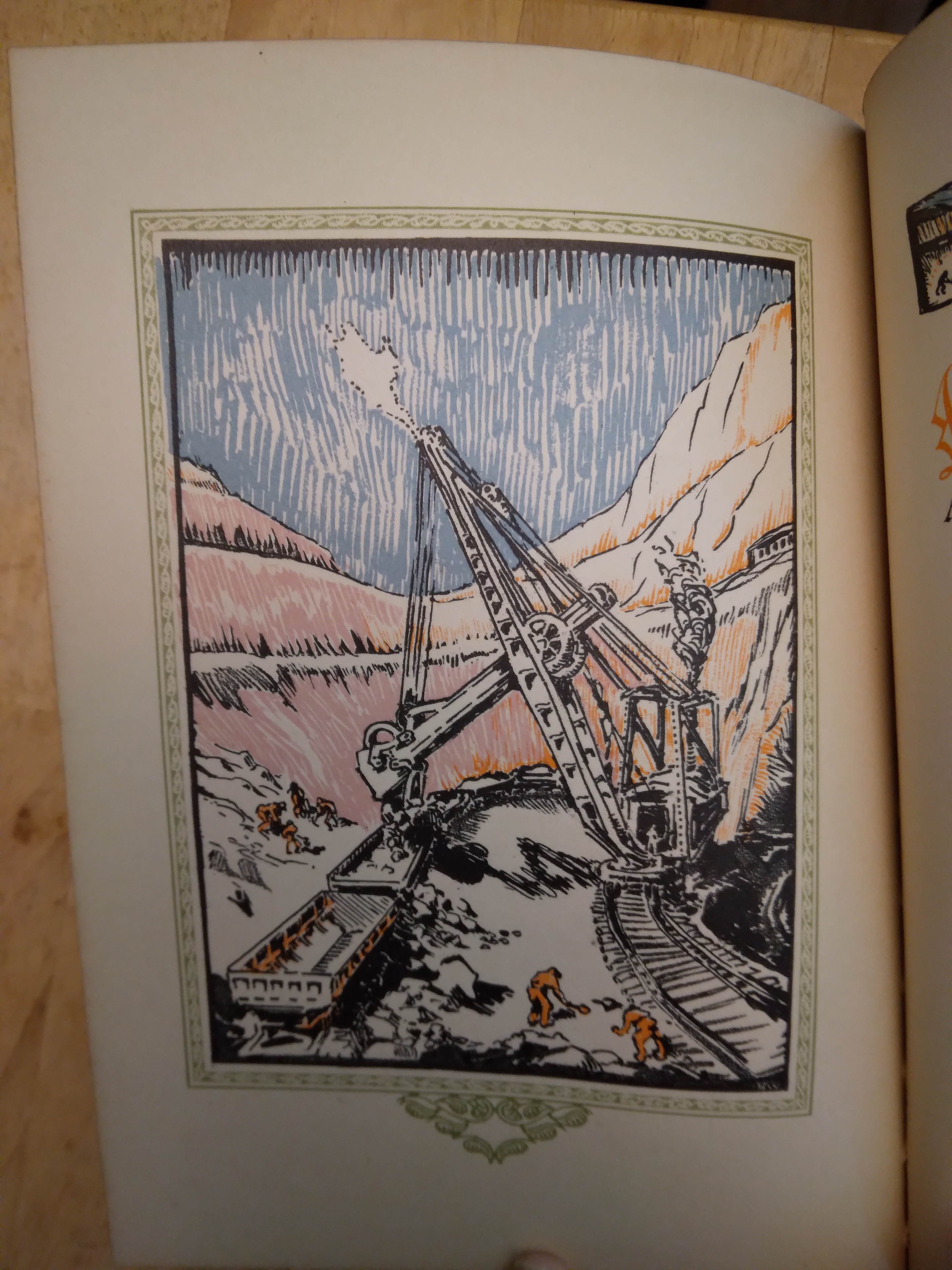
I bought this book for $8 in an online auction, sight-unseen, because the pictures looked really cool. And then I saw it in person and it’s adorable! Physically, it’s 5”x6.5”x0.25” and in not great shape, but uses thick paper to make up for the fact that it’s only 10 pages long — 5 verses of a poem and 5 wood cut illustrations – plus a handful of opening and closing pages.

The illustrations are beautiful woodcuts. It’s going to join Gods’ Man in my small collection of beautiful old illustrated novels.

The poetry is… sweet. It feels like something out of one of the red bound Children’s Hour books. It’s lovely and motivational about doing the best one can and being happy regardless of the results because you did the best you can. The message is how everything will work out in the end if you just do your best. It strikes me as an excellent poem for children.

I just have to remember that it was written at the beginning of the first world war. This is the innocent version of Ayn Rand’s dream world: everyone does their individual best and it’s enough.

In today’s economic climate of corruption, stock prices before product quality, and massive corporations setting employees against one another, the impact of this poem feels more like propaganda against taking the larger view or addressing systemic inequalities and injustices. And, frankly, I suspect that there was both similar propaganda and the need for it in the early 1900s, as well.

But it still is a sweet poem about enjoying the pleasure and pride of a job well worked and I do appreciate that. Plus, just physically adorable as a book. This publisher was like: yes, I will publish a beautiful little book with ten pages!

Between Jobs

By W. R. Gingell

This is the first in a series that is weird, funny, and not always so tightly plotted, but I’m popping them like potato chips! I’m already on the third, after reading the first two over a couple of days each. They are narrated by a teenage girl who is most likely borderline psychotic (or at the very least deeply dissociative) after her parents are murdered. She’s been squatting in her parents’ house trying to support herself, when a neighbor is murdered just outside the house and three very strange men move in to investigate.

They turn out to be two fae and a vampire, and they grudgingly agree to keep our narrator as a pet of sorts, much to her glee. Clearly this premise has the potential to be deeply troubling and problematic, but our narrator is just so happy with the situation and the supernatural beings just so bemused that it is instead the precise type of light and absurd book I’m feeling right now. It also reminded me strongly of this tumblr post:

So far, our narrator is pleased as punch to be a pet, but the relationships are slowly evolving over the books, so I look forward to the changing dynamics among them all. That said, as I hinted above, sometimes the plot takes second place to the very amusing characters and setting, and I wasn’t sure I fully grasped the final solution of the mystery at the end of the first book, but I also didn’t particularly care, I was enjoying it so much!

Kickstarter comics

As the year at work started off with a cascading series of problems, I have been in a bit of a reading slump , not able to focus on reading and getting distracted even from stories that I’m actively enjoying. I’ve started a number of books and haven’t completed any of them, and it’s definitely me rather than any judgement on the books. Hopefully I’ll get back to those later and be able to enjoy them when I’m in the right mindset.

But one of the things I enjoy doing is browsing the comics section of Kickstarter. There’s always a wild array of possibilities there with stories that couldn’t or wouldn’t or just haven’t found a way into mainstream graphic novel publishing, at least not in the US. I semi-regularly support the stories that catch my eye and then just wait to see what shows up as a surprise gift to myself however many months later.

Last week while I was moping around not able to read anything much, one of the projects I supported was fulfilled and I received a package that contained two thin volumes that were each short enough that I could just sit down and read them in one go:

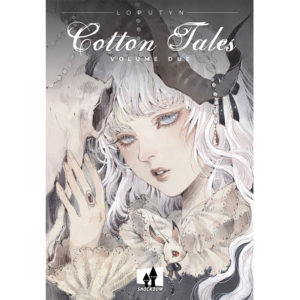
Cotton Tales, Volumes 1 & 2
by Jessica Cioffi, AKA Loputyn
2022

These beautiful books full of ethereal images tell a gothic story of a boy who has woken from an injury with no memories in a mansion that’s haunted by a ghost and there are a huge number of rabbits that only he can see. The world has magic in it, but it’s unclear what is real to that world and what isn’t. And everyone he meets has ulterior motives and hidden histories.

It’s a fairy tale story with a simplicity that let me read and enjoy it within a day and break my streak of unfinished books. I’m also looking forward to seeing if there is an eventual volume 3, although volume 2 does end with a satisfying conclusion even as it sets up for the next stage of events. Volume 1 ended with much more uncertainty so I’m glad I got these both at once.

Having enjoyed these books so much, reminded me of another Kickstarter comic that I’d received some time back and then never got around to completely reading:

Elements of Fire
edited by Taneka Stotts
2016

This more hefty book is a limited-palette graphic novel (black, white, and red) anthology of 23 stories with lengths ranging between two to sixteen pages each. The first couple of stories reminded me of why I hadn’t completed this before: they weren’t bad, just not to my taste: one high fantasy and one overly twee. But this time I persevered and I am so grateful that I did because the third story blew my mind! It was so good and so beautiful both visually and conceptually. And then there were twenty more stories!

With any anthology there are going to be better and worse stories but this is really an amazing collection. I loved more stories than I didn’t and now I’m a bit embarrassed for having set it down for so long. The artists made some amazing and fascinating choices with how to use the restricted palette to best effect, and created vast and complex worlds in just a few pages each.

Each story is unique — Stotts did an amazing job of curating a wild diversity with this collection that went above and beyond the stated intent of diversity in having all creators of color. It really shows a diversity of cultures and styles and approaches to the art of graphic novels.

While they all very good, my favorites — the ones where the stories and the art combined to touch my heart — were:

  • Cactus Flower by Sara Duvall
  • Pulse by Der-Shing Helmer
  • Hearth by Jaid Mandas and Marisa Han
  • Preta by Chloe Chan and Nina Matsumoto
  • Meta Helmet by Deshan Tennekoon and Isuri Merenchi Hewage
  • Caldera by Jemma Salume and Taneka Stotts
  • Firestom by Melanie Ujimori and Chan Chau
  • Home is Where the Hearth Is by Veronica Agarwal

I highly recommend this anthology to any and everyone to see which stories and images touch them. Because all of the stories are skillfully written and drawn: after that it’s a matter of personal preference.

This anthology also really presses home why I browse Kickstarter so much more often than I step into any comic bookstore anymore. A good comic book store will have an “Other” section in addition to their Marvel and DC, but they necessarily cater to the masses in a way that Kickstarter doesn’t have to. Plus each comic is a unique creation of love by an artist rather than a business decision by a corporation, so even when they wind up not to my taste (which happens sometimes), I never regret supporting them.

It was also wonderful to sit down with some books and actually read them, cover to cover, and have a sense of completion that I’ve been missing in the last couple of months.
The Prisoner

By B. A. Paris

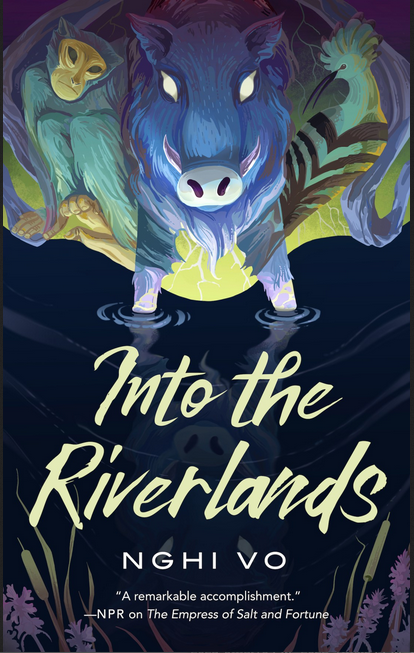
I’m not even sure how to review this book, quite frankly. I definitely enjoyed it, but it was listed sort of vaguely as psychological thriller, and while it is that, it also read as decidedly YA. And I don’t mean that as a bad thing!

Well, not all the way, at least. The characters are two-dimensional enough that I kept waiting for a reveal beneath the surface that never came. However, a plot switcheroo halfway through the book reminded me strongly of Gone Girl, only as it would be written for children. It’s not a sophisticated book, so the switch didn’t come as a total shock, but it was still very satisfying, which I think represents the book well.

This would be an amazing book for a young teen or precocious tween, who feels ready for adult books but should still be somewhat eased into them. There are a number of tricks and schemes that weren’t the most subtle, but I still really enjoyed them, just in a sort of bemused way. There is no sex (though some non-specific mention of sexual assault in the past), no drug use, or even much swearing. There is violence, as befits a mystery and psych thriller, but not gruesomely described. I would have loved it and felt so mature if I’d read it at 14 or 15! (I was not a precocious tween.)

Once I had a clearer realization of the proper audience for the book, I enjoyed it even more and stopped looking for hidden meanings or nuance that wasn’t there. That said, I was pleasantly surprised that the author gave serious attention to the protagonist’s trauma response, instead of brushing it aside or romanticizing it, which I’d half expected.

Lavender House

By Lev AC Rosen

This mystery novel had shown up on several recommendation lists over the last few months, and it is well justified! Rosen beautifully takes the noir sensibility, which imbues generalized disenfranchisement, and applies it very directly and acutely to the LGBT community in 1950s San Francisco. It becomes a somewhat pointed critique of noir in general, I think, by contrasting what has typically been a general mental oppressiveness in the great noir writers like Chandler and Hammett, with actual systemic and malicious oppression against specific people.

Traditional noir characters sense a true darkness in the world that the general populace ignores or is blind to. In Lavender House, the gay characters only wish they had the option to ignore the ugliness of the world, instead of having it thrust upon them if they drop their defenses for a second. While San Francisco was just starting to be a budding haven for gay people, so there were more underground clubs and the like, the whole of the United States remained very dangerous.

Our protagonist, Levander “Andy” Mills is as aware of this anyone else. As a (closely closeted) gay cop, he is both threatened and the threat, and straddling that line, can trust no one. Before the start of the novel, however, he was discovered in a club raid, kicked off the force, and all but run out of town. He is getting drunk in a bar before throwing himself into the Bay, when Pearl comes to ask him to investigate the suspicious death of her wife. Pearl is the surviving matriarch of the Lavender House, where the now deceased scion of a wealthy soap family created a home where a handful of gay couples can live freely, while showing a much different face to the outside world.

Andy moves into the house in order to investigate, mostly with the idea that he has nothing left to lose at this point, but it opens his mind to a whole different world. And this is what I really loved about the book: it explores the seductive but false appeal of noir and cynicism. It’s a really interesting play on noir – the detective himself has bought into the ideological grimness, but the novel makes the effort to show that his cynicism, though not unfounded, is a blindness of sorts. He expects the worst from people, and while this protects him to a point, he closes himself off so no one can either hurt him or care for him. And then, worst of all, believes that is all there is to life.

I don’t think I’ve ever read a book before that did such of a good job of criticizing its genre so validly, while also perfectly exemplifying it. A very minor spoiler: the end is both satisfying and a poignant summary of the overall themes, with a hopefulness that would feel jarring after a traditional noir but feels like the point of the whole book here.

The Screwtape Letters by C.S. Lewis

The Screwtape Letters
by C. S. Lewis
1961

Having enjoyed The Great Divorce and found it extremely thought-provoking and had a casual book club with various members of my family, it was proposed that we read The Screwtape Letters next. It was just as thought provoking, if not more so, although somewhat less enjoyable. It consists of 31 chapters/letters plus one toast, and it’s all told from the perspective of a demon, the titular Screwtape, who is giving advice on how to lure humans into sin.

Despite having been written 80 years ago, it is decidedly timely today, as it addresses the devil’s goal of keeping humans constantly focused on doom scrolling and headlines and thoughtless denigration of anyone who disagrees with you, while avoiding humility, charity, respect, or thoughtful consideration. I felt decidedly called out at various points. I should be better! I will try to be more thoughtful and focused and enjoy the pleasures that are available to me in the present and worry less.

At other points, however, it feels dated in the way that it appears to be arguing about social trends that I’m not even aware of. At one point the devil is recommending that people should stay focused on government policies rather than prayers since those are so much less important and I really hope that Lewis had no expectation of “thoughts and prayers” becoming such a catch phrase for politicians refusing to update policies. As Screwtape presents himself as the arbiter of what is evil, Lewis comes across as an arbiter of what is good, and that is, occasionally, rough. Historians, modern artists, and unions are all mentioned as being misleading to Good Christians.

Lewis definitely takes the opportunity to call out some of his personal most and least favored theologians, placing them either as godly agents or thoroughly controlled by the devils’ temptations to sin. This book also has a nearly Ayn Randian Objectivist perspective on the world: what is Good is very clear and natural and unaffected by different lives, perspectives or understandings. Devils provide temptation and people provide false information but a Good Christian will just know what is right due to God, much the same way that Ayn Rand’s protagonists will know what is right due to Logic, despite any lack of education or resources for either. Peak individualism, despite the differences in both methods and goals.  

I found that I needed to read this book one chapter at a time and take at least a little break between. They were thought provoking and inspiring and occasionally quite funny, but they were also quite dense and more than occasionally rather florid.

This book also made me think that I should get around to reading Lolita, at some point, as the only other book I can think of that has the protagonist/narrator also be the unrepentant villain of the story. I did wonder how many people read this book and think Screwtape is an anti-hero instead. Some of his advice came across as fitting right in with big business and some of my least favorite managers at my job, so it’s not out of the question.

I got a lot out of this book and enjoyed talking about it with Anna as we progressed through, but the book started out strong and then got progressively more wearying as it continued. It’s worth reading, but be prepared to decide what you take seriously. (Note: Cherry-picking what to take seriously is also advice that Screwtape would offer a human and C.S. Lewis specifically rejects when it comes to religious contemplation. So, you know: Enjoy!)