Eli the Good

While I’ve been enjoying Anna and Rebecca’s fall into the Randian rabbit hole that is Atlas Shrugged, I think it might be time to break all that up with something a little lighter. So let’s talk about the book that might be the polar opposite of Atlas Shrugged: Eli the Good by Silas House. One of the Amazon reviews called this book gentle, and that is the absolutely perfect word for it–it is a gentle story about a young boy growing up in a small town in the South in the 1970s. More specifically, the story follows Eli through the Bicentennial summer of 1976 as he and his family try to deal with his father’s trauma after coming home from Vietnam and the sudden arrival of his war-protestor aunt. I feel like that description makes it sounds more dramatic than it really is. While dramatic things definitely happen, overall the book has the sort of slow, leisurely feeling you get in the summer when even important things happen at half speed.

For me, the most powerful part of the book was how well House captures what it was like to be a kid in the rural South in the 70s. I am not quite old enough to remember the Bicentennial, but so many of the things he talks about in the book–trying to sleep in a house with no air-conditioning, riding bikes all over town with your best friend, riding around in the bed of a pick-up truck–were almost painfully familiar. (Okay, to be fair, my mother never let me ride in a truck bed. At the time I thought she was no fun, but now I’m thinking I should call and thank her for being ahead of her time in auto safety and for keeping me alive. See also: not letting me play with the fireworks you could buy on the side of the road.) The book also has a powerful feeling of nostalgia, since it is about Eli as a child but is told from a perspective of him looking back as a adult. This made the book feel even more like memories of my own childhood. I also really liked perspective on the political tensions of the Vietnam era. I feel like people don’t talk about that time much today–maybe because it’s too recent to be considered “History” but too long ago to be at the top of our minds–but it has shaped all sorts of things about the world today, so I always like reading about it.

At one point Anna and I had discussed doing one-word book reviews, and I think that is shorter than I can handle, but I am going to start trying a couple of new things in my reviews. From now on, I’m going to include a three-word review of each book, and a sort of book association game: “if you liked this other thing, you might enjoy this thing I am recommending.” My hope is that this helps our readers get a sense of the books, while also helping me really crystallize my feelings about the books. So, for Eli the Good:

Kinsey’s Three Word Review: Sweet Southern tale.

You might also like: Bridge to Terabithia or anything by Lee Smith.

And now the Atlas Shrugged live blogging can continue. (And for the record, while I remember enjoying The Fountainhead well enough when I read it in college, these days you couldn’t pay me enough to tackle Atlas Shrugged. I will stick with my YA and vampire books.)
Teeth

Edited by Ellen Datlow & Terri Windling

Book Cover: TeethI picked up this book as an impulse loan at the library when the title typeface caught my eye. (Design nerd moment: I really like how they were able to make the title actually look like teeth without being totally cheesy about it – very elegant, especially coupled with the lack of teeth in the image) I also had already heard of the book because one of my favorite blog writers, Genevieve Valentine, wrote one of the stories in the collection, and posted that story online. It was awesome, so I figured I wouldn’t mind reading it again and see if the other stories were of the same caliber.

Of course, some were and some weren’t. Well, Valentine’s was still the best, but there were others I really liked, too. In fact, Valentine’s story was first in the collection, and then the second story, All Smiles by Steve Berman, dealt with a vampire myth from a more unusual, non-European culture, as well, so I was pretty pleased. (Actually, both these first two stories are available in a preview of the book here.)

The problem with this type of anthology is that lots of people, me included, like to read about vampires, so it makes sense to collect stories about them. Good vampire stories, though, often use vampirism as a surprise twist in the story, so you see the problem. Just being included in this type of anthology spoils a lot of the stories, so there were certainly several that I think I would have liked a lot more if I hadn’t just been reading them waiting for the vampires to show up.

A not-so-brief gripe to close out this review: the book cover promises contributions from Cassandra Clare & Holly Black, Neil Gaiman, Melissa Marr, and more. Now, I’m a recent fan of Holly Black, and I really enjoyed her story here, co-written with Cassandra Clare; and I’m starting to think Melissa Marr’s Wicked Lovely was a fluke because I haven’t enjoyed any of her other writing nearly as much; but my real gripe is with Neil Gaiman. I love his Sandman graphic novels and every full-length novel he has ever written. I consider myself a huge fan of his. However, his short stories are crap. So, I knew not to actually consider his name on the cover to be any sort of selling point, but he must have disappointed legions of not-already-disappointed fans with his short and hasty-seeming poem that reads more like a pop song. Weak sauce, Gaiman, weak sauce.

—Anna

The Diviners

Despite my best efforts at remaining separate from the sick people surrounding me, I started 2013 off with a wicked cold that left me too dazed to read or to even watch a movie. Instead I spent most of the first week of the new year slumped on my couch, grimly watching How I Met Your Mother reruns. But I finally appear to be pulling out of it, demonstrated by the fact that I managed to actually finish a book! A big one, in fact: The Diviners by Libba Bray.

Bray is a popular YA writer and The Diviners is the first in her new series about teenagers with special power living in Jazz-age New York. And even after reading all 500+ pages, I’m not quite sure how I feel about it. As I was reading, I kept just coming up with a continual list of pluses and minuses that seemed to balance each other out.

Plus: It was a fun look into 1920s New York! Remember way back in the summer when I mentioned The Rules of Civility, and how I was still looking for a better book about the glittering 30s? Okay, the 20s are not the same as the 30s, but this met my needs. Bray did a great job creating a past-New York that felt real and alive.

Minus: The main character was weirdly flat. The reader was clearly supposed to identify with this young girl who comes to New York from small-town Ohio, ready to have fun and make her mark, but she came across as a brat with no depth or internal monologue. I got tired of her very quickly, and she felt like a character in a middle-reader or kids book.

Plus: While the main character left me cold, the supporting characters were really interesting and much more complex. Specifically, a showgirl with a history and a numbers runner in Harlem.

Minus: It was dark. Like, really, really, creepy Criminal Minds kind of dark. I generally don’t get too up in arms about kids reading adult material and I’m not easily spooked myself, but I am not sure I was old enough to read this. That, combined with the weird flatness of the main character, made me wonder who the audience for this was supposed to be.

Plus: This initial story in the series was wrapped up quite neatly and there was a good sense of closure.

Minus: Despite being a long, looong book, character reveals were made super-slowly and a few really major pieces of information were tossed out at the end and not really followed up on. I’m assuming these threads will get picked up in future installments, but it still felt like I had made a pretty sizable investment of my time to end up with so many unanswered questions.

Final verdict? I’m still in. I wouldn’t recommend it to younger readers (super creepy!), but I was intrigued enough by the setting and some of the side characters that I’ll read at least one more to see where this is going. I’m just going to hope that the next book focuses on the showgirl, because she was aces.

White Cat

By Holly Black

Book Cover: White CatThis Christmas, I’m spending the holiday with Tom’s family in Arizona, so I grabbed White Cat off of my to-read shelf on my way out the door to the airport. We had managed to get a nonstop, five-hour flight to Phoenix, and I had intended to take a nice long nap through most of it. Instead, I did nothing but read this book, and finished all but the last 50 pages by the time we landed, which I promptly finished that night.

Author Holly Black builds a very interesting world with crime families that deal in illegal magic that can control or kill others with just a touch of the hand.* Our protagonist (I don’t quite want to call him a hero) is introduced to us as the youngest son of a somewhat minor crime family and the only member without a magical ability, so he struggles to remain equal to the other members through mundane cons.

The brilliant thing about the book is that the whole thing is a string of cons, making up one giant one, and the reader is along for the ride. It is one of those rare narratives where each twist surprised me as it came up, but also made absolute sense in retrospect.

One of the praise blurbs on the inside cover of the book describes it as “part X-Men and part Sopranos,” and for some reason I find that really kind of off-putting, even though I enjoyed both of those. However, after having finished the book, I had to agree that it is a pretty good description, but instead of the amalgam of the kind of crappy parts of both, which is what I immediately feared, it takes the best of both and makes something even better.

The sequel, Red Glove, is already out, and I’m going to track that down as soon as I get home (although, I also now need a book for my flight home again), and then the third book of the trilogy, Black Heart, is due in April 2013.

Anyway, happy holidays to you all, and I hope you get lots of good books for presents!

—Anna

*Very minor spoiler and pet peeve: since a bare touch of a hand can be so dangerous, everyone is this world wears gloves, which I found vaguely interesting until they put in details like “licking the grease from the French fries off of the gloves” that both makes it so much more realistic, and somehow just really grosses the hell out of me.

Sequels, Follow Ups, Trailers, and Recommendations

As the holidays come barreling towards us, I first want to point you toward my entry last year on good Christmas books. I haven’t started my annual rereads yet, but I need to get on that. It doesn’t feel like Christmas to me until I’ve read a few Connie Willis short stories.

https://biblio-therapy.com/2011/11/27/christmas-reads/

But if you don’t want to create an entire holiday reading plan, here a few other things that have come up lately that relate to some of my past posts.

Remember when I raved about The Girl of Fire and Thorns by Rae Carson? And said that I wasn’t sure whether it was going to be part of a series? It is! The second book, The Crown of Embers, is out now and it might be even better. I’m not going to go into any detail, since talking about this one would spoil the first one, but I loved it and it reminded me a lot of Bitterblue. The only downside is that it ends on a bit of a cliffhanger–Elisa’s story is clearly going to be a trilogy.

Now remember when I, and everyone else in the world, raved about Gone Girl by Gillian Flynn? I recently read one of the books she wrote before that, Sharp Objects, and it was equally compelling and creepy. In fact, if anything I felt even ickier after reading that one. So if you liked Gone Girl and want to read a disturbing mystery novel, Sharp Objects is perfect. (Also, we get a surprising number of Google hits on things like “gone girl linda holmes hugged the book.” So for the record, future Google searchers, I feel confident that she hugged the book at the point where Amy’s journal ends, and that next section of the book starts. Is that clear without being too spoiler-y?)

One of the best things about seeing the last Twilight movie in the theater (oh yes, I did), was that they showed about 10 different awesome previews. My sister was thrilled about the Catching Fire trailer, but I was most excited about City of Bones. I’ve already explained how much I like those books and, at least in the previews, it seemed like they had the look of everything right. I am too old to recognize any of the teenagers playing the leads in the movie, but I am excited about the parental-level casting. Aidan Turner, who was a vampire in the Being Human series (the BBC one, not the Scyfy remake), is Luke and Jonathan Rhys Myers is absolutely perfect as evil, creepy Valentine.

Finally, if you’re not already reading Tomato Nation, well, I don’t see what you’re even doing on the Internet. But just in case, one of the recent entries in her advice column, the Vine, asked readers for book suggestions for preteen/teenage readers. The comments on the entry are great, reminding me of YA books I loved and introducing me to some new ones. The comments to Anna’s recent Sunshine post included some discussion about what ages that book would be appropriate–the comments on that Vine post might provide some other great options.

Twilight, An Argument For

Last week, Rebecca wrote quite a scathing review of the Twilight series, identifying a whole range of problems, from bad writing to bad gender models. However, we also wanted to offer another perspective on the whole phenomenon, and since I am the one here who has read all the books, saw all the movies in the theater, and say in my own bio that I like the books, the favorable review fell to me. But this is a challenging assignment, because it’s not that I actually disagree with anything Rebecca said. I think she’s right about all of it. On the continuum of me, Anna, and Rebecca, I am clearly the most pro-Twilight among us, but I will freely admit that these are Not Good books. Nonetheless, I like them, and I’m going to try to explain why.

First, let’s quickly run through some of the key problems with the books, just so that you know I’m aware of them:

1) The Twilight books are not-well written. The Host, Meyer’s non-vampire sci-fi novel, is actually kind of interesting, giving me hope that she might be able to turn out okay material. The Twilight series is not that okay material.

2) Bella is completely uninteresting. Seriously, totally blah. Say what you will about Kristen Stewart, she makes that more character more interesting than the source material. Which leads into the biggest issue . . .

3) Wow are these not feminist at all. Like, let’s make sure that the female characters have no agency whatsoever, and are completely at the whim of stalker-y, creepy, borderline-abusive men!

NONETHELESS, I like these books! They’re like Cheetos–you know they’re not good for you and you know you will feel a little ill when you’re done, but in the moment you enjoy yourself. I don’t want a relationship like Bella and Edward’s, but I sure wanted to find out what happened to them. The characters didn’t feel like real high school kids, but I enjoyed thinking about how much more interesting high school would have been if there had been vampires around. I also found that I enjoyed the books and the movies more when I had placed them in the proper context. These aren’t sci-fi books featuring teenagers, or coming of age stories with a supernatural twist. These are teenage romances that happen to feature vampires. When you read a Harlequin romance novel, you know that there’s a formula involved and that you’re going to get a certain set of ideas and characters. A romance novel may not lead to any epiphanies, but it will entertain you. The Twilight books aren’t trying to create an intricate vampire mythology, but once I read them as romance novels telling sort of fantastical love stories, it made more sense.

Plus, I am fascinated by Mormonism, and I love how you can SEE Stephenie Meyer’s Mormon worldview coming out in crazy vampire plot points.

Look, sometimes when I read I want to be challenged or to learn something or to be comforted. And sometimes I want to shut my brain off so that I forget the world around me. I wouldn’t want this to be the only thing I read, and I wouldn’t want for young women to read these without having taken the number of feminist theory courses I have. But I have read a whole lot of crappy Dan Brown and Michael Critchon books in my day, and if I’m going to pass the time on an airplane or at the end of a stressful day with something, I’m happy to pass it with sparkly vampires.

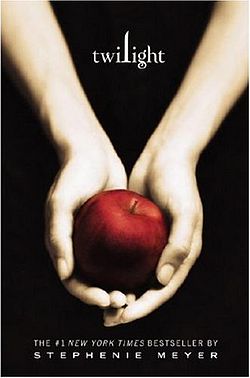
Twilight by Stephanie Meyers

Twilight
By Stephanie Meyers
2005

In honor of the last of the Twilight movies coming out, Biblio-therapy is going to be posting two reviews: one positive and one negative. I’m posting the negative review. I read it when the series was only just becoming a phenomenon. Someone told me that I’d love because I like young adult fiction and I like vampire books.

Alas, I did not like it, but I also wasn’t horribly offended by it.

There were a few good scenes, a few interesting premises, but overall the characters and plot didn’t hold together for me. The only character I actually felt any empathy for was the main character’s poor beleaguered father. I took this as a sign that I was, perhaps, finally aging out of my YA fiction reading days, and got on with my life.

It’s not that it’s a bad book, per se, because, let’s face it, I have read and enjoyed many quite bad books. The problem is that it’s bad in ways that I can’t wave away with a thoroughly suspended disbelief or a good faith effort to believe some character is not an idiotic milksop in need of a spine.

I am perfectly capable of overlooking all of the weird and outdated sexual advice presented in metaphor that has offended so many readers. At least the advice is presented metaphorically and in regards to vampires rather than outright (I’m looking at you, Barbara Cartland).

Belle is something of an idiot, making peculiar and random decisions, trusting strangers too much and her family too little. I found her mostly confusing. Why does she do the things she does? Is it just the “she’s a teenager” excuse that lets her get away with random acts of idiocy? I have apparently become an old woman, shaking her head at “kids these days.”

Edward is an unfortunately standard paradox of a stoic individual, putting great effort into showing how stoic he is so that everyone else can look at him and see that he’s really hurting inside and is a soft woobie. Also, as any strong guy (vampire or not) should know, that excuse of “I can’t help myself” is not a valid excuse for anything. If you have the strength to hurt someone then you had damn well better have the control to refrain from doing so.

Some of the basic premises of the story are even more problematic than having characters that I simply didn’t care for.

Bella enters school as a new student, having been nothing special before, and is suddenly the most popular and desirable person there. This is completely random. There’s no reason for it, either internal to the high school social structure (why did the kids like her?) or external to the plot arc (what did it bring to the plot?).

Despite first appearances, the trope of instantaneous and unexpected popularity is not inherently terrible; it can be done well. In fact, Meg Cabot has a few books that deal with exactly that issue and do it well: How popularity occurs and/or is manipulated, and what some of the related issues are. Stephanie Meyers, in contrast, avoids all of the real complexities and looks at the issue of popularity very much from the perspective of an unpopular student: I want to be popular but I don’t want to be like those popular girls*, and if I were suddenly popular I would show a becoming amount of humility and talk about how I really didn’t want it, so there.

Then we come to the sparkly vampires. This is possibly the best thing ever since the Care Bears and/or My Little Ponies. I’m not even joking. Here are Vampires that can’t go out into the sun because they Sparkle! How is that not awesome?

However, it does raise the question: why can’t they go out into the sun and share their sparkly magnificence with the world? They have none of the traditional vampire weaknesses:
• They don’t fall dead during the day.
• They can’t be staked.
• They’re too fast to be snuck up on.
• They’re too strong for it to matter if they are snuck up on.
• They have family and community ties.
• They aren’t creating enemies by eating anyone.

So why are they hiding?

If you answer: “Edward is a teenage boy (no matter how long he’s been that way) and doesn’t want to let anyone know that he naturally looks like he’s covered in glitter,” I would definitely agree with you. That would be an awesome answer. Unfortunately, it’s not Stephanie Meyer’s answer.

She doesn’t give an answer. Vampires hide because they’re vampires and hiding is what they do.

Admittedly there are bad vampires, too, who do go out and make enemies by killing people and fail to make allies by, you know, killing people. However, they still have all the other strengths of these Meyer Vampires. So why are they hiding out in the wilderness rather than simply living in a house and eating anyone who tries anything?

The vampire culture, such as it is, is a hold over from the traditional vampire cultures of other books, all about angst and dark secrecy. The problem is that Meyer has changed the vampire mythos so much already that it’s disappointing that she didn’t follow through on the repercussions of those changes.

So, to sum up, it was a story about stupid people making random decisions in a world that didn’t make sense. This was not, alas, the worst book I have ever read, or even real competition for the title, but it was still pretty bad.

However, one good thing about this book (and movie) is:

It’s very popular and has gotten a lot of creative people talking about it (positive and negative) and a lot of those responses are quite hilarious.

* I must have been really lucky in my high school because the popular girls that I knew (not very many of them, admittedly) were all very nice. They were popular because they were nice and outgoing and people wanted to be their friends. That’s what made them popular.

Willful Impropriety

Edited by Ekaterina Sedia

Book Cover: Willful ImproprietyIn spite of considering myself an avid reader, I don’t actually buy books very often. I have a history of moving every 4-5 years, and after a couple of times moving countless heavy boxes of books, a large personal library just seems cumbersome. However, when I saw a copy of Willful Impropriety in the store, I bought it without a second thought. Young adult fiction, with some Fantasy elements, set in the Victorian Era? Yes, please!

Plus, I had originally heard of the book on the blog of one of the contributing authors, Genevieve Valentine, of whom I’m a big fan. (Also, she tends to contribute stories to more esoteric collections that are not picked up by my library.) Valentine is a bit of a conundrum for me, though. I love both her blog and her fictional writing, but they are shockingly different. Her blog is very funny with acute analysis of current popular culture, while her fiction has a lyrical and melancholy tone, and her story in this collection is no exception.

I was also pleasantly surprised that another of the authors, Caroline Stevermer, was the co-author, along with Partricia C. Wrede, of Sorcery & Cecilia, which I’ve already raved about here. Her story was probably my favorite of this collection, and has inspired me to track down some more of her books Another author, M. K. Hobson, whose story felt a bit like a P.G. Wodehouse story but with magic, also wrote The Native Star, which Kinsey recommended to me a while ago, and while is definitely going on my to-read list.

The introduction to the book describes that young adult literature set in the Victorian Age seemed like a complimentary match, since YA Lit is often about rebelling against the status quo to establish an individual identity, and the Victorian Age sure had a lot of status quo to rebel against. But after more than a dozen stories, I was a little saddened by how many of them ended with the heroine finding a solution in a relationship with a man.

Which, of course, is one of the few historically accurate ‘happy endings’ for women, but the stories didn’t stay so rigidly accurate in other features, so having them return to that trope was a bit of a bummer. The stories that did not include such a pat ending stood out all the more, though.

— Anna

Liar and Spy, Sort Of

As Anna said in her last post, all of us here at the blog were awfully worried about Hurricane Sandy, but we were fortunate enough to have made it through the storm with power and without major damage (and of course our thoughts are with the folks further North who were not so lucky). But I did end up spending a couple of random days trapped in my apartment–an excellent opportunity to finish up some library books. Some of my reading was grown-up (Capital by John Lanchester, which was just fine), but I also raced through a sweet middle-reader book by Rebecca Stead called Liar and Spy.     

This super-quick read was a charming story about a Brooklyn middle-school kid whose family is forced to sell their house and move to an apartment, and how he makes some friends and learns some lessons in the process. Like I said, sweet and charming, but I’m really talking about Liar and Spy so that I can tell everyone to go read Stead’s last book, When You Reach Me, which won her the Newbery Medal in 2010. It’s another middle-reader about New York City kids, but this one has a sci-fi twist and a major plot point turns on one of the characters reading Madeleine L’Engle classic children’s book A Wrinkle in Time.
Now, I have a particular soft spot for Madeleine L’Engle (I actually named my litter sister after her!), so this was an automatic hook for me. I’ve seen some criticism of When You Reach Me arguing that using L’Engle’s book makes it somehow less original, almost like fanfic. I think that A Wrinkle in Time is such a classic at this point, such a familiar institution to some many kids, that it’s a smart way to connect with readers. Particularly since the book is set in the 1970s–young readers might find some 70s elements strange, but A Wrinkle in Time might be familiar. As an older reader, I found it nostalgic. I also got completely sucked into trying to figure out the plot and worrying about the character–Stead takes things in a really interesting direction and uses the ideas in L’Engle’s book to tell a completely different kind of story.
As much as I love YA books, I usually find middle readers a little lightweight. Liar and Spy was lovely and I would happily recommend it to kids I know, but When You Reach Me was something else–clever and touching and powerful. It’s only going to last you an afternoon, but it’s well worth a library visit.

Every Day

As with Gone Girl, I feel like I’m making a fairly unoriginal recommendation here, but Every Day by David Levithan is so good that I will be the latest in a long line of people saying how awesome it is. In fact, when Anna and I saw John Green speak recently, he even specifically recommended this book to the audience. (He and Levithan wrote another awesome book together called Will Grayson, Will Grayson, so they’re clearly friends, but it’s a good recommendation nonetheless.)

Okay, stay with me here, because this is going to sound odd. Every Day is about a teenager who wakes up every morning in the body of someone else. Sometimes it’s a boy, sometimes it’s a girl, but it’s always a teenager, and always someone within a few hours of the person the day before. On one day the main character (who has no name and no gender) falls in love with a girl, and after a lifetime of floating through bodies without leaving a trace, there is suddenly a reason to try to take control and get back to this girl.

Now, this sounds pretty high-concept and I held off reading this book for a while–it sounded sort of overdone and like it would be a slog. But the writing is clean and elegant, and the conceit of changing bodies every day comes to feel normal very soon, allowing the reader to focus on the story. Levithan not only makes his central idea functional, but by the end of the book it seems almost normal–plausible, even.

It’s not a cheery book–I’m going to call it “tinged with sadness”–but it’s both a good story and an impressive feat of writing. Made even more impressive because reading it doesn’t feel like it takes any effort at all.