The Man in the High Castle Book vs. Movie Showdown

It often feels like people set up book readers and movie watchers as adversaries, especially when it comes to adaptations of written works to movies (or TV). “Are you mad that they’re turning this into a movie?”  “How bad will the movie be?” “If you didn’t read the book, you’re not really a fan! You can possibly appreciate the story!” And as a self-proclaimed reader who loves books, people seem to think that my loyalty will lie with books and I will be offended by any adaptation. But I actually love watching movies or TV versions of books and short stories! I find it fascinating to see how something from one medium is changed to another. What characters have to be cut or combined to make something work on screen? How does a plot need to be condensed or modified to work visually? Rather than take the changes personally, I find the adaptation process to be like watching someone work out a logic problem and I like seeing the solutions people come up with. For example, when I heard they were making a movie of the Cheryl Strayed book Wild, I just couldn’t imagine how they were going to turn that very introspective story into a movie. But the movie did a fabulous job of weaving in flashbacks while using silence to communicate Strayed’s loneliness and solitude on her hike. After I saw the movie Brokeback Mountain I went and read the source material–in that case, the movie was based on a short story, so the screenwriter had to create new material to fill out the story. If I had read the story first, I would not have believed it could be successfully expanded to a two-hour movie, but that movie is beautiful and, I think, very true to the original story. Adaptations don’t always work, of course–Little Women  is one of my very favorite books of all time, and pretty much every movie version has serious problems with casting (Winona Ryder as Jo, really?) and issues with the (admittedly) serial plot. But I also once saw a stage production of Little Women that was a failure in almost every way, EXCEPT they totally fixed Professor Bhaer by making him the same age as Jo and writing him as an absent-minded young man. He instantly went from creepy to cute. My point here is, I like comparing different media versions of the same material and seeing what works and what doesn’t, but I don’t always feel like I have to rule that one is better than another.

Having said all that, let’s talk about The Man in the High Castle. In late 2015 Amazon released a ten-episode season of an original drama based on the Philip K. Dick novel. I had never read the book, so I went into the show knowing only that it was an alternate history about a world where the Axis won WWII, and the U.S. was now divided into a West Coast occupied by the Japanese, an East Coast occupied by the Nazis, and an independent, lawless Rocky Mountain region. It’s now the early 1960s and the story follows, among other characters, members of a resistance group that are working to smuggle newsreels that seem to show the Axis losing the war to a mystery “man in the high castle” who provides them anti-Axis intel in return. The show definitely has some issues. The most primary characters–young people caught up in both the resistance and a love triangle–are the dullest on the show. Things move slowly at times, and it is dark. Really dark. Like, there were several times when I thought, “Well, surely they won’t go that far.” But, they’re Nazis! Of course they will go that far! But I really enjoyed the show overall. The world building is excellent–the scenes in San Francisco show all sorts of subtle ways that Japanese culture has been woven into the American city–and Rufus Sewell is chilling as a New York-based Nazi leader. And the newsreels that seem to show the U.S. winning the war raise all sorts of interesting questions that introduce a sci-fi element to the story (Are these fake newsreels? Are they showing our world? Is some sort of time travel happening?). By episode 10, the plot was moving along at a good pace and it ended on a cliffhanger than makes me very eager to check out (the yet-to-be-announced) Season 2.

As I was watching I heard, either online or on podcasts, that the plot of the show branched off from the book very quickly, and that in the book the newsreels were actually books themselves. This kind of change–changing a book to a film so it plays better in a visual medium–is exactly the sort of thing that fascinates me, so I decided to read The Man in the High Castle and see how the book compares. WELL. Look, I know that Philip K. Dick is a highly-regarded giant of science fiction, and I’m sure there are people out there railing about how the TV show completely ruined the book. But as far as I am concerned? DO NOT READ THIS BOOK.

First of all, the plots of the two versions are wildly different, and the characters just barely even line up. The Rufus Sewell character (probably the most compelling on the show) isn’t in the book at all, and most of the other characters bear little resemblance to their TV versions. The plot does involve a mysterious book and a resistance movement, but that’s about it–it feels as if the TV writers took the basic premise of an occupied U.S. and the character names, and then went off and did their own thing. And for the most part, that new thing is more complex, with more moving parts and more people, than the book. The TV show did drop a few things that could have been interesting–in the book the Nazis are in the process of colonizing Mars–but that were presumably too complicated for TV. But overall I found the multiple plot threads of the TV show more twisty and fun. However, none of that is why I am telling you not to read this book. My issue is that the book was horribly, terribly, sexist and racist. Every female character is both stupid and mean, and Dick makes a disturbing number of “dumb, like all women” comments. And there are plenty of cases where the book will use a racial slur, and it’s obviously because that is what a particular Nazi character would say or how a white man living under Japanese occupation would feel. But there were also lots of times where it seemed pretty clear that Dick was using a slur because he himself did not realize it was a slur. It all made me feel icky and I almost gave up on the book entirely because it was so gross.

So, although I generally don’t feel the need to decide whether the book or the movie (or TV show) wins, or to tell people that one version is definitive, in this case I am clear: the TV show is better. The move down the scale of racism and sexism would be all that I needed to make that call, but I actually also thought that the TV show’s expansion of the plot and characters and the visual world building were significantly more interesting than in the book. So, as long as you have a high tolerance for darkness, I would say watch the show, and don’t feel a single bit of guilt about ignoring the book altogether.


Miss Fisher’s Murder Mysteries

By Kerry Greenwood

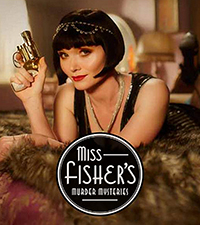
Cover photo: Miss Fisher's Murder MysteriesThe Australian television show is hugely popular on Tumblr, but I’ve been resisting it because it just looked a bit twee for me. However, when trying to unpack those last random boxes from my latest move (including one marked “desk stuff” that I never unpacked from the previous move that turned out to include a large set of random pens, at least half of which had dried out), I ran a couple of episodes from PBS in the background, and I was hooked. Literally, it appears to take two episodes. I finally caved and checked out the first season on DVD from the library, and Rebecca wandered in and out of the room for the first episode, sat down for the second, and then demanded that we watch the remaining ones together. We finally ended up with Netflix primarily to have access to the third and most recent season.

In case you are not on Tumblr and have somehow avoided all the Miss Fisher love, she is a flapper in 1920’s Melbourne, who sort of falls into detection through lack of anything better to do with her life. It is really hard to put my finger on what makes it so addictive, but I think it is primarily due to the characters and the actors. The plotlines are fun, but not too noticeably different from the many, many other mystery shows. Miss Phryne Fisher is unrepentantly wealthy, frivolous, feminist and raunchy, and that is actually very rare in television these days. I think this is probably the biggest aspect of her popularity – we are so parched for portrayals of sex-positive femininity that we will fall all over any and all portrayals like rabid dogs. Which is not to say that Miss Fisher doesn’t deserve all the fandom, but just to try to explain the level of adulation that even the show-creators seem a little puzzled by.

She has endearing friendships with both her best friend, a gay lady doctor, who assists in some of the cases and is wonderfully dry, and her paid companion, Dorothy, who is a relatively conservative Catholic girl slowly falling (rising?) to Miss Fisher’s influence. Her flirtation with the local police inspector is masterful, as he clearly respects her, is attracted to her and finds her intrusive and annoying all at once. Rebecca pointed out that the actor playing the inspector deserves more than whatever they are paying him just for his very restrained but communicative expressions alone.

So, after enjoying Season 1 so much, Rebecca and I checked out a large stack of the novels it is based on. Each one is barely 200-pages long, and we anticipated a lovely month of entertaining fluff, but neither of us cared to actually read more than the first one. There was no obvious flaw to point at, but the charm of the television show just wasn’t there. Miss Fisher is described as significantly younger, and is more sarcastic and dissatisfied, which comes across as sort of bratty. The other characters are similarly diminished – Dorothy is somehow both more bitter and naïve, Inspector Robinson almost nonexistent, and the communist cab drivers more zealous and confrontational.

I started to think of this series as the flipside to the Haunted Bookstore series that I reviewed earlier. With the Haunted Bookstore novels, I could list several concrete reasons why I shouldn’t have enjoyed them, and yet I loved them all completely and read them straight through until I was so sad to reach the end. With the Miss Fisher novels (or at least the first one), there were so many reasons I should have really enjoyed it, and yet I just didn’t. I even found that while I was reading the book, my enjoyment of the television show fell off a little, so while I finished the first book, I determined not to read any more and just enjoy the show on its own.

—Anna

Moving Pictures

While this is a book blog and we are all book people, we are not anti-TV. We love TV! (Basically, we are just indoor kids.) None of the books I am reading at the moment lend themselves to blogging, but I have watched some GREAT TV this summer* and look, I have a blog! So here are my summer TV recommendations:

UnREAL–This Lifetime drama is set behind the scenes of a fictionalized version of the Bachelor. Did every element of that sentence just make you roll your eyes? Listen, this is not a typical Lifetime show and it’s not really about reality TV. It’s a drama about the trade-offs people make between professional success and personal happiness, and about how far you can bend, ethically, before you break. The most amazing thing about the show is the main character, who I have seen described as a female anti-hero, a reality show Walter White. Shiri Appleby (who I have loved since Roswell and who was great in Life Unexpected, which only I watched) plays Rachel, a producer on the show. She does terrible things, but your heart still breaks for her. Also, she generally looks awful, especially when compared to the glammed out contestants, which was genuinely surprising to see from a woman on television. The first season is just 10 45-minute episodes, and every one gets wilder and wilder. I watched this on my cable’s OnDemand but I think it’s also on the Lifetime app and/or website.

Catastrophe–This is a tiny little show, 6 half hour episodes, and my only complaint is that there is not enough of it. The premise is that an American business man goes to London, has a week-long fling with a British woman, and she gets pregnant. He decides to move to London to be with her and the baby, and the show is them trying to navigate this weird situation like grown-ups. It’s hilarious and raunchy and awfully sweet. As a bonus, Carrie Fisher plays his mother, who is awful. This is available on Amazon, free for those of us with Prime.

The Fall–We all knew that Gillian Anderson was cool, but I am now dedicating my life to becoming her character in this show. Stella Gibson is a British police officer who goes to Belfast to investigate a series of murders being committed by a remarkably well-adjusted serial killer (played by Jamie Dornan). The show spends equal time with these two main characters so, as a viewer, you always know what’s going on–this isn’t a whodunit, it’s about the cat-and-mouse game of the police desperately chasing this guy and him evading them. But the best part is that Stella is this whip smart, sarcastic woman with no patience for men, who always wears the most perfect silk blouses, and is always in control of the situation. My friend Lisa brilliantly summed her up by saying that she’s what Claire Danes’s character on Homeland could have been, if she weren’t so busy crying and falling in love. The show itself is dark and creepy and made me check the chain on my door over and over, but it’s also hypnotic. Watch it on Netflix and turn on the closed captioning so you don’t miss anything between the whispering and the accents.

*One of things that has allowed me to watch all this awesome TV is that I recently got a Roku. I really do not understand all this fancy technology the kids have these days, but I asked my little sister what I needed to do to make Netflix show up big on my TV and she told me to buy a Roku. It was $80 on Amazon, it took me 20 minutes to set up, and it’s amazing.

Finally, just to spread the love across media platforms: a podcast. I have an annoyingly long commute and podcasts keep me sane. Mostly I listen to pop culture podcasts, but I recently found the History of English podcast and I am hooked. This is a VERY detailed review of the history of the English language, starting with it’s earliest origins. Have you ever wondered why sometimes we pronounce the letter c like an s and sometimes like k? There’s a whole episode about that! Would you like to know how the ancient Hittite language is related to English? You’ve come to the right place. This is maybe the geekiest thing I think I have ever been interested in, and that is saying A LOT. There are 60 episodes and counting, so this is an investment, but that’s a plus for me as I look into a future of morning rush hours. Plus, as someone who had years of speech therapy and can still just barely control what sounds come out of my mouth, I am fascinated by linguists who can demonstrate what Old English or Proto-Indo-European would have sounded like. That ability feels like a superpower to me, and the host of this podcast does a great job of it.

Jonathan Strange & Mr. Norrell, part 7

By Susanna Clarke

Book Cover: Strand & NorrellSo, last episode! I’m running a little late with this one since I was on vacation last weekend, but better late than never, right? I thought about never, but just couldn’t quite bring myself to leave it hanging. The conclusion in the tv show was very satisfying, but the book conclusion was particularly gripping, I thought. Here are all the final spoilers in a particularly long post, I’m afraid, since a whole lot happened at the end. Continue reading →

Jonathan Strange & Mr. Norrell, part 5

By Susanna Clarke

Book Cover: Strand & NorrellAlright, I am in Volume III now – titled “John Uskglass” (the mundane name for the Raven King, remember). I am now wholeheartedly enjoying reading the book, but am not quite enjoying trying to recap all the characters and events. I am about two-thirds of the way through the book (Chapters 45-52), and so much craziness is happening now that I’m in awe of the screenwriters. They are practically having to rewrite huge chunks of the book in order to fit it into the seven episodes. Anyway, here’s part 5, with spoilers:

Continue reading →

Jonathan Strange & Mr. Norrell, part 4

By Susanna Clarke

Book Cover: Strand & NorrellSo, I reached the halfway point (Chapters 32-44, roughly translating to Episode 4 in the show) and things are going downhill fast. (Plot-wise, things are going downhill; the pacing is actually quite speedy which is a relief after the slow start.)

I believe I have found my purpose for these recaps, however! Out of a poll of three (Kinsey, my dad, and someone that Rebecca follows on LiveJournal), all three said that they had read this years ago but barely remember it. I also struggle to remember exactly what happened in the tv show from week to week, though I thought that might be due to reading the book at the same time. So since this book doesn’t seem to have much sticking power, so this can stand as a rudimentary refresher (with spoilers, of course). Continue reading →

Jonathan Strange & Mr. Norrell, part 2

By Susanna Clarke

Book Cover: Strand & NorrellI’ve realized now that I’d inadvertently picked the perfect book for my first live-blogging—The Shining has three characters and almost nothing happens. It makes for very concise recaps. Atlas Shrugged was a complete mess, of course, and now I’m struggling with the various characters and plot threads in Jonathan Strange & Mr. Norrell, as well.

I have (mostly) stopped sulking over the size of this brick of a book, and am starting to appreciate the absurd humor of all the side diversions (though they do make it hard to figure out what will be pertinent later in the story – I have even more appreciation for the script writers of the television show now). I think part of my problem was that I was expecting what it seemed to be at first glance – a historical fiction with magic and adventure – but now I think that it is really more of a satire of the different social circles of high society, military, and academia, with the magic providing a distance with which to skewer them. Let’s dive right into Episode 2/Chapter 10-22, with spoilers: Continue reading →

Jonathan Strange & Mr. Norrell, part 1

By Susanna Clarke

Book Cover: Strand & NorrellAlright, I’m going to try to use the new BBC miniseries as a motivator to get through this book. I’ve tried a couple of times already, and never got past the first chapter. I was particularly excited about the miniseries, since I figured I’d just watch it and never read the book. But now it is leaving me with questions that I figured the book would probably answer. As an added motivator, I’m going to attempt to semi-live blog my progress, but even though this damn book is nearly as long as Atlas Shrugged, I’m going to stick to the seven-part schedule dictated by the mini-series, so hopefully not bog us all down too badly.

Also, I’m having to play catch-up a bit, since we are already in the second week. So here’s Episode 1/Chapters 1-9 with the caution that this is a recap, not a review, so spoilers everywhere: Continue reading →