Dirty Biology by Léo & Colas Grasset

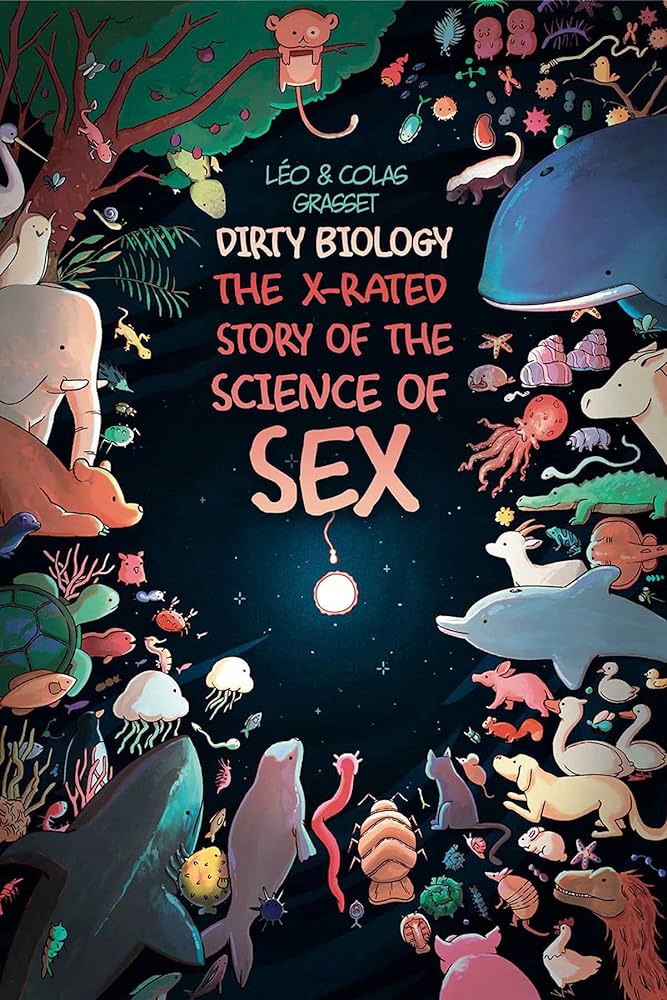
Dirty Biology: The X-Rated Story of the Science of Sex
written by Léo Grasset
illustrated by Colas Grasset
2021

This is a fabulous and hilarious non-fiction graphic novel* about the biology of procreation through time and across species, on both theoretical and practical levels, and gives a really good basic introduction to the topics and peculiarities, with lots of great examples. The book is narrated by a small cast of cartoon figures that keep the discussion very conversational, and the cartoon nature of the illustrations keep the discussion amusingly raunchy without being unpleasantly graphic (in my humble opinion.)

I bought it at the Graphic Mundi stall at the Small Press Expo and the woman there said that it was frequently used in biology classes, and I believe it. This made biology really accessible. At the same time as reading this, I was also reading Evolution’s Rainbow by Joan Roughgarden (I haven’t finished that yet) but reading Dirty Biology was helpful in giving me some context to understand Roughgarden. And in a time when trans issues and gender identity are controversial political topics, I find it useful to have an understanding of what “sex” means in biology jargon, which, as it turns out, is completely unrelated to any political talking point I’ve heard.

For the most part, I find graphic novels much quicker reads than the equivalent books, and this was no different, but it still took some time to get through, to properly follow the discussion even with extremely helpful illustrations. I was even slower in the occasional sections delving into topics that weren’t easily illustrated, such as the pros and cons of sexual reproduction versus cloning and the effects of genetic recombination.

Anyway, I highly recommend this as a fun introduction to a complex topic.

*I really wish that there was a term for this kind of book that wasn’t “graphic novel” or “comic book” because those terms just seem really misleading when it comes to nonfiction.

Nonfiction Graphic Novels

For several months this summer, my local library ran a reading rewards program for both children and adults, and I should definitely be too old for this, but I was thrilled to be able to read a book and get a little treat for filling out a quick review. After the first few times, I tried to maximize my treats by checking out a bunch of graphic novels, and then didn’t get to them until after the program ended. Even though I didn’t get a chocolate for either of these, I still recommend them quite a bit (and also strongly recommend public libraries)!

The Magical Life of Long Tack Sam

By Ann Marie Fleming

This book, called an “illustrated memoir” caught my eye because it is a really interesting mix of comics panels, photographs, and printed copy, all from the author’s research into her great grandfather. Long Tack Sam was the most famous Chinese acrobat and magician in the US vaudeville circuit in the early 1900s, but he’s basically unheard of today. Fleming pieces together what she can from archival records around the world, and the story she puts together is fascinating.

What is almost as interesting, though, is what she isn’t able to find: Long Tack Sam had told at least three distinct “origin” stories of his upbringing and introduction to acrobatics, all of them about equally likely or unlikely, and with no evidence anymore to substantiate any of them.

In addition to being the story of her great grandfather, it is also the story of Fleming’s search for her ancestry, and also a look at what is preserved and what is lost in history and documents. I occasionally wished the book had explored that last more deeply, but Fleming is already packing a lot into a relatively short book.

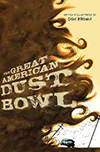
The Great American Dust Bowl

By Don Brown

My brother was telling me about the Saharan dust hitting Texas over the summer, and I asked whether that had contributed to the 1930s Dust Bowl. Upon being assured it wasn’t, I realized that I was woefully ignorant of any real knowledge about it and jumped on this very short graphic novel when I saw it at the library. Only 77 pages, and many of them sprawling full-page illustrations, this book is still chock full of facts that seemed to me to give a concise but comprehensive overview of the causes and effects.

The illustrations really captured the horror and scope of it better than the verbal descriptions or numbers. Whole pages of deep brown watercolor splashes enveloping tiny cars in the bottom corner, tall vertical panels with the dust hovering high above the minuscule Washington monument, and 14 panels of storm after storm really give you a sense of how badly the farmers of the plains were pummeled.

Don Brown stays very factual and almost entirely limited to the historical events of the 30s, but still ends the comic ambivalently, that such crises (or worse) could definitely be on the horizon today.

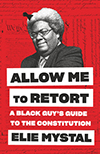
Allow Me to Retort: A Black Guy’s Guide to the Constitution

By Elie Mystal

Elie Mystal remains so funny and smart on the slowly dying Twitter platform, and his book is funny and smart, of course, too, but also infuriating. He uses his very comprehensive knowledge of law to walk the reader through how the constitution has been twisted to protect only some citizens while continually persecuting others.

After giving a fair amount of background in a much needed (for me) setting of the legal stage, Mystal gets down to his two central theses: 1) that originalists (like our current sitting conservative judges) are simply wrong for trying to solely recreate the intention of rich white slave-holding men who did not accept women or any nonwhite people as equals; and 2) all or at least most of our current constitutional crises could be fixed if everyone followed just the 1st and 14th amendment to the fullest extent (that all the other amendments are just closing loopholes that conservatives should never have been allowed to make in the first place).

Every point is bristling with examples from real life cases, which was both immensely helpful to put in context and a struggle, either intellectually because of the legalese or emotionally because of the hypocrisy of the judgments. I truly think Mystal does a masterful job of simplifying each case down to its basics, but I still had to take a deep break and brace myself before each v.

Mystal divides the book into short chapters addressing discrete arguments and provides not only legal, but also philosophical, and anecdotal examples. This makes the book much more readable than it otherwise could have been, but it still hovered around the top edge of my understanding. Which isn’t a bad thing at all! It’s good to stretch with books that are a little advanced, but I definitely had to take my time. (Bless him, though, for mixing in Star Wars and Marvel movie metaphors with Socratic and Hobbesian arguments.)

He closes the book with some quite straight-forward suggestions for fixing our current predicament, mainly eliminating the electoral college and expanding the supreme court, and makes solid arguments for the logic and legality of both. It left me with a lot to think about, and a mixture of hope and pessimism about our government and society as a whole.

Cultish

By Amanda Montell

One of my new year’s resolutions was to lose some weight and, realizing that I wasn’t going to be able to do it on my own, I looked at some diet apps. I went through the one-week free trial of the ubiquitous Noom, and though I found it somewhat helpful, the language in the lessons made me a bit uneasy. I decided to read Cultish as a counterbalance, to help me ward off any susceptibility to a diet cult. (I ended up quitting Noom at the end of the trial, partially because of the high cost but mostly because it’s nutritional guidelines did not allow for my morning latte and my evening glass of wine, and those are non-negotiable.)

However, Cultish still ended up being hugely relevant. Amanda Montell looks at a variety of ‘cult-like’ entities, from the obvious like Jonestown and Heaven’s Gate to the much milder like Instagram influencers, primarily through the lens of language and speech. As she delved into the oratory style of Jim Jones, who studied persuasive speakers ranging from Martin Luther King, Jr. to Adolf Hitler, I began to recognize similar stylings in extremist politicians (on all sides of the political spectrum, though I do think the ultra-conservative right has a special talent for it) and even in mainstream media chasing after clicks.

Catastrophizing news items or historical events, often out of context, and creating a sense of urgency sounded exhaustively familiar:

Jonestown survivor Yulanda Williams recalls Jones showing the Redwood City congregation a film called Night and Fog about the Nazi concentration camps. “He said, ‘This is what they have planned for people of color. We’ve got to build our land up over there in Jonestown, we’ve got to get over there. We’ve got to move fast, we’ve got to move swiftly, we’ve got to pool our resources together,’” she explained.

The repetition of key phrases is also a seemingly obvious but very effective oratory tool, as well. It also reminded me of the Scam Goddess podcast, which I highly recommend and which ties into this quite well. As podcaster Laci Mosley describes, scams rely on creating a sense of urgency where there’s no time to stop and think through practicalities and logistics, since you may then start seeing the logical holes.

The big cults are the ones known throughout the country, so it’s not until Montell starts diving into MLMs and fitness crazes that she turns to more personal connections and anecdotes. They are fascinating and relatable, but at the same time, pervasively LA-centric. There’s a certain glib assumption that the author and her family are the most sophisticated skeptics possible, which sticks out from the narrative, though doesn’t take away from the still fascinating analysis of language usage.

Good Talk by Mira Jacob

Good Talk: A Memoir in Conversations
by Mira Jacob
2019

This is a very good book. It’s made up of illustrated conversations that the author had with various people in her life — her young son, her aging parents, her brother, her friends, her boyfriends and girlfriends, her husband, her extended family, her in-laws — skipping backward and forward through time. It starts out cute and funny but with heart and then keeps going, right for the heart. It never loses the cute, but it gets pretty serious.

The author is a dark-skinned child of Indian immigrants, born and raised in New Mexico, who moved to NYC to become a writer. She lives in NYC, married to a Jewish man, and with a son just old enough to watch the news as Trump runs for election. The conversations address and illustrate a number of issues — racism and colorism, expectations and dreams, personal identity and political division — from a very personal perspective. The central theme of the book is how can she be honest with her child, preparing him for the world and raising him to be a good person, while also protecting him from the pain of a world that’s not going to be as kind to him as he deserves. In many ways, it reminds me of Coates’ Between the World and Me.

One of the real strengths of this book, that comes from Jacob’s use of dialogue, is how it presents these complex interactions without attempting to simplify or explain them. It’s all friends and family and lived experiences. As she explains to her son on page 85: “We’re in the middle place where sometimes we get treated badly and sometimes we do it to other people. But I mean, that’s not the end of the world, right? Knowing we’ve got room for improvement?” To which her young son Z replies: “I’d rather just be the good guys.” (Me, too, kid. Me, too.)

As the memoir of a living women still very much in her prime, this book doesn’t really come to any conclusions other than the need to continue on, trying to find a way to make the world better than it currently is and trust that loved ones can be better too. It ends with a kind of grim determination to keep trying.

Clean by Michael De Jong

Clean: the humble art of zen-cleansing
by Michael De Jong
2007

This author reminds me of Marie Kondo in that he is crazy obsessive regarding his particular field of interest but also cheerfully understanding of how few other people share his joy. Luckily, like Kondo, he is happy to share the results of his obsession to help make other people’s lives easier.

He makes the solid argument that there are a lot of chemical cleaners for sale for increasingly specific uses and also increasingly long lists of dangers and side-effects to using them. Instead of spending large quantities of money on a vast assortment of supplies while hoping that you don’t accidentally recreate chlorine gas, it’s better to go back to basics with five essential cleaning ingredients: baking soda, borax, lemon, salt, and white vinegar.

The first 14 pages of the book are cleaning chart and indexing listing, in alphabetic order, all the types of cleaners you might want and which of the five ingredients is best to be used for that role and which page it’s discussed on. The next 14 pages are about the author and his philosophy of cleaning. After that, each ingredient has it’s own two-page spread on history and basic usage, and a slew of suggestions and life tricks on particular uses, each no more than a single short paragraph.

Physically, it’s also a cute little book, only 130 pages.

I got this book out of the library but I’m thinking of buying a copy to have on hand. It was interesting to read straight through, but seems like it would be more useful as a reference. Some of the recommendations seem so miraculous that I wouldn’t be surprised if they didn’t actually work, but everything seemed good to know and well worth a try.

Adventure Cats by Laura J. Moss

Adventure Cats: Living Nine Lives to the Fullest
by Laura J. Moss
2017

This is a fun and inspiring book that I ran across at some point well after I’d already started taking my cat on walks with a halter and leash.* I thought to myself: this is a nonfiction book about adventure cats, my cat would definitely like to go on more adventures, so this might give me ideas.

And it did. Sort of. Maybe I’ll like outside adventures more if I have my cat with me. But as I’ve stated before, I find the concept of long walks a lot more interesting than the practice of it.

It turns out that I’m pretty much the exact opposite of the intended audience for this book. The intended audience is made up of adventurous people who are interested in seeing if they can get their cat involved in their lifestyle. My situation is that I am a standard couch-potato cat-owner who has stumbled across ownership of an adventure cat and now needs to figure out how to keep his life suitably enriched while also keeping him safe and me sane.

About half the book is made of short bios of various adventure cats and their people and what all is involved in their lifestyle. I adored these parts! So cute! There are cats who go hiking and camping and sailing and surfing and skiing and rock climbing and so much more. Awesome!

The other half of the book is focused on how-to instructions and lists of important information on how to safely go adventuring with a cat. It seems very useful and also highlighting that this is not my preferred method of relaxing or enjoying the world.

The directions on how to train a cat are also so slow and careful that it struck me as more of a deterrent than an inspiration to actually follow the method, but again: I’m not the audience of people who are adventurous and want a cat to match. I expect the written method is the correct way to train a cat, but my relationship with my cat is a lot more mutual training as I figure out how to accommodate his desires as much as I train him to accommodate mine.**

This book also ran into my standard pet peeve with pretty much all self-help books: they tend to talk to the reader with broad assertions (“you think”, “you feel”, “you respond”) that always make me feel particularly contrary (“you don’t know me!”), and I was getting that with this book as it simplified cat body language and responses in a way that was absolutely necessary for the scope of the book, but didn’t match my cat at all.***

A final warning: Every couple of pages this author uses a cutesy pun (being “purrpared”; anything being “pawsible”) and it’s way too cutesy for me.

Despite the various caveats, I do recommend this book. It is an inspiration to see about pushing the boundaries of what I do for my cat’s enrichment and maybe for my own enrichment too.

* As a kitten, my cat was extremely curious and completely fearless and had to be held back from stalking a flock of Canadian geese, and he doesn’t appear to have gained much sense of self-preservation since then.

** I didn’t have to lure my cat into liking the halter and leash: He wanted to go outside so I made wearing a halter and leash a condition of that, and it wasn’t so much leash training as it was compromise negotiation. If he came near the door, I would put the halter/leash on him, and he’d be allowed out. If he didn’t want the halter leash on him, then he shouldn’t come near the door as I was going out.

*** Yes, my cat got startled and poofed out with a full bottle-brush tail on a walk this weekend, but he also continued to explore and had absolutely no interest in returning to the safety of the house. Yes, at another point he froze absolutely still and then had to slowly approach and cautiously whack a fallen leaf like a dangerous enemy, but again, no interest in retreating to safety.

The Mueller Report: 3 graphic novels

I was certainly never going to read the actual 400+ page report, so I was intrigued with the idea of a graphic novel that breaks it all down. Then, when I saw there were three different versions, I clearly had to compare and contrast!

The Mueller Report

By Shannon Wheeler and Steve Duin

I read this one first because the illustrations are fun and cartoony, if not exactly true to life (I very much appreciated the authors including footnotes identifying key actors on each page and an illustrated index, since there are so many, and middle-aged white men in suits tend to all look alike anyway).

In 200 pages the graphic novel gives an impressively comprehensive overview of the entire report, breaking down the two different probes and the final conclusion that managed to disappoint and anger pretty much everyone. Because they have so much territory to cover, it moves quickly from event to event without delving into any one of them deeply.

The Mueller Report Illustrated: The Obstruction Investigation

By The Washington Post

This is the one I was most anticipating, with the most realistic graphics and the heaviest hitting analysts, but I was a little disappointed when I realized that it only delves into the second probe (which I only knew to distinguish because of Wheeler and Duin’s graphic novel). It does, however, give more nuance to events that I then realized had been compressed in the previous comic, and provides some of the supporting evidence in reproduced memos and articles. That said, this being The Washington Post, their own articles are heavily featured, of course.

However, if you, like me, think this is basically the only way you are going to be able to review the Mueller report, this is available free online with a scrollable layout here, so I recommend checking it out.

The Mueller Report Graphic Novel

By Barbara Slate

This Mueller Report went back even further than the first one, setting the stage in 2014 with Russia’s Internet Research Agency and the initial plans for Trump Tower Moscow. It is also the shortest of them all at just 107 pages, so it whizzes through everything at a brisk pace, occasionally leaving me a little lost among all the names, even after having the read the other two. The illustration style, too, was sketchy and inconsistent enough that I struggled to match the figures to the real life people.

That said, I think Slate really shined best in the occasional, isolated full-page graphics each dedicated to one specific issue, such as Russia’s approach to organizing political rallies in America and the search for Hillary’s emails.

***

All in all, I found them all interesting and entertaining, and while I didn’t grasp everything, I’m much better informed than I was before. What I found particularly interesting was seeing what scenes all three decided to emphasize (Trump’s unorthodox one-on-one dinner with James Comey, Chris Christie’s prescient warning that Flynn would be an on-going scandal, Trump keeping Session’s resignation letter even after asking him to stay) and where they diverged.

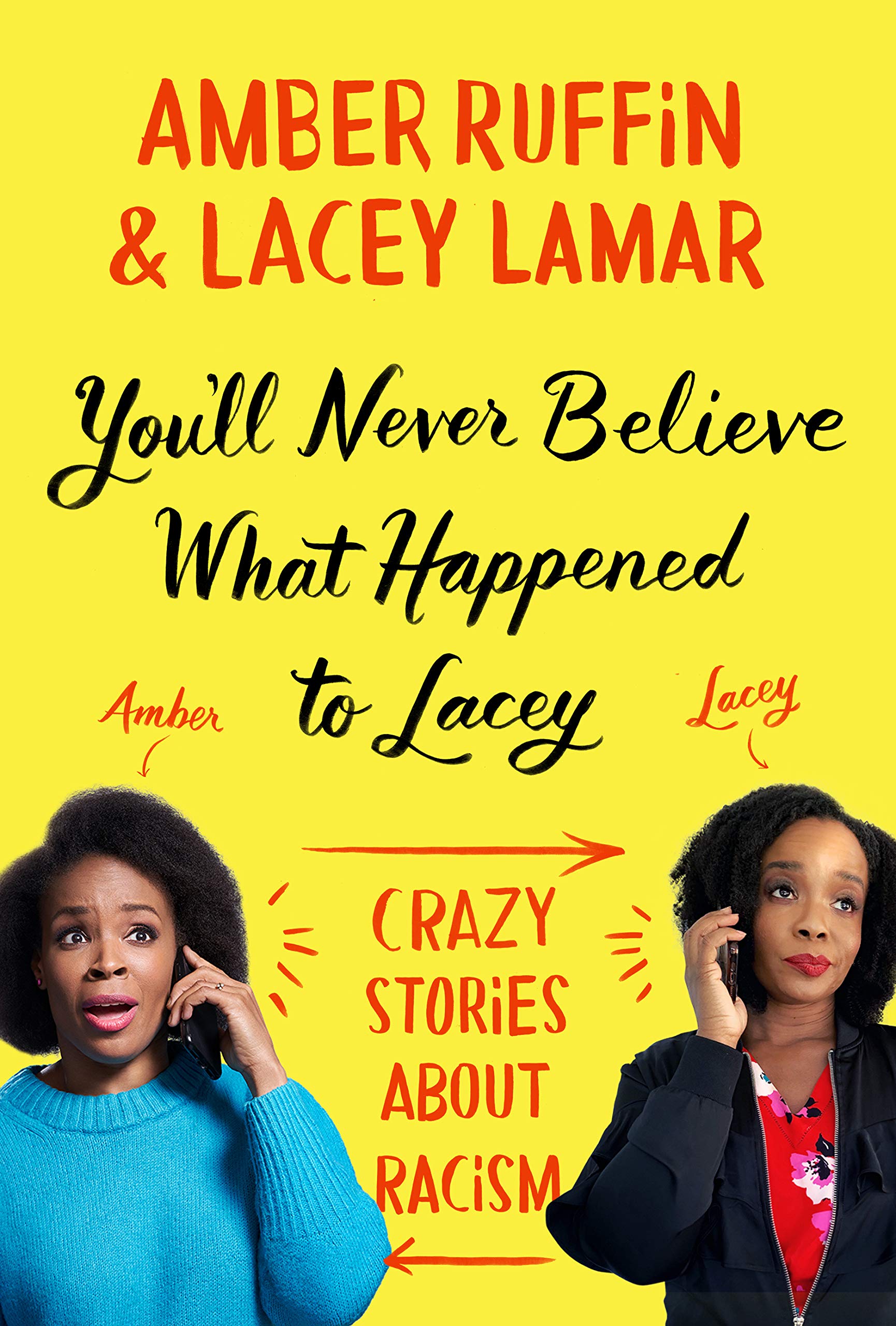
You’ll Never Believe What Happened to Lacey

By Amber Ruffin and Lacey Lamar

Comedian Amber Ruffin relates, with her sister’s help, all the bonkers stories of racism that her sister Lacey experiences in her hometown of Omaha, Nebraska. As she writes in the introduction, these stories will shock white readers and relate to Black readers, and man, was I shocked! She also warns that many of the stories don’t seem to have any logical motivation behind them, that people just seem to wild out for absolutely no reason, and that is racism in a nutshell.

At one point, after a particularly enraging story, Amber writes, “I have never been able to understand why white people have such a low tolerance for hearing about racism.” And I thought to myself, I could tell her why. It’s that most of us white people have the same sense of race relations as very young Black children before they’ve been fully exposed to the onslaught. I went most of my life thinking that the vast majority of people are generally decent and trying to do right, though they may stumble occasionally. All while Lacey, her siblings, and her parents experience daily racist words and actions from people just being mean to be mean.

It is a real testament to their writing how laugh-out-loud funny the book is, and how well they capture their relationship as sisters on the page. While Lacey deals with some truly outrageous shit, she often gets her own again in satisfying ways and reassures the reader that she is doing just fine with a loving family and friends and successful career. Of course, she has her sister to commiserate with as well, and I’m just grateful that they let us readers take a peak into their conversations (not to mention the brilliant photographic evidence)! The book alternates fonts for the two, which is very effective, but afterwards, I somewhat regretted not listening to the audiobook read by the two authors. The conversational tone makes it a quick read, but I bet would really shine in audio.

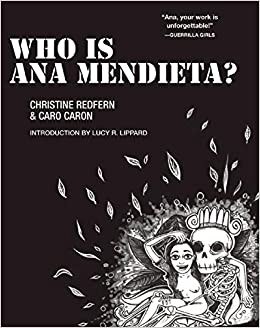
Who Is Ana Mendieta? by Redfern & Caron

Who Is Ana Mendieta?
by Christine Redfern & Caro Caron
introduction by Lucy R. Lippard
2011

This is a relatively short but extremely full and dense graphic novel. It’s a biography of an artist, but also a window into an artistic movement, and also a true crime tragedy, and also a demonstration of how systemic prejudice works to keep a whole demographic down. The particular art styles of both the book and the art movement that it describes are not ones that I particularly enjoy (a lot of shock value and intentionally disturbing imagery), and yet, I still highly recommend the book. It was a reminder to me of what second-wave feminism was trying to accomplish and the context it was working in.

Ana Mendieta was born in 1948 in Havana, Cuba, moved to the US in 1961, and died violently in 1985 (her husband was indicted for murder three times by a jury, and acquitted three times by a judge who then sealed the records.) During her life, Mendieta was a rising star in the art world and making waves. But the book also points out that she, like so many women before her, had to be their own firsts, breaking the glass ceiling, not because there hadn’t been women before her, but because the existence of those women was and is so regularly denied. This book itself is an effort to not have Ana Mendieta suffer the same fate, not just of death but of being quietly brushed aside, leaving art history to continue as a history of male artists.

So all of this to say: this book is educational, distasteful, enraging, and important.