The Little Book of Bees: An illustrated guide to the extraordinary lives of bees written by Hilary Kearney illustrated by Amy Holliday 2019
This is a really nice, easy, nonfiction read about bees, with gorgeous illustrations and fun facts and the text broken into many short sections, which is good for my current level of concentration (which has been shot recently.) It felt like it was structured a bit like an elementary school textbook, with lots of side bars and large illustrations, but written for an audience with an adult reading comprehension.
A bit more than half of the book is a solid overview of what bees are, how many types of bees there are (hint: it’s a lot!), and what the differences are between the different types of bees.* The remaining sections talk about different kinds of honey (which led me down an extra online rabbit hole regarding the most expensive honeys), a brief overview of beekeeping (which I’m already thinking of trying), and how modern environmental issues are causing declines in bee populations (which is really depressing although this section does include some suggestions of things regular people can do to help, many of which I’m already doing, but I can try to do more).
Bees really are very cute and I enjoy seeing them in my garden and this book was lovely and interesting, written by someone who really loves bees. And the illustrations are gorgeous!
* I do have to call out one sub-section that discussed the differences between bees, wasps, and flies, though, because it is hilariously biased and told me a lot more about the author than it did about bees, wasps, or flies. According to this author bees are cute and adorable and elegant and lovely, while wasps and flies are simply not as wonderful. (Examples: A bee has elegantly curved eyes wrapping around its head, while a fly has ugly bulbous eyes protruding from its head. A bee has playfully curious antennae, while a wasp has restlessly jittery antennae.) HAHAHAHA! It was a single section that stood out as being uselessly subjective and that made it all the more hilarious.
I hadn’t been quite sure what to expect from the Detroit Zine Fest, but was delighted to discover that it was like a local mini Small Press Expo. Maybe somewhere between 50 and 80 vendors? Thus, it was still slightly overwhelming to browse through all the stalls, but was also delightful and I bought a number of really good zines:
Michigan Cryptids by Shi Briggs A Michigan UnnatureJournal by Shi Briggs These are two books, 12 pages each, about cryptids natives to Michigan, with absolutely gorgeous illustrations and short descriptions. I don’t actually know much about cryptids, so I’m not sure how much these were researched versus created, but I did recognize the Michigan Dogman as a thing. But the black and white illustrations are so beautiful and creepy and inspiring.
Thank You by Eddie Roberts 2023 This is a gorgeous and pointed poem about the culture of consumerism and the push-pull of gratitude for getting things you desire with the discomfort of always having more pushed upon you. It described many of my own conflicting feelings. The author also experiments with some really interesting typography effects.
Passages by Liana Fu 2019 Is a series of poems and musings on being Chinese diaspora going to visit Hong Kong and trying to learn Cantonese, struggling to figure out where they fit in the world where all their native cultures see them as other, and how this intersects with the ongoing cultural struggle of Hong Kong itself under an increasingly oppressive Chinese government.
Of Course I’d still love you if you were a worm, but like we might have to renegotiate certain aspects of our relationship, y’know? It’s a big adjustment: A guide to safely and responsibly loving your partner post wormification by Seth Karp This is hilarious and also the best kind of crack-treated-seriously brochure. It’s clearly a take-off of the “Would you still love me if I were a worm?” meme, but reminds me even more of an elaborate version of the Jack Harkness test meme. It’s got advice and perspective on what to do if your significant other spontaneously turns into a worm. (Step one: ask what kind of worm? There are different kinds of it will effect your decision.)
Helianthus by Jone Greaves There is Something in the Basement by Jone Greaves Instructional Musings for Encounters & Summoning by Jone Greaves IntenttoCarcinize by Jone Greaves I spent some time trying to figure out which of Jone Greaves’ zines to get since they were all such fascinating titles and wound up getting four of them, each of which is unique and fascinating and thought-provoking. I’ve been getting into short-story writing competitions recently and I feel like these are all examples of how it’s done: to create a world and a concept and maybe a character in just a few pages.
Gentle Laundry by India Johnson 2023 This is a surprisingly fascinating non-fiction 24-page zine about laundry. As someone who mostly learned to do laundry to the extent of put clothes in a machine with detergent and it will come out Officially Clean regardless of any evidence to the contrary, this zine opens up whole new worlds of understanding about what is actually happening and what detergents, soaps, bleaches, etc actually do. It’s also tonally very approachable, although by about halfway through I was feeling somewhat overwhelmed by the all the options and decision branches. But it’s valuable information to know and I have a few ideas for changes I want to try when doing my own laundry. Once I’ve tried a few things, I’ll need to re-read it to see what else.
The Archer by Paulo Coelho illustrated by Christoph Niemann translated by Margaret Jull Costa 2020
I picked this up randomly at the library when I was searching for something else, and I’m glad I did. It’s a short book (only 160 pages) with beautiful illustrations, and it feels like a combination of Zen and the Art of Archery by Eugen Herrigel and Sun Tzu’s The Art of War. The text is not quite poetry, but I want to refer to the verses rather than paragraphs, due to the care and curation that has gone into the prose. It’s a short book but not a quick read, not because it’s difficult but because it leads me to slow down and take breaks and think about what it’s saying.
It has an extremely basic framing story where a boy discovers that the local carpenter in his little village is a famous archer, and asks him how one masters archery. The archer says that he can tell the boy how in an hour, but doing so takes years. The bulk of the book is made up of the short descriptions on what it takes to master a skill and thus master oneself. It’s essentially a book of meditations, with the skill of archery being itself a framework for self improvement.
The framing story sets this book as fictional with characters and events — that was what had originally drawn me to it and I enjoyed both the opening and the closing chapters — but it feels more like nonfiction to me. This book consists of the advice man gives to a boy about how to live a good life: how to be a bow, aim an arrow, pick a target, and be respectful of it all.
Also, the illustrations really are gorgeous, in a very simple style.
It is all too easy to buy a whole bunch of really cool graphic novels from either Small Press Expo or Toronto Comic Arts Festival, be absolutely delighted with them all, and then go home and get distracted from actually reading them, in part because there are so many and where do I even start? (It turns out collecting books and reading books can be two separate hobbies!) But I don’t want to forget about these in my ever-growing to-read pile, and so here are another three graphic novels that I acquired, read, and enjoyed.
She Walks With The Giant by John V. Slavino 2022
This is a beautifully illustrated book with gorgeous vistas set in a post-apocalyptic world in a fantasy ancient Asia. The girl is an orphan in a ghost town who first sees the giant robot appear, and decides (much to the giant robot’s dismay) to follow along. The first part of the book is an exploration of the world as it is, while the second part is an exploration of the history that brought it to this point, where the giant came from, and how there’s no real escape from being part of that history.
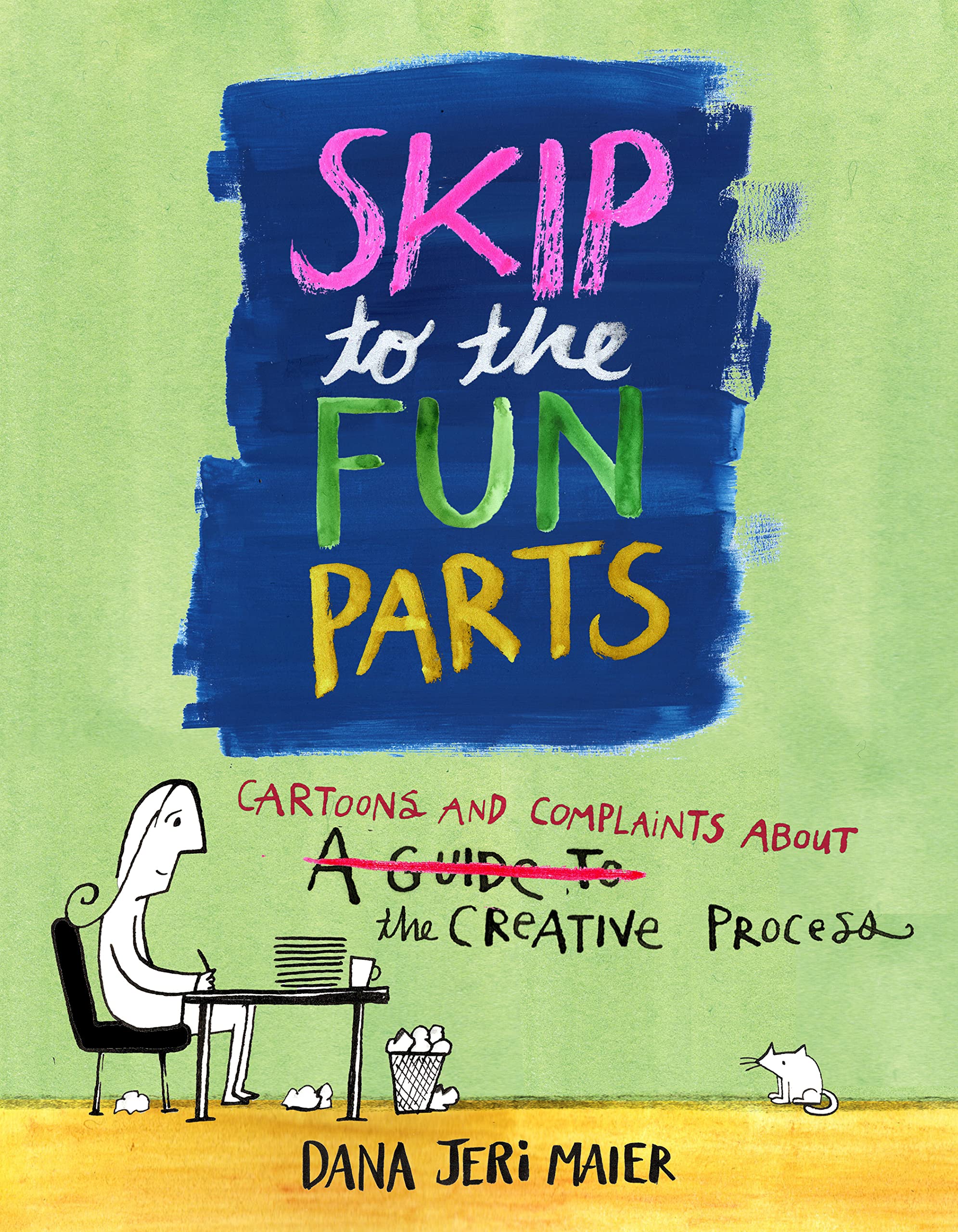
Skip to the Fun Parts: A Guide to Cartoons and Complains about, the Creative Process by Dana Jeri Maier 2023
Admittedly I bought this with the expectation that this would be something of a guide to the creative process written by a published graphic novel writer/artist despite the clear strike-through of those exact words, and it’s decidedly not that, but I still found it remarkably reassuring and comforting, and also extremely funny and with a few good ideas thrown in. It felt comforting to see someone successful face some of the same issues I am with energy vs inspiration, and still persevering with good humor.
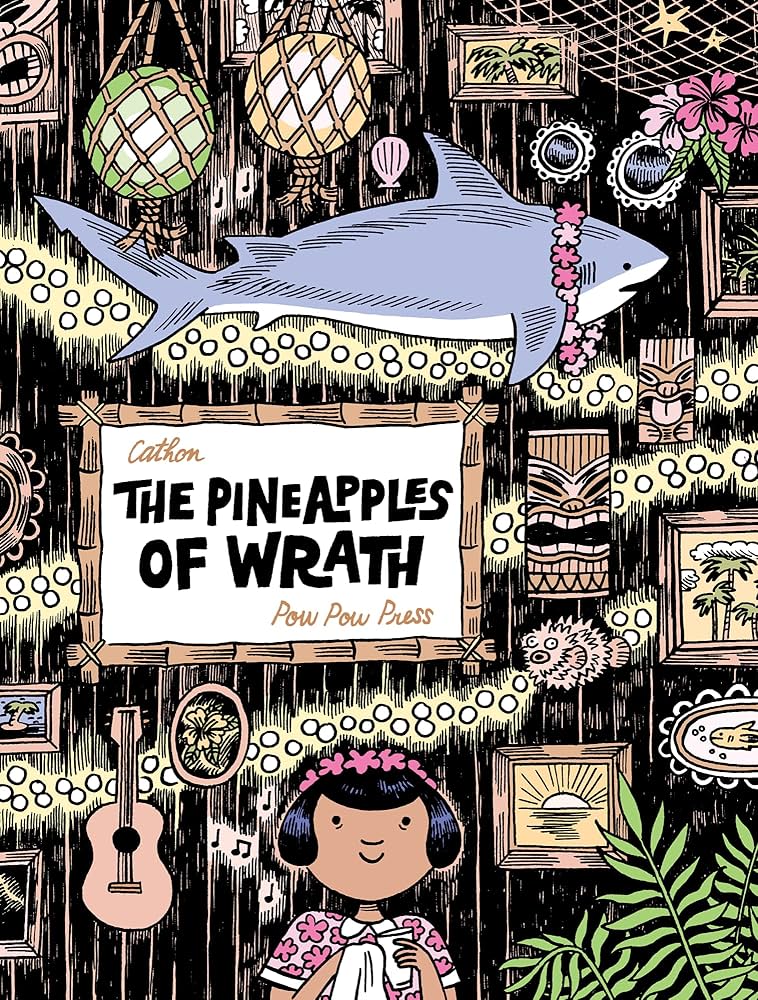
The Pineapples of Wrath by Catherine Lamontagne-Drolet 2018
A friend who wasn’t particularly interested in graphic novels was curious to try one out and asked for a recommendation, so we asked her what genres she generally read, since graphic novels come in all genres. At which point she asked for a cozy mystery and Anna and I were both stumped. Graphic novels do come in all genres… but that was a rare one! However, we persevered and found a cozy mystery graphic novel: The Pineapples of Wrath, which is hilarious and adorable and has quite the body count as Marie-Plum, bartender and mystery-reader, determines that her elderly neighbor was murdered and if the police won’t investigate, then she will! The setting is a fictional little-Hawaii neighborhood in Québec, Canada, and it is just as ridiculously touristy as you can imagine and maybe a bit more.
The Incredible Story of Cooking: from prehistory to today, 500,000 years of adventure written by Stéphane Douay drawn by Benoist Simmat translated by Montana Kane 2021, 2024
This is such a fabulous premise, and at first glance it looked well done, with good art and nine chapters creating an interesting outline about a truly fascinating topic. I was extremely pleased to acquire it at the last Small Press Expo. After reading it, though, my conclusion is that it was… decent. But it didn’t live up to the premise and that was ultimately disappointing. As a 200-page graphic novel covering 500 thousand years of global history, it was obviously always going to be a quick skim over the topics, but it often felt more like disjointed trivia rather than even a summary. There was some general overview and where there wasn’t, the trivia was still fascinating.
What really struck me, though, was that the authors don’t seem to appreciate or enjoy food. Given that it was about how people throughout history had developed all sorts of wild cuisines, it was weird and off-putting how the authors’ distaste for those cuisines came through so much stronger than the historical figures’ enjoyment of them. There was more focus on the politics of food distribution than there was on the development of the dishes, and the text was often felt both judgemental and mocking.
There were a number of basic recipes that were referenced in the text, but of course were very generalized in such a way that you couldn’t actually follow them, which makes sense for being embedded in the story. However, there’s also a section at the end that contains 22 recipes from around the world and throughout time, and they just aren’t good recipes. It’s not that the dishes aren’t good, but that the instructions are poorly written, with ingredients and processes skipped or listed out of order, and written in ways that introduce a lot of ambiguity. An experienced cook or baker could probably fill in the blanks, but they are clearly written by someone who doesn’t cook or know how to write directions for others to follow a process.
I don’t want to just slam this book, because it was interesting and well-illustrated, but it was such a great concept. Why couldn’t it have been better?
I love going to the Small Press Expo every year and seeing what new and unusual things are available and buying a whole stack of comics/graphic novels, and hanging out with a really fun crowd of creators. This was the first year that I attended some of the workshops in addition to the panels and vendor market, and they were so much fun and extremely inspiring. I bought a stack of new comics and have already read a number of them:
Garibaldiology: Japan Travelogue 1 by Garibaldi, 2014 This is an extremely cute little travelogue/drawn journal about the artist going on a trip to Japan, and is quite funny in a day-in-the-life manner about exploring a new place and meeting new people being a little gremlin. What particularly struck me is how non-judgemental, good or bad, it is in narration even as the person is judging the things around them. Their opinions are their personal opinions and not to be taken as anything greater than that. The over-all effect is just: wow, this is a thing that happened. And it’s just very cute.
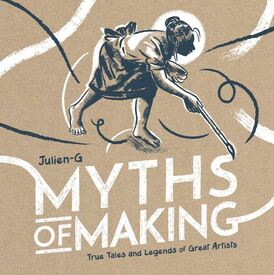
Myths of Making: True Tales and Legends of Great Artists by Julien-G, 2024 The art is really striking restricted pallet of only three colors, that works to excellent effect, with retelling 25 stories and legends from pre-64,000 BCE, up to 2022. I really enjoyed both the art and the stories, but what really caught my eye was the book binding, which is beautifully done sewn pages onto a fabric spine with heavy board covers, such that a quite thick volume can be opened to lay flat without any concern for the gutters. I do have an appreciation for the artistry in bookbinding.
No Pants Revolution #8: Acceptance by Andrea Pearson, 2024 This is the eighth issue in a series for which I haven’t ready any of the preceding issues, but it’s okay because each one is a stand-alone auto-biographical collection of thoughts and experiences. In this particular issue, the author is contemplating acceptance as in a stage in grief, a prayer for serenity, and part of self-care.
I Got a Tattoo Every Month of 2023 and Now I’m Broke, by Clau, 2024 I got this at the same stall as No Pants Revolution, because it is very small accordion format zine and I liked the way the artist used a cartoon kewpie figure to show where the tattoos were located. It also seemed like a representation of how many people are struggling to get through the year, finding their own methods for motivation.
Body Issues: Comics About Body Image, art by Babs New, 2022 One of the workshops I went to at this small press expo was a life drawing (ie, nude model) class hosted by the artist/author of The Cadaver Diaries, which I’d bought and enjoyed last year, and modeled by Babs New, the non-binary artist for this book. This book is composed of short accounts by people talking about their struggles with feeling comfortable with their own body and societal perception, and illustrated by this artist. Each speaker has a little cartoon animal representative and then concludes with a simple line drawing of them in the nude, revealing the body they’ve been struggling with.
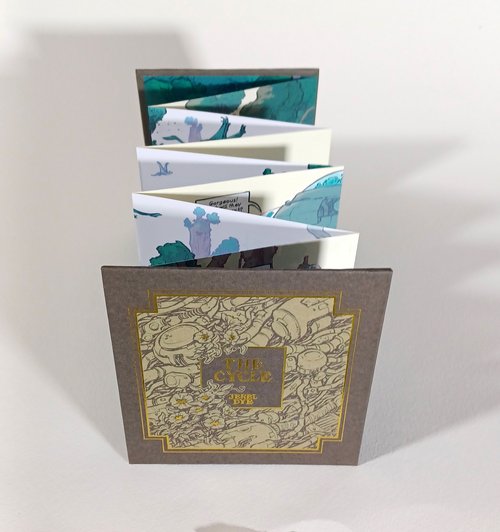
The Cycle by Jerel Dye, 2023 This is gorgeous little accordion book that is so beautifully crafted that I bought it without even really considering the story, but the art is lovely and the story is both simple and increasingly deep as I continue to think on it. I do love the use of gold foil on the cover. It’s drawn as a single scene in both the front and the back but it’s also a timelapse of events, scanning over a scene. The author makes excellent use of the different ways the book can be read.
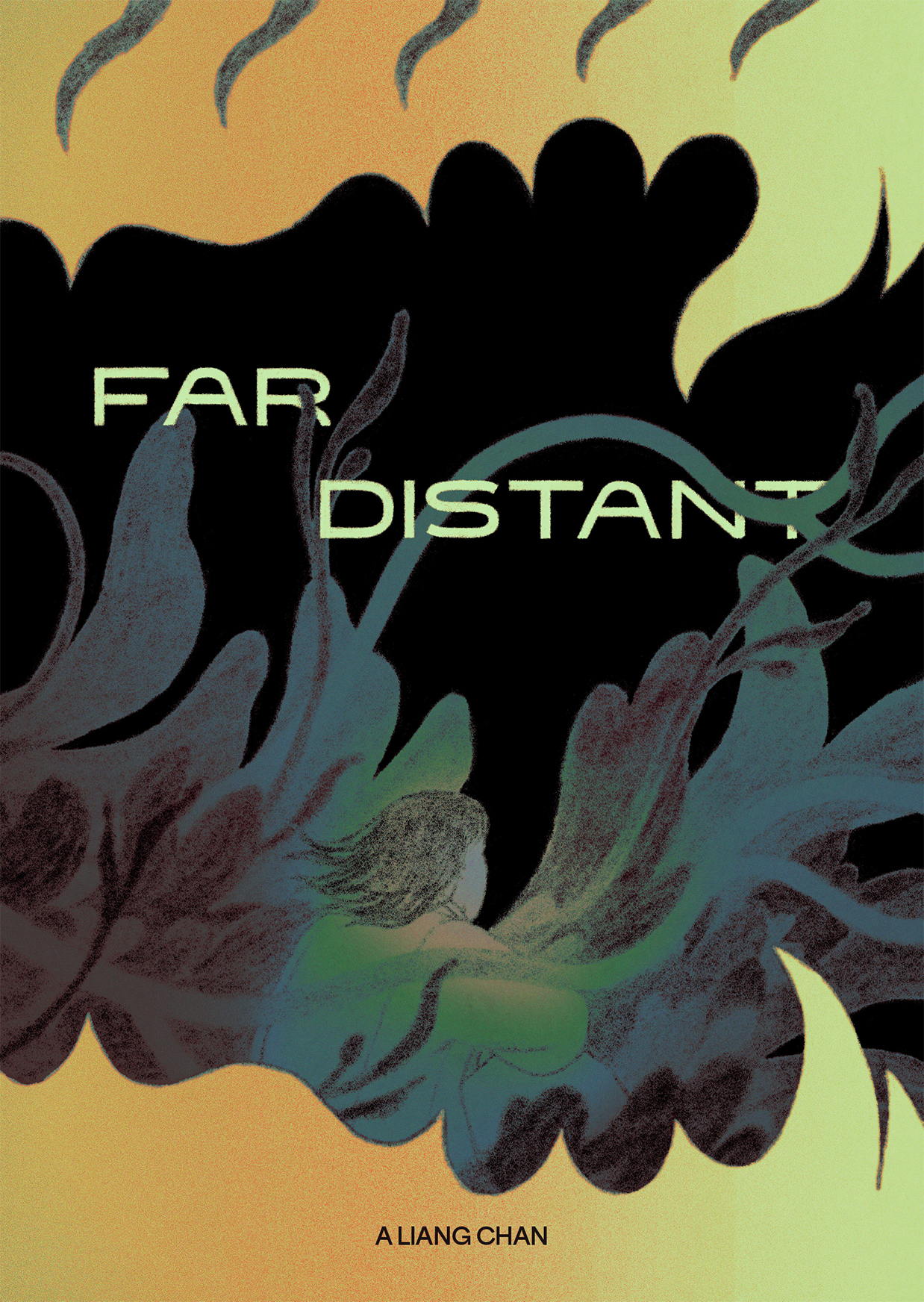
Far Distant by A Liang Chan, 2023 This is a beautifully illustrated stand-alone short story graphic novel about a researcher stationed alone on a distant outpost in charge of managing some transmissions, but receives a series of transmissions that at first seem to simply be corrupted, but instead are a communication from something else entirely. This is a really excellent example of stories that require thought to tease out the implications rather than having everything be explicitly told, and I really enjoyed it. It also felt like a good companion piece with The Cycle, although they are completely unrelated.
Devil in the Pines by Natasha Tara Petrović This is a beautifully illustrated “short comic about the tragedy of the Jersey Devil“, which I hadn’t particularly known about before, but this is beautiful and tragic, and makes me sad for a little devil who’s own mother cursed it. It’s just 16 pages long, and feels like it sits in the middle ground between a comic book and a picture book. It’s just a little devil who was born that way, does no harm, and is lonely being it’s own unique self.
Coextinct by Edea Giang, 2024 This is just 12 pages in black and white, a short but direct manifesto about how extinction events are happening across all species, not just the cute and beautiful ones, and how important it is to not ignore the small and unsightly. It looks specifically at the louse that lived exclusively among the feathers of a single species of bird that was also going extinct. The rescue workers who successfully managed to pull the bird species back from the brink of extinction, were also the ones who killed the the last examples of the louse. There was no evidence it actually hurt the bird at all, merely that it lived among the feathers. And no one knows what the relationship was between the louse and the bird.
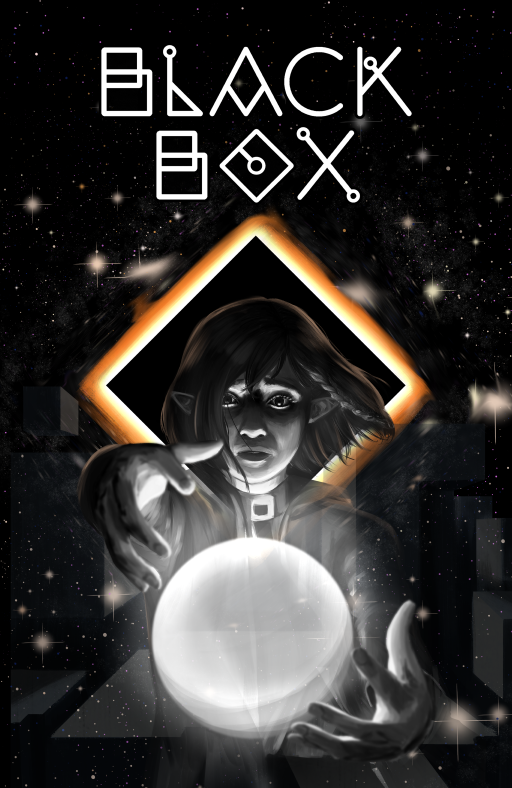
Black Box by Carlos Chua and Regina Chua, 2024 This is the first issue in a proposed comic book series, so it’s just setting the premise but the premise is both a delight and a horror: it’s a fantasy world based on magic, but it’s also a modern world with capitalism and stock exchange, and our main character is an oracle who’s feeling burnt out after years of running prophesies about how stocks will fluctuate, and finally quits after she prophesies a major disaster and her boss reams her out for not suppressing that in her report. It felt remarkably realistic.
2020 was HELL but the KPOP was good! by Kori Michele The first workshop I attended at small press expo was held by this author, about making extremely small zines, with simple folding techniques: teaching us how to make them and showing us examples of artists who had used them to good effect. This isn’t an example of those folding techniques, but is an example of her philosophical approach, which was to just make a zine as a way to give information to her friends and families: such as a playlist of the songs she was enjoying. The workshop was both fun and inspiring, and I got one of the authors larger books as well, but I haven’t read it yet. I also got this little zine, because it was a fun introduction to a music genre I’m not particularly into. I have since watched/listened to all the music videos, and it was a fun intro, even though it’s still not my music genre of choice. But it remains an inspiration of a fun way to create a modern mix-tape, leaving it to the reader to actually acquire the songs.
And, of course, these are just the relatively short comics that I’ve already read in the week since I got them. I have another stack of five larger and more extensive graphic novels that I need to read. But just, I do love the Small Press Expo and the whole range of people and creations that I see there.
Of course the title and cover of this booked grabbed my attention immediately! I’d read articles about romance scams before and wondered how anyone could fall for them. And, as the author points out, thinking yourself impervious to a particular type of scam can lead you to lower your guard and become more susceptible. So, I clearly had to learn more.
Becky Holmes is quite funny, in a particularly British way that I don’t always get, so while I was giggling out loud several times, I also occasionally just sort of shrugged. She begins with a lot of texts leading various scammers on, which is entertaining but gets repetitive. This is also how she first got interested in the topic, entertaining herself with the various scam messages she got across social media platforms. The silliness sometimes felt a little jarring in contrast with the harm being discussed, but as she got more into the topic with accounts from victimized people, it got fairly grim and I appreciated the levity.
As ridiculous as the scams sound when reading them from the comfort of one’s own home, she explains that they are most effective on people going through other trauma in their lives, and desperate for love and connection enough to overlook the signs of fraud that are obvious to the rest of us. And in that light, scammers purposefully looking for people in trouble and illness is particularly disgusting. The people Holmes interviews look back at their own situation and can’t quite believe they were in such bad shape to fall for the lines they did, which really struck me because I’ve certainly related to being retrospectively astonished at how stress and exhaustion can compromise my reasoning.
Towards the end of the book, though, the cumulative stories all started to feel a bit draining. I felt discouraged by the cynicism of the scammers preying on people looking for love, and wondered what it was doing for their long-term psyche. Even worse, I fell back into some victim blaming, not for falling for fairly blatant false scenarios, but their willingness to go along with some incredibly shady dealings that could have gotten them in serious legal trouble if they’d been real.
The author’s total and unconditional support of the victims (and mild scolding of anyone even remotely critical of them) didn’t help. Holmes explicitly compares romance scams to abusive relationships, but they seemed more comparable to addiction to me. The victims become so attached to the scammer that they’ll do anything for them and deny all reason, including pushing away family and friends. (Especially shocking is when some admit that they would welcome the scammer back if they got back in touch.) Of course this is terrible and they need help and understanding, but it is not such a shock that their other personal relationships have taken a hit in the process.
Like a lot of people I’m sure, I’ve been reflecting more and more lately on how much waste and plastic in particular there is in my life. It feels really daunting though, to try to cut it down, so I jumped on getting some clear guidelines on where to start. This turns out to have been a very timely read, since I just learned about the Plastic Free July campaign, started in 2011.
Will McCallum is Head of Oceans at Greenpeace UK, so feels VERY strongly about all of this, naturally. He begins by making the case for trying to eliminate plastics with some rather harrowing stories of natural devastation that I kind of wish I hadn’t read. I gritted my teeth and got through the first two chapters, though I wasn’t sure why I was pointing myself through the stress of it all, since I was already on board. However, I began to understand later why McCallum hits it so hard. A lot of the approaches toward eliminating plastic are going to be annoying (to you and others), inconvenient, and a little confrontational at times, so it is important to keep in one’s mind the criticalness of the endeavor. I also found some resolve in the idea of fighting against the notoriously anti-environment petroleum companies, who are incredibly invested in continuing to escalate plastic use for their own profits.
The third chapter gives some hope with initiatives that are beginning to work around the globe, primarily government and policy interventions; the fourth on the impact that individuals can make, both in their own actions and influencing their community and local government; and finally in the fifth chapter we get down to the nitty gritty of tracking down plastic alternatives. Luckily, the easiest replacements also seem to be the most critical. The book mentions the Big 5 of disposable plastics, those plastic items that we use for mere minutes one time and then throw out: cups and lids, straws, water bottles, plastic cutlery, and of course plastic bags.
A quote by oceans activist and actress (Ginny Weasley!) Bonnie Wright sums it all up nicely, “If I had a message, it would be that yes, it is very overwhelming and it is a really big issue, but these small changes that you are making are significant. It can be hard, so just choose one part of your household—like food, or cleaning products, or toiletries—to tackle first.”
Entangled Life: How Fungi Make Our Worlds, Change Our Minds, and Shape Our Futures by Merlin Sheldrake read by Merlin Sheldrake 2020
I adore this book! It is fabulous! It made various lists in 2020 and I’ve been sort of vaguely meaning to read it since then, but only just recently got to it when I was looking for an audiobook for a road trip. But it is so good!
Sheldrake is so deeply delightfully peculiar, surrounded by similarly peculiar researchers, that the most shocking point, beyond even his loving description of zombie ants as fungi who have temporarily become ants, or his musings on the heat produced by decomposition as he stewed himself at a fermentation spa, is when he refers to someone else as “eccentric”. I’m just like: “Sir!, you are not in a position to call someone else eccentric!”
He has a wide range of stories from his studies, his life, the studies and lives of his friends and peers, and from world history about how people think of and related to fungi, and they are all fascinating in ways I hadn’t previously imagined.
Sheldrake reads his book with a soft melodic voice that soothes the reader into an understand of the world from his perspective, from the fungal perspective, and makes a convincing argument for how important that perspective is.
He reminds us that there’s still a lot of unknowns in the world, and scientific theories are only as good as the phenomenon they explain. For any given law of nature that we think we know, there seem to be a variety of exceptions and ambiguities, and this book is focused on a huge category of beings that are pressure testing much of our current understanding of the world, and have been for as long as we’ve been aware of fungi as something to study. For example: the very word “symbiosis” was only created in 1876 to describe lichen, and “symbiotic” is even more recent as it became evident that the relationship was more common than just in fungal scenarios.
This book is fascinating and funny while giving an accessible overview of the current state of fungal studies. (Just take a moment to consider that sentence: fascinating! funny! fungal studies?) It also introduced me at least to the existence of a community of professionalandamateurfungalenthusiasts I had not previously been aware of. They sound delightfully bonkers while still having some very real ideas and possible solutions to saving the environment and showing that both humans and fungi have a role in a sustainable ecosystem.
Braiding Sweetgrass: Indigenous Wisdom, Scientific Knowledge and the Teachings of Plants by Robin Wall Kimmerer 2013 read by Robin Wall Kimmerer 2016
This is a gorgeous and fascinating book, and I’m glad that I was able to listen to a version read by the author. The book is a wide ranging series of stories and musings about her life, family history, biology, ecology, and reclaiming that which is too nearly lost. It starts with a very personal focus, about her life and self-reflection and moves onto some really fascinating discussions of plants and of Native American culture and history, and then continues onto a discussion of both the dangers of ecological destruction and the importance of not giving up on repairing such casualties.
Kimmerer was raised with a Native American’s perspective on nature which gave her a love of plants and a desire to study them, and then went on to get a PhD and then a professorship in biology with a very scientific perspective on nature. It was later that she realized how important it was to combine the two approaches to nature rather than to give up one for the other. The scientific perspective is one of studying plants as objects, with scientists as unbiased outsiders, while the Native American perspective is one of being part of the nature with humanity as the younger sibling needing to learn from the plants and animals who came before them.
One of the themes that really got to me was her description of how nature is a gift economy: plants give fruits and berries to the birds, and birds give transportation of seeds to the plants. And also how humans are part of this gift economy, not separate from it. Our role in nature is supposed to be taking what is given with gratitude and giving back with reciprocity. The dangers comes with refusing what is given, taking what is not given, not having gratitude, and not giving back.
Another metaphor that she used to great effect was delving into the story of the windigo — a Native American monster that is constantly hungry and can never be satiated — and how capitalist society is trying to turn everyone into this very monster: hungry for more and never satisfied.
The audiobook is approximately 17 hours long, so I’ve been listening to this on my work commute for more than a month, and Anna has been inundated with “In Braiding Sweetgrass…” statements, because every day there is some new and fascinating story or perspective. I’ve also had to deal with becoming a bit teary-eyed while driving a few times.
This is truly an amazing book, and I highly recommend it to basically anyone and everyone.










 Biblio-therapy