Live With A Man and Love It

By Anne Fisher

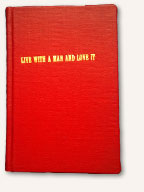
Book Cover: Live With a Man and Love ItLive With A Man and Love It, published in 1937, is a small red book that Thomas and I ran across several years ago at the Boulder library sale. We bought it for a dollar to have a laugh, and then promptly forgot about it.* I was additionally a little charmed by the author’s acknowledgement that one wouldn’t naturally and automatically love living with a man.

Book Inside Page: Live With a Man and Love ItWhen I finally cracked open my copy, I found several pages have some disconcerting rust-colored stains, hinting at the possibility that at least one reader decided not to learn to love living with a man, and chose a more violent solution.

Anyway, Live With A Man and Love It unfortunately falls in sort of a murky area between being hilariously out-of-touch and being an actually useful relationship guide. I was surprised how modern some of the advice seemed to be:

“During the first year have a monthly check-up in which you both agree to be perfectly honest and frank, and tell the other fellow about the things he does that are irritating. Promise not to get sore, but endeavor if possible to change the faults.”

Seriously, that’s not bad advice at all (though probably easier said than done). But before I could get too impressed she would bust out some shockingly dated language:

“Urge him to see other people once in a while. He won’t get that love-strangled feeling and he’ll come into the noose without knowing it’s tightening!”

My favorite part of the book is getting a peek into life and marriage in the 1930s, like spending evenings visiting friends and neighbors, playing bridge and handing out calling cards. That is so different from my own life that it blows my mind! It sounds like it could be kind of nice, actually.

The book also brings up a personal rant of mine, so I’m going to take the opportunity to share it here: Rule 11 in the book is “Never Go to Sleep With a Quarrel.” I think that rule is just the worst and was probably invented by a divorce lawyer. Just keep staying up later and later, while you both get increasingly tired and cranky, until you both dissolve into crying and screaming barely coherent insults? Seriously, just go to bed! You’ll be amazed at how much less you care about whatever you were fighting about once you get a good night’s sleep. So, there’s my relationship advice for you: always go to sleep (actually that’s sort of my general advice for most things in life).

*I had a little daydream that perhaps this overlooked little book would be a rare antique, but no luck.

—Anna

Management of the Absurd by Richard Farson

Management of the Absurd: Paradoxes in Leadership
by Richard Farson
1996

This was one of the books from the list of 40 that I posted about previously. It is essentially 33 quite short essays regarding some counterintuitive issues in management. I have mixed feelings about it.

On the one hand, I liked it a lot better than any of the other management books I’ve had to read. In some ways, it is very much a response to other management books, even. I’m not sure it would even stand alone very well if you haven’t already read others, since so much of the time it is pointing out flaws in common management techniques. It does give some background for the points it makes, so maybe it could stand alone. I’m just not sure. But anyway, I believed a much larger percentage of this book than I did any of the other management books I’ve read.

The main piece of advice that the book gives is that managers should treat people as people and give them some respect. Human interactions are complex and most people will react badly to managerial manipulation. This is a conclusion that I appreciate a great deal.

On the other hand, the book is more a series of philosophical discourses rather than any specific advice, and a lot of the examples the author uses are rather dated. Farson comes across as a bit of a technophobe with too much nostalgia for ‘the good old days.’ (And the fact a book published in 1996 comes across as dated makes me kind of depressed. I’m getting old! 1996 wasn’t that long ago, surely?) He also really likes the words “absurd” and “paradox,” using them whenever he possibly can.

Anyway, I would say that this is not an inherently good book, so I don’t recommend it as such. But, if you’ve read a lot of management books or are interested in management, this is a very useful book to give you an alternative perspective from the standard ones and I highly recommend considering that alternative.

40 Modern Nonfiction Books Everyone Should Read

40 Modern Nonfiction Books Everyone Should Read
by Marc, of Marc and Angel Hack Life: Practical Tips for Productive Living
2009

I have, of course, read nonfiction books for classes, but I don’t tend to read them for pleasure. There are a few exceptions, but not many, and they certainly don’t include self-help books.

However, I was recently sent a link for this list of 40 Modern Nonfiction Books Everyone Should Read, all of them self-help oriented, and I was actually pretty impressed.

I started skimming the list, wondering if I had been assigned to read any of them and how much I had (or would have) disliked them. Instead, I was actually kind of impressed by the collection. Several of the titles and descriptions popped up as ones that I really should read.

There are four that I am actively excited to read. I checked that my library has them and I am looking forward to reading self-help nonfiction.

There are more about which I agree with the author of the article, that it would probably do me good to read, and not just in a putting-serious-effort-into-picking-out-some-small-amount-of-wheat-from-the-chaff type of good that I mostly see in self-help books. There are an additional ten of the books that I plan to check out and see if they live up to Marc’s descriptions. Because I think they might do me good without being too painful.

Of course, there’s also the other 26 books that I have no intention of reading, either due to disinterest or out-right dislike, but I still feel that, given a list of 40 books in a genre I don’t read, having a third of them look good is an amazing percentage and deserves some kudos.

I’m not going to list out here which books I thought were appealing and which I didn’t* because I think it’s well worth your time to skim the list yourself and see which ones you think sound interesting or useful for you.

So check it out and see what you think.


* There will be reviews here in the relatively near future of the some of the books I thought looked good as I go through the ones that I liked.

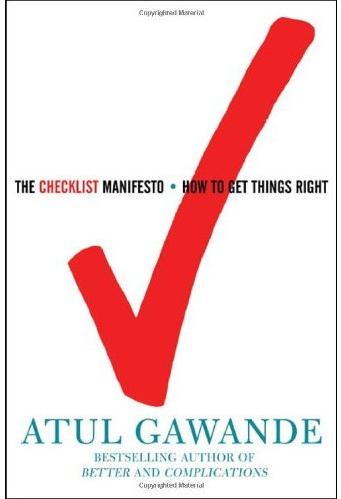
The Checklist Manifesto by Atul Gawande

The Checklist Manifesto: How to get things right
By Atul Gawande
2009

To start off, this is a really excellent book and I recommend it to everyone. I’ve reviewed a few management books in the past, but this one is by far the best one, in part because it’s less about managing people in specific scenarios and more about managing complex situations in general, and in part because it’s focused on a single recommendation and discusses how and why that recommendation is important. As the title says, the book is about the importance of checklists.

As a manifesto, it set out to convince me of its premise: that checklists can be used to great effect. It succeeds. I am thoroughly convinced and now think you should be convinced, too.

A lot of jobs today are incredibly complex and only getting more so as time goes by. Checklists can go a long ways towards helping to compensate for this extreme complexity. The examples Gawande uses are surgery (Gawande himself is a surgeon), aviation, building construction, investment analysis, and cooking.

Historically, these jobs were all performed by individuals relying solely on personal experience and instinct. Now, these jobs are most often performed by teams of experts with access to vast quantities of research in addition to their own personal knowledge. This is an improvement, of course, but it also introduces problems of complexity in having to coordinate with multiple people and incorporate excessive amounts of information.

In performing these jobs, the professionals need to know and be able to instantly recall more detailed information than is really possible and they need to be able to trust that their teammates are performing equally super-human mental tasks as well. Such trust is often a mistake. When dealing with extremely complex tasks, professionals will sometimes focus so much on the difficult or tricky portions of their tasks that they forget to perform the basic preliminary steps. Even the best and most experienced experts in their fields are still just human. Checklists, however, can supplement memory to ensure that everyone remembers the basic steps, while at the same time running through a checklist as a group can ensure that everyone on a team is on the same page.

I would love to go through each of Gawande’s examples and explanations because the examples were all so interesting and the explanations were all so useful. For example, the discussion of how airplane pilots came to use checklists and why they go through some every single time they fly, no matter how experienced they are, is fascinating. Equally fascinating is the interview with Boeing’s master checklist writer regarding what defines a good or bad checklist. The whole book is both interesting and useful and I could burble on about each of the stories or arguments or lessons, but really, it’s probably better if you just go and read the book.

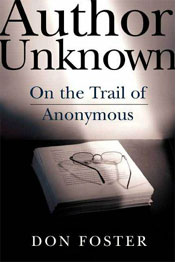
Author Unknown

Author Unknown: On the Trail of Anonymous
Don Foster
2000

I like books and I like reading but, while I am capable enough of literary analysis to have graduated from high school, I admit to a somewhat patronizing attitude regarding the field. My reaction opinion has generally been: well, if you want your life’s work to be looking for “hidden meaning” in texts, go for it, but really, what’s the point?

In Author Unknown, Don Foster answers that (rhetorical) question with six anecdotes about the real-world application of literary analysis.

A couple of the chapters support (in my opinion) my previous stance of: who cares? It was interesting to see how Foster investigated the authorship of a particular poem written centuries ago, but in the end, what does it matter?

However, other chapters demonstrated much more immediate relevance: Tracking down the authors of terrorist manifestos can save lives.  Proving the authorship of witness tampering documents in the White House can threaten administrations.

Each chapter describes the process of literary investigation and analysis, of a piece of writing with the intend to prove or disprove the authorship of the piece, relying on internal evidence. While Foster does look for external evidence as well (could the author have known of events the piece is discussing?), the investigations in this book are all focused on internal evidence (what person would have written these words in this way?) The way Foster comes to his conclusions and the evidence he looks at is pretty fascinating. Each chapter can also be read alone, as an individual story.

Chapter 5, Wanda, the Fort Bragg Bag Lady, is my favorite of the stories. It may not demonstrate a great deal of real-world impact but it does present a real-world black-humor farce, involving multiple anonymous authors, obsessions, murders, suicides, Hells Angels, bad poetry, good poetry, beat poetry, and a complete absence of bag ladies.

Over all, the book is fun and Foster has a lightly humorous way of writing even as he delves into close readings of archaic documents. For anyone who has doubted the importance of literary analysis: read this. I feel a nice combination of convinced that literary analysis is important after all while still vindicated that a lot of the use it’s put to is pretty darn silly.

Pyongyang: A Journey in North Korea; Shenzhen: A Travelogue from China

By Guy Delisle

Kinsey, these may be the comic books for people who don’t really like comic books. They are really more travel journals that use the illustrated panels to give atmosphere in a way written descriptions can’t quite capture.

The author is an animator who gets sent to various sites to oversee the outsourced animation, so in addition to the interesting locales, he also throws in a few details about the animation business, which is equally interesting to me.

Book Cover: PyongyangPyongyang: A Journey in North Korea was published in 2005. A couple of pages in, I realize that this is Eloise for adults! He lives out of a hotel for the entire trip, and has a guide and translator who serve as nannies for him, escorting him anywhere he travels outside of the hotel. The atmosphere he describes in North Korea also sounds very similar to that in Eloise in Moscow, first published in 1959.

Shenzhen: A Travelogue from China, published in 2006, is a disconcerting contrast to Pyongyang, still very foreign, but in an almost diametrically opposite way. After being immersed in the very communist North Korea, every mention of Rolexes and Gold’s Gyms comes as a bit of a shock.

Book Cover: ShenzhenAt the beginning of Shenzhen, Delisle says that he has trouble starting the writing/drawing process, and I have to say that it shows. It is much more a collection of vignettes and is a little disconcertingly random, while Pyongyang has a much tighter story narrative. I think that Delisle found his stay in Pyongyang not more enjoyable, exactly, but more interesting, just due to the foreignness of it all. He finds Shenzhen a bit of a grind, and it shows. I would recommend reading both back to back like I did, since I think they are good companion pieces, but if you are only going to read one, go with Pyongyang.

(From my quick amazon.com research, he has also done graphic chronicles of Jerusalem and Burma, both of which I very much look forward to reading.)

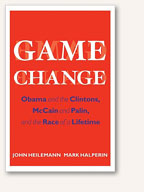
Game Change: Obama and the Clintons, McCain and Palin, and the Race of a Lifetime

By John Heilemann and Mark Halperin

I know I haven’t posted in a while, and it is because I’ve been hauling my way through a large and very unusual book for me—political nonfiction—so I’m writing a very long post to compensate.

I checked this book out from the library the day after seeing the HBO movie of the same name, which was just a narrow slice of the full scope of the book*. I enjoyed the movie; I knew all the public politics already, but it was fascinating seeing all the behind-the-scenes shuffling, like peering backstage at a show. I wanted to know more about it, so I checked out the book.

And very quickly realized that I did not want to know more about it. Politics isn’t a Broadway show, it’s a sausage factory**, and if I wanted to still enjoy sausage, I damn sure didn’t want to see how it is made. Now, I’m a democrat and the book reads somewhat democrat-leaning, though the authors are political correspondents and journalists who I am sure pride themselves on their unbiased stance. However, every single person comes across as single-mindedly, self-centeredly ambitious in a microcosm of politics that not only doesn’t seem to have much relevance to the rest of the nation, but seems to disdain the rest of the nation a bit. So, I guess that, at least, is something bipartisan.

I will give Game Change this: it is so minutely, exhaustively researched that it sort of boggles the mind. It is written in a narrative structure, following the various candidates like protagonists in a story. When tracking Obama in 2006, well before he was in the national consciousness, they extrapolate his frame of mind from a note he passed to another senator in a committee meeting and a hand gesture (not the one you are thinking of right now) he made in the hallway of the Capitol. I imagine the two authors scouring every building he ever set foot in and asking everybody and anybody there, “Did you ever see President Obama? What was he doing? Did he say anything—anything at all?!”

The best part is reading about the events that I actually remember from the race, but reading them in context with everything else that came between. The oddest part, though, is reading about pivotal, influential events about which I had no idea here in the midlands of America. (ex. Apparently, Maureen Dowd wrote an article in which she interviewed David Geffen about his disillusionment with the Clintons? It was a big moment where democrats felt free to criticize the Clintons and support Obama instead? I mean, I know who Maureen Dowd is, though I’ve never read anything by her. I initially thought David Geffen might be Liza Minnelli’s most recent husband, until it quickly became clear that wasn’t right.)

I guess I can kind of see where politicians get their contempt for all the rest of us, but I think that contempt comes from a very ignorant place—they have no idea how we think and how we make decisions. And because they don’t understand it, they disdain it. I imagine that it is stories like my own that drive politicians crazy: I saw the campaign ads, read articles, and still couldn’t make up my mind between Clinton and Obama. Then, I read a post on a small blog that I regularly check out where the author commented that if Clinton gets elected, two families would have been running the White House for 24 years and that is some disconcerting dynasty-building right there. And that’s what did it for me—that one post made my decision.

Later, it occurred to me that this phenomena kind of highlights how insular the political world is, at least for the active players. For myself, only the largest of political events break into my brain space that is otherwise occupied with my daily office work, what I’m making for dinner, how to balance this month’s budget, etc. For the people in this book, though, this is their entire life.

When the HBO movie came out, Palin understandable objected to it, and HBO tried to argue that it wasn’t necessarily an unflattering portrait, which of course it is. The book is not truly flattering either, but it is a lot more balanced in assigning blame equally on McCain’s people.

The vast majority of the book is spent on the democratic primaries, to the point where it gets a little bogged down, but then it rushes through the general race at breakneck speed, making me feel like I was missing things that they simply weren’t discussing.

This is perhaps the best compliment: Game Change already has me looking at the 2012 race in a different light.

A couple of random concluding thoughts:

  • The book does a great job of humanizing the politicians. It is a little embarrassing to admit, but it had not occurred to me that politicians could actually be sad or get their feelings hurt while on the campaign. I guess I just thought that so much of the discourse was overblown wind-bagging, that it all was. I was kind of shocked how many of them break down into tears at one point or another.
  • Hillary Clinton’s political career so far could almost be a Greek play (I’m not sure yet whether a tragedy or comedy): her husband is the one that initially gives her the political clout and name-recognition to run for president, but he was also her biggest obstacle in the campaign and probably the strongest reason she lost.
—Anna
__________________________________________

*A VERY narrow slice – the book breaks down as follows:

  • Pages 1-267: the race for the Democratic nomination, focusing on the Obama and Clinton campaigns, with some discussion of Edwards (which has been very informative in light of the current trial)
  • Pages 268-319: the race for the Republican nomination, focusing almost entirely on McCain with a few pages about Giuliani
  • Pages 320-436: the general election (the events of the HBO movie are all contained within pages 353-416)

**The 12-year-old in me says, “YEAH, it is!” (sorry)
The Hare with the Amber Eyes

I can’t believe that I haven’t already written about The Hare with the Amber Eyes: A Family’s Century of Art and Loss. I loved it so much I was sure that I had written a review of it, but it must have slipped between the cracks, which I cannot allow to happen. This book has been all over the place lately so I know I’m not exactly letting you in on a secret with this recommendation, but sometimes books are popular for a good reason. This is a non-fiction family memoir written by an English ceramics artist whose family was one of the richest, most powerful Jewish banking families in Europe in the 19th century. He traces the history of his family as they climbed to the top of European society, and then were devastated by two World Wars and the anti-Semitism that was always waiting just under the surface of polite society.  (As I said to my sister when I was about 2/3rds of the way through the book, “This has been really enjoyable so far, but now it’s 1930 and they’re Jews in Austria. I feel like things are about to take a turn.”)

There are plenty of WWII memoirs out there–what makes this one stand out is that the story is all told in the context of the family’s art. Specifically, de Waal traces a collection of small Japanese carvings known as netsuke–how his family obtained them, how they fit into the rest of the family’s collection, and how they survived the twists and turns of history to end up in his possession. Political events are a major part of the story, but even those are filtered through the lens of how they affected the family’s patronage and collection of art. The book is more art history than history, and it makes what is a familiar story feel fresh and interesting. One thing did puzzle me: the book did not include any pictures of the netsuke. Lengthy, lengthy descriptions of the tiny carvings and pictures of the family, but no pictures of the carvings themselves. That seems like it must be a deliberate decision, to make sure that the readers’ focus is on the family and the people instead of on the things, even though the fate of the netsuke is the hook the entire book is based around. I ended up going to Wikipedia to find out what these things actually looked like, and then falling down an internet-rabbit hole about Japanese art. If you’d like to see some very detailed pictures of netsuke, let me recommend JapaneseNetsuke as a starting point.

Also, although I linked to the Amazon page, I would recommend not reading the reviews there before you read the book, because they give away some of the major twists. I’m not someone who gets overly concerned about spoilers, but I went into this book blind and I think that especially well.  I knew that the netsuke collection survived the wars, but I learned how that happened as the author did, and I think that made the experience more powerful. It can be hard when reading history to remember that the things that happened in the past were not inevitable or destined, but that life at those moment in the past was just as fluid and unpredictable for the people living it as our lives feel today. Having only a general sense of what was going to happen made following the story of this one family, and this one collection of tiny objects, feel like a thriller.

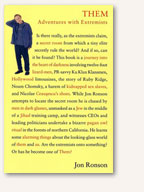
Them: Adventures with Extremists

By Jon Ronson

I am very much a believer of Occam’s Razor—that the simplest answer is usually the correct one—which makes me pretty much anti-conspiracies. I have to admit, though, that Jon Ronson’s Them gave me pause.

The front cover has this description:

Is there really, as the extremists claim, a secret room from which a tiny elite secretly rule the world? This book is a journey into the heart of darkness involving twelve-foot lizard-men, PR-savvy Ku Klux Klansmen, Hollywood limousines, the story of Ruby Ridge, Noam Chomsky, a harem of kidnapped sex slaves, and Nicolae Ceausescu’s shoes. While Jon Ronson attempts to locate the secret room he is chased by men in dark glasses, unmasked as a Jew in the middle of a Jihad training camp, and witnesses CEOs and leading politicians undertake a bizarre pagan owl ritual in the forests of northern California. He learns some alarming things about the looking-glass world of them and us. Are the extremists onto something? Or has he become one of Them?

Book Cover: ThemI had previously discovered Jon Ronson when he was on a hilarious episode of NPR’s This American Life, talking about his most recent book, The Psychopath Test. (If you haven’t heard the episode, you definitely should—they bring in a psychologist to administer the “psychopath test” to the NPR staff.)

I promptly picked up the book at the library and realized that I had experienced Jon Ronson before—he wrote the book Men Who Stare At Goats, which was made into a movie a few years ago with Ewan McGregor and George Clooney. Several things became clear all at once: Ronson has a writing style unlike anything I’ve read before. He describes himself as a humorous journalist, but he writes in a kind of nonfiction stream-of consciousness. I enjoyed the movie “Men Who Stare At Goats,” but the characters just seemed to sort of float along and kind of accidentally run into important people or pivotal events. It didn’t seem very realistic in the movie, but it now seems very much how Ronson operates, and once you get used to it, it is pretty awesome being along for the ride.

Ronson just seems like the most pleasant, unassuming, agreeable person, and he must be because he gets interviews I wouldn’t have believed possible. In “The Psychopath Test,” he meets with CEOs, even after telling them he wants to see if they are psychopaths! It is unbelievable—they are just sort of amused. I think he must have some superpower of not giving offence. Them starts off with him spending a year off and on with Britain’s self-proclaimed right-hand man of Bin Laden, even though Ronson himself is Jewish.

Ronson has a very active voice in his books, unlike most journalists, and that is very much part of the charm. The reader gets a much clearer sense of the full interactions, and I started to notice that Ronson asks lots of questions but only very rarely disagrees or confronts people. Even his questions are very inviting, sort of “I’m sure I’m being very stupid about this, but what about….” People seem usually pretty delighted to speak with him. (Although if I recall, The Psychopath Test begins with one of his subjects from Them being very unhappy with his treatment in the book and threatening him.)

In the book’s preface, he explains how he came up with the title Them. While in the middle of researching the book, he describes his research to a friend, and the friend replies, “You are sounding like one of THEM.” And I have to warn that after reading this book, not all the extremists will seem so extreme to you, either.

It reminded me of watching a tv program on the Society of Masons with Tom. They had lots of conspiracists describing various farfetched theories about the Masons, and Tom and I had a good time laughing at how ridiculous it all was. Then, the program interviewed a representative from the Masons, and he was so slick with complete non-answers (“why, we are just a normal fraternal order, how could you possibly think otherwise?”) that for the first time I had some momentary doubt.

—Anna

Please don’t talk to me, middle seat person. I’m reading.

I spent the last two weeks traveling on business, which meant that I was too exhausted at the end of the day to put two words together for a post, but I got LOTS of reading done in airports, on airplanes, and in hotel rooms and lobbies. While I will spare you descriptions of the many in-flight magazines and celebrity tabloids I read during the enforced no-electronics portions of my flights, here are quick summaries of the books that kept me sane as I criss-crossed the country:

The Marriage Plot by Jeffery Eugenides
This was fine, I guess? I was interested in all the characters and I wanted to find out what happened, so it was compelling reading. On the other hand, it was really long and nothing much actually happened and there was almost no resolution of any sort and just because I was interested in the characters didn’t mean I liked them. In fact, pretty much everyone in the book was extremely unpleasant or shallow, so it was a bit like watching a very long, slow train wreck as these characters messed up their lives over and over. I had initially written here that I wanted to warn people about an unflattering portrayal of a character with a mental illness, but all of the characters were portrayed in unflattering ways so the manic depressive actually came out pretty well, comparatively speaking. I loved The Virgin Suicides, so Eugenides has credit in the bank with me, but while The Virgin Suicides felt airy and impressionistic, this dense, heavy, weighty novel feels like it was written by someone else entirely. English majors might like it though, since it seems to feature a lot of inside jokes about literary criticism.

Let the Great World Spin by Colum McCann

Remember how back in the 1970s a French guy strung a tightrope between the two World Trade Center towers and walked back and forth between the buildings, a hundred floors up with no safety net? This novel describes what was happening in the lives of a number of New York residents on that day, and how they were all connected to the wire walker and to each other. Although it does feature the walker (in real life, his name was Philippe Petit and you can watch an amazing documentary about his walk called Man on Wire), the story isn’t really about him at all. It’s really about New York, and America, in the 1970s–Vietnam, crime in the cities, race, immigration, and how all these things play out in the life a few individuals. As a general rule, I don’t like books that follow multiple characters connected only by the thinnest of threads. However, in this book each character is beautiful and heart-breaking and I found that they all looped together in really satisfying ways. Sad, but lovely.

The Thrift Book by India Knight
I think I’ve explained here before that I want India Knight to be my best friend, so I adored this book, even though it is basically just a list of fairly obvious ways to save money. You know, cook at home, make Christmas presents, grow your own herbs, don’t be fooled by fancy skin creams. Knight puts a fun spin on it by focusing not on getting out of debt or being as cheap as possible, but by talking about all the ways her strategies make you feel (to sound English about it) posher and more glamorous by not trying to hard or getting caught up spending on foolish thing. Plus, she’s funny. At one point she refers to playing Scrabble online as her “ongoing Alzheimer’s prevention project,” which is exactly how I think of Words with Friends. However, if you are not trying to befriend or become India Knight, it’s probably not necessary to read this.

Ready Player One by Ernest Cline

Really fun, and absolutely perfect airplane reading. A sci-fi story that manages to be both a puzzle/treasure hunt and a celebration of 80s pop culture. I think is truly aimed at folks a few years older than I am who spent much more time in video arcades, but I loved it and was so absorbed I was able to read it in even the loudest terminals and restaurants.