The Best of the Rest of 2014

I’ve said here before that when I read a really great book, I am so excited to share it with people that I immediately write a blog review. Hence, my short list of the best things I read this year would be The Goldfinch, The Signature of All Things, Love, Nina, and Americanah. (I was looking at the list of the books I read this year and wondering why it was so much shorter than last year–I read about 45 books this year, rather than my typical 80-100. Maybe it’s because I spent half the year reading giant doorstop literary novels that took forever? At least most of them were good; let’s just not talk about The Luminaries.)
But  I did read a few other things in 2014 that I loved but that never made an appearance here. So before this year runs away from us entirely, let me put in my vote for a few more things:

1) Bridget Jones: Mad About the Boy

I have a love for the first Bridget Jones book that I cannot explain. I just think it’s brilliant and is working on about four different levels and I still reread it once a year. Even Helen Fielding would probably admit that the second one went off the rails a bit, but I really, really enjoyed this third Bridget installment. Rather than picking up where things left off, the book ages Bridget and puts her in an entirely different situation. Bridget is still recognizable, but she’s gown up a little, and as predictable as the book was, I found it charming and surprisingly touching.

2) Mastering the Art of Soviet Cooking

I am kind of obsessed with the Soviet Union, but I find it really difficult to find things to read about it. Nonfiction books tend to be incredibly dense, academic tomes along the lines of “and then that other diplomat issued a statement that countered the previous statement  . . . ” And fiction tends to be unbearably dark, which is understandable but difficult to read (Child 44, you still give me nightmares). This memoir uses food–from pre-revolutionary excess to the siege of Leningrad to Soviet institutional cafeterias–to show how the Soviet state affected the everyday life of it’s citizens. And it shows how one family rebelled against that state, at least partly through food. Really charming, although I’m not likely to cook any of the recipes provided.

If you are not already reading the website Bitches Gotta Eat, you should go do so immediately, because it is one of the funniest things on the Internet (assuming you’re over 18–if you’re not, please go look in our YA tag for something more appropriate, because this sure isn’t). Meaty is a collection of essays by Samantha Irby, who writes the site, and it is equally funny. However, I should warn you that she uses the essay format to also tell some less funny stories about her life, including one about her mother that was so sad it made me put the book away in a drawer for several months so I could recover. But the funny stories are really funny, the sad stories are stunning, and Irby definitely deserves a bigger outlet than she’s gotten so far.

Love, Nina

Some of my favorite people on Twitter are a group of British authors that includes Bim Adewunmi (@bimadew), India Knight (@indiaknight), Jojo Moyes (@jojomoyes), and Emma Beddington (@Belgianwaffling). In addition to being generally hilarious, they often have conversations amongst themselves about what they’ve been reading, and paying attention to those back-and-forths is a fabulous way of staying on top of what the cool (but non-pretentious) kids in publishing are reading and enjoying. The problem is that not everything they talk about is available in the U.S. I spent months watching them rave over a memoir that I couldn’t get, but just when I was about to cave and pay the insane shipping on amazon.co.uk, Love, Nina: A Nanny Writes Home by Nina Stibbe came out in the U.S. And it is just as great as they said it was.

Now, if I had just read a description of the book, I’m not sure if it would have caught my eye: in the 1980s, a young woman takes a job working as a nanny for two boys whose parents run in London’s fancy literary/artsy circles, and this is a collection of the letters she wrote home to her sister. I don’t know, it sounds very, innocent-country-girl-in-the-city? Or like a pre-Internet mommyblog? I’m just not sure I would expect much. But it is so much more sharp and thoughtful and, friendly than it sounds.

First of all, Nina and the family she works for are all hilarious. It’s clear that MK (the mom) was far more interested in a nanny who was clever and could keep up with the jokes and get along with the kids than in someone who could cook, clean, or successfully park a car. So there’s no employee-employer feel here, but rather it seems like you’re reading about the daily lives of a snarky bunch of friends. In the letters themselves, Nina often entertains her sister with retellings of conversations she has with the kids or MK, which are awesome. And presumably because these were going to a sister she was close to, Nina doesn’t try to make herself look good in the letters (there is kind of an on-going joke about Nina lying when she gets stuck in unpleasant situations). But that just make her seem even more relatable, and like someone you’d very much like to hang out with. In fact, the whole books feels like you’re getting to be in on all the jokes and secrets of some very cool people—there is one bit when Nina is evaluating a number of people on whether she is going to try to make friends with them, and I found myself thinking, “I really hope she’d have thought I looked worth the effort.” There’s no huge dramatic arc here, or any big tragedy, it’s just a lot of smart people who like each other chatting and having tea and reading things. It’s the perfect life, really.

I should say that this is an incredibly English book. There is a lot of discussion of English foods and dish soap and lots of slang, and lots of references to people that I suspect are more household names in the U.K. than they are here. The book opens with a list of main characters, and I did have to refer back to it and to Google occasionally to make sure I understood all the references. But you wouldn’t have to do this—the point here is not the celebrity gossip, and I think you could skim over every odd English reference and still enjoy this immensely.

Kinsey’s Three Word Review: Cool, charming, and funny.

You might also like: This is not at all original, because a number of other reviewers have mentioned this, but Love, Nina feels a lot like 84 Charing Cross Road, another sweet English book of letters. And Nancy Mitford’s books are from a different generation, but I think they also have a similar chatty, inside-joke sensibility (with just a tiny little bit of added Nazis).

A Fun Story…

So, it’s been a week, hasn’t it? I have a treat for us all to see us into the weekend.

We occasionally link to other blogs that we have found particularly interesting, but I don’t know that we have ever linked to a specific piece of writing floating around the internet. However, Rebecca sent me this link that has been blowing up Tumblr over the last week or so, and it made me laugh until I cried, so if any of you haven’t seen it yet, treat yourself to what is being called by appreciative readers “Porn Prison”:

http://ofgeography.tumblr.com/post/94085997576/so-heres-a-fun-story-about-this-movie-guess-who

(Despite the title, this is completely fine for work; well, the content is fine – you will absolutely audibly laugh.)

—Anna

I Can Barely Take Care of Myself: Tales from a Happy Life Without Kids

By Jen Kirkman

Book Cover: I Can Barely Take Care of MyselfSo, I struggled a bit writing this review because this is a book-reviewing blog, not an autobiographical blog. But, clearly, I didn’t just pick up this book out of the blue, thinking, boy, I’d like to read more about comedian Jen Kirkman’s personal views on pregnancy and childhood.

Much like Kirkman, I have never felt a strong desire for children or even envisioned children in my future. Also like her, I have been told by people older than me, in very decisive tones, that I will change my mind when I get to be that age, and I guess I sort of believed them. I knew that I didn’t want children at the time, but accepted that I could change my mind (I’m a big fan of spinach now, and I wouldn’t have anticipated that when I was a kid, so, sure, tastes change) and that would be fine.

However, if I may put this delicately, I’ve come to the age, where perhaps sooner rather than later is a good time to plan for children, and I have experienced no change in my feelings. This really does seem to be a somewhat shocking aberration in our current society, and I thought it would be comforting to read someone else’s struggles with the same outlook.

So, I approached this book wanting a philosophical discussion on what it means to be a woman in our society who simply chooses not to have children. I was slightly disappointed right off the bat because it was no different than many other comedic memoires I’ve read, an overview of her childhood and young adulthood and what drew her to comedy; she’s funny and an engaging author, but it wasn’t what I was looking for in this particular book. About halfway through, though, she really delves into the subject of not wanting kids and her immediate surrounding’s reactions to that, and it was exactly what I wanted. I even understood that she had to set the stage before: that she was a normal kid, from a loving, intact family, with siblings who have happily chosen to have kids. There is no childhood trauma to be used as an excuse, and her lifestyle choice cannot be called a symptom of anything.

The most important thing that came out of the book for me is that she doesn’t ever explain exactly why she doesn’t want children, and I believe the truth is that she can’t. I certainly couldn’t, either. Can parents truly describe why they wanted children? I get that there are concrete reasons; I have concrete reasons, too, for not wanted children, but they aren’t really the whole story, or even most of it, are they? It is simply something deep down inside you that desires something, or does not. I have a million reasons why I don’t want kids, but reading this book helped me come to the understanding that they are all just extraneous excuses and it all boils down to the very basic truth that I simply don’t want them.

I have had various conversations about it with family, friends, and acquaintances, and found them all to be much more accepting than the conversations that Kirkman relates. Towards the end of the book, she goes on a bit of a screed about parents wanting to push everyone else to be parents, too. For me, though, reading this book made me more comfortable with my choice, but also more comfortable with people who chose to have children, as well. If my choice to not have children is deeply embedded in who I am (and it is), then their choice to have children is, too, and that is certainly something to respect and admire.

—Anna

P.S. – Jen Kirkman wrote a short column for Time Magazine, giving a brief overview of her book here.

P.S.2 – Jen Kirkman was also featured in the Boston episode of Drunk History, which I just love and you should definitely watch (but not at work)!

P.S.3 – A few days after reading this, I had a super realistic dream that I was pregnant and it was awful. Even in the dream, I thought “how ironic that after coming to a comfortable acceptance of not wanting children, now I will have one for the rest of my life.”
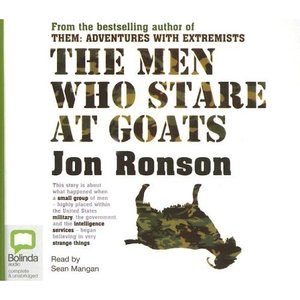
The Men Who Stare at Goats

men-who-stare-at-goatsThe Men Who Stare at Goats
by Jon Ronson
2004
read by Sean Mangan

This book is awesomely hilarious. Hilarious, if, you know, you can get past the very real horror that is mixed in with the craziness. Apparently, I can. In many ways, the book as a whole reminded me of Keller’s Catch-22, an awesomely hilarious comedy all about the inhumanity of war.

And unfortunately, I once more have to warn for animal harm. Given the intent (by the men who stare at goats) of doing harm, I shouldn’t be surprised, but given the proposed method (i.e., staring), I found I was surprised after all. (It hadn’t occurred to me to ask: where are these goats coming from?) Plus, once we’re past the animal harm, we then move on to torture of prisoners.

Somehow it still manages to be super funny.

Jon Stewart on the Daily Show called Jon Ronson’s writing “investigative satire” and that’s pretty much what it is. This book is also an illustration of the phrase: “Truth is stranger than fiction, (because fiction has to make sense.)” In the final chapter of this book, Ronson sums it up by explaining that this is the story of how, in the aftermath of the Vietnam War, the discouraged and demoralized U.S. army attempted to incorporate some of the “New Age” culture that was developing, but in true military style, rather than seeking new ways to find peace, they looked for new ways to make war.

Ronson himself is also quite the character: a soft-spoken, somewhat nebbish guy. He’s gone on The Daily Show with Jon Stewart, twice, so you can see him for yourself. It’s worth seeing him for yourself, especially if you’re planning on listening to the audiobook version of this book, because, in stark contrast to Ronson, Sean Mangan reads the text with a deep intent and melodrama that just adds an extra layer of hilarity to it all.

There are a lot of conversations in which the various interviewees are saying something either crazy or horrifying or both, and Ronson is recounting the conversation:

So-and-so said: some crazy and/or horrifying thing

I said, “hmm.”

Now imagine that spoken in a deeply melodramatic fashion.

“I said,” Mangan intones, “hmm.”

I, the listener, can’t help but giggle.

To use Kinsey’s practice of a Three Word Review: funny, informative, disturbing

Rest In Peace, Elmore Leonard

Elmore LeonardMan, 2013 has not been a good year for authors! Today, Elmore Leonard passed away, and even if you don’t think you are familiar with him, you are sure to be familiar with some of the movies and television shows he wrote or inspired: Out of Sight, Get Shorty, 3:10 to Yuma, and Justified, to name just a few. I was first introduced to Leonard through the very short-lived tv show Maximum Bob which ran for just seven hysterical episodes in 1998, but inspired me to read the novel with the same name and become a lifelong fan of the author.

I consider him one of the founding fathers of the craziness-in-Florida niche genre continued by Dave Barry and Carl Hiaasen, and if you haven’t read any of his work, you should definitely check it out if you want to laugh at some head-shaking craziness that doesn’t seem that farfetched anymore. Honestly, with Florida, you laugh so you don’t cry, and Leonard is very good at making the reader laugh. In eulogy, Vulture posted Leonard’s Ten Rules of Good Writing, and it is easy to see why I am such a fan.

—Anna

Gulp: Adventures on the Alimentary Canal

gulpGulp: Adventures on the Alimentary Canal
By Mary Roach
2013
Read by Emily Woo Zeller

This was excellent, but…

That’s pretty much my review of this book. It was excellent—funny and informative—and yet, there are so many warnings necessary before I could possibly recommend this to anyone else.

I read Mary Roach’s Stiff: The Curious Lives of Human Cadavers some years back and enjoyed it a lot. It was funny and educational and oddball and also kind of gross but mostly that just made me get all picky about what I want to have done with my body after I die. I had not expected adventures in the alimentary canal to be significantly grosser than a recounting of the things that can and do happen to bodies after death. Oh, how wrong I was! Gulp got incredibly gross, and I am now hyper conscious of my bowels. I can only hope that awareness disperses after I move on to another book.

Second: I have to warn about animal harm. So. Much. Animal. Harm! You know how people have learned about the digestive track over the centuries? Largely by doing really unpleasant things to animals. Do you know what vivisection is? If you don’t, then count your blessings and don’t ask.* If you do, well, if you read this book, you’ll know a lot more about it. The people at the dog food factory loved their dog taste-testers and treated them extremely well. I cling to the fact that there are people here who love their animals. Because all the other animals mentioned in this book came to gruesome ends.

Moving on, I was surprised about how Roach didn’t spend much time on the intestines. She started at scent and taste and swallowing, moved on to the stomach, and then dealt with digestive juices, but then moved on to the colon (and stayed there for a really long time) but I didn’t really think the small and large intestines got their fair share of time. On the other hand, this isn’t exactly intended as a textbook. Maybe she just couldn’t find the same number of stories—horrifying and hilarious—for that particular section of anatomy as she could for the rest.

Finally, while I listened to this in audiobook format, I think it probably works better read in a traditional book format. There were a fair number of footnotes that discussed tangential issues and it was occasionally difficult to track the divergence and subsequent return to the regular text.

So, if my various warnings haven’t put you off too much, then I do recommend this book. It is hilarious and I have learned things that I never would have expected.

* I first learned of vivisection from a book in which the bad guys did it and the good guy was Jack the Ripper. Let that give you some perspective.

Redshirts by John Scalzi

Redshirts_John_Scalzi1Redshirts
by John Scalzi
2012

First off, this is an extremely meta novel. It doesn’t so much break the fourth wall as it goes right up to fourth wall, run tests on its density and permeability, and then proceed to report the results to the reader.

The story is set in a quasi-Star Trek universe, from the point of view of one of the ubiquitous “Red Shirts,” wondering why there’s such a high fatality rate among his compatriots and such a low fatality rate, given the exact same circumstances, among the command staff. Anyone who watched the original Star Trek series will understand why this premise made me giggle. Plus, I’d read The Android’s Dream by John Scalzi before, and it was awesomely, ludicrously hilarious.

I intended to read this as a bit of a palate cleanser to my Atlas Shrugged marathon as well as a less controversial book to take with me and read in waiting rooms. It worked beautifully for the second intent, but turned out not to be nearly as light-heartedly fluffy as I had been expecting for the first intent.

It does start out fluffy and funny. The first half was straight up silly. Then it begins to really break the fourth wall and the plot is resolved by three-fourths of the way through the book. Then the final quarter deals with the fall out. Most books have, at most, a short epilog summarizing the foreseeable future. This book, on the other hand, spends a significant amount of time confronting issues of self-agency and choice and worth.

While it’s nowhere near a perfect match, in some ways it makes an interesting compliment to the movie Inception.

It was a good book and I do recommend it, but go in realizing that it’s going to wind up more serious than it starts.

Captain Vorpatril’s Alliance by Bujold

Captain Vorpatril AllianceCaptain Vorpatril’s Alliance
by Lois McMaster Bujold
2012

This is an excellent fast-paced romantic adventure comedy. I sped through it in two days and kept giggling to myself. It just leaps from one ludicrous situation to another and yet, the plot still tracks beautifully. I can see why and how these situations came about, and I can also see why and how these characters managed to get themselves into these situations, even if I want to slap them upside the head for doing some of the things they do.

Interestingly, it takes place prior to Cryoburn, which might explain why Cryoburn made so few references to off-planet events in general, less to avoid spoilers than to avoid a sense of WTF?.

There’s an elopement with the use of a box of instant groats, a 100-year-old buried treasure, a 30-year-old hidden bomb, a handful of beautiful ladies (all of whom are extremely wily), a handful of wily men (many of whom are extremely beautiful), cross cultural laws and smuggling rings and bounty hunters. And, in the middle of all of this, is Ivan Vorpatril, who has, much to his dismay, lots of experience regarding such insanity.

In previous books in this series, Ivan generally gets drawn into his cousin Miles’ crazier plots despite his own efforts to remain an innocent bystander. In this book, though, Miles appears in only a quick cameo, and Ivan manages to get involved in a crazy plot all on his own. The book also develops a few other secondary characters from the series, showing more of Byerly Vorrutyer and Simon Illyan than we’ve gotten previously.

While it’s more than a bit self-indulgent, the book maintains its self-indulgence with aplomb and delivers an immensely fun roller-coaster of a story that I enjoyed immensely.

Is Everyone Hanging Out Without Me? (And Other Concerns)

By Mindy Kaling

Having finished The Checklist Manifesto on my beach vacation (taking a lot of grief from my friends for bringing such antithetic beach reading), I picked up Mindy Kaling’s memoire, Is Everyone Hanging Out Without Me?, at my friends’ house while waiting for my airplane back home, and it really would have been a much more suitable book for the beach. I really enjoy Mindy Kaling as Kelly Kapoor in “The Office,” and I’m a little embarrassed that while I realize logically that as a successful writer, director and producer, she must be much smarter and more insightful than Kelly, she does such a good job of inhabiting that character that I keep sort of forgetting that she’s not Kelly. At least I’m not alone at this, because Kaling includes a whole list of ways she is similar and ways she is dissimilar to Kelly as a service to her readers. In all of our defense, she does actually have quite a few similarities, including the tone of the book.

My friends had warned me that it isn’t quite on the level of Tina Fey’s Bossypants, and it isn’t, but I think I enjoyed it just as much, quite frankly. Bossypants is a much more traditional memoire, while Is Everyone Hanging Out Without Me? is more of a collection of comedic bits strung in chronological order of her life. I perhaps would have liked a little bit more about her actual life stories, like her childhood in what sounds like a very well-to-do and predominantly white neighborhood in Massachusetts, the lasting friendships she made in college, and her breakthrough in New York and then LA. But, I wouldn’t have wanted to sacrifice the stand-up-comedy tone of the book, either. I do also love “listicles,” which are getting a bit of a backlash on the Internet nowadays, and there are several chapters that are structured as lists.

So, basically, this would have been a great book to read on the beach but was also a good book to read during the Olympics’ endless volleyball games, being then easy to put down for the gymnastics or diving.

Graphic design addendum: I think this book just has the prettiest cover ever. Like, lots of covers are elegant, striking, distinguished, mysterious, or garish, but I can’t think of another one that is just so straight-up pretty.

—Anna