The Men Who Stare at Goats

men-who-stare-at-goatsThe Men Who Stare at Goats
by Jon Ronson
2004
read by Sean Mangan

This book is awesomely hilarious. Hilarious, if, you know, you can get past the very real horror that is mixed in with the craziness. Apparently, I can. In many ways, the book as a whole reminded me of Keller’s Catch-22, an awesomely hilarious comedy all about the inhumanity of war.

And unfortunately, I once more have to warn for animal harm. Given the intent (by the men who stare at goats) of doing harm, I shouldn’t be surprised, but given the proposed method (i.e., staring), I found I was surprised after all. (It hadn’t occurred to me to ask: where are these goats coming from?) Plus, once we’re past the animal harm, we then move on to torture of prisoners.

Somehow it still manages to be super funny.

Jon Stewart on the Daily Show called Jon Ronson’s writing “investigative satire” and that’s pretty much what it is. This book is also an illustration of the phrase: “Truth is stranger than fiction, (because fiction has to make sense.)” In the final chapter of this book, Ronson sums it up by explaining that this is the story of how, in the aftermath of the Vietnam War, the discouraged and demoralized U.S. army attempted to incorporate some of the “New Age” culture that was developing, but in true military style, rather than seeking new ways to find peace, they looked for new ways to make war.

Ronson himself is also quite the character: a soft-spoken, somewhat nebbish guy. He’s gone on The Daily Show with Jon Stewart, twice, so you can see him for yourself. It’s worth seeing him for yourself, especially if you’re planning on listening to the audiobook version of this book, because, in stark contrast to Ronson, Sean Mangan reads the text with a deep intent and melodrama that just adds an extra layer of hilarity to it all.

There are a lot of conversations in which the various interviewees are saying something either crazy or horrifying or both, and Ronson is recounting the conversation:

So-and-so said: some crazy and/or horrifying thing

I said, “hmm.”

Now imagine that spoken in a deeply melodramatic fashion.

“I said,” Mangan intones, “hmm.”

I, the listener, can’t help but giggle.

To use Kinsey’s practice of a Three Word Review: funny, informative, disturbing

Dark Triumph

By Robin LaFevers

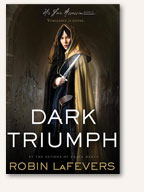
Book Cover: Dark TriumphKinsey recommended the first in the His Fair Assassin series, Grave Mercy, just a couple of weeks ago as a fun historical romance about deadly nuns. I was at the library when I read her post, and figured, why not? I checked it out, despite the size of the book (large), the cover of the book (beautiful girl posing melodramatically), and the inside blurb description (“For how can she deliver Death’s vengeance upon a target who, against her will, has stolen her heart?”), and I gobbled it up within the next week. It is just nonstop fun with the historical intrigue, which I liked better than Kinsey, and lots of romantic hijinx. I had a great time reading it, but wasn’t sure I was going to continue to read the series until I read the little teaser for the sequel in the back, at which point I immediately went back to the library to get the sequel.

Dark Triumph follows a peripheral character introduced in Grave Mercy, another, more troubled novice of the nunnery for the God of Death. The book focuses more on the character and her past than the surrounding politics, and is thus able to make her more nuanced and interesting to follow. The two books remind me a bit of Ilona Andrew’s Edge series, where the first one is lots of fun action with somewhat generic heroine and hero, and the second one takes the more interesting side character and continues his story. While I liked Grave Mercy, I loved Dark Triumph, and literally struggled to put in down at times within the three to four days that I devoured it. So Grave Mercy is worth reading if only to then read Dark Triumph (which does not stand alone, so needs to be read sequentially).

I would be reading the third book in what I believe will be a trilogy if it was out already, but unfortunately I have to wait until Spring 2014. I’m not terribly intrigued by the heroine, already introduced in the background of both books, but I’m hooked on the series now. In the meantime, I will leave you with a phrase from a critic’s praise for Grave Mercy that I found amusing (from the back cover panel of Dark Triumph): “a plot that nods to history while defying accuracy.” (Yep, that seems about right.)

P.S. – While looking for the book cover image, I ran across the author’s website, where she has posted the first chapter of Dark Triumph, which gives an excellent preview to the book, and also does spoil Grave Mercy a bit, so use caution.

—Anna

Grave Mercy

Have you been thinking that there are not enough young adult novels out there about nuns who kill people in the name of the god of death? Well then, I have the book for you! But seriously, I really enjoyed Grave Mercy by Robin LaFevers, and it’s lots of fun to tell people that you’re reading about assassin nuns.

Set in Brittany (now part of France) in the 1400s, the story follows Ismae, a teenage girl who is saved from an abusive father and an arranged marriage by joining a convent dedicated to Mortain, the god of death. And this convent teaches it’s novices some very specific skills, training them to be sent out into the world to kill those people marked by Mortain for death.

This was clearly published in the wake of The Hunger Games and Divergent and all those other teenage dystopian future series (this is the first in what looks like a planned trilogy), and it feels very much like those books. But if you’re a little sick of dystopian futures, like I am, this offers a nice twist by being set in the past. And while there is a bit of the magic/supernatural happening with the god of death and all, it’s really mostly a historical novel about life in medieval Europe. It featured a little more political intrigue than I would have preferred (However will the Duchess keep her crown? I don’t really care all that much!) but it also had adventure, romance, and strong female characters with a lot of agency. And it sure wasn’t like anything else I’ve read lately.

Kinsey’s Three Word Review: Dramatic, historical, romantic.

You might also like:  Scott Westerfeld’s Pretties/Uglies series. Those are set in the future, but the books felt very similar. And I consider those really fun books, so.

Code Name Verity

I’ve been home sick from work for a couple of days now, and while I am tired of coughing and sick of my couch, I did get a chance to finish an AMAZING book: Code Name Verity by Elizabeth Wein.

This WWII story is about a young, female British intelligence agent who is captured in Occupied France while on a mission, and is writing her confession for her Gestapo captors. But telling her story also involves describing her friendship with a female pilot, so while it’s a war novel, there’s also this lovely thread of friendship running through it. I’m a sucker for WWII stories and this one is clearly impeccably researched. It’s also really cleverly put together–things are not the way they may appear on the surface of the story, which is completely appropriate for a tale told by intelligence officers. As I was reading, I had a sense that something else was going on, but was still surprised by how things came together at the end. It was difficult to read, at times, but so well constructed. After Eleanor and Park, this was the best thing I’ve read this year.

One note: my library classified this as YA, but I found it pretty disturbingly violent. Realistically violent, not gratuitously so, but still. I would call this a book for adults or maybe older teens.

Kinsey’s Three Word Review: Harrowing, heart-breaking, and gripping.

You might also like: The Book Thief by Marcus Zusak, or How I Live Now by Meg Rosoff, or Gone to Soldiers by Marge Piercy

The Song of Achilles

I just finished up some work travel, during which I seemed to have terrible reading luck and suffered through one bad book choice after another–overly-dense historical non-fiction, some ridiculous self-help that made me roll my eyes, etc. Luckily, I finally hit a good one and The Song of Achilles entertained me through the last little stretch of  waiting out summer thunderstorms in various airports.

Written by Madeleine Miller, it tells the story of Achilles, the great Greek warrior who led Greek troops in the Trojan War and was (spoilers!) ultimately killed by one of the princes of Troy. Now, there are certainly plenty of stories out there about the Trojan War, including The Iliad, if you’re in the mood for some epic poetry. The twist in this one is that the narrator is Patroclus, a young Greek prince who is exiled from his home and raised with Achilles. Patroclus is right there alongside Achilles as he is taught by a centaur and fights the Trojans and moves through all the other relevant bits of Greek mythology. And in Miller’s version of the story they become lovers and life partners.

After I finished the book I reviewed some of the stories of Achilles on-line, and it’s clear that Miller did a tremendous amount of research. The book includes references to some very minor points of mythology and even touches on how stories change over time (that whole Achilles heel thing only came up in later stories, so it doesn’t come into play here). If you’ve read any of Marian Zimmer Bradley’s modern retellings of story of King Arthur or Troy, this book won’t seem all that revolutionary–Miller’s not striking any new ground here by putting a new spin on a classic story. And it looks like that there has long been scholarly debate about the nature of the relationship between Achilles and Patroclus, so even that aspect of the book is based in history. However, the writing is refreshingly crisp and straightforward and the action moved quickly. Even knowing the basic structure of the story, I was whipping through the book as fast as I could, desperate to find out what would happen next. It was a perfect book to keep my attention while smushed in an airplane seat.

And just this week this book won the 2012 Orange Prize, the British award that “celebrates excellence, originality and accessibility in women’s writing from throughout the world,” so apparently this book is even more well-regarded than I thought. (Plus, the chair of the judges this year for the Orange Prize was Joanna Trollope, who I also love–go read The Rector’s Wife!)